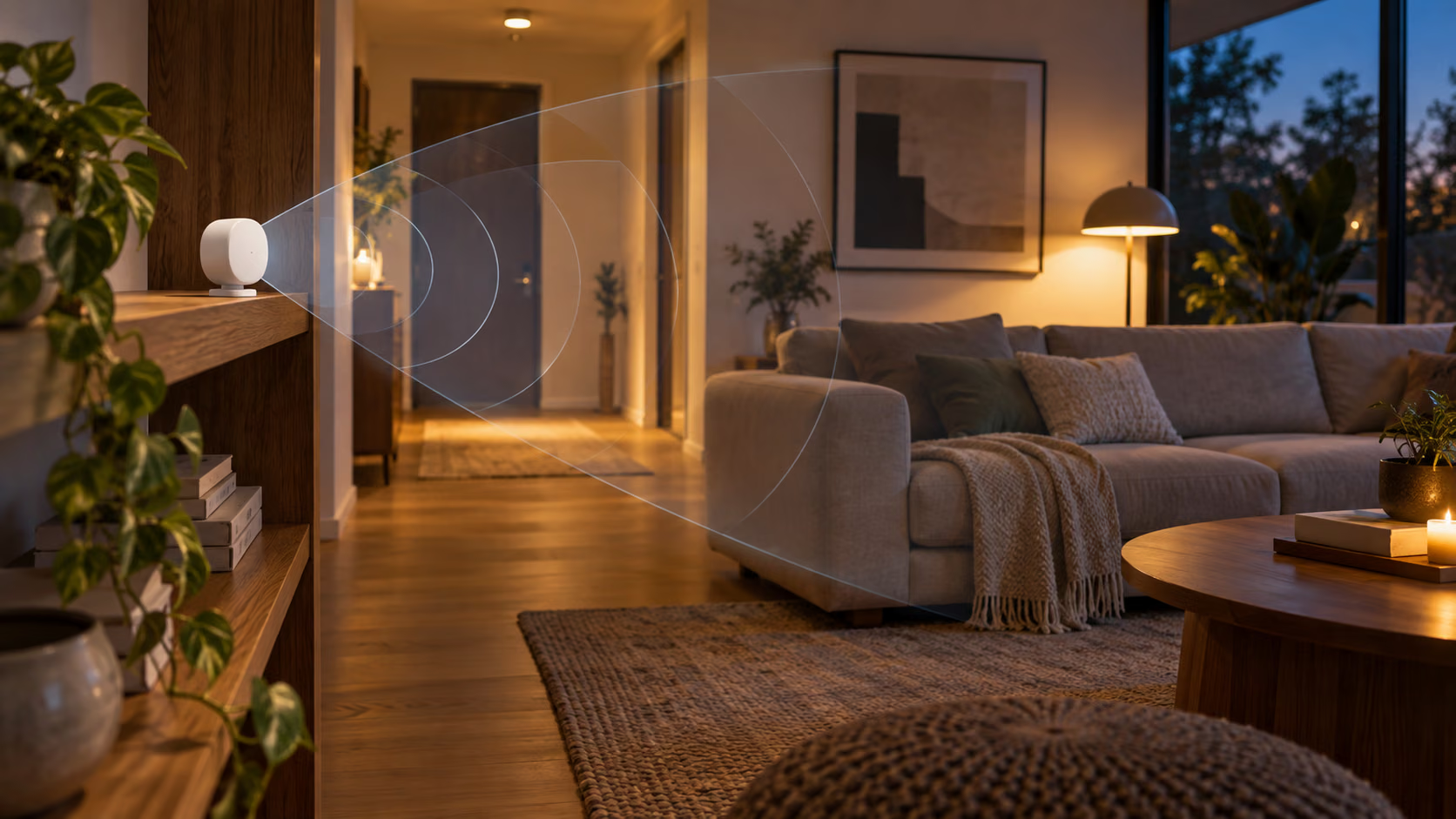
Retrofitting a blind looks easier than replacing it. Keep the existing fabric and tube, attach a motor to the beaded chain, set the open and closed positions, then add it to the smart home. No electrician and no new window covering.
The Zemismart MTP1 follows that idea and adds Matter over Thread. It can join Apple Home, Google Home, SmartThings, Home Assistant or Homey through a compatible Matter controller and Thread border router. A rechargeable battery avoids permanent wiring, while an RF remote keeps a direct physical control.
The protocol is not the difficult part. A blind driver is a mechanical product first. The wheel has to grip the chain, the mount has to remain aligned, the motor has to lift the real blind and the sound has to be acceptable at the time an automation runs. Matter cannot compensate for a chain that skips.
Compatibility begins with the chain
MTP1 pulls an existing loop rather than turning the blind’s tube directly. The supplied wheel or adapter must match the bead size, spacing and material. Too loose and it skips under load. Too tight and the chain binds or wears.
Inspect the blind before ordering. Measure bead diameter and pitch, photograph the chain and confirm that it forms a continuous loop with enough straight length near the wall. Cord, metal chain and plastic beads behave differently. The official product page says the motor supports roller, zebra, venetian and honeycomb blinds, but category compatibility is not a measurement of one installation.
Test the selected wheel by hand before fixing the mount permanently. The chain should sit fully in the profile and move without climbing out. Rotate through an entire cycle because connectors or damaged beads may pass differently from the normal section.
A retrofit motor cannot repair a stiff blind. If manual operation already needs high force, clean and service the mechanism first. Extra motor torque may hide the problem until the mount loosens or the chain fails.
Mounting decides whether the motor remains calibrated
The driver needs a firm relationship with the chain loop. It must apply enough tension to prevent skipping without pulling the blind sideways or overloading the clutch. A few millimetres of movement can change tension and position accuracy.
Dry-fit the motor, move the blind through its full travel and watch the chain enter and leave the wheel. The path should remain straight. Mark the position before using adhesive or screws so the final installation does not depend on memory.
Adhesive is attractive in a rental, but wall finish, dust, humidity and continuous chain tension all affect it. Use the supplied mounting method within its instructions and avoid fragile paint or wallpaper. A mechanical fixing is easier to trust for a heavy blind when drilling is acceptable.
Keep the charging port and manual control reachable. A motor installed neatly behind furniture becomes irritating when the battery needs attention. The RF remote should also have a known location rather than becoming another loose device.
Related reading

After a week, inspect the mount, chain path and wheel for movement. Mechanical settling often appears after several full cycles, not during setup.
Torque is meaningless without geometry
Motor torque becomes pulling force through the radius of the drive wheel. Force is torque divided by radius. The blind then adds its own roller geometry, friction and balance. A single load number cannot cover every installation.
Zemismart’s current MTP1 listing does not provide enough mechanical detail to calculate a universal maximum honestly. That makes an incremental load test more useful than repeating an unsupported claim.
Begin with the blind partly open, where the motor can be stopped quickly. Run upward and listen for slowing, clicking or chain movement without fabric movement. Then test a full close-to-open cycle several times. The driver should reach the limit without the mount flexing or the chain jumping.
Do not increase tension until a weak motor appears to work. Excess tension adds load to the blind mechanism and wall fixing. If the motor struggles on a manually smooth blind, the installation may simply be outside the product’s useful range.
A bathroom or child’s room also needs a safety assessment. A motor does not remove the hazard of a looped chain unless the installation follows local child-safety requirements and keeps the loop correctly tensioned and inaccessible.
Calibration turns rotations into position
The motor has to learn fully open and fully closed positions. Percentage control then estimates travel between those endpoints. The number shown in the app is useful only when it corresponds consistently to the physical blind.
Set limits with the blind and mount in their final positions. Stop before the fabric or mechanism hits a hard mechanical end. Forcing the motor against a stop increases noise and load without improving closure.
Test 25, 50 and 75 percent from both directions. Backlash and chain stretch can make the same target land differently when approached from open versus closed. Mark a reference on the frame and compare repeated cycles.
If the chain skips once, the motor’s internal count may no longer match reality. Recalibration fixes the symptom but not the mechanical cause. Inspect tension and wheel fit first.
Position reporting after a restart matters for automation. Remove power only in a controlled test, restore it and compare the app’s value with the blind. A battery motor may retain state differently from a mains device, and a full discharge is not identical to a normal reboot.
Matter over Thread removes a vendor hub, not every hub
MTP1 communicates using Matter over Thread. It does not need a Zemismart Zigbee bridge, but Thread devices still need a Thread border router and a Matter controller. An Apple TV, HomePod, compatible Google device, Home Assistant setup or Homey Pro may provide those roles.
This distinction prevents disappointing purchases. A phone can help commission the motor, but it is not a permanent border router. Confirm that the chosen ecosystem has current Thread-capable hardware in the home.
Thread uses an IPv6 mesh designed for low-power devices. The motor will usually behave as an end device rather than infrastructure other products can route through. Its reliability depends on border-router placement and the wider mesh.
The official MTP1 product page lists Matter ecosystem support for Apple Home, Google Home, SmartThings, Home Assistant and Homey. That means standard blind controls should appear. It does not guarantee every diagnostic, battery or calibration feature is exposed identically in every app.
Commissioning should be recorded, not improvised
Keep the Matter QR code and numeric setup code before mounting the motor. Photograph or store them in a secure home-inventory record. If the label becomes inaccessible, a reset should not require removing the whole installation merely to find a code.
Add the device through one chosen Matter controller first. Name the room and blind clearly, then verify open, close, stop and percentage control. Only after that should it be shared to a second ecosystem through Matter multi-admin.
If commissioning fails, reset according to the manual and remove any incomplete device entry from the controller before trying again. Repeatedly scanning the code without clearing stale state can make diagnosis harder.
Keep the phone, controller and border router on the intended home network, with Bluetooth enabled for initial discovery. Matter commissioning can use Bluetooth before transferring Thread credentials. Network segmentation or missing IPv6 multicast may block the handoff even when ordinary Wi-Fi works.
Time and count attempts during the trial. One successful pairing is enough for use, but a painful recovery process matters when the controller changes later.
Related reading
Multi-admin is useful when it remains understandable
Matter allows one device to belong to more than one controller fabric. The blind can appear in Apple Home and Home Assistant, for example, without one platform pretending to be the other’s cloud bridge.
Share from the controller that already owns the device using its supported Matter flow. Do not factory-reset and scan the original code independently into each ecosystem. That can create competing setup attempts rather than one multi-admin device.
After sharing, operate from both platforms, restart controllers and verify state updates. Automations should not fight. If Apple Home opens at sunrise while Home Assistant closes for temperature, the protocol is working and the policy is not.
Choose one place for schedules and advanced logic. Multiple control surfaces are convenient. Multiple sources of truth make troubleshooting miserable.
Document which fabric commissioned the device first. That information helps when removing a controller or transferring the installation to another household member.
Local control is Matter’s strongest practical benefit
Core Matter control should remain on the local network after commissioning. Test it by blocking internet access for the controllers while keeping the LAN and Thread network active. Open, close and set a position from the local app.
Remote control from outside the home naturally requires a controller with internet access. Voice assistants may also depend on cloud speech processing even when the final device command is local. Separate those tests.
The RF remote provides another path independent from Matter. Keep it paired and accessible. A physical control is valuable during controller maintenance, network outages and for guests who should not need an app.
The motor also has direct buttons for setup and operation. Verify they remain usable after ecosystem pairing. Smart-home products age better when their essential function survives the service around them.
Noise is about the room and time
Zemismart describes normal blind automation but does not publish a sufficiently controlled acoustic figure on the current page. Quiet is not a number, and a motor acceptable in a living room at noon may be unwelcome beside a bed at 06:30.
Listen from the normal occupant position, not beside the motor. Test opening and closing because load and sound can differ. The chain clicking against the wheel or wall may be more noticeable than the motor itself.
For a measurement, use an A-weighted sound meter at one metre and at the pillow or desk, and record the ambient room level immediately before the run. Consumer phone apps can compare two mounting options but should not be presented as laboratory instruments.
Schedule the automation at the time it will run and ask whether the sound wakes or distracts anyone. A slower motor speed would sometimes be preferable, but only if the product exposes one. Otherwise move the schedule or choose a quieter mechanism.
Mechanical noise that grows over time is a maintenance signal. Recheck alignment before assuming the motor is failing.
Battery life is measured in cycles, not months
MTP1 contains a rechargeable battery so the installation can remain cable-free. The official listing describes a large-capacity battery but does not currently state a complete, test-conditioned cycle figure. Blind weight, travel, temperature, radio quality and daily frequency all matter.
Record the charge date and approximate cycles. A blind that moves twice a day has a different requirement from one used repeatedly for glare control. Battery percentage may stay high for a long time and drop more quickly near the end.
Charge before the motor becomes unavailable, especially when the port requires moving furniture or using a long cable. Do not leave an unsuitable charger permanently connected if the manual expects periodic charging.
Test low-battery behaviour. The controller should expose enough warning to plan a charge, and the RF or manual path should remain understandable. After a complete discharge, verify calibration and Matter reconnection.
If battery replacement is not user-serviceable, longevity becomes part of the purchase. A retrofit product should not turn a working blind into electronic waste after a few years.
Automations should respect the physical world
Morning opening, sunset privacy and heat management are obvious automations. They should include constraints. A window may be open, furniture may obstruct the blind or someone may be working late.
Related reading
Begin with schedules that notify or run while occupants are awake. Watch full travel until the installation proves it does not snag. Keep hands and loose objects away from the chain.
Sun and temperature automation can reduce heat, but a single sensor reading should not cycle the motor repeatedly near a threshold. Add hysteresis and a minimum time between movements. Mechanical devices have finite wear and produce noise on every correction.
Manual operation should not be treated as an error. If someone changes the blind with the remote, controller state needs to follow. Test this before building automations that assume the last commanded position is the actual one.
Price and alternatives
Zemismart’s official store currently lists MTP1 at a promotional $69, reduced from $98.57, with shipping options from several regions. Sale prices change, so confirm the current product page and import costs before ordering.
The closest alternatives include Zigbee chain drivers such as Aqara’s E1 and other Zemismart models, Wi-Fi motors and complete replacement blinds. Zigbee requires a compatible coordinator but has mature local integrations. Wi-Fi avoids Thread infrastructure but may depend more heavily on a vendor app or cloud. A tube motor is cleaner and often stronger, but installation is larger.
Choose based on the blind and existing network. Matter over Thread is attractive when a reliable border router already exists and cross-platform control matters. It is not worth replacing a stable local Zigbee setup merely for the logo.
Include mounting, charging access and the cost of one motor per blind. A room with four windows can turn an inexpensive device into a significant project.
Verdict
The Zemismart MTP1 has a sensible proposition: add rechargeable motor control to an existing chain blind and expose the basic functions through Matter over Thread without a dedicated Zemismart bridge.
The buying risk is mechanical, not conceptual. Chain fit, mount alignment, blind friction, calibration and sound determine whether the motor remains installed. Matter improves controller choice, but the home still needs a border router and each ecosystem may expose a different subset of detail.
I would buy one unit before equipping a room. Dry-fit it, run repeated full cycles, measure position from both directions, test local control without internet and listen at the time the schedule will run. If the chain never skips and the manual and RF fallbacks remain clear, MTP1 can make an ordinary blind usefully smart. If the blind is heavy or stiff, fix the mechanism or choose an integrated motor rather than asking a small retrofit driver to overcome the wrong problem.
One email a month: new articles, reviews and the upcoming live webinar + free recording. No spam, unsubscribe anytime.