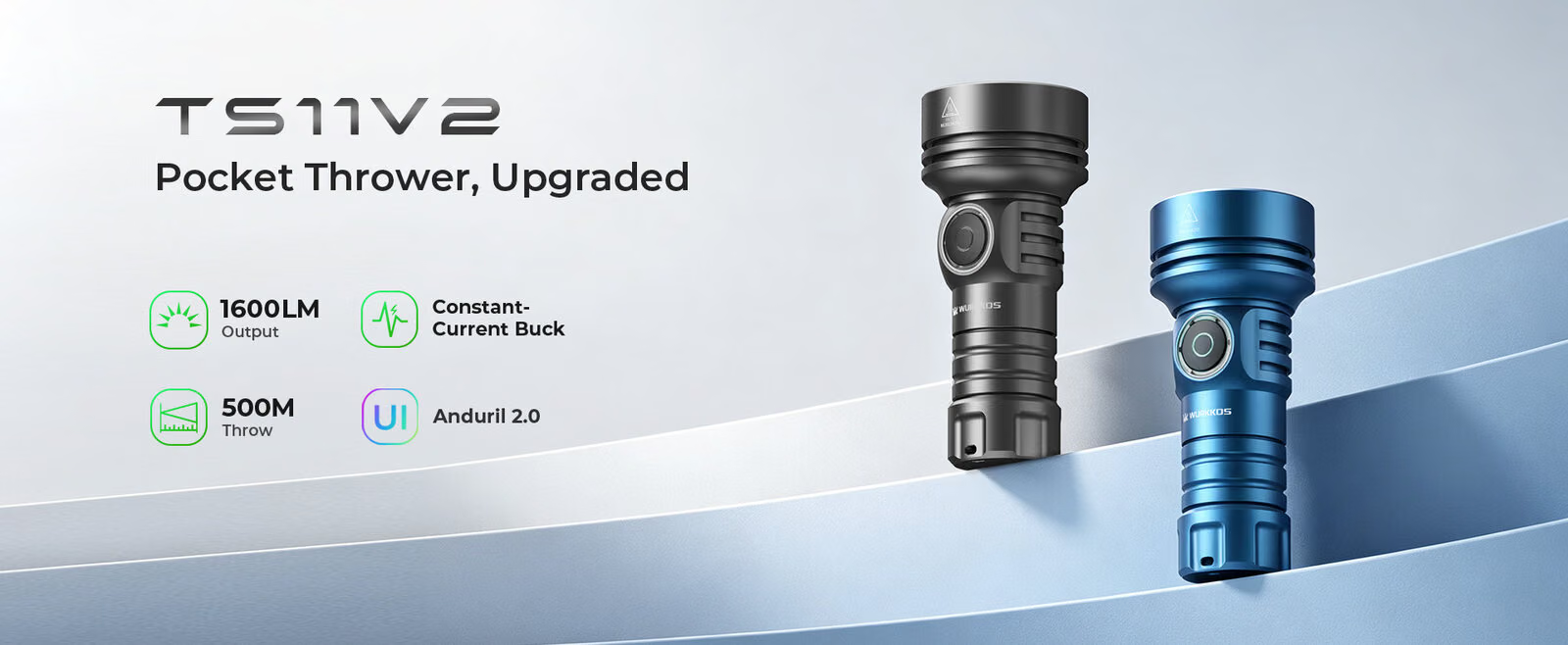
Most small flashlights are built to light up a room. The Wurkkos TS11 V2 is built to light up the far end of a field. It is 89.5 mm long, runs on a single 18350 cell, and puts nearly all of its output into a 10 degree beam. Wurkkos rates it at 1,600 lumens and 500 metres of throw, and that pairing is the whole point. A light this short is not supposed to reach that far.
The interesting part of the V2 is not the throw, though. It is the fact that the second version is rated lower than the first. The original TS11 was sold at 2,000 lumens. The V2 says 1,600. Wurkkos changed the driver, the electronics that decide how much current the LED gets, and accepted a smaller number on the box in exchange for steadier light. That is an unusual decision in a category where the headline figure sells the product, and it is the reason this light is worth a closer look.
Disclosure: Wurkkos sent this TS11 V2 free of charge for review and I keep it. No money changed hands, and Wurkkos had no approval over the text.
What a pocket thrower is for
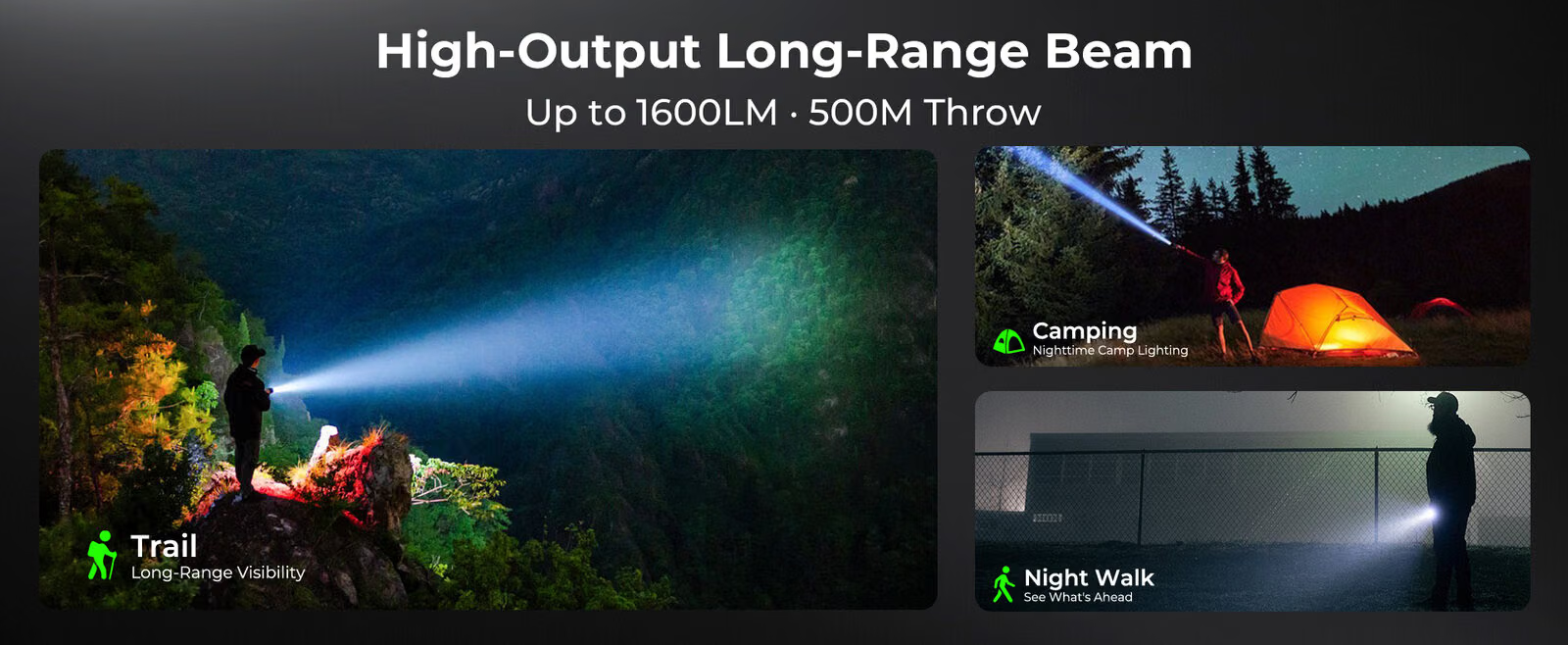
Flashlight people split beams into two families. A flood spreads light wide and close, which is what you want for cooking, camping chores or finding a dropped key. A thrower concentrates light into a narrow, intense spot that reaches a long way and shows very little at your feet. The TS11 V2 sits firmly in the second family.
The emitter is a Luminus SFT40, a small, very bright LED die that pairs well with a deep optic, behind a TIR lens that Wurkkos shapes into a 10 degree beam. The figure that matters for throw is peak intensity, and Wurkkos lists 61,833 candela at the top level. Under the ANSI FL1 standard that converts to roughly 500 metres, the distance at which the beam still delivers the light of a full moon. In practical terms, it means a reflective trail marker, a gate across a meadow or the eyes of a deer at the edge of a forest become visible long before a typical EDC light would show anything.
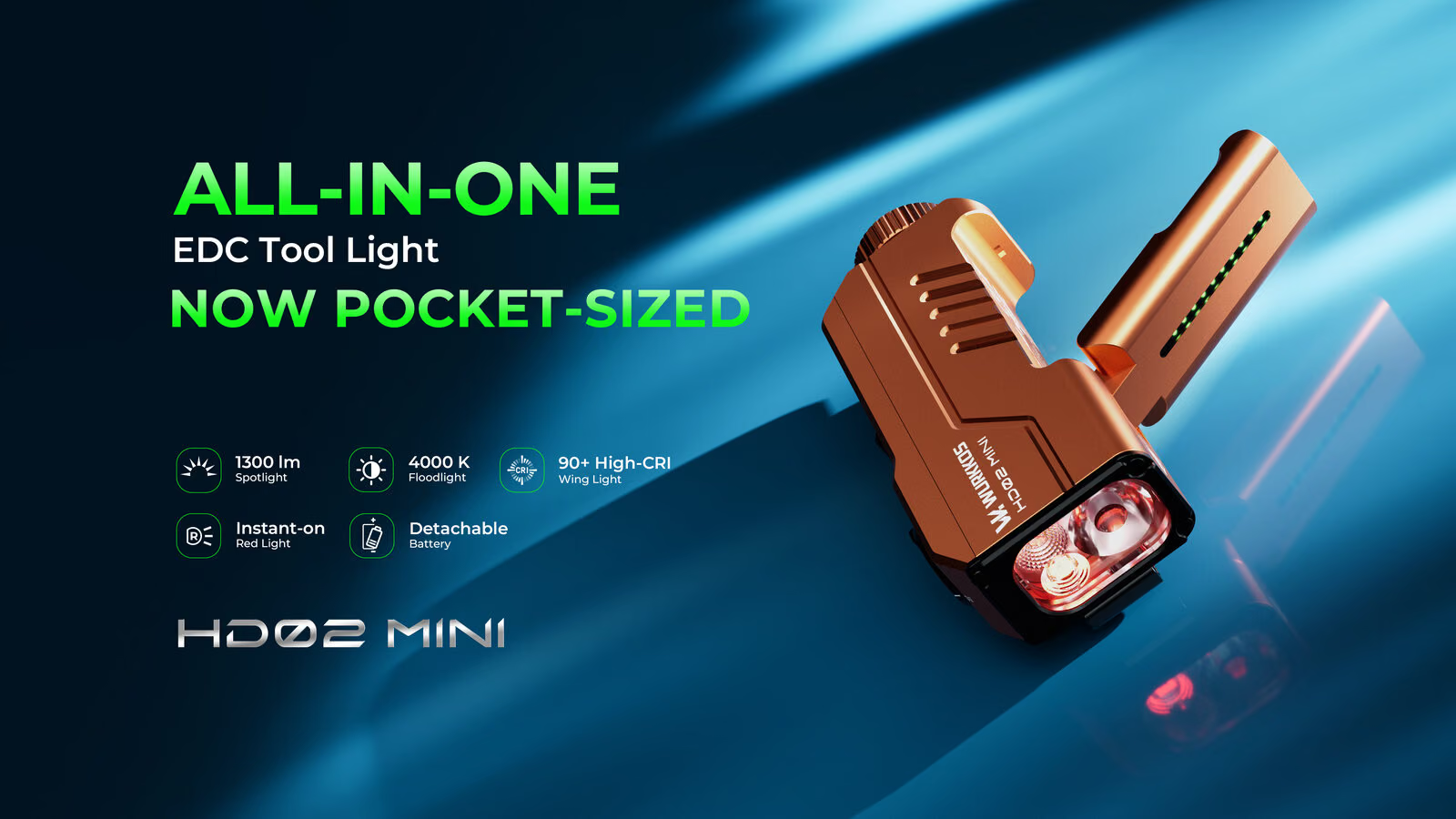
The cost of that reach is width. A 10 degree spot lights a small circle with a dim spill around it, so walking a forest path with the TS11 V2 is a little like reading with a laser pointer. It is superb for looking and mediocre for working. If most of your night-time light use happens within two metres of your hands, this is the wrong tool, and the HD02 Mini that Wurkkos sells alongside it is the better match.
Related reading
The driver change, explained without the jargon
The original TS11 used a FET driver. In its brightest mode a FET essentially connects the battery straight to the LED, so the light is as bright as the battery can push at that moment. A full cell produces a dramatic burst and the output then sags as the voltage falls and as heat builds. Below turbo, FET lights typically dim themselves with PWM, switching the LED on and off very fast, which some people notice as flicker on camera or in peripheral vision.
ZeroAir’s review of the TS11S, the earlier sibling on the same platform, shows how that plays out. Against a 2,000 lumen claim it measured about 1,032 lumens at switch-on and 785 lumens at 30 seconds, and it described the thermal regulation as very active. The throw was still impressive at a calculated 56,184 candela, but the brightness on the box and the brightness in the hand were very different numbers.
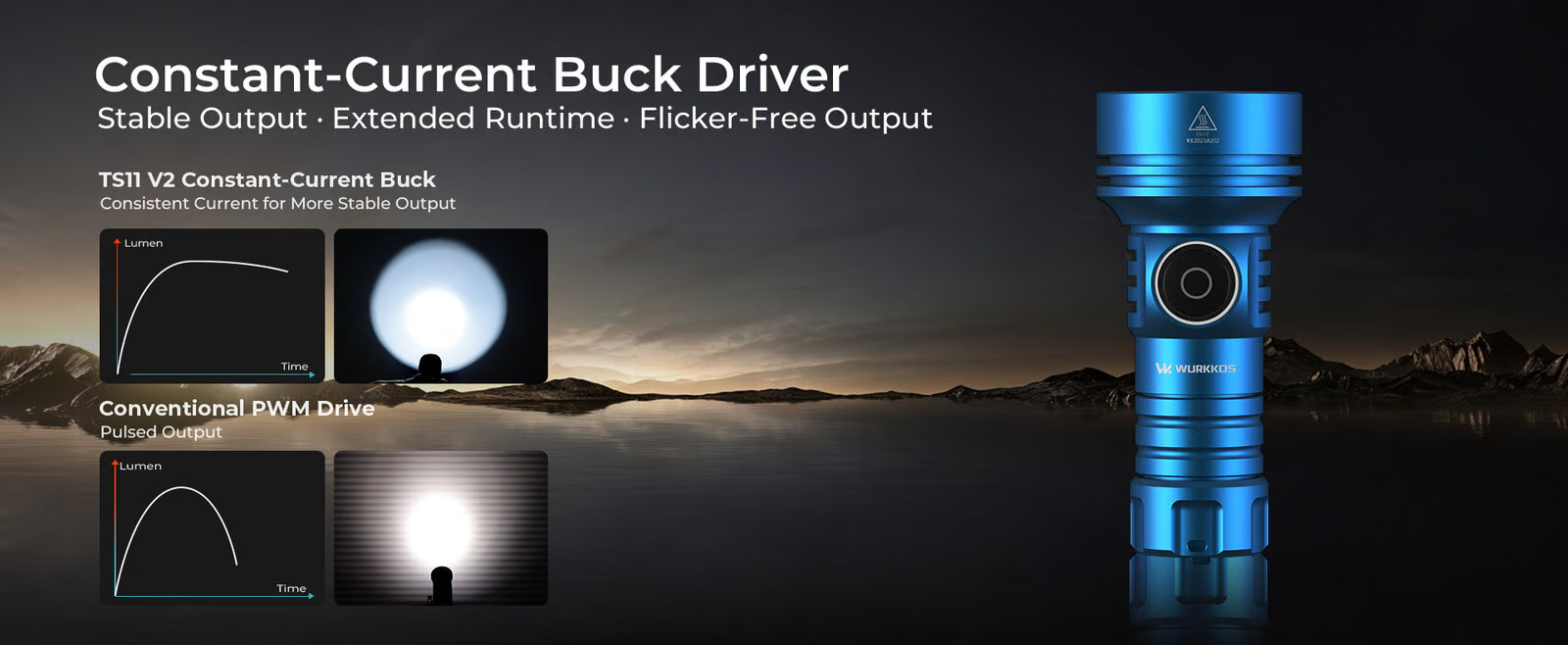
A constant-current buck driver works differently. It steps the cell voltage down and regulates the current to the LED, so a chosen level stays at that level while the battery drains instead of drifting with it. It is also more efficient in the middle of the range, where most people spend most of their time, and it does not need PWM to dim. Wurkkos’s own FAQ is refreshingly direct about the trade: peak output and throw are lower on paper, and the reward is more stable current regulation and reduced flicker.
I would rather have that trade than the old one. A 2,000 lumen claim that turns into roughly 1,000 lumens in a real measurement is a marketing number. A 1,600 lumen claim on a regulated driver has at least a chance of being close to the truth, and a regulated 337 or 612 lumens is far more useful on a two-hour walk than a turbo flash that lasts a minute.
Output levels and runtimes on paper
Wurkkos publishes an eight-step table for the standard kit with the 18350 battery. The lowest step is 3 lumens for a claimed 131 hours, which is a genuine night-time level that will not wreck dark adaptation. The working range runs through 18, 55, 149 and 337 lumens, with claimed runtimes from almost 37 hours at 18 lumens down to 1 hour 57 minutes at 337 lumens. The two top steps are where the regulation story shows: 1,100 lumens for 20 minutes before stepping to 500 lumens for another 36, and 1,600 lumens for 9 minutes before the same step down to 500 lumens for 39 more.
Two things stand out. First, the drop from 1,600 to 500 lumens is a deliberate, published behaviour, not a failure. A head this size cannot dissipate the heat of 1,600 lumens for long, and the honest thing to do is to tell the buyer when the light will step down. Second, the middle of the table looks generous for an 18350 cell. Nearly two hours at 337 lumens, with a beam this concentrated, is a lot of useful light from something that fits in a coin pocket.
Those are manufacturer figures under FL1 conditions, and FL1 runtime is measured until output falls to 10 percent of the starting value. They are a fair basis for comparing lights from the same maker and a weaker basis for promises. I treat them as a ceiling rather than a promise.
Anduril 2.0, the interface people love and fear
The TS11 V2 runs Anduril 2.0, the open-source firmware written by ToyKeeper that has become the default interface for enthusiast lights. It has a reputation for complexity, and the reputation is earned in the sense that the full manual is long. In daily use it is much friendlier than that.
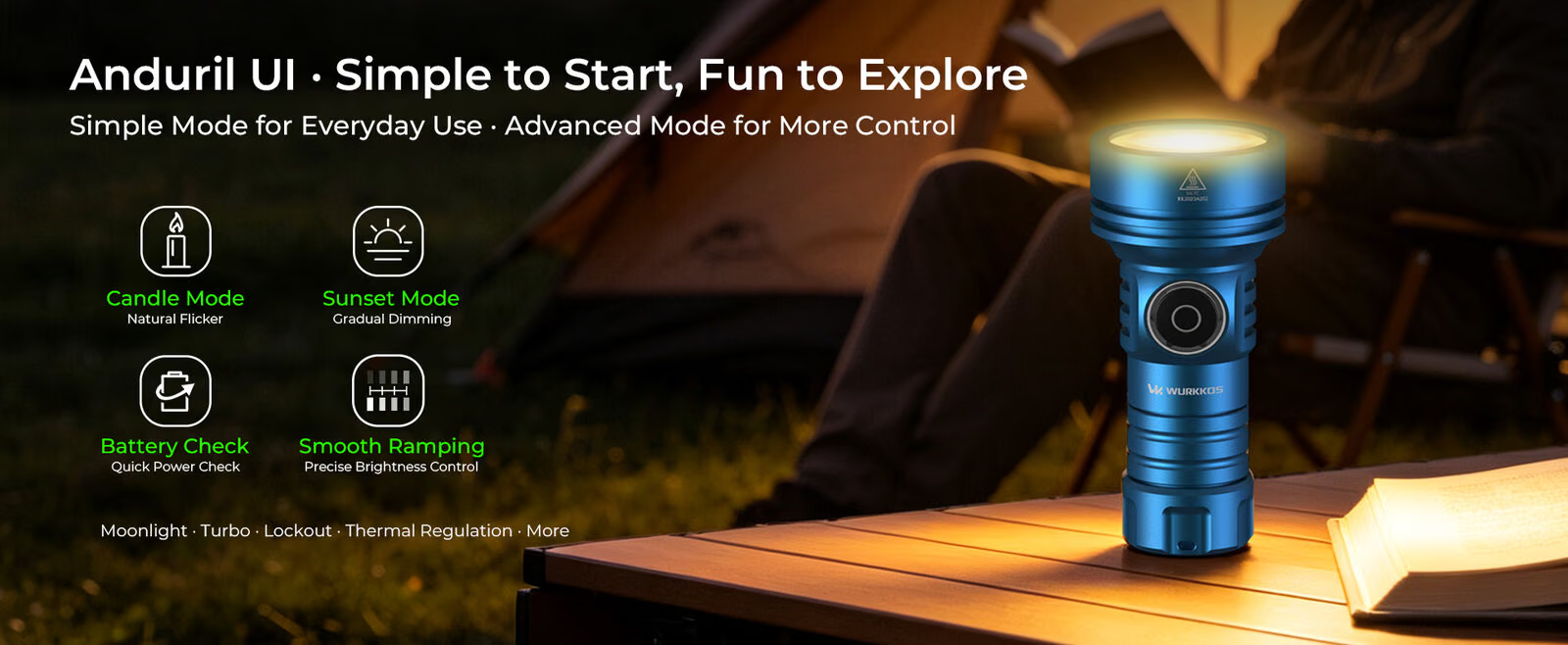
The light ships in Simple UI. One click turns it on and off, holding the button ramps the brightness smoothly up or down, and two clicks jump to the top of the ramp. That is the whole interface for someone who never wants to learn more. Ten clicks from off unlock the Advanced UI, where the depth lives: stepped or smooth ramping, a battery check that blinks out the cell voltage, a candle mode, a sunset timer that dims the light and switches it off after a set time, configurable thermal limits and, most usefully for a pocket light, a lockout that four clicks engage and the same gesture releases.
The reason Anduril matters on a thrower specifically is the ramp. With a narrow beam, the right level depends heavily on distance. A low level is enough for a path, a higher one for scanning a field, and turbo only for the occasional look at something far away. Being able to hold the button and settle exactly where you want, then have the light remember that level, suits this kind of beam better than a fixed set of four modes.
The fair criticism is discoverability. A new owner who presses the button ten times by accident will find a light that behaves differently from the one in the box, and the paper manual is the only guide. If the light is a gift for someone who does not enjoy that kind of thing, it is worth leaving it in Simple UI and saying so.
Related reading
RGB auxiliary LEDs, more useful than they look
Around the optic sit RGB auxiliary LEDs, small low-power lights that glow while the main LED is off. On the TS11 V2 they cycle through several colours and modes, and in Anduril they can also show the battery state by colour.
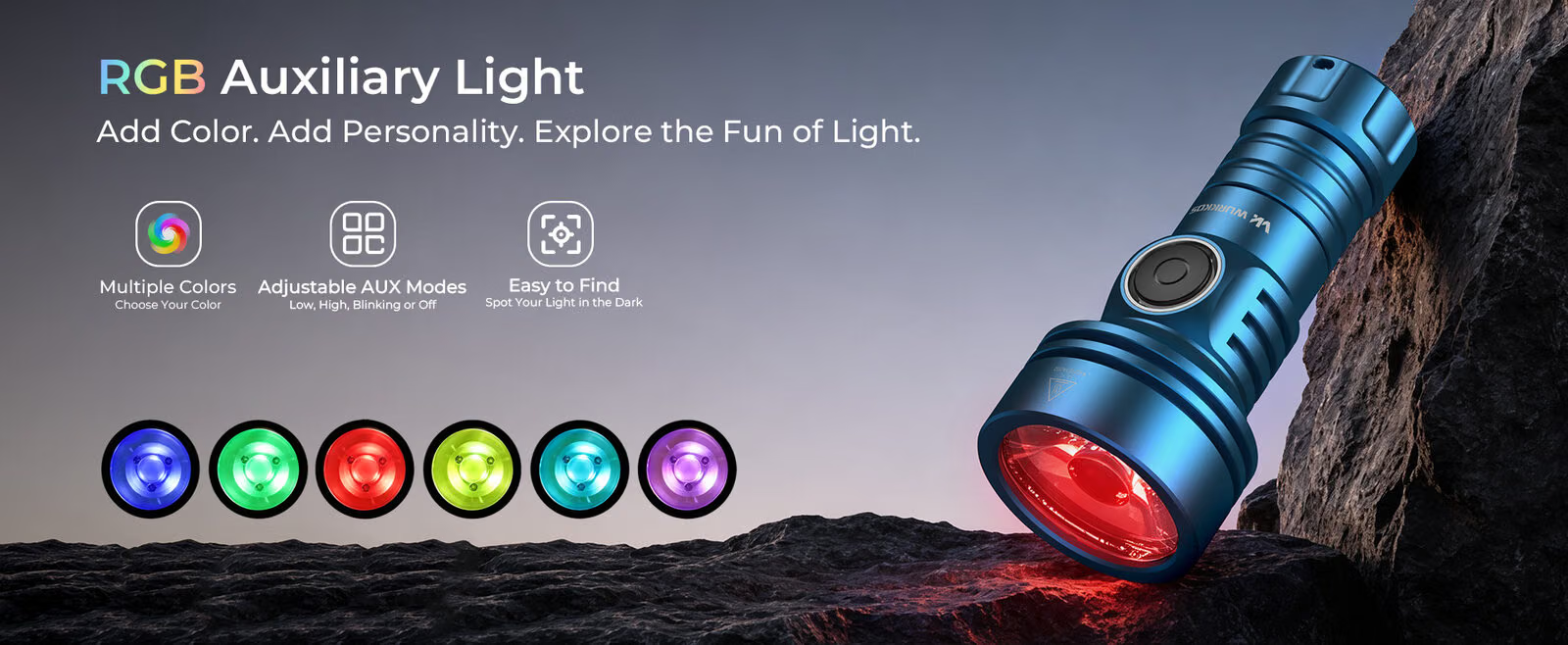
It is easy to dismiss aux LEDs as decoration, and on a desk they mostly are. Their real job is location. A light that glows faintly in a tent, a glovebox or a dark hallway is a light you find in the dark without already needing a light. The battery colour is the second job, a glance at the head tells you whether the cell needs charging before you leave the house. The cost is a small standing drain on the battery, which matters more on a 1,100 mAh 18350 than on a large 21700, so I would set them to low or switch them off for a light that lives in a drawer for weeks.
Battery, charging and the 18650 option
The standard kit includes one 18350 cell, which Wurkkos lists at 1,100 mAh in the packaging contents, and a USB-C port that charges the cell inside the light at a listed 5 V and 2 A. The battery is removable, which I consider non-negotiable for a light like this. Lithium cells age, and a light with a sealed battery becomes e-waste when its cell does.
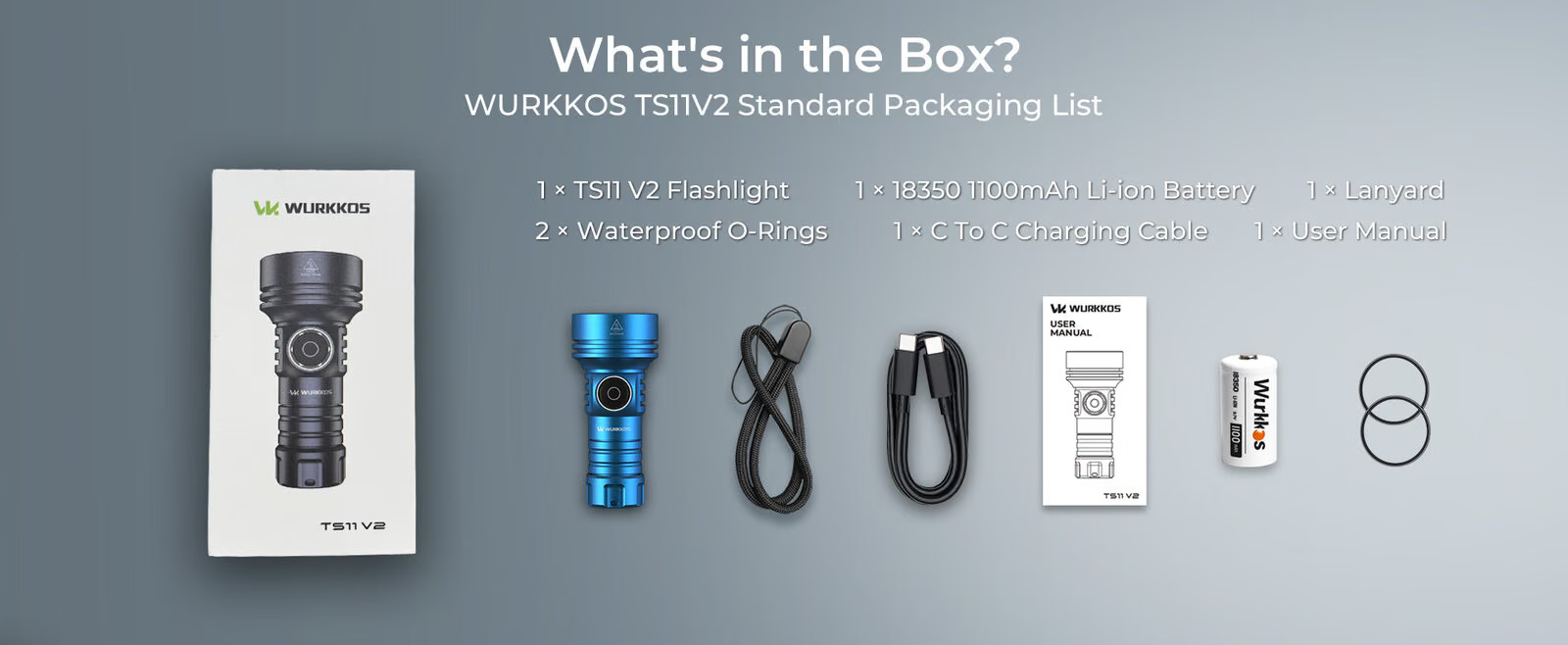
There are three kits. The Standard Kit has one 18350 cell. The Extended Runtime Kit adds two more 18350 cells, which is the practical choice for anyone who wants to swap rather than wait for a charge. The 18650 Conversion Kit includes an 18350 cell, an 18650 cell and a longer tube, turning the pocket thrower into a longer light with roughly two and a half to three times the capacity. Wurkkos says grey and blue 18650 tubes are in production planning, so availability of the tube in a matching colour may lag the launch.
The 18650 version is the one I suspect many owners will end up using at home or in a car, with the short tube kept for days when pocket size matters more than runtime. The flexibility is the strength of the kit approach, and it makes the light easy to recommend to people who are not sure how they will use it yet.
Build, size and carry
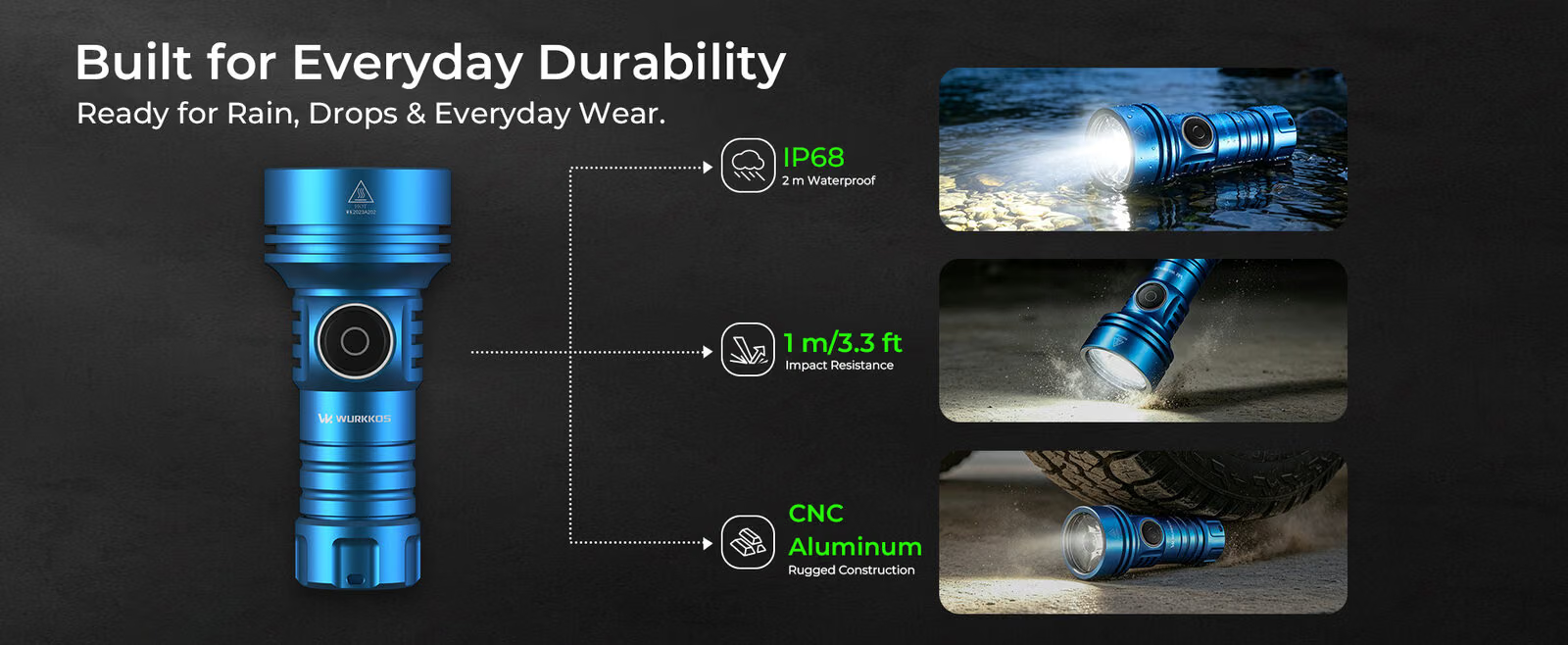
Wurkkos specifies a CNC-machined aluminium body, IP68 water resistance to 2 metres and 1 metre impact resistance, and gives the weight as 110 g with the battery. The head is noticeably wider than the body, which is unavoidable with an optic deep enough for a 10 degree beam. The original TS11 measured 40 mm across the head, and the V2 shares the format.
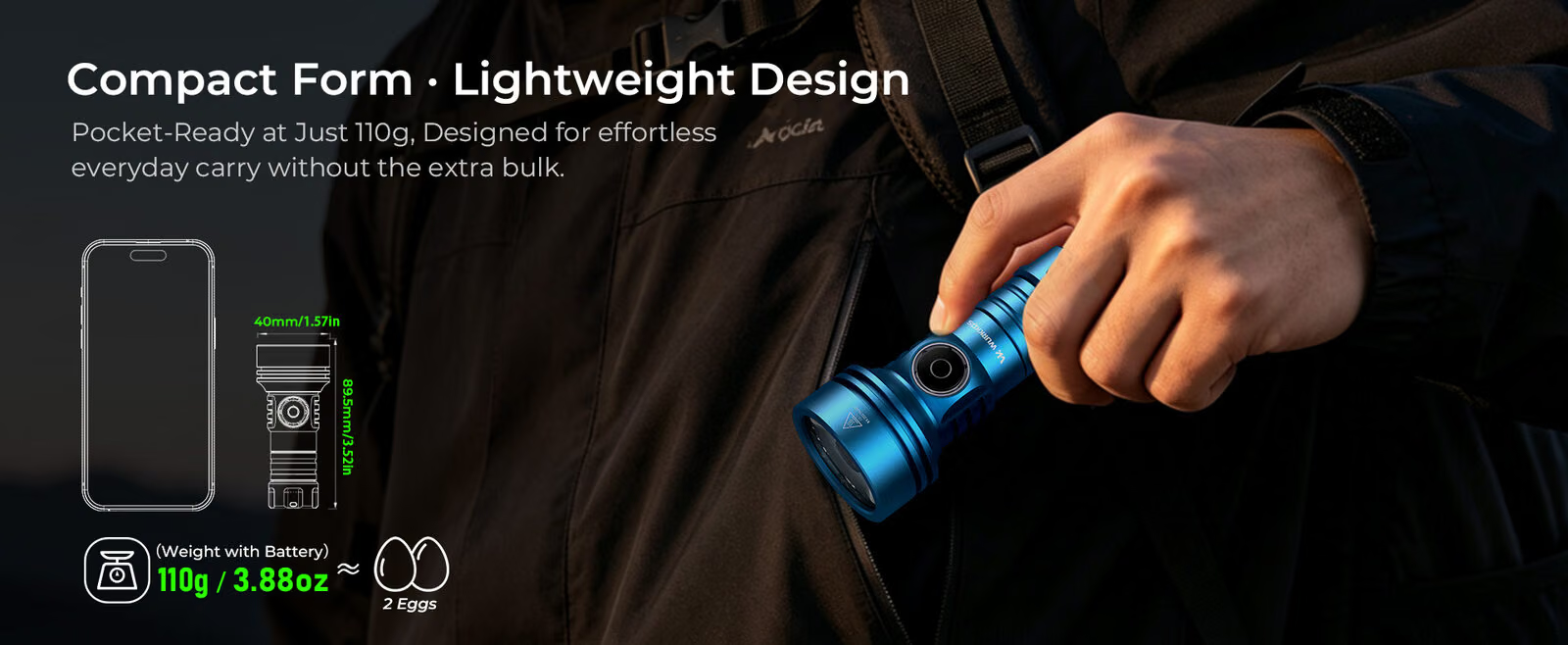
That proportion is the main ergonomic fact of the light. It is short enough for a jacket or trouser pocket, but the wide head means it does not disappear in a jeans pocket the way a slim 14500 light does. It lives better in a jacket, a bag pocket or on a lanyard. Water resistance to 2 metres covers rain, puddles and the occasional drop into a stream, and the 1 metre drop rating is honest for something that will be dropped on stone or tarmac now and then.
Colours at launch are grey and blue, both with a 6,000 K emitter. 6,000 K is a cool white, the tint that maximises throw from the SFT40. It renders colours less faithfully than a warmer high-CRI emitter, so it is the wrong light for judging the colour of a wire or a wound, and the right one for seeing as far as possible.
Price and alternatives
At launch Wurkkos sold the Standard Kit at $34.99, with a higher list price beside it, and the extended and conversion kits for more. That is in line with the original TS11 and squarely in the budget enthusiast range, where Anduril, USB-C charging and a removable cell are now expected rather than special.
The obvious alternative is the original TS11, which is still sold. On paper it is the brighter light, and if all you want is the highest possible turbo burst for a few seconds, it wins. Everyone else, and especially anyone who uses a light for minutes at a time rather than seconds, is better served by the V2’s regulated output. The other alternative is a larger 21700 thrower, which will outrun and outthrow the TS11 V2 at the cost of pocketability. The V2 exists for people who want throw in a size they will actually carry.
Related reading
What this review is based on
The TS11 V2 arrived on 21 October 2026 together with the HD02 Mini. This review is built on Wurkkos’s product page, FAQ and published output table, its launch materials, and ZeroAir’s measurements of the earlier TS11S for context. Every output, throw and runtime figure above is Wurkkos’s unless it is attributed otherwise.
I do not publish my own measurements. The figures are Wurkkos’s and ZeroAir’s as attributed, and the verdict is mine.
Verdict
On paper the TS11 V2 is the more mature version of a light that was already popular. Wurkkos kept everything that made the original appealing, the short 18350 body, the SFT40 behind a deep optic, Anduril 2.0 and the RGB aux LEDs, and replaced the one part that made its numbers look better than its behaviour. A 1,600 lumen claim on a constant-current buck driver, published with an honest step down to 500 lumens, is easier to trust than a 2,000 lumen claim on a FET.
It suits someone who wants to see far with something small: dog walks on unlit roads, rural property, boats, search and rescue volunteers who need a backup thrower, or anyone who enjoys a flashlight that does one thing exceptionally well. It suits Anduril users who will appreciate the regulated ramp most of all. It does not suit anyone whose light use is mostly close-range work, anyone who needs accurate colour rendering, or anyone who wants a slim light for a jeans pocket. For those people a floody high-CRI light is the better purchase.
The TS11 V2 is the pocket thrower I recommend to friends, with the Extended Runtime Kit as the sensible default and the 18650 tube as a cheap upgrade for the car.
Product images: Wurkkos.
One email a month: new articles, reviews and the upcoming live webinar + free recording. No spam, unsubscribe anytime.