I am the author of Prompt Engineering That Gets Results: LLM Applications, RAG Pipelines, Fine-Tuning & Evaluation. I earn royalties from sales, and the labelled Amazon link can also earn an affiliate commission. This is my explanation of the book’s intended reader and scope, rather than an independent customer’s review of my work.
Quick verdict
I recommend considering it for a technically involved reader improving a real LLM application against a clear standard.
Best for: A developer connecting instructions, supporting information and evaluation for a bounded application task.
Main benefit: The stated scope places prompts beside RAG, fine-tuning and evaluation rather than treating wording as the whole system.
Biggest drawback: A fluent example is not broad evaluation evidence, and extra techniques add work unless they solve an observed problem.
Prompt Engineering That Gets Results
Amazon US · US
Check price and availability: Prompt Engineering That Gets Results at Amazon USAffiliate link. As an Amazon Associate I earn from qualifying purchases.
Reviewed version: Prompt Engineering That Gets Results: LLM Applications, RAG Pipelines, Fine-Tuning & Evaluation
Compatibility: Check sample, format and edition at ASIN B0GWV73TXC. Verify exact models, APIs and current limits in official documentation.
Review context: The recommendation uses the published author description and scope. It does not claim an independently verified reading result or invent chapter contents.
The subject interests me because a useful prompt does not live outside the rest of the application. The task, available information and way of checking the answer all affect what a good request looks like. I prefer that complete engineering conversation to the idea that one clever sentence can reliably repair every model or every kind of input.
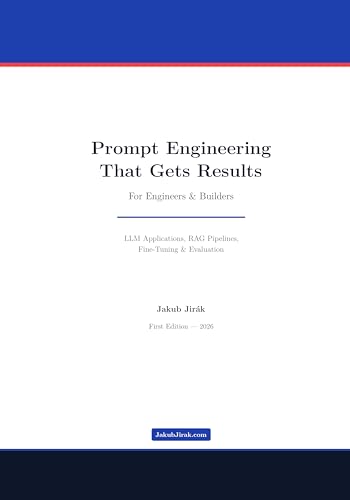
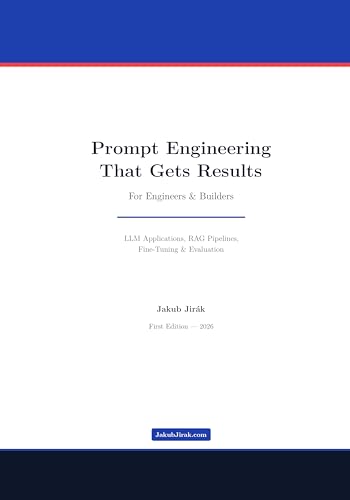
Prompt Engineering That Gets Results — actual author-owned cover Author catalogue source.
The reader I have in mind
The public description names LLM applications, retrieval-augmented generation, fine-tuning and evaluation. I would recommend considering it to a developer or technically involved practitioner who wants to connect those choices. The starting question should be what result the application needs, not which technique sounds most advanced.
I would bring a bounded task and some representative examples. A useful example has an input, an expected kind of answer and enough context to judge whether the result helps. The task could be small; it does not need a large application architecture before the reading becomes relevant.
I would choose AI for Non-Technical People for someone whose immediate goal is ordinary workplace assistance without an implementation project. A ready-to-use request and an application evaluation system are different needs. The reader should not have to buy a technical reference merely to prepare a clearer email.
Define useful before optimising the wording
My preferred starting point is a description of the intended output in ordinary language. Who will use it, and what should they be able to do afterwards? That gives the prompt a purpose. Without it, repeated wording changes can produce different answers without establishing that any of them is better.
I would also identify the mistakes that matter most. A response can be readable while omitting a required condition or inventing a detail. The application needs a standard that recognises those problems, rather than accepting the answer because its tone sounds confident and complete.
For a practical reading exercise, I would keep a few examples where the current approach succeeds and a few where it fails. The set should reflect the actual job, including incomplete or awkward inputs. A prompt improved only against one favourite demonstration may disappoint when the next ordinary request arrives.
Give the model the right context
A request can be long without being informative. I would choose context according to the decision the model needs to make. The user’s goal, relevant source material and required output format have different roles, and making those roles clear can reduce avoidable guessing.
I would keep instructions distinct from material that needs analysis. A quoted document may contain statements that the application should examine, not commands it should follow. The system design needs an intentional way to preserve that distinction rather than expecting every input to be friendly and perfectly structured.
I would also preserve uncertainty. If a required fact is missing, a useful result may be a focused question or a clear limit on the answer. A fluent invented detail is not an improvement over an honest gap. The acceptance standard should reward the application for handling that situation correctly.
Retrieval needs a reason
RAG pipelines are part of the published scope. I would consider retrieval when the application needs information that should be supplied from a relevant source. The useful question is what evidence the answer needs and how the system can provide it at the right time.
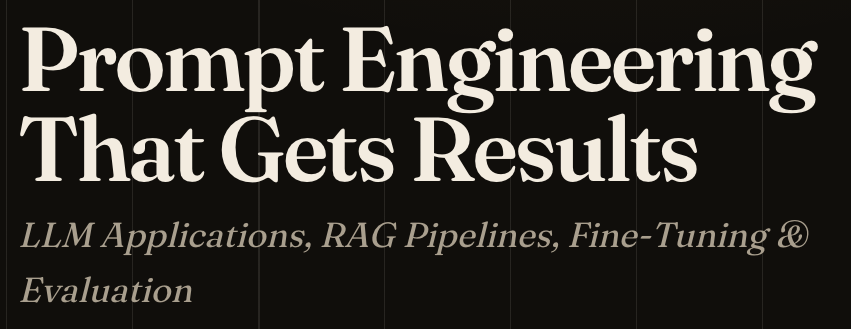
Title and description presentation from my author catalogue; this is not an interior page. Author catalogue source.
I would not assume that adding a document store automatically makes every answer grounded. The application still needs to retrieve useful material, keep the relevant conditions and connect claims with their support. A missing or irrelevant passage can leave the model with the same uncertainty in a more complicated workflow.
For a small investigation, I would inspect the material returned for several real questions before judging the generated answers alone. That helps separate a retrieval problem from a response-generation problem. The next improvement becomes clearer when the system can show which evidence was actually available.
Fine-tuning is another decision
Fine-tuning also appears in the title and published scope. I would approach it by defining what should change and how the change will be evaluated. A training process needs a reason that is more specific than the current output sometimes being disappointing.
I would first understand the quality and purpose of the available examples. A larger collection is not automatically a better teaching signal if its standards are inconsistent. The useful question is whether the examples describe the behaviour the application should reproduce, with enough separation to assess whether it learned something useful.
I would also compare the intended improvement with simpler options. Clearer instructions, better source material or a more suitable model may be the relevant intervention for a particular task. I would choose fine-tuning when the evidence supports that route, not as a badge that makes the application more serious.
Evaluation makes the discussion concrete
Evaluation is the part of the subject I would keep beside every proposed improvement. The team needs a way to judge whether a changed prompt or pipeline actually serves the intended user better. A collection of attractive sample responses does not establish the result across the work the system will receive.
I would include correctness, required content and usable format where those matter. A report that contains the right facts in an unusable structure can still fail the task. A well-formatted answer with the wrong facts can fail more dangerously. The evaluation should know which conditions are essential.
I would keep human review in the loop where judgement is needed and make its standard explicit. Reviewers should understand what they are looking for, rather than assign a general feeling of quality to every response. Clear examples of acceptable and unacceptable results can make that discussion more consistent.
Change one meaningful thing at a time
I would keep the previous version of a working prompt and record why a change was made. That provides a useful comparison when the new wording helps one case but harms another. The aim is to learn what changed, not simply accumulate increasingly long instructions after each failure.
I would also distinguish a development example from a fair check of the revised system. If every difficult case becomes part of the instruction, success on that same material can become less informative. A useful evaluation needs some way to ask whether the approach transfers to the next relevant input.
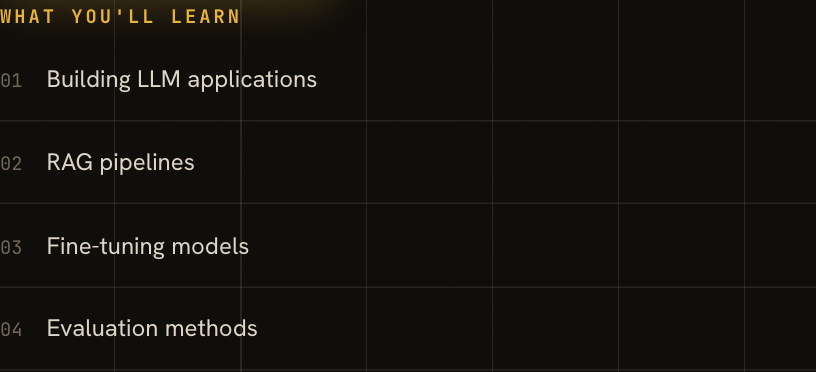
Published scope from my author catalogue; this is not an interior page. Author catalogue source.
Cost and time deserve attention alongside answer quality. A workflow that eventually produces a good result after many repeated attempts may not fit the product’s intended use. The application should have a clear sense of what completion requires and when another kind of assistance is needed.
The application needs an operating plan
An LLM application has users, inputs and changing dependencies. I would plan how the system handles a tool failure, unavailable source or unsupported request before those situations become urgent. A useful fallback should make the state understandable rather than conceal the problem behind a generic confident answer.
I would also keep appropriate records of the configuration and evidence needed to investigate failures, while respecting the data involved. A team should be able to identify which version produced a result and what relevant context it received. That is part of maintaining the application, not only a debugging convenience.
The exact implementation details need current official documentation. Models, APIs and service limits evolve. The public catalogue establishes the book’s subjects, not a promise that every present-day integration uses the same option names. I would check the sample and edition if a specific product decides the purchase.
How I would use the book
I would choose one small application task and write its acceptance standard before changing the prompt. Then I would inspect failures and decide which part of the system could plausibly explain them. That makes the reading useful as a guide to decisions, rather than a collection of techniques to add indiscriminately.
I would keep the simplest arrangement that meets the standard. Retrieval, fine-tuning and more elaborate workflows can be useful, but each should have a job. A smaller system with understandable evidence can be easier to improve than a larger one whose successful answers cannot be explained.
The companion I would choose
Build AI Agents That Actually Work is a better starting point when the central problem is an agent taking actions through tools. The Complete AI Model & Mode Selection Guide is more focused on choosing the assistant and interaction style. I would choose this book for the connection between application output, supporting information and evaluation.
My author recommendation
I recommend considering Prompt Engineering That Gets Results for a technically involved reader who wants to judge and improve a real LLM application. I like the connection between prompts and the wider system around them. I would buy for that scope, bring representative tasks and choose each technique because the evidence shows what it should improve.
What worked
The stated scope places prompts beside RAG, fine-tuning and evaluation rather than treating wording as the whole system.
What bothered me
A fluent example is not broad evaluation evidence, and extra techniques add work unless they solve an observed problem.
Who should not buy it
I would choose an introductory workplace guide when the need is ordinary chat assistance without an application project.
Alternatives I would consider
AI for Non-Technical People. I would choose its ordinary workplace starting point without an implementation project. Read my AI for Non-Technical People author overview.
Build AI Agents That Actually Work. I would choose it when actions through tools and the agent workflow are the main system problem. Read my Build AI Agents That Actually Work author overview.
Evidence and sources
The stated scope comes from my published author catalogue. The images show the actual cover and author-catalogue presentation, not interior pages or independent customer evidence.
This is the author's account of the book's scope and intended reader. Check the selected Amazon edition for its current format, sample and availability.
Conclusion
Worth considering with representative tasks ready; current references remain necessary for exact service interfaces.
Prompt Engineering That Gets Results
Amazon US · US
Check price and availability: Prompt Engineering That Gets Results at Amazon USAffiliate link. As an Amazon Associate I earn from qualifying purchases.