I am the author of Build AI Agents That Actually Work: Agentic Workflows, Tool Use, Multi-Agent Systems & Production Deployment. I earn royalties from the book, and the labelled Amazon purchase link can earn an affiliate commission. This is my explanation of the book’s fit and purpose, with that commercial relationship stated openly.
Quick verdict
I recommend considering it when the agent workflow itself needs an engineering design.
Best for: Software engineers connecting agentic workflows, tool use, multi-agent responsibilities and deployment.
Main benefit: The stated scope puts an agent's actions in the context of a complete maintained system.
Biggest drawback: The public description cannot establish the exact depth of a preferred framework or provider.
Build AI Agents That Actually Work
Amazon US · US
Check price and availability: Build AI Agents That Actually Work at Amazon USAffiliate link. As an Amazon Associate I earn from qualifying purchases.
Reviewed version: Build AI Agents That Actually Work: Agentic Workflows, Tool Use, Multi-Agent Systems & Production Deployment
Compatibility: Check the sample, format and current edition at ASIN B0GWV16JS8. Verify exact implementation APIs against current official documentation.
Review context: The recommendation uses the published author description and scope. It does not claim an independently verified reading result or invent chapter contents.
The part of the title that matters most to me is actually work. An agent demonstration can be interesting while leaving important questions unanswered about the real task. I want to connect the appeal of an assistant taking action with the ordinary engineering work needed to make its behaviour understandable, checkable and useful beyond one successful example.
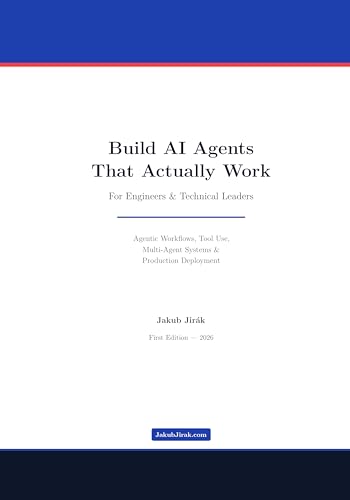
Build AI Agents That Actually Work — actual author-owned cover Author catalogue source.
Who I would recommend it to
The published scope joins agentic workflows, tool use, multi-agent systems and production deployment. I would recommend considering it to a software engineer who wants to connect those subjects as one system. The reader’s question should be more concrete than whether agents are exciting. There should be a task that an agent might help complete.
I would read with a bounded example in mind. It might involve gathering information, preparing a change or completing a repeatable internal process. The exact example matters less than being able to describe what the agent is allowed to do and what result another person can inspect. Those boundaries give the discussion a useful shape.
I would choose a more introductory book for someone whose immediate goal is using a chat application at work. The agent-systems perspective involves the relationship between instructions, tools and software behaviour. It is a different purchase from a collection of ready-made prompts for ordinary office tasks, even though both can involve similar underlying models.
Start with the result, then the workflow
My preferred first question is what a completed task should look like. If nobody can describe that, adding an agent can make the uncertainty faster without making it smaller. A useful objective should let a person recognise success and understand which important constraints the system had to respect.
I would then describe the steps that are already known. Some tasks have a clear sequence, while others genuinely need investigation and adaptation. That distinction helps decide where an agent should make choices and where ordinary deterministic software remains the clearer arrangement. The point is to choose useful flexibility, not maximum flexibility.
I like working from a small complete path before expanding the task. One input, a defined action and a reviewable result can reveal more about a system than a complicated diagram of possible agents. While reading, I would keep returning to whether the workflow has a reason for each step and a way to recognise a failed one.
Tools turn language into consequences
Tool use is one of the book’s explicit subjects, and it changes the engineering conversation. An assistant describing an action is different from software being able to perform it. The tool interface needs to make the available operation and its expected result clear enough that the wider system can handle it sensibly.
I would think about an operation’s inputs, errors and boundaries before giving it to an agent. Can the result be inspected? Is it safe to retry the operation? Does the tool expose more capability than the task requires? These are useful design questions even if the chosen agent framework supplies a convenient way to declare a tool.
I would also distinguish permission from preference. A task may describe a desired outcome without authorising every possible route to it. The surrounding application needs an intentional way to represent those boundaries. I would not expect a longer system prompt alone to replace the controls that belong in the software and its operating environment.
Title and description presentation from my author catalogue; this is not an interior page. Author catalogue source.
Context should support the next decision
An agent can receive a large amount of material without receiving the right material. I would organise context around what the next decision requires. A repository convention, a user’s current objective and a tool’s returned observation play different roles, and keeping those roles clear helps make later behaviour easier to explain.
For a practical reading exercise, I would trace where a relevant fact enters the system and how it reaches the point of use. If the agent repeatedly guesses something the application already knows, that is a useful place to investigate. The improvement may be in context delivery rather than a different model.
I would keep uncertain information visibly uncertain. A generated plan is not an observation, and an observation from an old run may no longer describe the current system. The more actions an agent can take, the more useful it becomes to distinguish what was requested, inferred, attempted and actually confirmed.
More agents need a reason
Multi-agent systems are part of the published scope. I find the subject interesting when separate responsibilities can improve the result or reduce a meaningful wait. Dividing a task can create useful independent investigation, but it can also create handoffs and conflicting assumptions that one simpler workflow would avoid.
I would begin by identifying the independent work. Each participant needs a clear assignment and an output that another part of the system can use. If several agents all modify closely connected details without shared decisions, the integration effort can grow faster than the useful parallel work.
I would keep the final owner of the result explicit. A collection of plausible responses is not the same as a completed task. Someone or something still needs to combine the evidence, resolve disagreements and check the actual outcome. That responsibility should remain visible even when the internal arrangement becomes sophisticated.
Evaluation should follow the actual job
I would not assess an agent only by how convincing its final paragraph sounds. The question is whether it completed the intended task under the required constraints. A polished explanation can accompany an incomplete action, while an unremarkable response can accompany a genuinely useful result. The evaluation needs to know the difference.
I would choose examples that represent the real work, including a few that expose unclear instructions or missing information. Easy demonstrations are useful for establishing the first complete path. They are less useful as the only evidence for a system expected to handle a wider range of requests.
When a failure appears, I would trace the decision and the available observation before changing several things. Was the objective unclear, the tool inappropriate or the verification missing? The answer determines whether the next improvement belongs in the instructions, application, test set or model choice.
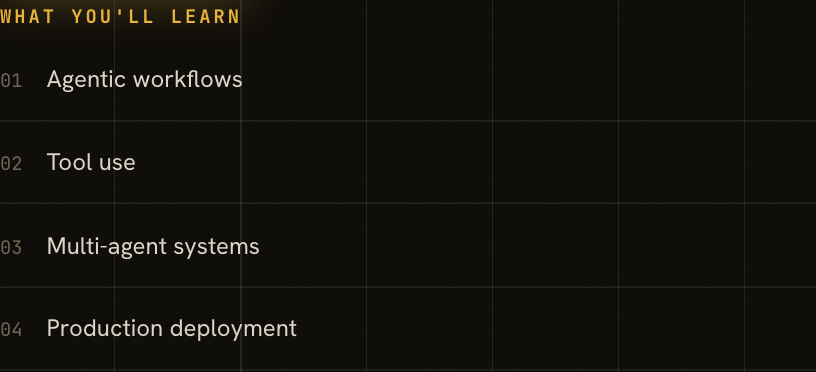
Published scope from my author catalogue; this is not an interior page. Author catalogue source.
Deployment adds an operating responsibility
Production deployment is the fourth part of the published scope, and I think it belongs in the conversation early. A system that works once still needs a clear way to operate, inspect and recover. The person responsible for it should know where progress is visible and what happens when the workflow cannot finish.
I would plan ordinary limits around time, cost and repeated actions. These are not separate from product quality. A task that eventually succeeds after an uncontrolled amount of work may be unsuitable for the user or business. An understandable stopping condition can be more useful than an impressive but unpredictable run.
I would also plan how changes to the system are evaluated. A new model, tool or instruction can affect behaviour beyond the example that motivated the change. The useful habit is to keep enough relevant evidence to judge whether the new arrangement improved the real task, rather than assume newer components automatically improve the whole system.
What I would not promise from this book
The public description establishes the subjects, not a guarantee that a particular framework version or deployment provider is covered in the exact depth every reader needs. I would check the current sample and edition if a named implementation detail decides the purchase. Current official documentation remains the right place for exact APIs and configuration requirements.
I would not present the book as a shortcut to unrestricted autonomy or a guaranteed business return. The value depends on choosing an appropriate task and doing the engineering work around it. A narrow workflow that reliably helps a person can be a better result than a much larger agent system with no clear owner.
The companion I would choose
For selecting an assistant and interaction style, The Complete AI Model & Mode Selection Guide is the more direct starting point. For working from a terminal in an existing repository, The Power User’s Guide to AI-Powered CLI Tools has another focus. I would choose this agents book when the system itself is what I want to design.
My author recommendation
I recommend considering Build AI Agents That Actually Work when you want to connect agent behaviour with tool boundaries, meaningful evaluation and a maintainable deployed workflow. I like that practical engineering question much more than a demonstration alone. I would buy for that scope, start with a bounded task and let useful evidence decide how far the system should grow.
What worked
The stated scope puts an agent's actions in the context of a complete maintained system.
What bothered me
The public description cannot establish the exact depth of a preferred framework or provider.
Who should not buy it
I would choose an introductory office-use guide when the need is ordinary chat assistance rather than building agent software.
Alternatives I would consider
The Complete AI Model & Mode Selection Guide. I would choose it for selecting an assistant and interaction mode rather than building the system. Read my The Complete AI Model & Mode Selection Guide author overview.
The Power User's Guide to AI-Powered CLI Tools. I would choose it for terminal use within an existing development workflow. Read my The Power User's Guide to AI-Powered CLI Tools author overview.
Evidence and sources
The stated scope comes from my published author catalogue. The images show the actual cover and author-catalogue presentation, not interior pages or independent customer evidence.
This is the author's account of the book's scope and intended reader. Check the selected Amazon edition for its current format, sample and availability.
Conclusion
Worth considering for a bounded real task; it does not promise unrestricted autonomy or a guaranteed business return.
Build AI Agents That Actually Work
Amazon US · US
Check price and availability: Build AI Agents That Actually Work at Amazon USAffiliate link. As an Amazon Associate I earn from qualifying purchases.