I am the author of Rust from First Principles: Ownership, Concurrency, WebAssembly & Systems Programming. I earn royalties from sales, and the labelled Amazon link can also earn an affiliate commission. This is an author’s explanation of the book’s intended role, not an independent customer’s verdict about my own work.
Quick verdict
I recommend considering it for deliberate learning across ownership, borrowing and the stated systems topics.
Best for: A programmer prepared to practise with small Rust programs and reason about data relationships.
Main benefit: The published scope connects the ownership model with concurrency, WebAssembly and systems work.
Biggest drawback: Understanding takes implementation practice, and the public description cannot establish every library or toolchain detail.
Rust from First Principles
Amazon US · US
Check price and availability: Rust from First Principles at Amazon USAffiliate link. As an Amazon Associate I earn from qualifying purchases.
Reviewed version: Rust from First Principles: Ownership, Concurrency, WebAssembly & Systems Programming
Compatibility: The selected edition is ASIN B0GWTWLGKJ. Check sample and format, and match current compiler and target requirements to the intended project.
Review context: The recommendation uses the published author description and scope. It does not claim an independently verified reading result or invent chapter contents.
What interests me about Rust is the way it asks a programmer to make important relationships in the program clearer. The learning process can feel different from collecting familiar syntax in another language. I would approach the book with curiosity about that model and enough patience to investigate why a piece of code is accepted or rejected.
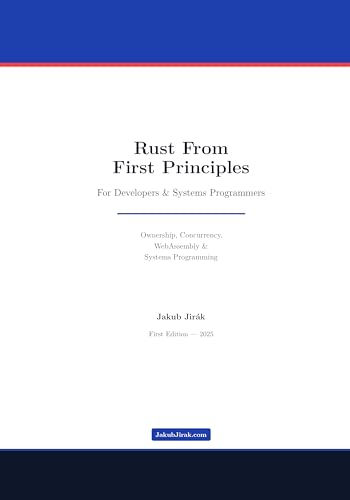
Rust from First Principles — actual author-owned cover Author catalogue source.
The reader I have in mind
The published scope begins with ownership and borrowing, then extends to concurrency, WebAssembly and systems programming. I would recommend considering it to a reader who wants those subjects connected as part of learning Rust. The useful starting point is a willingness to understand the language’s ideas, not only copy code until it compiles.
I would find a small project or exercise that has a clear result. A command-line task, a simple data transformation or another bounded program can provide a manageable setting. The exact project matters less than being able to explain what data it holds and what the program should do with that data.
I would choose a narrower current reference when today’s problem is one library call or an exact compiler diagnostic. A broader book serves a different purpose: helping the reader build a model that makes later details easier to understand. Those two kinds of learning can work well together without pretending that either replaces the other.
Ownership is a way to discuss the program
The ownership and borrowing model is central to the book’s public description. I would read that topic with a simple question: which part of the program is responsible for a value at this point? Being able to answer clearly is more useful than remembering a slogan about memory safety.
I would draw small examples before trying to understand a large application’s data structures. A few values and functions can expose the relationship that matters without adding unrelated complexity. The aim is to connect the rules with the program’s intention, so that a compiler message becomes information about the design rather than an arbitrary obstacle.
I would also keep the original problem visible when changing code to satisfy a rule. A change can make an error disappear while making the design less understandable. The better result is an arrangement the programmer can explain: who owns the value, who may use it and what remains valid afterwards.
Borrowing rewards small clear examples
My preferred learning exercise changes one relevant detail at a time. Keep the original example, alter a relationship and observe what the compiler reports. That makes the boundary between working and rejected code easier to understand than repeatedly rewriting a larger program without knowing which change mattered.
I would write down the reason in ordinary language after an example works. The explanation does not need to sound like a language specification. It should describe the relationship clearly enough that the reader can recognise the same situation in a different piece of code later.
I would avoid turning the learning process into a contest to eliminate every clone or lifetime annotation. Those decisions need context. A small learning program should first be understandable and correct for its task. More demanding design and performance questions become easier to judge once the basic model is clearer.
Concurrency needs a purpose
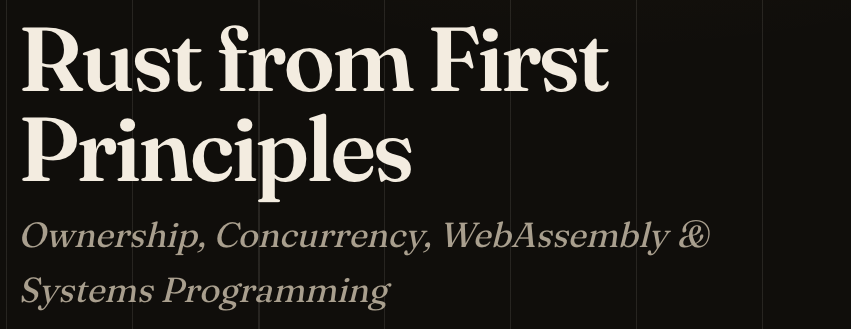
Title and description presentation from my author catalogue; this is not an interior page. Author catalogue source.
Concurrency is part of the stated scope, and I like considering it after asking what work should overlap. Adding concurrency to a task does not automatically improve it. The useful question is which operations can proceed independently and what information needs to pass between them.
I would begin with a simple correct sequential result where practical. That provides something to compare when the concurrent version becomes harder to reason about. It also helps separate a mistake in the underlying task from a mistake in coordinating the work.
The catalogue uses the familiar phrase fearless concurrency. I would not interpret that as permission to stop reasoning about the program. The developer still needs to understand ordering, ownership and the required result. Language support can make some mistakes harder to express while the application’s own correctness remains an engineering responsibility.
WebAssembly changes the environment
Compiling to WebAssembly appears among the published highlights. I would approach it as a question about where the program runs and how it connects to its surroundings. A useful computation still needs inputs, outputs and a clear relationship with the host application.
I would begin with a small component that has a stable interface. That makes it easier to understand which work belongs in Rust and which belongs in the surrounding system. Choosing a compilation target is not a substitute for deciding where a boundary makes sense.
I would check the current tools and host requirements for the intended project. A book can provide a useful introduction to the subject while exact installation commands and supported targets evolve. If the reader needs a particular framework or deployment route, the available sample and official documentation should establish that fit before purchase.
Systems work includes the edges
Systems programming patterns are also part of the public scope. My reading interest is in the parts of the program that meet real constraints: files, external data, resource limits and failures. A useful program needs to say what happens when an operation cannot complete, not only what it does on the favourable path.
I would choose one failure case in a small exercise and make the result understandable. What information should the caller receive? Which resources need attention? Can the operation be retried safely? These are questions I would bring to the reading, rather than invented promises about particular examples inside the book.
I would keep the public interface proportionate to the task. A small utility can be a good place to practise clear error handling and data ownership without designing an elaborate architecture. The learning result should remain simple enough to review and change as understanding improves.
How I would organise the learning
I would keep a working environment with a known toolchain and a small set of examples. Each example should have a reason to exist and an expected result. That gives the learner a way to return after a break without reconstructing a long sequence of experiments from memory.
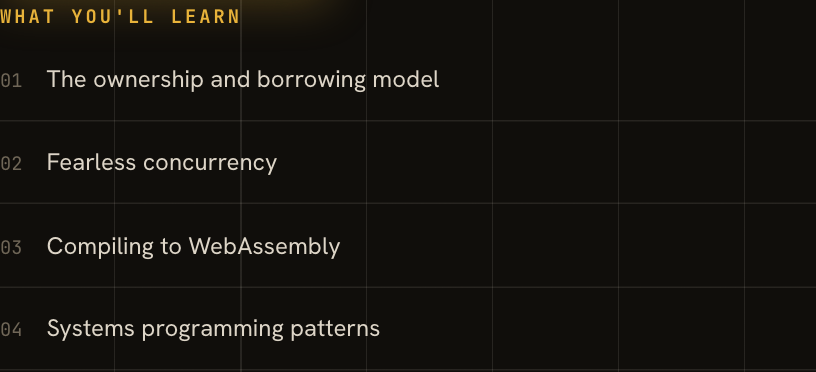
Published scope from my author catalogue; this is not an interior page. Author catalogue source.
I would make room for reading compiler output carefully. The first response to an error should be understanding what relationship the compiler is reporting. Repeating suggested edits can occasionally produce a working file while leaving the underlying idea unclear. I would prefer a slower first explanation that makes the next problem easier.
I would also keep the scope of each session modest. Ownership, concurrency and a new deployment environment can each introduce unfamiliar ideas. Combining all of them immediately may make it difficult to see what caused a problem. A sequence of small complete results can build confidence without hiding the complexity.
What I would check before buying
The author catalogue establishes the subject areas, not the full table of contents or the exact depth of every library discussion. I would inspect the current sample and edition when a particular topic decides the purchase. A reader should not have to infer detailed coverage from a broad subtitle alone.
I would also be realistic about the time needed to practise. Reading a conceptual explanation and being able to apply it in an unfamiliar program are different milestones. The book’s value depends on doing enough implementation and observation to connect the words with real code.
I would not recommend it as a guarantee of a faster application simply because the language changes. Performance depends on the task and implementation, and a rewrite has its own cost. I would choose the learning goal first, then investigate whether Rust is a suitable tool for the actual project.
The companion I would choose
Metal 4: Expert GPU Programming on Apple Silicon concerns a different low-level environment. I would choose it when the GPU task itself is the focus, rather than general Rust ownership and systems concepts. An interest in systems work can connect the subjects, but it does not make the books substitutes.
Think Different has another useful angle around quality and feedback. I would choose it for a wider testing discussion, while keeping Rust learning tied to small programs and current language references. The immediate question should decide which book is most useful now.
My author recommendation
I recommend considering Rust from First Principles when you want a deliberate path through ownership, borrowing and the wider systems subjects in its published scope. I like the learning approach of making relationships in the program understandable. I would buy with time for small experiments, use current references for exact tooling and choose a narrower resource when one immediate API question is all that needs answering.
What worked
The published scope connects the ownership model with concurrency, WebAssembly and systems work.
What bothered me
Understanding takes implementation practice, and the public description cannot establish every library or toolchain detail.
Who should not buy it
I would choose a narrow reference for an immediate library issue or another approach when a language rewrite has no defined project purpose.
Alternatives I would consider
Current official Rust documentation. I would use it for exact current syntax, compiler behaviour and toolchain requirements.
Metal 4: Expert GPU Programming on Apple Silicon. I would choose its different advanced GPU scope when low-level compute or rendering is the immediate problem. Read my Metal 4: Expert GPU Programming on Apple Silicon author overview.
Evidence and sources
The stated scope comes from my published author catalogue. The images show the actual cover and author-catalogue presentation, not interior pages or independent customer evidence.
This is the author's account of the book's scope and intended reader. Check the selected Amazon edition for its current format, sample and availability.
Conclusion
Worth considering for broader learning; a current reference is faster for one exact API or compiler question.
Rust from First Principles
Amazon US · US
Check price and availability: Rust from First Principles at Amazon USAffiliate link. As an Amazon Associate I earn from qualifying purchases.