I am the author of Metal 4: Expert GPU Programming on Apple Silicon. This is an author’s explanation of its intended fit. I earn royalties from the book, and the labelled Amazon link can also earn an affiliate commission. I want the buying recommendation to be read with that relationship in view, rather than as an independent customer’s verdict.
Quick verdict
I recommend considering it for experienced developers with a concrete Apple Silicon GPU problem.
Best for: A developer investigating low-level compute, shaders, memory and a real-time pipeline.
Main benefit: The published scope connects GPU operations with their wider compute or rendering role.
Biggest drawback: It is an advanced subject, and the public scope does not establish every API detail or hardware requirement.
Metal 4: Expert GPU Programming on Apple Silicon
Amazon US · US
Check price and availability: Metal 4: Expert GPU Programming on Apple Silicon at Amazon USAffiliate link. As an Amazon Associate I earn from qualifying purchases.
Reviewed version: Metal 4: Expert GPU Programming on Apple Silicon: Low-Level Compute, Shaders, Unified Memory & Real-Time Pipelines
Compatibility: Confirm the selected edition B0GWV5967J, sample and required hardware, operating system and developer tools for the desired Metal feature.
Review context: The recommendation uses the published author description and scope. It does not claim an independently verified reading result or invent chapter contents.
The part of GPU programming that interests me is the connection between a useful result and the work needed to produce it. A technically impressive effect or compute kernel still belongs inside an application with a budget, a target device and a reason to exist. I would approach this book through that engineering question rather than treating a low-level API as an end in itself.
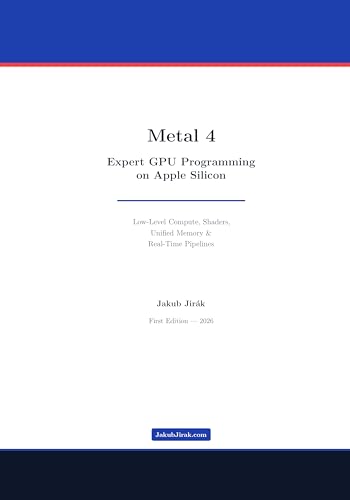
Metal 4: Expert GPU Programming on Apple Silicon — actual author-owned cover Author catalogue source.
An advanced reader, with a real problem
The published scope covers low-level compute, shader programming, unified memory and real-time pipelines on Apple Silicon. I would recommend considering it to an experienced developer who wants to work closer to the GPU. The intended conversation is more specific than a first introduction to programming or a general tour of what a Mac can do.
I would come to it with a project or bounded experiment in mind. That could be a rendering task or a computation whose behaviour needs investigation. Having a real target makes the questions about data, scheduling and visible results more useful. Without one, it can be easy to collect technical terms without deciding where they belong in actual software.
I would not use the word expert as a promise that reading alone produces expertise. Understanding grows through implementation, observation and correction. A book can help structure the work, while the reader still needs a suitable environment and time to investigate the behaviour of a real program.
Compute should begin with the data
Low-level compute kernels appear explicitly in the author catalogue. My preferred reading question is what data the application has and what result it needs. That keeps attention on the whole operation rather than choosing a GPU implementation simply because parallel execution sounds attractive.
I would describe the input, output and dependencies before concentrating on the kernel. Which values can be processed independently? Which steps depend on earlier results? What does the application need to do before and after the computation? Those questions help make the eventual implementation understandable to another engineer.
I would also keep a straightforward reference result where practical. A faster implementation needs to remain correct for the intended input range. Comparing a carefully chosen small example can reveal a misunderstanding earlier than running only a large impressive demonstration. That is the kind of working habit I would bring alongside the reading.
Shaders belong to a visual purpose
Shader programming is another part of the published scope. I like approaching it through the visible result the application needs, with enough context to understand why a stage exists. A shader is easier to reason about when its inputs and expected output have a clear role in the larger image.
For a visual experiment, I would begin with an uncomplicated scene and change one relevant part at a time. That makes it easier to connect a code change with the resulting picture. A complicated scene can conceal an incorrect assumption behind several layers of other effects and content.
I would keep visual correctness and speed as related but distinct questions. A result that looks plausible in one scene may still be wrong for another input. A result that is correct may still need a different performance arrangement. A useful investigation should be able to say which question it is answering.
Unified memory deserves deliberate thinking
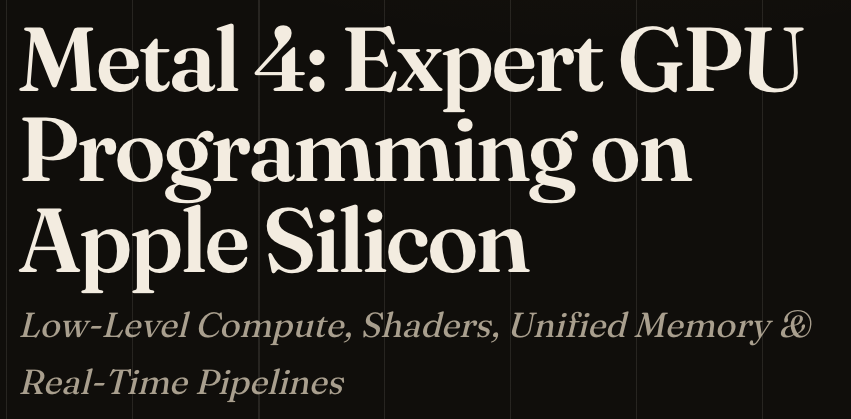
Title and description presentation from my author catalogue; this is not an interior page. Author catalogue source.
Unified memory architecture is part of the book’s stated subject. I would read that topic with the application’s actual data movement and lifetime in mind. A convenient architectural description should not become an excuse to stop asking where data is produced, when it is needed and who may change it.
I would make the ownership of important resources clear in the design. The CPU side of an application and the GPU work it schedules still need a coherent relationship. Being able to explain that relationship is useful when a result is incorrect or a task sometimes takes longer than expected.
The reading exercise I would choose is a small diagram of one resource’s path through a task. It should show creation, use and the point where the next operation may safely depend on the result. That can expose a missing assumption without requiring the whole application to be understood at once.
Real-time means a complete budget
The published scope includes real-time rendering pipelines, and I would keep the word pipeline visible. The final frame depends on more than one isolated operation. Improving a small kernel is valuable only if it helps the larger task in a way that matters to the application.
I would begin with the intended experience: the scene, output and target hardware. Then I would identify which work contributes to the critical path. This is a reading strategy rather than a claim about particular chapter contents. It gives the technical discussion a concrete environment in which to be useful.
I would also keep repeatability in mind. One favourable result does not establish that a frame budget is met across the intended range of content. The application needs a sensible way to observe demanding cases and distinguish a persistent limit from a temporary disturbance. Numbers become useful when the conditions behind them are clear.
Measurement should answer one question
I would not buy an advanced GPU book expecting a universal performance multiplier. The useful improvement depends on the original task and its limiting factor. An investigation should first establish what is being measured and which part of the system could plausibly change the result.
For a personal project, I would keep the test input and relevant settings recorded. That makes later comparisons easier to interpret. Changing the scene, device and implementation at the same time can produce a different number without explaining which change helped.
I would also keep correctness checks alongside performance work. A change that removes required work can look fast while delivering the wrong result. I want the engineering conversation to include what must remain true, not just what the timer reports. That is a useful expectation to bring to any advanced systems reference.
The environment is part of the purchase
Before buying for a specific feature, I would confirm the required Apple hardware, operating system and developer tools against current official documentation. A book title is not a compatibility matrix. The reader should know whether the intended experiment can run in the environment actually available to them.
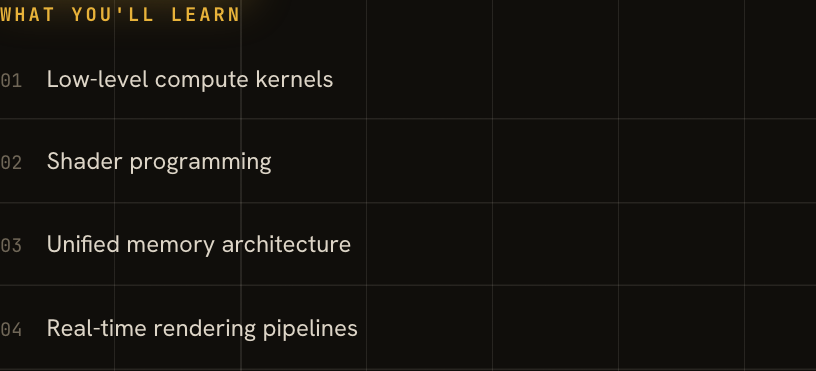
Published scope from my author catalogue; this is not an interior page. Author catalogue source.
I would also inspect the current sample and edition information. The public catalogue establishes the broad subject, but it does not prove the exact coverage of every API or a buyer’s preferred library. If one feature decides the purchase, it deserves a direct check rather than an assumption based on the title alone.
For a team, I would consider whether the project needs this level of control. Low-level GPU work can be a good fit when a specific requirement calls for it. A higher-level framework may be the better use of time for another application. The book’s value depends on the question being appropriate for the reader’s work.
How I would use the book alongside a project
I would choose one small part of the application to understand more deeply. It should have a clear expected result and a manageable set of inputs. That keeps the first experiment reviewable and avoids making the rest of the project depend immediately on an unfamiliar implementation.
I would keep notes about assumptions, observed behaviour and unresolved questions. Those notes can be as useful as the final code when returning to the experiment later. The aim is to build an explanation that another engineer can follow, not just an implementation that happened to produce the desired picture once.
I would then decide whether the result warrants integration. A successful experiment may show that the chosen approach is worthwhile, or it may show that another layer of the application deserves attention first. Either answer can make the reading useful if it improves the engineering decision.
The companion I would choose
Build Spatial Apps for Apple Vision Pro has a different application-level starting point around visionOS, RealityKit and SwiftUI. I would choose that direction when spatial interaction is the main problem. I would choose the Metal book when low-level GPU computation or rendering control is the question itself.
Rust from First Principles addresses systems programming from another language and ownership perspective. It is not a substitute for Metal API documentation. I see the subjects as potentially complementary for an interested developer, while keeping the immediate learning goal narrow enough to make progress.
My author recommendation
I recommend considering this book for an experienced developer with a specific interest in Apple Silicon GPU work. I like the connection between compute, shaders, memory and the complete real-time pipeline. I would buy for that advanced scope, with suitable tools and a bounded project ready, rather than expect a beginner introduction or a guaranteed performance result.
What worked
The published scope connects GPU operations with their wider compute or rendering role.
What bothered me
It is an advanced subject, and the public scope does not establish every API detail or hardware requirement.
Who should not buy it
I would choose a beginner resource for first programming lessons or a spatial-app guide when interaction is the main goal.
Alternatives I would consider
Build Spatial Apps for Apple Vision Pro. I would choose it when application-level spatial interaction is the main learning goal. Read my Build Spatial Apps for Apple Vision Pro author overview.
Rust from First Principles. I would choose its different language and systems perspective when ownership and general systems programming are the task. Read my Rust from First Principles author overview.
Evidence and sources
The stated scope comes from my published author catalogue. The images show the actual cover and author-catalogue presentation, not interior pages or independent customer evidence.
This is the author's account of the book's scope and intended reader. Check the selected Amazon edition for its current format, sample and availability.
Conclusion
Worth considering with suitable tools and a bounded project; a higher-level framework can be the better answer to another task.
Metal 4: Expert GPU Programming on Apple Silicon
Amazon US · US
Check price and availability: Metal 4: Expert GPU Programming on Apple Silicon at Amazon USAffiliate link. As an Amazon Associate I earn from qualifying purchases.