I am the author of Build Spatial Apps for Apple Vision Pro: visionOS, RealityKit, SwiftUI & Immersive Experiences. I receive royalties from sales, and the labelled Amazon link can also earn an affiliate commission. This is my own explanation of the book’s intended audience and fit, rather than an independent customer’s review.
Quick verdict
I recommend considering it for a developer with a useful spatial application idea and a realistic way to evaluate it.
Best for: A developer connecting visionOS, RealityKit, SwiftUI and the person's actual spatial task.
Main benefit: The published scope brings interface, scene building and immersion into one application-focused discussion.
Biggest drawback: A build or simulator image is not complete evidence of the headset experience, and exact current platform requirements still need checking.
Build Spatial Apps for Apple Vision Pro: visionOS, RealityKit, SwiftUI & Immersive Experiences; selected Kindle edition
Amazon US · US
Check price and availability: Build Spatial Apps for Apple Vision Pro: visionOS, RealityKit, SwiftUI & Immersive Experiences; selected Kindle edition at Amazon USAffiliate link. As an Amazon Associate I earn from qualifying purchases.
Reviewed version: Build Spatial Apps for Apple Vision Pro: visionOS, RealityKit, SwiftUI & Immersive Experiences; selected Kindle edition
Compatibility: ASIN B0GWV5G6HW was identified as a Kindle edition. Confirm the offered format, sample, current tools and target hardware before buying for a specific feature.
Review context: The recommendation uses the published author description and scope. It does not claim an independently verified reading result or invent chapter contents.
What I find interesting about spatial applications is the relationship between software and the space around a person. A familiar feature can need a different presentation when it is no longer confined to a laptop screen. I would approach this book with a useful experience in mind, not just a wish to place an existing interface in front of someone wearing a headset.
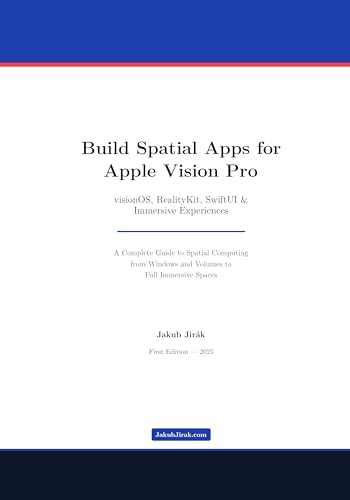
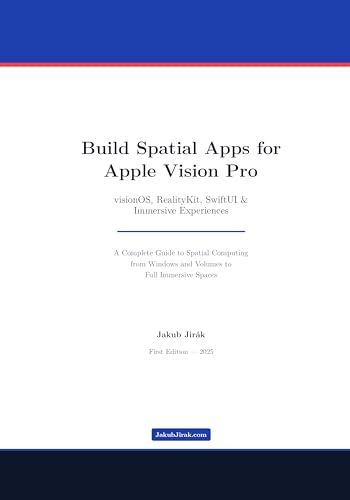
Build Spatial Apps for Apple Vision Pro — actual author-owned cover Author catalogue source.
The reader I have in mind
The published scope names visionOS, RealityKit, spatial UI in SwiftUI and immersive experiences. I would recommend considering it to a developer who wants those application-building subjects connected. The useful starting point is a concrete idea that could benefit from spatial presentation or interaction.
I would be particularly interested in a reader who is prepared to simplify that idea before expanding it. A small understandable experience can reveal whether the spatial approach helps. A large collection of objects and effects can make a demonstration look busy without giving the person a clear task to complete.
I would choose a first programming resource for someone who still needs the underlying development basics. I would also choose another reference when the real problem is a low-level GPU operation rather than the spatial application. The title establishes a platform and application focus, not a promise to replace every related technical reference.
Begin with a reason for the space
My preferred first question is why this experience belongs in a spatial environment. The answer might concern how information relates, how an object is understood or how a task uses the surrounding space. It should be more concrete than the platform being new or visually impressive.
I would write a short description of what a person should accomplish in the first few minutes. That makes it easier to decide which parts need to be visible and which can wait. The application should help someone understand the next action without requiring an explanation from the developer standing nearby.
I would also compare the idea with a simpler flat presentation. Sometimes a conventional window is already a good solution. Sometimes a spatial element makes the task clearer. The value lies in choosing intentionally, rather than assuming that a more immersive presentation is automatically the better application.
SwiftUI still needs a clear task
Spatial UI in SwiftUI appears explicitly in the author catalogue. I would bring the same concern for readable hierarchy and meaningful actions that I bring to other interfaces. Familiar implementation tools do not remove the need to reconsider how the interface fits this environment.
I would start with the most important information and the next useful control. If a person cannot tell what the application wants them to do, adding more panels is unlikely to solve the problem. A small coherent workflow can be a stronger first result than a complete collection of screens copied from another platform.
I would also think about what happens when attention moves away and returns. An application should remain understandable without depending on the user remembering every earlier step. Clear state and a sensible return path are useful design questions to bring alongside the technical reading.
A scene needs a purpose and a scale
RealityKit and scene building are part of the stated scope. I would use a scene to support the person’s task, with objects and relationships that are easy to interpret. A technically correct object can still be awkward if its position or scale makes the intended interaction unclear.
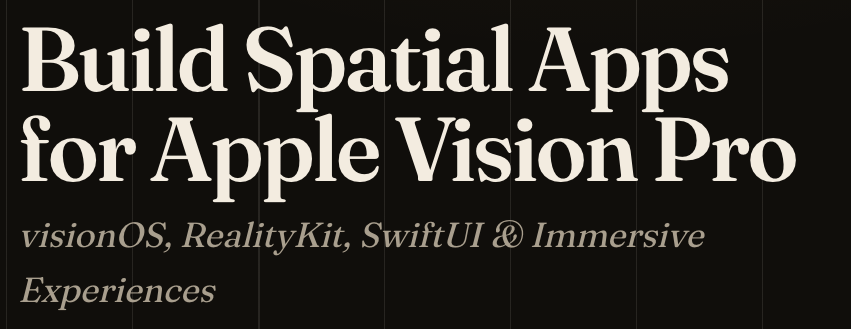
Title and description presentation from my author catalogue; this is not an interior page. Author catalogue source.
I would begin with a small amount of content and a stable reference. That makes changes easier to assess and helps separate a problem with the scene from a problem with its source asset. The aim is a result whose behaviour can be explained before introducing several interacting elements.
I would also plan how content enters the project. An asset’s appearance in a source tool and its usefulness in the application are related but different questions. The developer needs enough understanding of the content pipeline to investigate a mismatch without guessing which stage caused it.
Immersion should earn its place
Immersive experiences are part of the published scope, but I would not treat immersion as the default answer to every application idea. The person has a surrounding environment, a task and a level of attention they are willing to give. The application’s presentation should respect that complete situation.
I would decide when a deeper spatial presentation helps and how the person returns from it. The transition should have a clear reason, with the application’s state still understandable afterwards. A compelling entrance is only part of the experience if leaving it creates confusion.
I would keep the first experiment short enough to observe carefully. A useful question is whether the person can accomplish the intended task comfortably and explain what happened. That gives the developer more actionable information than a reaction to the visual effect alone.
Testing needs the actual experience
Development tools are valuable for iteration, but I would not treat a successful build or a simulator screenshot as complete evidence of the experience on a headset. The physical presentation, interaction and surrounding context add questions that a different viewing environment cannot answer in exactly the same way.
I would define a small set of real tasks and observe them on the intended hardware where possible. Can a person identify the controls, understand the content and recover after an unexpected action? The result should describe what was actually observed, rather than infer comfort or usability from technical success alone.
I would also keep accessibility in the design conversation from the beginning. Different people may use different interaction arrangements and have different needs. A useful application should not depend unnecessarily on one assumed posture, movement or way of perceiving a cue. Current platform guidance is important when turning that intention into implementation.
Performance belongs to the whole scene
I would approach performance through the intended experience and target environment. The number of objects or the complexity of an asset is only part of the work. The application needs a way to observe which part of the system affects the result before changing several things at once.
For a bounded experiment, I would keep the content and settings consistent while comparing a change. That makes a later conclusion easier to trust. A different scene on a different device can produce another result without establishing that the implementation improved.
I would keep quality and performance decisions connected. Removing the feature that makes the experience useful can make a technical measure look better while weakening the application. A good trade-off preserves the intended task and makes the compromise understandable to the people reviewing the work.
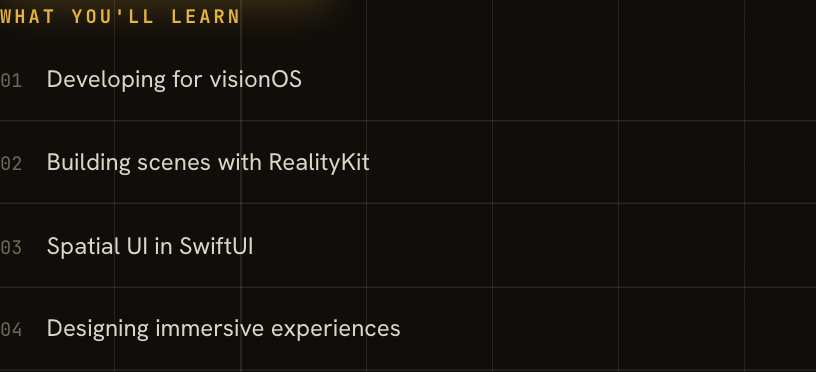
Published scope from my author catalogue; this is not an interior page. Author catalogue source.
Check the environment before buying
The selected public Amazon metadata identifies a Kindle edition, while the exact offer and available formats should still be checked at purchase. I would also confirm the current developer tools, platform requirements and hardware access needed for the intended project. The book’s title is not a compatibility matrix for every development setup.
The public description establishes the broad topics, not a complete table of contents or every API version. If one feature decides the purchase, I would inspect the available sample and current official documentation. That is especially useful for a platform whose interfaces and capabilities continue to develop.
I would not buy expecting a ready-made application business or a guarantee of store approval. The developer still needs a useful idea, appropriate assets, careful implementation and evidence from the actual experience. The book is a learning resource inside that work, not a replacement for it.
How I would use the book
I would begin with one small task and write down what should make it better in a spatial environment. Then I would build the smallest complete version that can answer that question. The result does not need a large feature list; it needs a clear beginning, useful action and understandable outcome.
I would keep a short record of what the experiment showed and what remains uncertain. That helps decide whether to improve the interaction, change the content or reconsider the idea. A useful negative finding can save a great deal of implementation work when it arrives early enough.
The companion I would choose
Metal 4: Expert GPU Programming on Apple Silicon is the more relevant direction when a low-level GPU computation or rendering pipeline is the immediate problem. I would choose the spatial-app book for the application and interaction perspective. The subjects can meet in a project without becoming interchangeable purchases.
Think Different offers another perspective on quality and useful feedback. I would keep that broader engineering concern alongside the device experience, while remembering that automated checks and direct observation answer different questions.
My author recommendation
I recommend considering this book when you want to build a deliberate spatial application using the platform subjects in its published scope. I like the connection between interface, scene and actual experience. I would buy with a small useful project and a realistic testing arrangement in mind, while choosing a narrower reference when the task is one exact API or low-level operation.
What worked
The published scope brings interface, scene building and immersion into one application-focused discussion.
What bothered me
A build or simulator image is not complete evidence of the headset experience, and exact current platform requirements still need checking.
Who should not buy it
I would choose first programming lessons for a new programmer or a low-level GPU reference for a specific compute problem.
Alternatives I would consider
Metal 4: Expert GPU Programming on Apple Silicon. I would choose it for a low-level compute or rendering problem rather than the application interaction. Read my Metal 4: Expert GPU Programming on Apple Silicon author overview.
Current official visionOS documentation. I would use it for exact present-day API and development-environment requirements.
Evidence and sources
The stated scope comes from my published author catalogue. The images show the actual cover and author-catalogue presentation, not interior pages or independent customer evidence.
This is the author's account of the book's scope and intended reader. Check the selected Amazon edition for its current format, sample and availability.
Conclusion
Worth considering with a small project and hardware-testing plan; a flat interface or narrower reference may fit another need.
Build Spatial Apps for Apple Vision Pro: visionOS, RealityKit, SwiftUI & Immersive Experiences; selected Kindle edition
Amazon US · US
Check price and availability: Build Spatial Apps for Apple Vision Pro: visionOS, RealityKit, SwiftUI & Immersive Experiences; selected Kindle edition at Amazon USAffiliate link. As an Amazon Associate I earn from qualifying purchases.