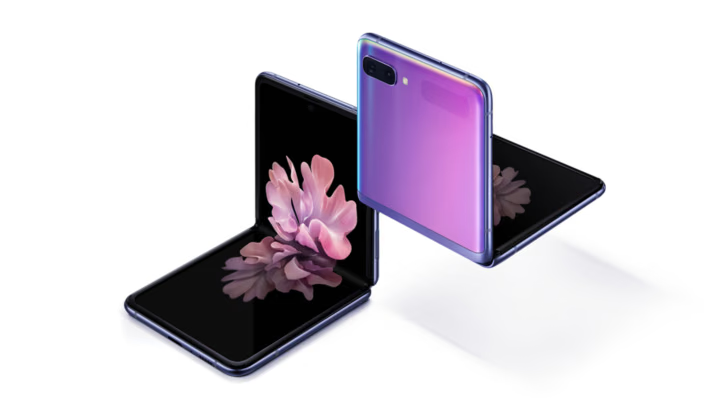
A Galaxy Z Flip starts to make sense when you have tried to carry a tall phone in a short pocket. The original could display a tall page when open and fold down to about half its length when put away. Unlike the book-shaped Galaxy Fold, it did not need to turn into a small tablet to justify itself. The part of the day it improved might be the time between uses. It also gave its camera a place to stand on a shelf or table. Those two ideas made the original Flip interesting in quite different ways.
Quick verdict
Retail release in the United States · Archive date
The original Flip offered a clear physical benefit to people who wanted a shorter device to carry.
Best for: A pocket-first buyer who still wanted a full-height screen or a self-standing camera.
Main benefit: The hinge shortened the folded phone and let the camera rest at an angle on a surface.
Biggest drawback: The tiny cover screen left most activity on the inside, requiring an extra movement.
Reviewed version: The original 2020 Galaxy Z Flip with LTE, before the separate Z Flip 5G.
Compatibility: Flex Mode, camera controls and cover display features are evaluated as documented at launch. They vary across later models.
Review context: The discussion considers the hardware and software as offered around the documented retail date.
Samsung started US sales on 14 February 2020 in limited quantities at $1,380. This review looks at the first LTE Z Flip, the 256 GB model sold at that US launch. The Z Flip 5G and later generations are separate models. Samsung’s US launch and specifications
A shorter phone can still be a thicker phone
The open device had a 6.7-inch, tall display. Folded, the original Flip reduced the height you had to put somewhere and roughly doubled the thickness compared with its open body. These measurements describe a particular win. A coat pocket or small bag may have ample depth but little height. A narrow trouser pocket that already fills easily could prefer a thinner slab. Two people can have the same complaint that their phone is too big and find opposite things when they try to carry a Flip.
Related reading
I would have tried the fit with the case I planned to use. A cover adds thickness where it wraps the two halves, and each half may need its own piece. Then I would have taken it out a few times as if paying at a counter or answering a call. The folded design keeps the display inwards while being carried, which was one of its attractions. Every time I wanted that display again I would be taking an extra action. Whether that feels like a nuisance depends on which tasks can be handled closed.
The mechanism stopped partway as well. That offered a benefit beyond full open and closed positions, but it also made the comparison with a traditional flip phone incomplete. A familiar silhouette tells you little about whether opening it quickly is convenient with the grip you actually use. At launch the best short test would be to place it on a table, open it while holding the lower half and set it into a few angles. You would then know whether buying the hinge would suit the way you use the object.
The 1.1-inch display was for deciding what to do next
The front display presented a small amount of information while folded. That worked for glancing at the time and seeing whether there was a reason to act. Samsung also described using it as a small preview with the rear cameras. It was never the surface I would choose for reading a long reply while trying to decide what to say. Most of the work belonged on the inside. The small outer screen was enough to make the hinge optional for some checks and mandatory for the others.
I would judge a glance by what it tells you before you reach for the phone. A bad one gives just enough information to pull you away from what you were doing, without telling you whether anything needs attention. A useful one lets you choose to leave the phone in place. For a person who checks notifications sporadically and acts on only a few of them, the small screen had a case. Someone who regularly reads full messages or wants to choose an app from the outside would be asking for a cover display that the first Flip did not have.
This division affected its use as a camera too. Using the rear camera closed could make quick framing possible, while the narrow preview left less room to judge the picture precisely. Open angles gave a second approach with more view. A reviewer has to keep those outcomes with the interface from the first generation. Features remembered from a newer clamshell can make an early one sound more complete than it was.
Related reading

The hinge could replace something else you carried
The camera benefited from a shape that could hold itself at an angle, within the usable positions of the hinge. A person making a video call from a table could keep the view reasonably stable and use both hands. For a photo, somebody could frame a group and leave the phone on a surface instead of holding it in front of the group. The angle remained connected to the available surface. A low shelf or a high desk still dictates the view, so a full tripod has its own purpose.
This is where Flex Mode mattered. Support in the app let the phone assign some controls and images to suitable halves. Opening a phone part way is only helpful if the next button remains usable and the subject stays visible. Samsung described launch support in particular applications. The result for a buyer depended on whether the camera or calling app they wanted actually supported the design. A feature that works in one well-chosen task can be worth more than broad compatibility claims that fail at the task you do most. Samsung’s design and software overview
The rest of the phone still had to serve you
The original packed two 12 MP rear cameras, a wide and an ultrawide, and a listed 3,300 mAh battery capacity. Its premise used those cameras in new positions rather than adding a separate long telephoto. A buyer who wanted to bring distant details closer could find a different flagship easier to justify. Someone who spent much of the day with navigation and the large screen on would have been wise to compare charging habits. An early foldable’s dimensions and battery were part of the product, just as its shape was.
Samsung described its display construction as using Ultra Thin Glass. That real material choice is not a complete description of every layer of the internal display. A good purchase check would compare the documented care instructions and support terms with the conditions where the phone would be carried. Surface protection, a moving hinge and replacement costs are especially relevant to a used specimen.
The outside and inside need their own tests
I would divide a short trial into two parts. One would use the phone while it stayed put. That is where a clock, a notification and a partly open call can be useful. The other would take it through motions you do in a hurry. Retrieve it from the pocket you actually have, open it, use the camera and put it away again. Trying each action once with plenty of time is a demonstration. Repeating the sequence makes it easier to decide whether it fits. The result can differ between two people with the same clothes or bag, because one person may take a phone out only a few times on a walk and the other may stop to photograph something every few minutes. How the shape changes that little loop is much of the reason to choose this particular kind of foldable.
Related reading

My verdict on the first Flip
The strongest argument was a compact folded shape in a place that could accommodate its depth. The second was a hands-free view without always packing an accessory. I would have paid attention to how often I relied on those things and how often a narrow glance led to opening the phone anyway. Looking at a particular day’s habits puts the large launch price into context.
The first Flip was an effective move because it made a regular phone smaller in one useful dimension while giving the hinge a second job. For a larger workspace when open, read the original Galaxy Fold review. For the other design turns Samsung made, see the Galaxy review timeline.
What worked
The hinge shortened the folded phone and let the camera rest at an angle on a surface.
What bothered me
The tiny cover screen left most activity on the inside, requiring an extra movement.
Who should not buy it
Buyers looking for current software and warranty support.
Alternatives I would consider
Original Galaxy Fold. A book-style model for readers who wanted more screen when open. Read my Original Galaxy Fold review.
Evidence and sources
Retail timing and specifications are tied to the market stated above. The author’s verdict evaluates the device in its launch context.
Features, compatibility and rated figures from the maker are manufacturer information. My opinions are identified in the review.
Conclusion
Its strongest legacy is a compact regular phone that benefits from folding in a few specific tasks.
One email a week with practical Mac workflows, useful comparisons and honest tech recommendations.