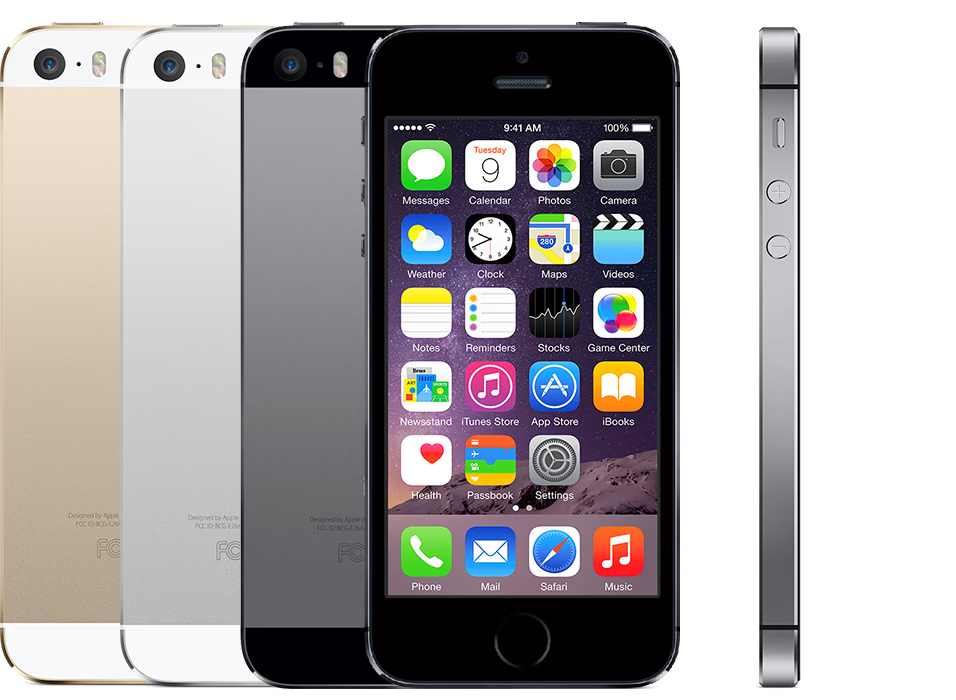
The iPhone 5s made unlocking part of touching the phone
Touch ID gave the iPhone 5s a reason to change a familiar way of using the Home button. Waking the phone and unlocking it can feel like two separate jobs when repeated through a whole day. A fingerprint sensor in the place your thumb was already going could combine enough of those actions to be useful. It was an advantage you could judge without a new class of apps. Apple also brought a 64-bit processor and a more flexible camera to the same four-inch shape. Those changes mattered in different ways if you were choosing it over the 5c that arrived on the same day.
Quick verdict
Retail release in the United States · Archive date
The iPhone 5s made sense for someone who unlocked frequently or could use the new camera capabilities.
Best for: A buyer who liked a four-inch iPhone and wanted a more convenient local unlock or more options indoors.
Main benefit: Touch ID put the fingerprint reader where the user already reached to wake or leave the current app.
Biggest drawback: The fingerprint reader still needed a passcode as a fallback, and the screen gave the same physical room as the iPhone 5.
Reviewed version: The four-inch iPhone 5s in the US September 2013 launch lineup.
Compatibility: At launch Touch ID covered device unlock and purchases in Apple's stores. The phone also used Lightning and model-specific LTE bands.
Review context: I evaluate the documented retail hardware and the software available in its release window. Regional variants and software changes are identified where they affect the verdict.
I owned the 5s as part of having every iPhone. This review looks back at the US launch on September 20, 2013. Apple sold the 5c on that date too, making it possible to compare the two offers directly. The 5s was harder to obtain when demand exceeded its initial supply. The delivery date of a particular storage option or colour could therefore differ from the launch date. Apple’s release and initial availability report
A small shortcut had a lot of opportunities to help
On a phone that went back into a pocket and came out a minute later, the unlock step multiplied. A person checking a code while carrying a bag, reading a message between tasks or getting a quick look at a route can see what one action is worth. The time saved on a single unlock is less interesting than whether entering the phone can be done in the same natural motion each time. The sensor made it more convenient to leave a credential in place and still reach the tools you wanted.
Related reading

The passcode remained important. You set one up and needed it in certain situations, including after restarting the phone. A fingerprint sensor can also have trouble when the finger or sensor is damp or dirty. I would have tried several normal grips and enrolled the finger I could reach most easily at a desk as well as the one I used while holding the phone. A device could be much easier to access in one circumstance and still ask for the older method in another. Apple’s launch description pointed to unlocking and approving purchases from its stores as the two immediate uses. The later reach of the technology into other apps belongs to a later software story. Apple’s original description of Touch ID
Biometrics and a passcode each solve a different part of local access. A passcode can be changed. Touch ID was deliberately integrated into the hardware and stored fingerprint information on the device according to Apple. Someone setting up a company phone still had to follow its rules for access, even if fingerprints were more convenient at home. A buyer particularly concerned with the feature had an easy test. Count how often you unlock the phone and compare enough attempts to learn whether you would be happy relying on it. That was more useful than treating the presence of a sensor as a general promise about security.
The A7 added room for software to grow
The A7’s 64-bit architecture was significant for software developers and Apple’s later systems. The day-one effect for an owner depended on the available apps. A process that opens and finishes quickly is better even when the user has no idea whether it is doing work with a 32-bit or 64-bit representation. App updates, faster graphics and the handset’s other parts all make a difference to that result. I would have given the most weight to how a particular app or camera action completed on the phone I intended to buy.
The M7 motion coprocessor offered another useful distinction. An app interested in movement could get data without asking the main processor to do all the work of collecting it. There is a good case for that on a mobile device that has to stay ready to communicate, conserve power and live in different pockets through the day. The reason to buy it for motion still depended on what a suitable app did with the data. Someone worried only about their common tasks could reasonably give the central processor more credit for making the rest of the phone feel more responsive.
Apple kept the screen the same physical size as the iPhone 5. That allowed it to make the device familiar while giving software more resources inside. A person looking mainly for room to read two columns or a larger keyboard could get little of what they wanted by buying a 5s. A person already comfortable with four inches could value the extra speed and go back to the same apps with much the same reach.
Related reading
The camera change was in the conditions
The rear camera was still rated at eight megapixels. Apple changed the sensor and lens and used two kinds of light in its True Tone flash. A flash changes what a camera sees. The subject nearest the phone can be too bright or look like it belongs in a room with different lighting than the background. Adjusting the light offered another way to handle common mixed indoor colours. As with any small flash, its effect declined across a much larger space. I would have checked ordinary indoor photos where the shortcomings of a phone camera were easiest to see.
The new burst and slow-motion options helped different jobs. A short sequence of stills gives more chances to have a useful position or expression. Slow-motion video gives room for an action that passes too fast at normal speed. That can be interesting for seeing the balance in a sporting movement or showing a fleeting event. It is less valuable for a steady conversation and asks for extra attention to timing, light and what happens after the recording. Seeing both choices in an otherwise familiar camera gave interested buyers a fair reason to compare a 5s with their existing phone.
What was worth paying for at the release?
The advertised US contract price for the 16 GB 5s was $199 for eligible buyers. That was also the upfront price of the 32 GB iPhone 5c under the launch terms. A person with a large local library could use all the extra space every day. Someone who unlocked often and took indoor pictures had a reason for the 5s even with less room. The shared features of iOS 7 did not make either choice an obvious winner. A person who mainly wanted Control Center or the redesigned interface could try the update on an existing compatible phone first.
I would have chosen the 5s at launch for the camera and the frequent convenience of the new Home button. Its processor was a welcome reason to keep the device longer, with immediate value depending on the software you ran. Someone satisfied with an iPhone 5 and using it primarily for messages and music could get a lot out of the same generation of software. The iPhone model timeline keeps those close comparisons visible. The 5s stands out there for making something as small as unlocking a phone feel worth redesigning.
What worked
Touch ID put the fingerprint reader where the user already reached to wake or leave the current app.
The revised flash, burst capture and slow-motion recording gave the camera three distinguishable jobs.
What bothered me
The fingerprint reader still needed a passcode as a fallback, and the screen gave the same physical room as the iPhone 5.
Buying the 16 GB 5s at the US offer price meant giving up the storage of the similarly priced 32 GB 5c.
Who should not buy it
Someone for whom a larger screen or extra space for a local library would matter every time they used the phone.
Alternatives I would consider
iPhone 5c. The cheaper sibling kept the four-inch screen and offered a 32 GB version at the 16 GB 5s's headline contract price. Read my iPhone 5c review.
Evidence and sources
The release date refers to general availability in the named market. The archive filing is ten days later. Feature assessments are editorial judgments based on the documented retail model.
Features, compatibility and rated figures from the maker are manufacturer information. My opinions are identified in the review.
Conclusion
The convenience was immediate on an ordinary day. The next benefits of a 64-bit processor would come as software used it.
One email a week with practical Mac workflows, useful comparisons and honest tech recommendations.