I like GoLand because a small language does not mean a small application. Go makes many local decisions clear, while a service can still spread behaviour across packages, interfaces, goroutines, and dependencies. I enjoyed having a dedicated environment around those relationships. The attraction is less typing assistance than a clearer route through the work.
Quick verdict
I recommend GoLand for understanding and maintaining Go services as they grow.
- Best for
- Developers moving between Go packages, tests, runtime state and dependencies.
- Main benefit
- I like the short route from a reference in the code to a relevant check or debugger view.
- Biggest drawback
- A small Go project may already feel clear in an editor and terminal.
GoLand
JetBrains · Choose the local store or delivery region
Check price and availability: GoLand at JetBrainsProduct link.
Reviewed version: GoLand
Compatibility: Choose the exact personal, business or bundle licence for the intended work. Check the current host, project-toolchain and account requirements.
Review context: The review focuses on developers moving between Go packages, tests, runtime state and dependencies.
We paid for our JetBrains software. The product images below are official JetBrains screenshots.
The GoLand product page presents the IDE around professional Go engineering. That is a useful description when the project has moved beyond a few source files. My reason to consider it is the connection between code understanding, focused tests, and the decisions involved in maintaining a running service.
Simple syntax does not remove design questions
Go can make a function easy to read without making the whole system obvious. An interface may have several implementations. A context may cross a package boundary. A helper can serve many callers with different assumptions. Understanding those connections is part of making a safe change.
This is where I like the idea of a dedicated IDE. I want navigation to help answer a question about the program, rather than simply show every matching word. The useful result is reaching the right declaration or caller with enough surrounding context to understand its role.
A package structure can help, but it still needs to be read. Names that seemed clear in a small service can become vague as the code grows. Good tools make it easier to improve those names and follow the consequences. They cannot decide the intended boundary of the design on the team’s behalf.
Related reading
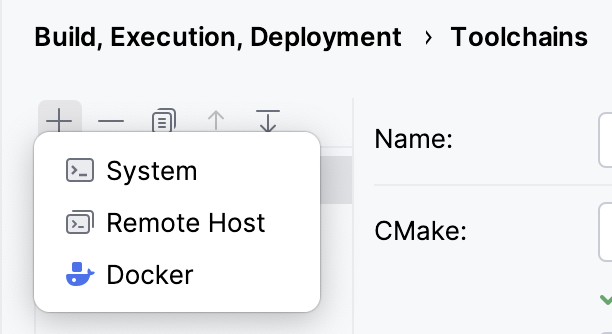
For a single command line tool, a lighter editor may already be comfortable. GoLand becomes more attractive when the repeated work involves several packages and regular investigation. That is a practical distinction, rather than a claim that every Go developer needs the same environment.
Inspections should explain a possible problem
GoLand’s inspection documentation describes analysis for issues including nil values and resource handling. I find this useful when a warning points to a specific path through the code. A good explanation can be more valuable than another red underline.
Consider a function returning a pointer and an error. The interesting question is how the caller handles both values. A local line can look reasonable while a later path assumes something stronger. Analysis is useful when it makes that relationship visible enough for the developer to judge.
The warning still needs judgment. Static analysis works from a model of the code and has a defined scope. A possible issue may need a test, a clearer contract, or a small redesign. Automatically suppressing every warning is not a review process, and automatically accepting every suggested fix is not one either.
I also want severity to be meaningful. A spelling preference should not compete with a likely nil dereference for attention. Shared inspection settings can help a team focus on the signals that matter. When everything looks urgent, people learn to ignore the whole panel.
Tests need a short path from the editor
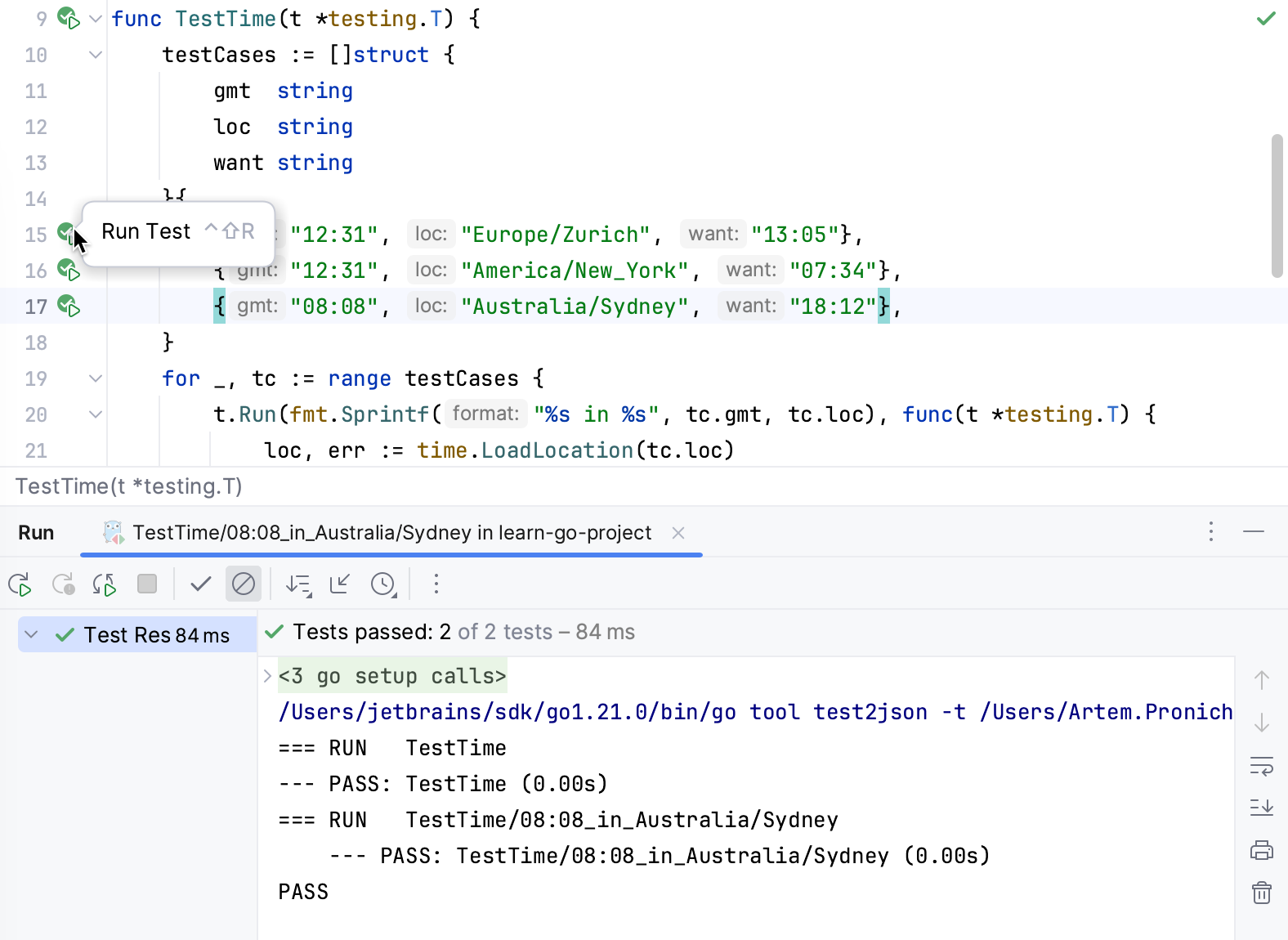
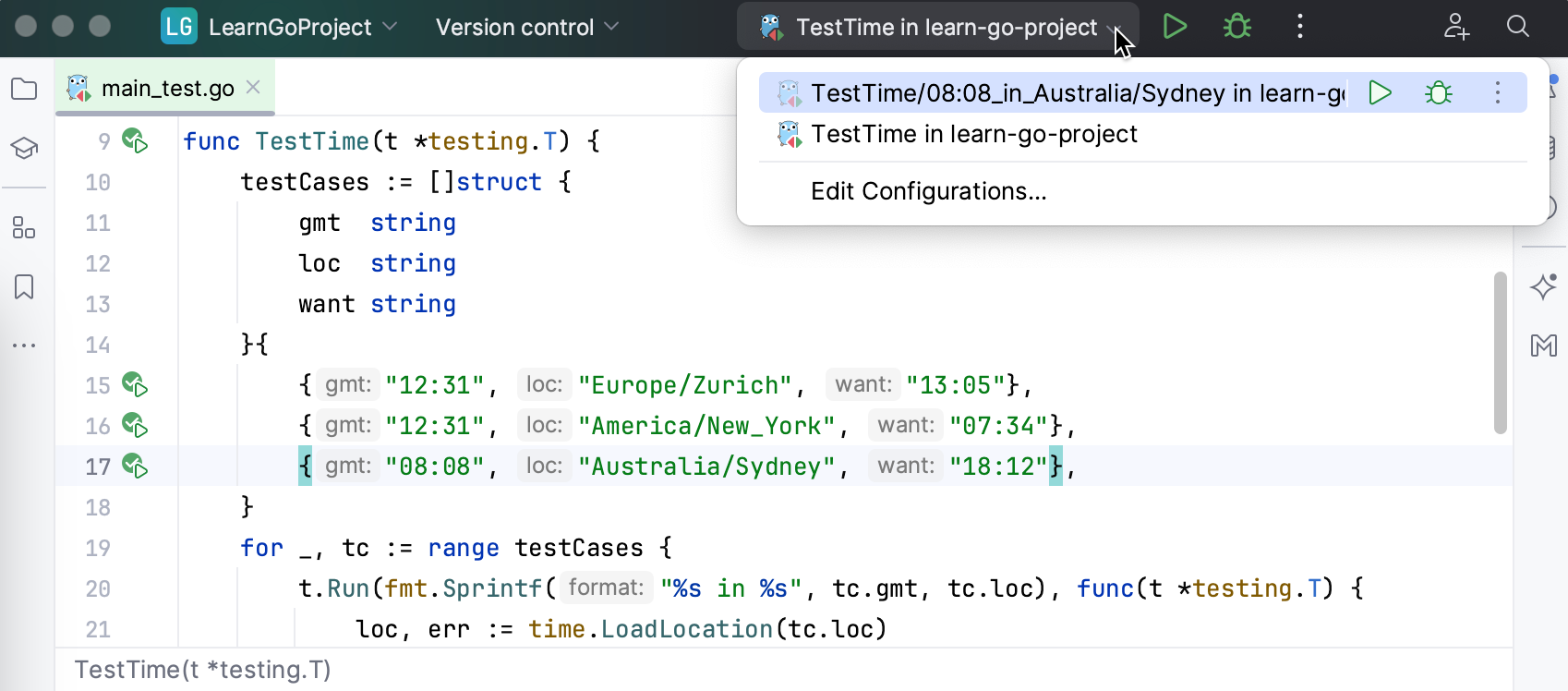
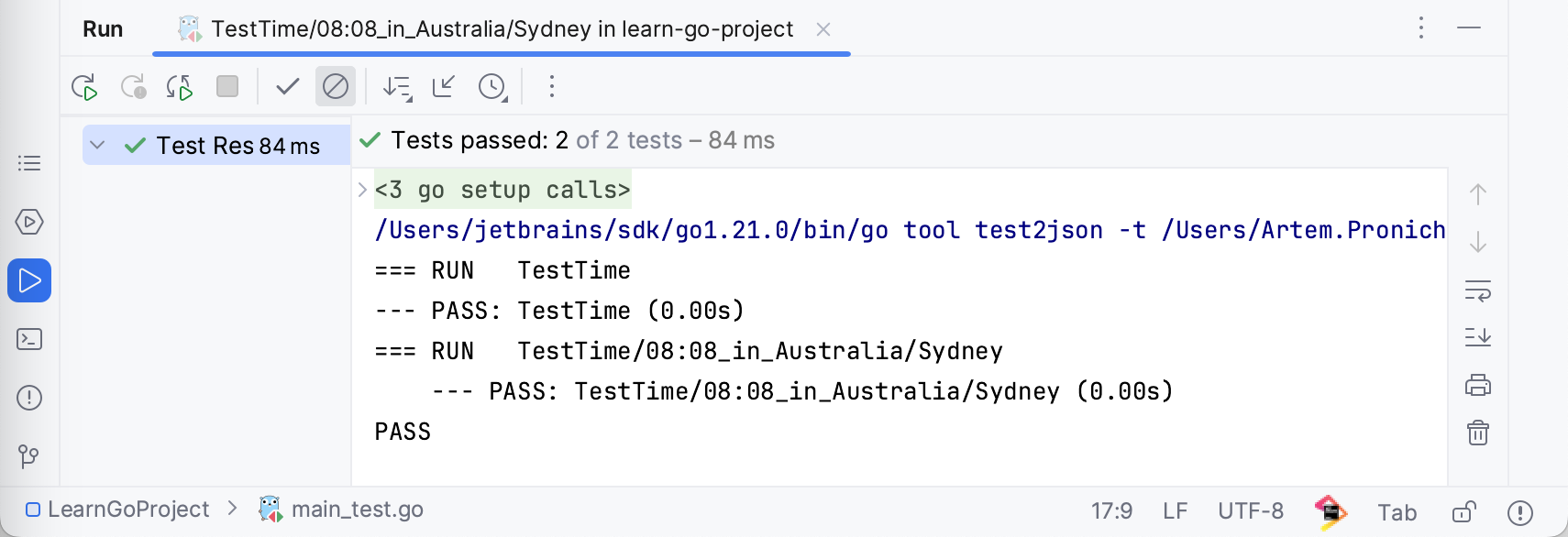
The GoLand test guide describes running individual cases, files, folders, and settings, along with test flags. That is the kind of integration I appreciate. A focused case should be easy to run while the relevant code is still in view.
A narrow test loop and a broad test run serve different purposes. The narrow loop helps understand the current failure. The broad run checks whether the change affected other code. A good environment should make both available without encouraging the developer to confuse them.
Table driven cases are a useful example of why the result view matters. Several inputs can exercise one rule, and the failed case should make its input clear. A red result without a helpful case name can send the reader back into a long list of data before the actual problem becomes visible.
The test’s content remains the important part. It should express behaviour that matters to the caller. A test that simply recreates the implementation may pass while leaving the underlying mistake intact. The IDE can make the evidence convenient to inspect, but it cannot make a weak assertion meaningful.
Concurrency needs more than a clean editor
Go’s concurrency tools are useful, but they also create questions that source reading alone may not settle. A goroutine can outlive the request that started it. A channel can block along a path that the main example never reaches. A shared value can be accessed in an order the developer did not expect.
I would judge an IDE by how well it helps organise that investigation, rather than expecting one inspection to prove correctness. The relevant tools may include tests, race detection where supported, logs, traces, and a debugger. Each answers a different question about the system.
Related reading
The test guide documents passing arguments for race detection and links to the Go toolchain’s requirements. That is a good place for the IDE to sit: a clear interface to established tooling. The developer still needs to know which setup ran and what the result can establish.
This matters when discussing a fix too. “The tests passed” is less informative than naming the relevant cases and the failure they protect. A short, exact explanation helps a reviewer decide whether the evidence matches the concurrency problem being addressed.
Refactoring should keep interfaces understandable
An interface can be small and still carry an important contract. Renaming a method or moving a type affects the code that describes and implements that contract. I like structured refactoring when it helps show that scope before the change spreads.
The practical aim is a patch that is easy to read. A naming improvement should not arrive mixed with unrelated formatting and a new error policy. Those changes may all be useful, but each asks a different review question. Keeping them separate makes the result clearer.
External callers are another boundary. The current project may not contain everyone using a public package. A careful developer must recognise that compatibility question even if the local references all update cleanly. Tooling can reveal more of the project without seeing every consumer in the world.
For me, this is one of the reasons a full environment can be worth paying for. It reduces bookkeeping around a careful change. The benefit is strongest when the person using it still has a clear idea of the design they want to preserve.
Keep the service’s workflow portable
Go tooling has a strong command line story. I would keep that as a shared foundation. The project should explain how to build, test, and run the service without requiring a particular editor. GoLand can make that workflow more comfortable while keeping its meaning visible.
Run settings should therefore carry useful choices rather than hidden knowledge. The working directory, environment variables, and arguments should be understandable. If a local setup is the only record of how a service starts, the team has a documentation problem that the IDE cannot solve alone.
This also helps when an agent contributes code. The agent needs the same project rules and meaningful checks as a human. A new patch should not quietly depend on a different local environment. The current GoLand page includes agent workflows, and I like that direction when it strengthens the connection between a planned change and the tools used to inspect it.
The standard stays practical: a focused difference, clear behaviour, and relevant evidence. The number of generated lines is a poor measure of progress. A small change that resolves the actual failure is much more valuable than a broad patch that creates another review project.
Why I like a dedicated place for Go
I enjoy Go’s directness, and I want the development environment to preserve it. The useful tools should explain a package relationship or a failure path without adding another layer of ceremony. GoLand appeals to me because the product can focus on the repeated work around a Go service rather than asking me to assemble that focus myself.
Related reading

My priority is keeping the problem readable. If an inspection points to a possible nil path, I want to understand the values and callers involved. If a test fails, I want the case to make its expectation clear. The best assistance leaves a sharper question, rather than simply more output.
That is why I enjoyed the product. The larger environment makes sense when it reduces the effort of moving between source, analysis, and evidence. I do not need to claim that Go itself is complicated to value that connection. A language can be with care small while the system built with it still deserves careful tools and a clear place to investigate its behaviour.
My verdict
I enjoyed GoLand, and I like its focus on the work around Go code: navigation, analysis, testing, and investigation. It is a convincing option for someone maintaining services or libraries where the relationships between packages matter every day.
It is less necessary for occasional Go edits in a small project that already has a comfortable lighter setup. The larger environment asks for learning and machine resources. Those costs should buy a visible improvement in the tasks repeated throughout the week.
My recommendation is to compare the current GoLand plans with one real project and a clear task in existing code. If the environment helps explain the affected code and keeps the feedback loop close, it has a strong case. I like the product because that is a more useful promise than simply helping me type Go faster.
Where to buy
See GoLand at the official product page. This is the product page for the model covered in this review. Check the model number, colour, included parts and delivery options before ordering. Prices and stock can change, so I use this page for the current offer. Matching the product to the review matters more to me than finding a similar name.
What worked
- I like the short route from a reference in the code to a relevant check or debugger view.
- A dedicated workspace keeps the relationships around a small language visible.
What bothered me
- A small Go project may already feel clear in an editor and terminal.
- The IDE cannot choose service boundaries or document hidden project decisions for the team.
Who should not buy it
- Someone expecting more tooling to replace a clear project structure.
Alternatives I would consider
- Your current Go editor and terminal. I would keep this arrangement when navigation, tests and debugging already feel direct; GoLand earns its place as the codebase becomes harder to follow.
Evidence and sources
The article separates my judgement from specifications and claims credited to their sources. Product images are identified by the credits in the article.
Features, compatibility and rated figures from the maker are manufacturer information. My opinions are identified in the review.
Conclusion
Worth it when the surrounding project work creates repeated friction, rather than simply because the language is Go.
GoLand
JetBrains · Choose the local store or delivery region
Check price and availability: GoLand at JetBrainsProduct link.
One email a week with practical Mac workflows, useful comparisons and honest tech recommendations.