The dimensions tell you most of what you need to know. Each Edifier R1280T cabinet is about 146 by 234 by 196 mm, which makes it a real bookshelf speaker rather than a small computer speaker. Put two of those on a normal desk and they take up the room your keyboard, your notes and your coffee used to share. Almost every good and bad thing owners say follows from that size.
Two of the reviews I use came from units Edifier supplied to the writers, and I say so where it counts. Owner comments are limited, so read them as examples and not as a survey.

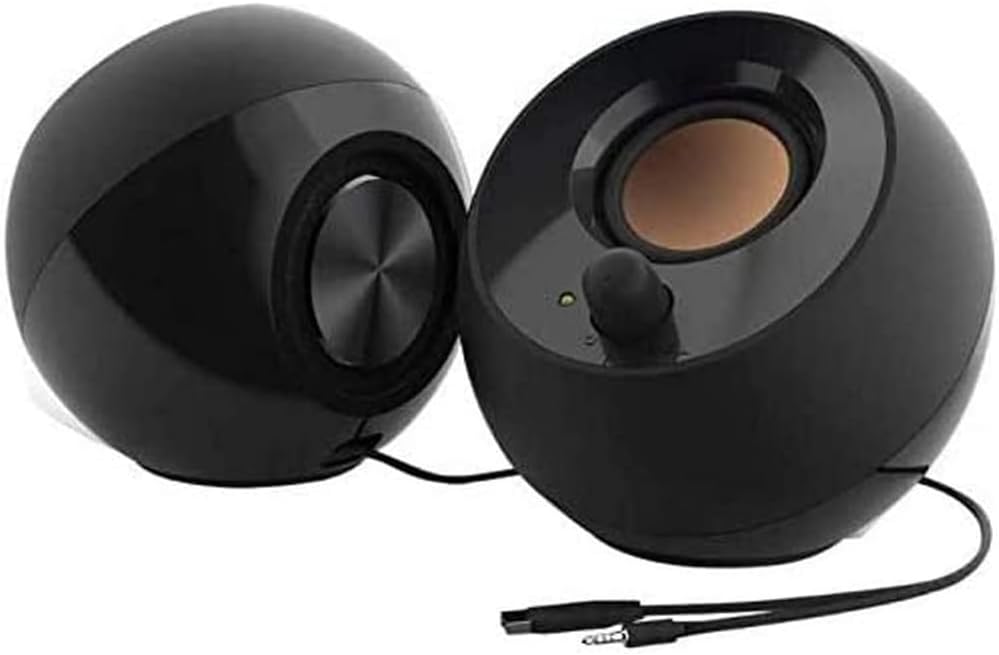
Product image from the Amazon listing.
One thing to clear up at the start: this is the plain R1280T, and it has no Bluetooth. The R1280DB is the Bluetooth sibling, and owner reports about it do not apply here.
Related reading
How It Connects to a Mac or Phone
Connection is simple, if old-fashioned. As SoundGuys explains, the only inputs are RCA, so a computer normally needs a 3.5 mm to RCA cable. PCWorld notes that such a cable comes in the box, and that a built-in amplifier means you plug into a computer and a wall outlet and you are done.
There are two pairs of RCA inputs on the back, with different sensitivity ratings, so you can leave two sources connected. There is no input switch to fuss with, and that comes with a catch. A commenter on Everyday Listening says you need to turn one source down to zero to hear the other. So a Mac and a turntable can share the speakers, as long as you remember to quiet one.
For a Mac with a headphone jack, you need only the included cable. A phone without a jack needs a USB-C or Lightning audio adapter, which turns these into a fairly clumsy phone speaker. No Bluetooth means no wireless convenience at all. If your plan is to stream from your phone most of the day, buy a different product.
The right speaker holds all the electronics. SoundGuys points out that the right side is always the powered one, and you can only change which side plays what by swapping the RCA cables. That matters on a desk where the outlet is on your left, since the speaker wire between the two has to reach. The left speaker connects through spring-loaded terminals using plain speaker wire.

Product image from the Amazon listing.
Placement Decides the Sound
PCWorld’s advice is the most useful sentence I found on these speakers: “For the best experience, you want them at ear level.” Below that height, it found the sound hollow and thin, and ended up raising them on books behind the monitor. Sitting flat on a desk with the tweeters aimed at your chest is probably the worst place for them, and it is where most people will put them.
Think about stands or a shelf before you buy. A stack of books works. So does a pair of cheap desk stands, if your desk is deep enough. In a shallow desk, these boxes will sit too close to you and crowd the monitor.
Two reviewers also took the grilles off. Pokde, which got its pair from Edifier Malaysia, says the grilles dampen the highs, and Everyday Listening also preferred the sound without them. That is a free change you can try on day one.
Related reading

The side dials help too. PCWorld found that the default tuning let bass overpower the mids and highs, and that adjusting the bass and treble knobs on the right speaker fixed it. Everyday Listening puts the range of each dial at about 6 dB. SoundGuys also ended up with slightly lower settings in its room. Expect to spend ten minutes setting these up.

Product image from the Amazon listing.
Quiet Listening Is Where They Make Sense
For a desk, the real test is sound at low volume, when you are working and someone is asleep in the next room. Direct evidence here is limited, but it points the right way. Everyday Listening, which used a loaner from Edifier, found the sound stayed consistent and crisp at lower volumes, and it links that to the design having no rear bass port. SoundGuys says the pair works best close up and at moderate levels.
Loud is a different matter. SoundGuys warns of “odd tweeter behavior” and distortion when you push them, and PCWorld agrees that they struggle with very loud playback. Neither of these will hurt you at a desk. They do rule the speakers out for parties or large rooms.
Do not expect deep bass either. Pokde lists a response of 75 Hz to 18 kHz, and says there is not much to show in the sub-bass. Everyday Listening describes the pair as lacking low bass, with a smooth, laid-back, midrange-focused sound. Voices do well, and PCWorld found the tone full and warm on video calls. If your work is podcasts, meetings and background music, that is a good fit. For film nights or electronic music, you may wish for a subwoofer.
The Small Annoyances
Noise is worth a thought, as cheap powered speakers often hiss. I found no measurement of it. One forum poster reported a very faint hiss audible only with an ear close to the speaker. Another owner mentioned Amazon reviews that talk about hiss or hum. That suggests a variable result between units or setups, rather than a defect in every pair.
Cables may play a part. On Kirstein, a German retailer, an owner in 2021 heard chirping noises with no signal playing, and the noise stopped after a change to a better cable. Everyday Listening found the supplied cables and jacks cheap, and got loud static when twisting the plug in the jack. So if you hear noise, swap the cable before you send the speakers back.
Another Kirstein owner had a different gripe. The volume went back to a medium level at each power-up, which annoyed him, because his speakers switched off with his PC through a master-slave socket. He also felt they took up too much desk space, and he sold them on at a loss even though he was happy with the sound and build. It is the most useful owner review here. Nothing was wrong with the product. It was simply the wrong size for his desk.
Everyday Listening suggests keeping the speaker volume low and the source volume high. If the speakers reset on every power-up, as this owner reports, check how that works with your routine. Then there is the remote. It handles only volume and mute, according to SoundGuys, and because it is infrared, you have to point it at the correct speaker. One Kirstein owner shrugged at it. You may too.
Related reading

Pokde’s other notes are cosmetic: a glossy remote that picks up fingerprints, side panels that do not sit flush, and a plastic shell prone to scratches. Fair complaints at any price, and minor at this one.
A Good Desk Speaker for a Big Desk
Take the owner reports and the reviews together, and the R1280T looks like an honest, plain product. SoundGuys scores it modestly overall and highest for value. Owners on Kirstein seem happy with the sound for the money.
I would buy these for a deep desk or a nearby shelf, wired to a Mac, for voices and quiet music through the working day. Skip them if your desk is shallow, if you want Bluetooth, if you need deep bass or if you like to play loud. If you want Bluetooth, look at the R1280DB and read its own reviews.
If you have the room, the Edifier R1280T Powered Speakers are a sensible step up from small computer speakers, provided you lift them to ear level. This is an affiliate link. As an Amazon Associate I earn from qualifying purchases.
One email a month: new articles, reviews and the upcoming live webinar + free recording. No spam, unsubscribe anytime.