I am the author of Kubernetes Without the Complexity: Pods, Services, Helm Charts, Operators & GitOps Workflows. I earn royalties from sales, and the labelled Amazon link can also earn an affiliate commission. This page is my own explanation of the book’s scope and intended fit, not an independent customer’s verdict.
Quick verdict
I recommend considering it for a clearer working model of the Kubernetes subjects in its published scope.
Best for: A developer or engineer with a small workload and a suitable non-critical learning environment.
Main benefit: The stated scope connects pods, services, Helm, operators and GitOps to the work around an application.
Biggest drawback: Clearer explanations do not remove operating complexity, recovery responsibilities or version-specific requirements.
Kubernetes Without the Complexity
Amazon US · US
Check price and availability: Kubernetes Without the Complexity at Amazon USAffiliate link. As an Amazon Associate I earn from qualifying purchases.
Reviewed version: Kubernetes Without the Complexity: Pods, Services, Helm Charts, Operators & GitOps Workflows
Compatibility: Check the current offer, format, sample and edition at ASIN B0GWTX1BK3. The catalogue has carried a planned release date; this overview does not promise present availability.
Review context: The recommendation uses the published author description and scope. It does not claim an independently verified reading result or invent chapter contents.
The title expresses the kind of learning experience I want to support: a clearer way to approach a subject that can become unnecessarily difficult to explain. It is not a claim that operating distributed systems has no complexity. I would rather help the reader recognise the important responsibilities than hide them behind a convenient command or a polished diagram.
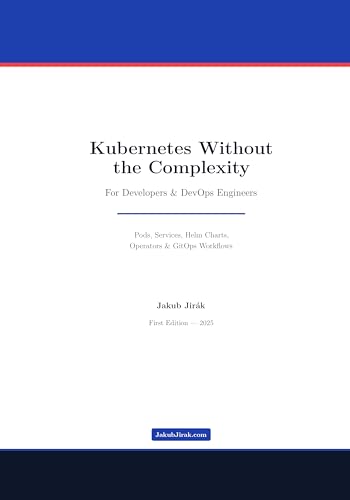
Kubernetes Without the Complexity — actual author-owned cover Author catalogue source.
The reader I have in mind
The published scope names pods, services, Helm charts, operators and GitOps workflows. I would recommend considering it to a developer or engineer who wants those subjects connected to a working application. The useful starting point is an understandable workload and a reason to investigate this way of running it.
I would choose a small non-critical environment for learning. That gives the reader room to inspect state, make changes and understand a failure without turning every experiment into an urgent operational event. The aim is to build a model that can later support better decisions, not merely complete a sequence of commands.
I would not buy because Kubernetes appears to be a compulsory destination for every application. A simpler hosting arrangement may fit the task better. The useful question is what capabilities the workload and organisation need, together with what they can operate responsibly.
Keep the application visible
My preferred first question is what the application needs in order to work. Its inputs, network relationships, configuration and persistent information matter before choosing deployment objects. A successful infrastructure command does not establish that the application serves its intended user correctly.
I would write down one complete request or job from beginning to result. Which components need to communicate? Where is information stored? What should happen if a component restarts? Those questions give the technical concepts a real setting instead of turning them into vocabulary to memorise independently.
I would also keep a familiar working version of the application where practical. That provides a useful comparison when something behaves differently in the new environment. The investigation can then ask whether the cause belongs to the application, packaging, configuration or operating arrangement.
Pods need context around them
Pods appear in the title because they are part of the subject’s core vocabulary. I would read about them while tracing the actual workload’s lifecycle. The useful result is knowing what should run, how it is configured and what evidence shows its current state.
I would distinguish starting a process from making the application ready for useful work. An operator needs observations that relate to the service’s real requirements, not just a reassuring status word. That distinction is helpful when the application depends on another component or needs time before accepting its normal traffic.
I would also investigate a restart in the learning environment. What changes, what remains and what information is available afterwards? A small controlled example can reveal an assumption that a successful initial deployment never exercised. The goal is understanding the lifecycle, not producing a dramatic failure demonstration.
Services should make the path understandable
Services are another explicit part of the published scope. I would connect that topic with the route between a caller and the intended workload. A clear model of the path helps the reader investigate a connection problem without changing unrelated settings at random.
Title and description presentation from my author catalogue; this is not an interior page. Author catalogue source.
I would begin with one caller and one destination, then confirm the relevant names, ports and expected result. If the request fails, the investigation should narrow the path step by step. The useful skill is being able to explain where the request stopped and what observation supports that conclusion.
I would keep external access as a separate deliberate decision. A component being reachable inside an environment does not mean it should be exposed more widely. The application’s intended users and operating boundaries should lead that design, with current official documentation establishing the exact configuration required.
Packaging should stay reviewable
Helm charts appear among the stated topics. I would approach packaging through the variations the application actually needs. A reusable package can help manage those variations, while an unnecessarily elaborate configuration can make a simple change harder to understand.
I would choose names and defaults that make the resulting deployment clear to another engineer. A value should have an understandable effect, and the generated configuration should remain something the team can inspect. The convenience of a package is strongest when it preserves that visibility.
I would also separate a package’s ability to install from the application’s ability to operate correctly. The team still needs to check the intended behaviour and understand how a later update affects existing state. A successful installation is an important milestone, but it is not the whole maintenance plan.
Operators need a repeated job
Operators are part of the public scope, and I would consider them when a repeated operating responsibility has a clear desired state. The useful question is which task needs that kind of automation and what observation tells the controller whether more work is required.
I would first understand the manual operation well enough to describe it. What inputs matter? Which changes are safe? What should happen after an interrupted action? Automating an unclear procedure can make the failure harder to explain, even if the initial successful case becomes faster.
I would keep the scope of the first implementation narrow. A controller should have a purpose that another person can understand without reading every internal detail. The point is to create a maintained operating behaviour, not add another custom component simply because the platform makes it possible.
GitOps needs a clear source of intent
GitOps workflows are also in the published description. I like considering the connection between a reviewable declared change and the resulting environment. The useful arrangement should make it easier to understand what was requested and what the system has actually reached.
I would plan how a normal change is proposed, checked and observed after it takes effect. The process should make a failed or incomplete update visible. A merged file and a healthy application are different milestones, and both need an appropriate way to be confirmed.
I would also consider urgent recovery and access boundaries before relying on the workflow. A team needs to know how it responds when the normal route cannot finish. The intention is a more dependable operating practice, not a rule that hides the actual state because the desired configuration looks correct.
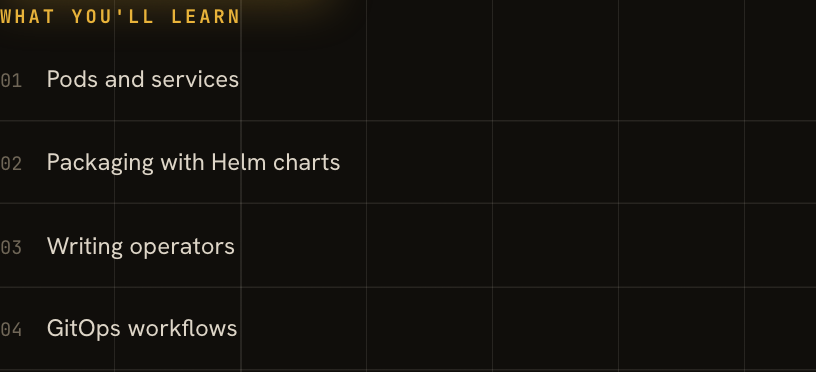
Published scope from my author catalogue; this is not an interior page. Author catalogue source.
Data and recovery deserve early attention
I would keep persistent data separate from an assumption that every component can simply be replaced. The application needs a clear understanding of which information must survive and how it can be restored. That responsibility does not disappear because the runtime can recreate a process.
For a learning project, I would choose a modest recovery exercise and keep the expected result explicit. A backup job reporting success is not the same as the application recovering useful information. The complete path should be checked under conditions the team understands.
I would also document the parts another person needs to operate. The environment is easier to maintain when ownership, access and normal recovery steps are clear. A technically sophisticated setup can still be fragile if only one person remembers how its pieces fit together.
How I would use the book
I would begin with a small workload and a short list of useful questions. Can I explain its configuration? Can I trace a request? Can I observe an update and understand a failure? Those questions create a practical path through the stated subjects without requiring a large production migration as the first exercise.
I would keep current official documentation beside the reading. Exact commands, available APIs and version requirements evolve. The public catalogue establishes this book’s broad subject, not every present-day implementation detail. I would inspect the sample and selected edition when a specific feature determines the purchase.
The catalogue has carried a planned release date, so this page does not promise present stock or a particular delivery date. I would check the actual Amazon offer and format before buying. A known product identifier is useful, while the store remains the place to establish the current purchase conditions.
The companion I would choose
Platform Engineering from Scratch is a more direct choice when the main question is the developer experience and supported paths around shared infrastructure. I would choose the Kubernetes book when understanding the platform’s application concepts and workflows is the immediate need. They can be complementary without being the same reading task.
My author recommendation
I recommend considering Kubernetes Without the Complexity when you want a clearer working model of the subjects in its published scope. I like connecting the vocabulary with a real application and observable outcomes. I would buy with a small learning environment ready, keep operating and recovery responsibilities visible and choose simpler hosting when it already meets the application’s needs.
What worked
The stated scope connects pods, services, Helm, operators and GitOps to the work around an application.
What bothered me
Clearer explanations do not remove operating complexity, recovery responsibilities or version-specific requirements.
Who should not buy it
I would not buy on the assumption that every application needs Kubernetes or that a deployment command proves the application works.
Alternatives I would consider
Platform Engineering from Scratch. I would choose it when the main problem is the developer journey around shared infrastructure. Read my Platform Engineering from Scratch author overview.
Current official Kubernetes documentation. I would use it for exact APIs, commands and supported version behaviour.
Evidence and sources
The stated scope comes from my published author catalogue. The images show the actual cover and author-catalogue presentation, not interior pages or independent customer evidence.
This is the author's account of the book's scope and intended reader. Check the selected Amazon edition for its current format, sample and availability.
Conclusion
Worth considering with a concrete learning task; simpler hosting can remain the better production choice.
Kubernetes Without the Complexity
Amazon US · US
Check price and availability: Kubernetes Without the Complexity at Amazon USAffiliate link. As an Amazon Associate I earn from qualifying purchases.