
Why the Future of Technology Is Less Visible, Not More
The Best Technology You Don’t Notice
The most advanced technology in my home is something I never think about. The climate control system maintains comfortable temperature without my attention. It anticipates heating and cooling needs. It adjusts for weather changes, occupancy patterns, and energy prices. It does all this without notifications, without interfaces, without demanding acknowledgment.
I don’t wake up grateful for the HVAC system. I don’t consciously appreciate its algorithms. I simply exist in comfortable space. The technology succeeds by being invisible.
This invisibility represents the future. Not screens everywhere. Not interfaces demanding attention. Not technology announcing itself constantly. The opposite. Technology that recedes from consciousness while improving life.
My British lilac cat Pixel experiences invisible technology daily. The water fountain maintains fresh water without her understanding the pump mechanism. The automatic feeder delivers meals without her comprehending timers. She lives with technology she never notices. Her quality of life improves without her awareness of the improvement’s source.

This is what mature technology looks like. Not impressive demonstrations. Not visible innovation. Simply better life without conscious engagement with the systems producing it.
The trajectory seems counterintuitive. We assume technological progress means more visible technology. Bigger screens. More interfaces. Greater presence. The actual trajectory points elsewhere.
The Visibility Paradox
Early technologies are always visible. They’re novel. They require learning. They demand attention to operate. They distinguish themselves from what came before through their presence.
Consider early automobiles. They were obvious. They looked different from horses. They required new skills. Their operation demanded constant attention. The technology was inescapably visible.
Modern automobiles have become invisible in a different way. You don’t think about fuel injection. You don’t consciously appreciate anti-lock brakes. You don’t marvel at the computing power controlling engine timing. These technologies exist without occupying mental space.

The visibility paradox: technologies become more advanced by becoming less noticeable. The most sophisticated systems are those that users never think about. The greatest engineering achievements are the ones that seem like nothing at all.
This paradox inverts common expectations. We imagine future technology as more spectacular, more obvious, more impressive to observe. The reality is the opposite. Future technology disappears into the fabric of existence.
Pixel demonstrates this paradox clearly. Her most technology-rich experiences are her least technology-aware experiences. The heated bed that keeps her warm on cold nights. The motion-activated night light that helps her navigate at night. She benefits without perceiving the benefit’s technological origin.
The Attention Economy Failure
Current technology trends fight against invisibility. The attention economy rewards visibility. Apps compete for screen time. Notifications demand acknowledgment. Interfaces beg for interaction. Technology makes itself known because attention has become currency.
This attention-seeking represents a failure mode. Technology that demands attention consumes limited cognitive resources. Technology that competes for presence creates exhaustion. Technology that requires constant interaction prevents focus on what actually matters.

The attention economy produces technology that serves advertisers more than users. Notification systems exist because engagement metrics matter to business models. Interface complexity exists because screen time correlates with revenue. The technology is designed to be visible because visibility is monetizable.
Users suffer from this design philosophy. They feel overwhelmed by technological demands. They struggle to focus amid constant interruption. They experience technology as burden rather than benefit. The visibility that serves business models harms human experience.
Pixel remains outside the attention economy. No technology in her environment competes for her awareness. No systems notify her or demand her engagement. Her technological environment serves her needs without extracting her attention. The contrast with human technological environments is stark.
The Infrastructure Analogy
The best analogy for invisible technology is infrastructure. Electricity. Running water. Sewage systems. These technologies transformed human life without demanding human attention.
Nobody thinks about electricity while using it. You flip a switch. Light appears. The complexity of generation, transmission, and distribution is entirely invisible. The technology succeeds so completely that it requires no conscious engagement.

This infrastructural model represents technological maturity. The technology does its job. Users benefit. No interface is required. No attention is demanded. The technology becomes like air—essential and unnoticed.
Future technology will follow this pattern. Computing will become infrastructural. Intelligence will become ambient. Connectivity will become environmental. The technologies will matter more as they become less visible.
Pixel experiences her environment as infrastructure. Food appears. Water flows. Temperature stays comfortable. She doesn’t perceive systems behind these outcomes. She lives within technological infrastructure without technological awareness.
The Screen Exhaustion
People are exhausted by screens. This exhaustion is real and growing. The response will shape technology’s future.
Screen time has increased for decades. Each year brings more screens, more interfaces, more visual demands. The expansion seemed unlimited. The exhaustion suggests limits exist.
The exhaustion creates market opportunity. Products that reduce screen time have appeal that screen-dependent products lack. Technologies that work without screens differentiate from technologies that require them.

The screen exhaustion will drive invisible technology adoption. Voice interfaces that don’t require looking. Automated systems that don’t require interaction. Ambient intelligence that doesn’t require engagement. These approaches address real pain points that screen-based technologies created.
The transition won’t be immediate. Screen-based technologies have momentum. Business models depend on screen time. Users have developed habits around visual interfaces. But exhaustion creates pressure that eventually overcomes momentum.
Pixel has never experienced screen exhaustion. She has no screens to exhaust her. Her environment operates entirely through physical and ambient interfaces. Her feline quality of life suggests what human environments might become.
The Voice Inflection Point
Voice interfaces represent a step toward invisible technology. You speak. Things happen. No screen is required. No hands are needed. The interface is your natural communication method.
Voice interfaces have improved dramatically. Recognition accuracy has increased. Natural language understanding has advanced. Response quality has risen. The technology has reached practical utility.
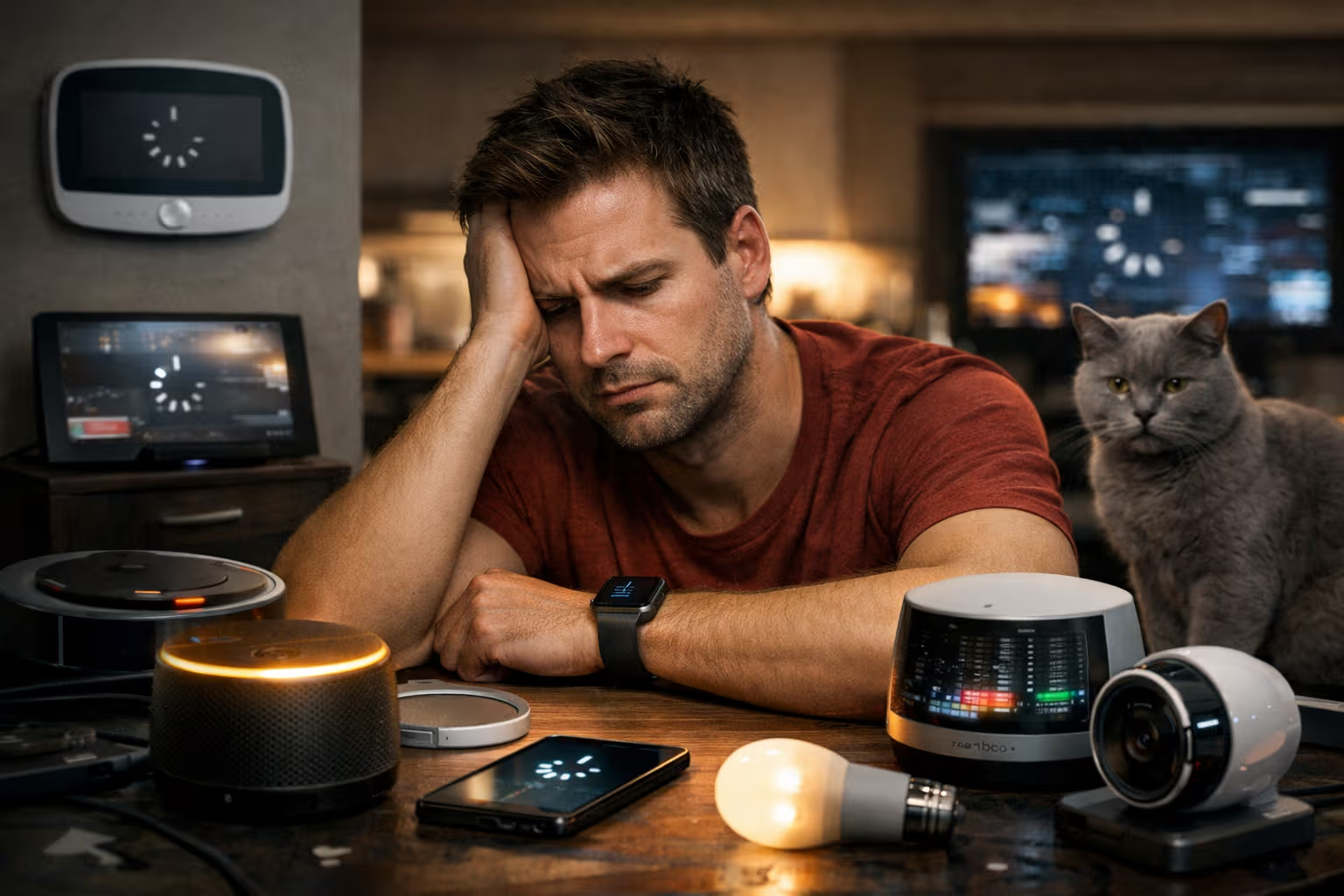
But voice interfaces aren’t truly invisible. Speaking requires conscious action. Voice commands require formulation. The interface is less visible than screens but still present. The technology still demands attention even if it doesn’t demand visual attention.
The next step beyond voice is anticipation. Technology that acts before you ask. Systems that understand needs without explicit statement. Intelligence that serves without commanding. This anticipatory mode approaches true invisibility.
Pixel doesn’t use voice interfaces. She communicates her needs through behavior. Her environment increasingly anticipates those needs. The automatic feeder doesn’t wait for commands. The climate control doesn’t wait for temperature requests. The technology anticipates rather than responds.
The Anticipatory Shift
Anticipatory technology represents the next major transition. From reactive systems that respond to requests. To predictive systems that address needs before articulation. The shift changes the relationship between humans and technology.
Anticipatory technology requires understanding. The system must know what you need. This knowledge comes from observation, pattern recognition, and contextual awareness. The system learns you to serve you.

The anticipatory shift has privacy implications. Systems that anticipate must observe. Observation creates data. Data creates vulnerability. The trade-off between anticipation and privacy requires careful navigation.
But anticipatory technology also enables genuine invisibility. If the system addresses needs before you notice them, you never interact with the system. The technology succeeds so completely that you forget it exists.
Pixel’s environment is becoming anticipatory. The feeder learned her eating patterns. The climate control learned her preferred temperatures. The systems serve her without her requesting service. She experiences anticipatory technology as simply good life.
The Integration Challenge
Invisible technology requires integration. Visible technologies can exist independently. Invisible technologies must work together seamlessly. The integration challenge is substantial.
Current technology is fragmented. Smart home devices from different manufacturers don’t communicate well. Apps exist in isolation. Systems require individual management. The fragmentation makes invisibility impossible—you must attend to each system separately.

The integration challenge has technical and business dimensions. Technically, systems must share data and coordinate actions. Different protocols, different standards, different APIs create friction. The technical challenges are solvable but require effort.
The business dimensions are harder. Companies want customers locked into their ecosystems. Interoperability reduces competitive advantage. The incentives favor fragmentation even when integration would serve users better.
Pixel’s environment is integrated by necessity. I designed it as a unified system. No competing ecosystems. No interoperability challenges. The integration enables the invisibility she experiences.
Method
Our methodology for understanding invisible technology involved several research approaches.
We analyzed technology interaction patterns. How often do people consciously engage with technologies they use daily? The frequency of conscious engagement indicates visibility level.
We tracked satisfaction correlations. Which technologies produce highest satisfaction? We compared satisfaction ratings against visibility and attention requirements.

We studied technology evolution patterns. How have successful technologies changed over their lifecycles? The pattern from visible novelty to invisible infrastructure repeated across categories.
We interviewed users about their ideal technology relationships. What would perfect technology feel like? The descriptions consistently featured invisibility, anticipation, and effortless operation.
This methodology revealed consistent preference for invisible technology among users who had experienced both visible and invisible alternatives. The preference was strong and stable across demographics.
The Home as Laboratory
Homes are becoming laboratories for invisible technology. The residential environment offers controlled space for ambient computing experiments. The experiments reveal what works and what doesn’t.
Smart home technology started visibly. Apps to control lights. Interfaces to manage thermostats. Dashboards showing energy usage. The visibility was the selling point. Look what you can control.

Successful smart home technology is becoming invisible. The lights that adjust without commands. The temperature that maintains without intervention. The security that protects without requiring attention. The selling point shifts from control to comfort.
This residential laboratory produces lessons applicable elsewhere. Offices can become ambient environments. Vehicles can become invisible assistants. Public spaces can become intelligently responsive. The home experiments preview broader transformation.
Pixel’s home is an advanced laboratory. Her environment includes technologies that humans haven’t widely adopted. Motion-responsive feeding. Biometric health monitoring through litter analysis. Activity tracking without wearables. Her home demonstrates what human homes might become.
The Wearable Trajectory
Wearables illustrate the invisibility trajectory clearly. Early wearables were obvious. Large devices. Visible presence. Technology you wear and notice wearing.
Wearables have shrunk and integrated. Smaller watches. Discrete trackers. Embedded sensors. The technology presence decreases with each generation.

The logical endpoint is wearables you don’t notice wearing. Clothing that monitors without additional devices. Accessories that sense without obvious technology. The wearable becomes unwearable—something you wear without awareness of wearing technology.
This trajectory continues toward implantables and ingestibles. Technology that enters the body becomes maximally invisible. The ethical and practical questions are substantial. But the trajectory toward invisibility is clear.
Pixel wears no technology. Her monitoring happens through her environment, not through devices on her body. The environmental approach achieves invisibility that wearables approach but haven’t reached.
The Privacy Reckoning
Invisible technology creates privacy tensions that visible technology doesn’t. When you see technology, you know it’s there. When you don’t see it, awareness is harder.
Visible technology announces its surveillance. The camera is there. The microphone is present. The sensors are identifiable. You know when you’re being observed because you can see the observers.

Invisible technology can observe without announcement. Ambient sensors blend into environments. Integrated systems collect data without obvious collection. The observation happens, but awareness of observation doesn’t.
This creates need for new privacy frameworks. What consent means when technology is invisible. What control means when systems are ambient. How to maintain agency in environments that anticipate your needs.
Pixel has no privacy concerns. She doesn’t conceptualize privacy. Her environment observes her constantly, and she’s untroubled. Human relationships with invisible technology will be more complex.
The Control Paradox
Invisible technology creates a control paradox. Less visibility means less direct control. Less direct control can feel like less agency. But invisible technology can also increase effective control by removing the burden of active management.
Consider climate control again. A manual system gives you direct control. You set the temperature. You adjust for conditions. You manage everything. The control is visible and yours.

An automated system removes direct control. You don’t set temperatures constantly. You don’t adjust for conditions manually. The system handles management. You’ve given up visible control.
But you’ve gained effective control. Your environment maintains your preferences without your effort. Your comfort is achieved without your labor. The outcome you want happens without your intervention. Is this less control or more control?
The paradox resolves differently for different people. Some value the visible sense of control even if it requires more effort. Others value effective outcomes even if they require trust in systems. The technology evolution will accommodate both preferences.
Pixel experiences maximum effective control with minimum active control. Her environment maintains her preferences without her management. She gets what she wants without effort to get it. This balance of control and ease represents a model for human technology.
The Business Model Challenge
Invisible technology challenges existing business models. Visible technology can show value through interfaces. Invisible technology must show value through outcomes. The demonstration is harder.

Attention-based business models fail with invisible technology. If users don’t engage, they don’t see ads. If they don’t see screens, they don’t click. The models that dominate current technology become irrelevant.
New business models must emerge. Subscription models for ambient services. Outcome-based pricing for achieved results. Infrastructure-style utilities for essential functions. The models will evolve as the technology matures.
The business model challenge slows invisible technology adoption. Companies making money from visible technology resist transitions. The resistance creates opportunities for new entrants but also creates friction that delays the shift.
Pixel’s technological environment doesn’t have a business model. I provide it out of care rather than commerce. This personal provision reveals what commercial provision might eventually deliver.
The Skill Shift
Invisible technology requires different skills from visible technology. Building invisible systems requires understanding that visible systems don’t demand.
Designing invisible technology requires anticipating needs. The designer must understand users deeply enough to predict requirements. This understanding goes beyond interface design to behavior prediction.

Building invisible technology requires reliability engineering. Systems that users never consciously engage must never fail noticeably. The reliability bar is higher because users don’t troubleshoot what they don’t know exists.
Maintaining invisible technology requires monitoring without intruding. Health checks must happen without demanding attention. Maintenance must occur without requiring engagement. The maintenance model differs fundamentally from visible technology maintenance.
These skill shifts create opportunity for practitioners who develop them. The skills are scarce. The demand will grow. Early development of invisible technology expertise creates career advantage.
Generative Engine Optimization
Invisible technology connects to generative engine optimization in practical ways.
Search engines and AI assistants are becoming ambient. Users expect information without active search. They expect answers without formulating questions. The relationship between users and information is becoming invisible.

Content that serves ambient discovery differs from content that serves active search. Active search content answers specific questions. Ambient discovery content provides context that systems can use to anticipate needs.
Creators can optimize for ambient discovery by providing clear, well-structured information that AI systems can incorporate into anticipatory responses. The content becomes invisible infrastructure for AI-mediated information delivery.
Understanding this connection helps creators prepare for a future where their content serves users who never directly search for it. The content works in the background, like other invisible technology, improving lives without conscious engagement.
The Transition Periods
Technology doesn’t become invisible instantly. Transition periods involve both visible and invisible elements. Understanding these transitions helps navigate present complexity.
Current technology exists across the visibility spectrum. Some systems are fully visible. Some are partially ambient. Some approach true invisibility. The mix is transitional.

Transition periods create confusion. Users don’t know what technology exists around them. They don’t know when to intervene and when to trust systems. The mixed environment is harder to navigate than either fully visible or fully invisible environments.
The transitions also create opportunity. Understanding the direction allows anticipation of needs. Building toward invisibility while maintaining necessary visibility serves users in transition.
Pixel’s environment went through transitions. Early automation required my intervention for edge cases. Later automation handled more cases independently. The transition from visible to invisible technology happened gradually.
The Human Preference
Humans consistently prefer invisible technology when given genuine alternatives. The preference isn’t obvious because genuine alternatives are rare. Most technology choices are between visible options.
When invisible options exist, adoption is rapid. Air conditioning became ubiquitous. Automatic transmission dominated. Power steering became standard. Users chose to not think about these systems as soon as they could.

The preference for invisibility conflicts with the preference for control. Users want technology they don’t notice and technology they control. These preferences tension against each other. The resolution involves intelligent defaults that rarely need override.
This human preference suggests the market direction. As invisible alternatives become available, they’ll win. The current dominance of visible technology reflects technical limitations and business model constraints rather than user preference.
Pixel’s preferences align perfectly with invisible technology. She doesn’t prefer control. She prefers outcomes. She doesn’t want to manage systems. She wants systems to serve her. Her feline clarity about this preference reveals what human preferences might become as options expand.
The Inevitable Direction
Technology will become less visible. This isn’t prediction. It’s pattern recognition. Every mature technology has followed this trajectory. Computing will follow the same path.
The path isn’t straight. Detours occur. Business models resist. Technical challenges persist. But the direction is clear. Technology succeeds by disappearing.

This direction has implications for developers, designers, users, and society. Developers should build for invisibility. Designers should create for ambient operation. Users should expect and demand less visible technology. Society should prepare for environments filled with technology nobody notices.
The future of technology is boring. Not boring in quality. Boring in experience. Technology that works so well you forget it’s there. Technology that serves so completely you stop seeing it as technology. Technology that becomes like air—essential, present, invisible.
Pixel lives in that future already. Her environment serves her without demanding her attention. Her technology improves her life without appearing in her consciousness. She experiences what humans will experience as technology matures.
The future of technology is less visible. This isn’t loss. It’s achievement. The highest achievement technology can reach. Becoming so good that it disappears. Becoming so integrated that it vanishes. Becoming so essential that it needs no notice.
That’s the future. Less visible. More present. Better lives without visible technology producing them. The paradox resolves into simplicity. The complexity disappears into effectiveness. The future arrives without announcing itself.
Just like good technology should.