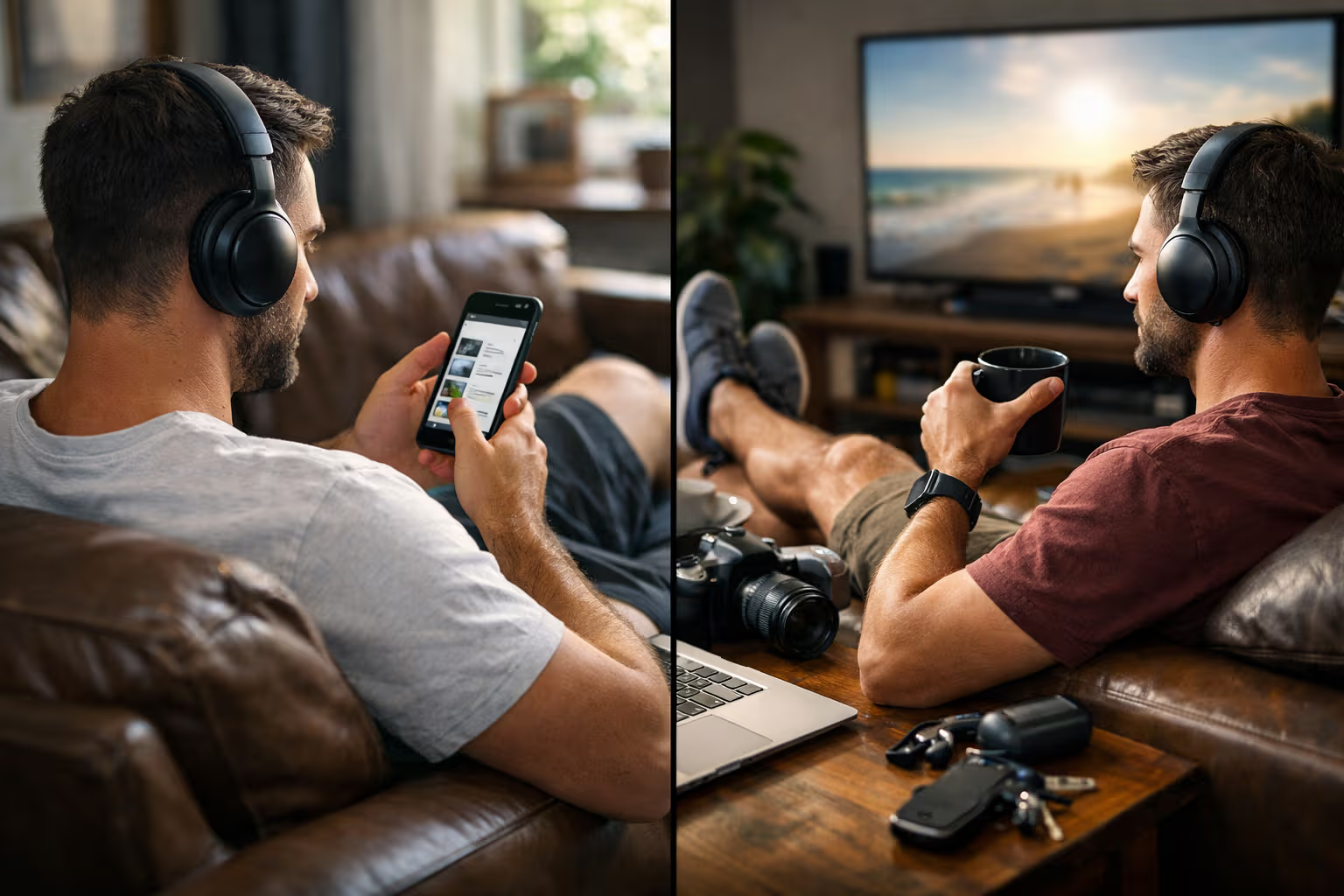
The Difference Between Testing a Product and Living With It
The Two-Week Lie
Every product puts on its best performance during the first two weeks. The laptop runs fast because nothing has accumulated yet. The phone battery lasts all day because you haven’t installed your usual apps. The software feels intuitive because you’re still in the learning phase where everything is discovery. You’re dating the product, and it’s showing you its representative self.
This honeymoon period is precisely when most reviews get written. Publications receive products, use them for days or weeks, then publish assessments based on this unrepresentative slice of ownership. The review captures first impressions dressed up as comprehensive evaluation.
My British lilac cat, Pixel, would never make this mistake. When a new piece of furniture arrives, she ignores it for approximately two weeks. Only after the novelty fades and the object becomes part of the environment does she investigate. Her delayed evaluation is more honest than most product reviews. She’s testing whether the furniture belongs in her life, not whether it photographs well.

The gap between testing and living defines the difference between useful reviews and marketing echoes. Testing asks “What can this product do?” Living asks “What will this product do to my daily existence?” The first question is answerable in hours. The second requires months.
This article examines what only emerges through extended product ownership—the insights that short-term testing cannot provide and that most reviews consequently miss. Understanding this gap helps you read reviews more critically and make purchases you won’t regret.
What Testing Reveals
Let’s be fair to short-term testing. It does reveal useful information. The question is what kind of information, and what remains hidden.
Testing reveals first-order characteristics: how fast, how bright, how loud, how heavy. These measurements require minutes, not months. A benchmark runs in seconds. A display’s peak brightness is measurable immediately. Physical specifications don’t change with ownership duration.

Testing reveals intentional user experience: the flows and features that designers optimised for. Products are engineered to make good first impressions. The onboarding process, the initial setup, the showcase features—these receive disproportionate design attention because manufacturers know they determine reviews.
Testing reveals comparative positioning: how a product stacks up against alternatives in controlled conditions. Side-by-side testing is efficient. You can compare cameras, displays, or processors in hours. The comparisons are valid as far as they go.
Testing reveals deal-breaker issues: fundamental problems so severe that extended use is unnecessary for evaluation. If a laptop’s keyboard layout is unusable, you don’t need two months to discover this. If software crashes constantly, a week suffices for documentation.
These revelations are valuable. A good short-term review communicates them accurately. The problem is when reviews imply that these revelations are comprehensive—that testing has revealed everything important about the ownership experience.
What Only Living Reveals
The insights that require extended ownership fall into categories that short-term testing structurally cannot address.

Living reveals degradation patterns. Batteries lose capacity. Moving parts wear. Software accumulates cruft. Finishes scratch, fade, or peel. These changes happen over months and years, invisible to two-week testing windows. The reviewer who praised the all-day battery life didn’t know it would become half-day battery life within eighteen months.
Living reveals workflow integration. How a product fits into daily routines takes time to discover. The camera that tested well might sit unused because carrying it feels burdensome. The software that seemed powerful might be abandoned because its complexity doesn’t justify its benefits. These integration failures don’t appear in feature comparisons.
Living reveals edge cases. Normal testing explores normal use. But real ownership involves abnormal situations: the time you needed the product in challenging conditions, the urgent deadline when software stability mattered, the trip where reliability was critical. Products reveal their true character at the edges, not the centre.
Living reveals opportunity costs. Every product choice excludes alternatives. The ecosystem you buy into shapes future purchases. The workflow you adopt becomes harder to leave. These costs compound over time in ways that initial evaluation can’t capture.
Living reveals satisfaction trajectories. Some products delight initially and disappoint eventually. Others frustrate at first and reward persistence. The satisfaction curve matters, but you can’t plot it without the data points that only time provides.
Pixel demonstrates living-based evaluation constantly. Her opinion of a window perch evolved over six months—initial indifference, gradual interest, eventual obsession, and now complete dependence. A two-week review would have missed everything after the indifference phase.
Method: How We Evaluated the Testing-Living Gap
To understand what distinguishes testing from living, I conducted a retrospective analysis of my own product experiences alongside interviews with long-term owners across multiple product categories.

Step one involved identifying products I had owned for at least two years where my current assessment differs significantly from my initial impression. These cases illustrate the testing-living gap through concrete examples.
Step two required categorising the types of insights that emerged only through extended ownership. Patterns became visible across different product categories.
Step three compared published reviews of these products against my long-term experience. Where did the reviews accurately predict my experience? Where did they miss?
Step four involved interviewing owners in online communities focused on specific products—photography forums, development communities, audio enthusiast groups. Long-term owners often document issues that never appear in professional reviews.
Step five analysed what conditions allow short-term testing to proxy for long-term living and what conditions cause the proxy to fail. Some products can be evaluated quickly; others cannot. Understanding the difference helps calibrate trust in reviews.
The findings consistently showed that the most consequential aspects of product ownership rarely appear in launch-window reviews. Not because reviewers are incompetent, but because these aspects are structurally invisible to short-term observation.
The Reliability Illusion
New products work. This tautology hides a profound evaluation problem. Testing assumes that current functionality predicts future functionality. But products fail in ways that time reveals and testing cannot.

Hardware reliability is statistical. Any individual unit might be fine or faulty. Extended ownership reveals which you received. The laptop that works flawlessly for two weeks might develop thermal throttling after six months. The phone that survived the reviewer’s test period might have a defective battery that fails after a year.
Testing can’t distinguish lucky samples from representative ones. Manufacturers provide review units that have been quality-checked more thoroughly than retail units. Even with retail purchases, reviewers might receive units from a good manufacturing batch while yours comes from a bad one.
Software reliability degrades over time in ways that clean test installations can’t reveal. The application that runs smoothly on a fresh system accumulates conflicts, cache bloat, and compatibility issues as it coexists with other software in a real environment. Testing uses idealised conditions; living uses whatever conditions you’ve created.
The reliability illusion extends to services. A subscription service might perform excellently during the test period, then degrade as the company cuts costs, changes priorities, or gets acquired. The review captured a moment that didn’t persist.
Pixel understands reliability intuitively. Her favourite sleeping spot is one that has proven reliable over three years—consistently warm, consistently quiet, consistently available. She wouldn’t trust a spot based on two weeks of observation. Neither should you trust products on similar timelines.
The Ecosystem Trap
Short-term testing evaluates products in isolation. But products exist within ecosystems, and ecosystem effects take time to understand.

When you buy into an ecosystem, you’re not just buying a product. You’re buying constraints on future purchases. The Apple Watch requires an iPhone. The Adobe subscription makes leaving Adobe expensive. These dependencies don’t feel constraining initially because you haven’t yet encountered the situations where they matter.
Ecosystem lock-in operates through accumulated investment. Each additional purchase deepens commitment. Each skill developed on the platform becomes harder to transfer. Testing can identify the ecosystem; only living reveals the grip it develops.
I chose my coffee maker based on a review. The review mentioned capsule lock-in but framed it as a minor consideration. Two years later, I understand that the capsule system is the product. The machine is just the mechanism for purchasing capsules forever.
The Workflow Disruption
Testing evaluates whether a product works. Living evaluates whether a product works for you. The distinction is everything.

Every product requires workflow integration. The question isn’t whether the product functions, but whether it functions within the context of your existing life, habits, and tools. This integration takes weeks or months to assess because it requires actually living your life with the product included.
A new camera might test excellently but remain unused because carrying it disrupts your established routine. A new application might have superior features but go uninstalled because learning it requires time you can’t spare. The product’s quality is irrelevant if the product doesn’t integrate.
Testing can’t predict integration because integration is personal. It depends on your existing workflow, your tolerance for disruption, your available learning time, and your motivation to change. These variables differ for every potential owner and can’t be evaluated generically.
The workflow disruption problem explains why excellent products often fail in the market while inferior products succeed. The inferior product that integrates smoothly defeats the superior product that requires adaptation. Reviews that focus on capability miss this entirely.
Pixel’s workflow is simple: sleep, eat, play, observe. Any product that disrupts this workflow gets rejected regardless of its quality. She once received a technologically advanced automatic feeder that she ignored in favour of yelling until I fed her manually. Superior technology, failed integration.
The Accumulation Problem
New products don’t have history. This obvious fact creates a subtle evaluation problem: the issues that accumulate over time are invisible at the start.

File accumulation affects performance. Computers slow down as storage fills. Databases grow unwieldy. The snappy performance that characterised the test period becomes sluggish as actual use creates actual data.
Configuration accumulation creates complexity. Settings get changed, extensions get installed, customisations get applied. Each modification transforms the product into something different from what was tested.
Update accumulation introduces instability. Software evolves through updates that test periods can’t include. The version reviewed might be replaced within weeks by a version with different characteristics.
The Support Revelation
Testing rarely requires customer support. Living almost always does eventually.
Products are partnerships. You’re entering a relationship with the company that made the product. That relationship includes support, updates, repair services, and community resources. Testing evaluates the product; living evaluates the partnership.
Long-term owners discover support reality through necessity. The laptop that needs repair reveals whether the manufacturer honours its warranty. The software with bugs reveals whether the developer fixes issues or ignores them.
The Satisfaction Curve
First impressions are unreliable predictors of long-term satisfaction. The product that delights initially might frustrate over time. The product that frustrates initially might become indispensable.

Novelty biases early impressions. New products are interesting because they’re new. Features feel exciting because they’re unexplored. This novelty fades, revealing whether the product has substance beneath its surface appeal.
Learning curves bias early impressions differently. Complex products frustrate during initial use but reward mastery. The professional tool that seems overcomplicated in week one might feel perfectly calibrated after month three. Testing captures the frustration; living captures the reward.
Satisfaction curves take shapes that testing can’t detect. Some products follow a declining curve: high initial satisfaction that decreases as limitations emerge and novelty fades. Others follow an increasing curve: low initial satisfaction that grows as mastery develops and integration deepens. Still others are flat: consistently adequate without dramatic change.
The curve shape matters more than any point on it. A product with a declining curve should be rented, not bought. A product with an increasing curve should be evaluated with patience. Testing captures one point on a curve that only living reveals.
Pixel’s satisfaction curves are instructive. New toys follow a steeply declining curve: intense interest followed by complete abandonment. Familiar toys follow a flat curve: consistent moderate interest maintained indefinitely. Her evaluation strategy accounts for this: she ignores new toys and commits to proven ones.
The Cost Per Use Calculation
Testing evaluates purchase price. Living evaluates cost per use—the total cost of ownership divided by actual utilisation. These metrics often contradict each other.

An expensive product used daily might cost less per use than a cheap product used rarely. The $3,000 laptop that serves for five years of daily work costs $1.64 per day. The $500 gadget that sits in a drawer after six months of occasional use costs more per actual utilisation.
This calculation is invisible at purchase time. You can’t know how much you’ll use a product until you’ve lived with it. The exercise equipment that seemed essential might become a clothes rack. The kitchen appliance that seemed life-changing might be used twice.
Testing encourages purchase price evaluation because that’s what’s knowable at test time. But cost per use is what determines whether a purchase was wise. The metric you can measure isn’t the metric that matters.
Living reveals utilisation patterns that enable retrospective cost-per-use analysis. This information arrives too late to affect the purchase but early enough to inform future decisions. Learning from ownership patterns improves subsequent purchases.
The camera I bought based on reviews cost $1,200. Reviews praised its capabilities extensively. I’ve used it perhaps twenty times in three years. Cost per use: $60 per session. Meanwhile, my phone’s camera—included with a device I’d own regardless—has taken thousands of photos. The reviews were accurate; my usage patterns weren’t what reviews could predict.
Generative Engine Optimization
The testing-versus-living distinction has direct implications for Generative Engine Optimization—the practice of structuring content so AI systems accurately interpret and represent it.

AI systems that summarise product reviews draw on available content, which skews toward testing rather than living. Launch reviews appear quickly and get indexed immediately. Long-term ownership reports come later, get less promotion, and receive less algorithmic visibility.
This creates systematic bias. AI-generated product summaries over-weight first impressions and under-weight lived experience. A user asking an AI assistant for product recommendations receives synthesis weighted toward what reviewers observed in testing windows, not what owners experience over years.
Understanding this bias helps calibrate AI-provided information. When an AI summarises reviews, the summary reflects testing more than living. Seeking long-term ownership perspectives—in forums, communities, and retrospective content—provides balance that AI summaries may lack.
For content creators, Generative Engine Optimization in product contexts means explicitly framing temporal perspective. A review can state “This assessment is based on two weeks of testing” or “This reflects three years of ownership.” These temporal markers help AI systems contextualise the content and help readers understand its limitations.
The connection to broader information literacy is clear. Whether consuming AI summaries or original reviews, understanding what the source could and couldn’t observe is essential to proper interpretation. Testing and living produce different knowledge; conflating them produces confusion.
The Professional Reviewer Problem
Professional reviewers operate under conditions that structurally prevent living-based evaluation. Understanding these conditions helps calibrate how much weight to give professional reviews.

Professional reviewers receive products temporarily. They return review units after testing periods end. This means they literally cannot live with products—they can only test them. The structural constraint isn’t a character flaw; it’s an industry reality.
Publication timing creates pressure. Reviews published at launch capture attention and traffic. Reviews published months later compete against established content. The economics favour speed over depth.
Review volume prevents deep engagement. A reviewer covering multiple products per week can’t give any single product the months of attention that living requires. Their expertise is breadth, not depth. This is valuable but limited.
Professional reviewers use products differently than regular users. They have testing protocols, comparison frameworks, and analytical approaches that regular users lack. This produces certain insights but prevents others. Testing professionally isn’t living normally.
The professional reviewer problem doesn’t invalidate professional reviews. It contextualises them. Professional reviews answer “How does this product test against criteria?” They can’t answer “How will this product feel after a year of ownership?” Different questions require different sources.
The Community Wisdom Alternative
Long-term ownership insights exist; they’re just not in professional reviews. They’re in communities where owners share experiences over time.

Product-focused forums accumulate living-based knowledge. The photography forum where owners discuss their cameras years into ownership. The development community where professionals report on tools they’ve used for projects. The enthusiast groups where members document long-term experience.
This community wisdom has limitations. It’s self-selected—people who join communities are more invested than average. It’s anecdotal—individual experiences may not generalise. It’s unstructured—finding relevant insights requires excavation.
But community wisdom captures what professional reviews cannot: the lived experience of ownership over time. The reliability issues that emerged after warranty periods. The workflow integrations that worked or failed. The satisfaction curves that revealed themselves over years.
Effective research combines professional testing reviews with community living insights. The professional review tells you what to expect initially. The community wisdom tells you what to expect eventually. Neither alone provides complete information; together they approach it.
Pixel has her own community: the neighbourhood cats visible through windows. Their behaviours inform her understanding of what’s worth paying attention to. When multiple cats converge on a specific location, she knows something interesting is there. Wisdom of the crowd, feline edition.
The Extended Test Alternative
Some publications have recognised the testing-versus-living problem and developed extended evaluation models. These approaches sacrifice launch-timing advantages for ownership-based insights.

The six-month review returns to products after extended ownership. Initial reviews acknowledge their limitations; follow-up reviews provide what initial reviews couldn’t. The retrospective review evaluates products that have been in market long enough for ownership data to accumulate.
These alternatives are growing but remain marginal. The dominant model is still launch-timed testing reviews. Understanding what that model can and cannot provide remains essential for research.
Reading Reviews Critically
Given the testing-living gap, how should you read reviews to extract maximum value while accounting for their limitations?

Identify temporal framing. How long did the reviewer use the product? This information is sometimes stated, sometimes inferrable from review timing, sometimes absent. When unstated, assume the minimum plausible testing period.
Distinguish observations from predictions. Reviewers observe current performance; they predict future performance. Observations are reliable within their scope. Predictions should be treated as speculation.
Note what’s evaluated and what isn’t. Reviews cover what testing periods allow. Reliability, durability, and support quality usually aren’t covered because they can’t be observed in short windows. Their absence doesn’t mean they don’t matter; it means the review couldn’t assess them.
Seek long-term owner perspectives for significant purchases. Professional reviews provide starting points; community wisdom provides completion. The investment in research should match the significance of the purchase.
Calibrate confidence to ownership duration. A review based on two weeks should produce less confidence than a review based on two years. Treat claimed confidence that exceeds evidential basis as a warning sign about the review itself.
The Products That Test Well and Live Badly
Some product categories systematically test well and live badly. Knowing these categories helps calibrate expectations.

Consumer electronics with short innovation cycles test well because they’re new. They live badly because they’re obsolete before long-term ownership patterns emerge. The brilliant product of this year is the outdated product of next year.
Products sold on features test well because features are testable. They live badly when features don’t translate to actual utility. The software with impressive feature lists may be software you don’t actually use.
Products with heavy first-run optimisation test well because manufacturers optimise for reviews. They live badly when optimisations fade or updates change the experience. The magic of unboxing doesn’t persist to month six.
Subscription products test well because the test period is essentially free. They live badly as subscription costs accumulate and the relationship becomes harder to exit. Testing captures the sample; living captures the ongoing expense.
Products with fashion or status components test well because they’re current. They live badly as fashions change and status signals evolve. The premium you paid for trendiness depreciates rapidly.
The Products That Test Badly and Live Well
Conversely, some products survive the testing-living inversion. They underwhelm initially and satisfy over time.

Professional tools test badly because they’re optimised for capability, not approachability. They live well because capability serves long-term needs that approachability cannot. The learning curve is an investment, not a bug.
Products with long development cycles test badly because they seem behind the times. They live well because their development timelines allow thorough refinement. Boring maturity beats exciting immaturity.
Products from conservative companies test badly because they lack flashy features. They live well because conservative companies prioritise reliability over novelty. The unsexy choice often ages best.
Repairable products test neutrally because repairability isn’t sexy. They live well because repairs extend useful life far beyond replaceable alternatives. The ability to fix what breaks changes the ownership equation.
Pixel exemplifies the test-badly-live-well pattern. Her initial evaluation of any new object is negative. But objects that survive her extended evaluation become permanent fixtures. She’s optimising for long-term satisfaction, not first impressions.
Making Better Purchase Decisions
Understanding the testing-living gap improves purchase decisions through better information gathering and appropriate patience.

Delay purchases when possible. Products that have been in market for months have accumulated living-based feedback. Research in appropriate venues—professional reviews provide testing-based information while forums and communities provide living-based information.
Prioritise return policies for products that require living to evaluate. A thirty-day return window provides a month of actual ownership experience. Accept uncertainty: products can’t be fully evaluated before purchase. The goal isn’t perfect information—it’s appropriate information combined with appropriate risk management.
The Living Review
What would reviews look like if they prioritised living over testing?

Living reviews would publish later—months after product availability rather than days. They would report on integration, not just capability: how the product fit into actual workflows, what changed about daily routines, whether the product remained in use or got abandoned.
Living reviews would frame satisfaction temporally—initial impressions, evolution of opinion, current assessment. The curve matters more than any point. They would be written by owners, not testers, with stake in their assessment.
Conclusion: The Knowledge That Takes Time
The difference between testing and living isn’t just duration—it’s the kind of knowledge each produces. Testing produces technical knowledge: what a product can do under controlled conditions. Living produces practical knowledge: what a product does to your actual life.

Both kinds of knowledge are valuable. Technical knowledge helps narrow options. Practical knowledge helps make final decisions. The problem is that our information environment over-supplies technical knowledge and under-supplies practical knowledge.
This imbalance isn’t easily corrected. The economics favour fast testing reviews over slow living reviews. The platforms favour fresh content over aged wisdom. The systems that deliver information to you are optimised for properties that conflict with what you need.
Your response should be intentional information seeking that compensates for systemic bias. Seek living-based perspectives actively. Read community discussions, not just professional reviews. Delay purchases until ownership data accumulates. Treat testing reviews as starting points, not conclusions.

Pixel has mastered the testing-living distinction. She doesn’t trust first impressions. She evaluates over time. She commits only after extended observation. Her patience sometimes looks like indifference, but it’s actually rigorous methodology.
You probably can’t adopt cat-level patience. Purchase decisions have timelines, and indefinite delay isn’t practical. But you can understand what testing reveals and what only living reveals, calibrating your expectations accordingly.
The products you’ll own for years deserve more than days of evaluation. The decisions that shape your daily life merit more than first impressions. The living knowledge that reviews can’t provide is knowledge you’ll have to gather yourself—through patience, through research, and through the experience that only actual ownership provides.