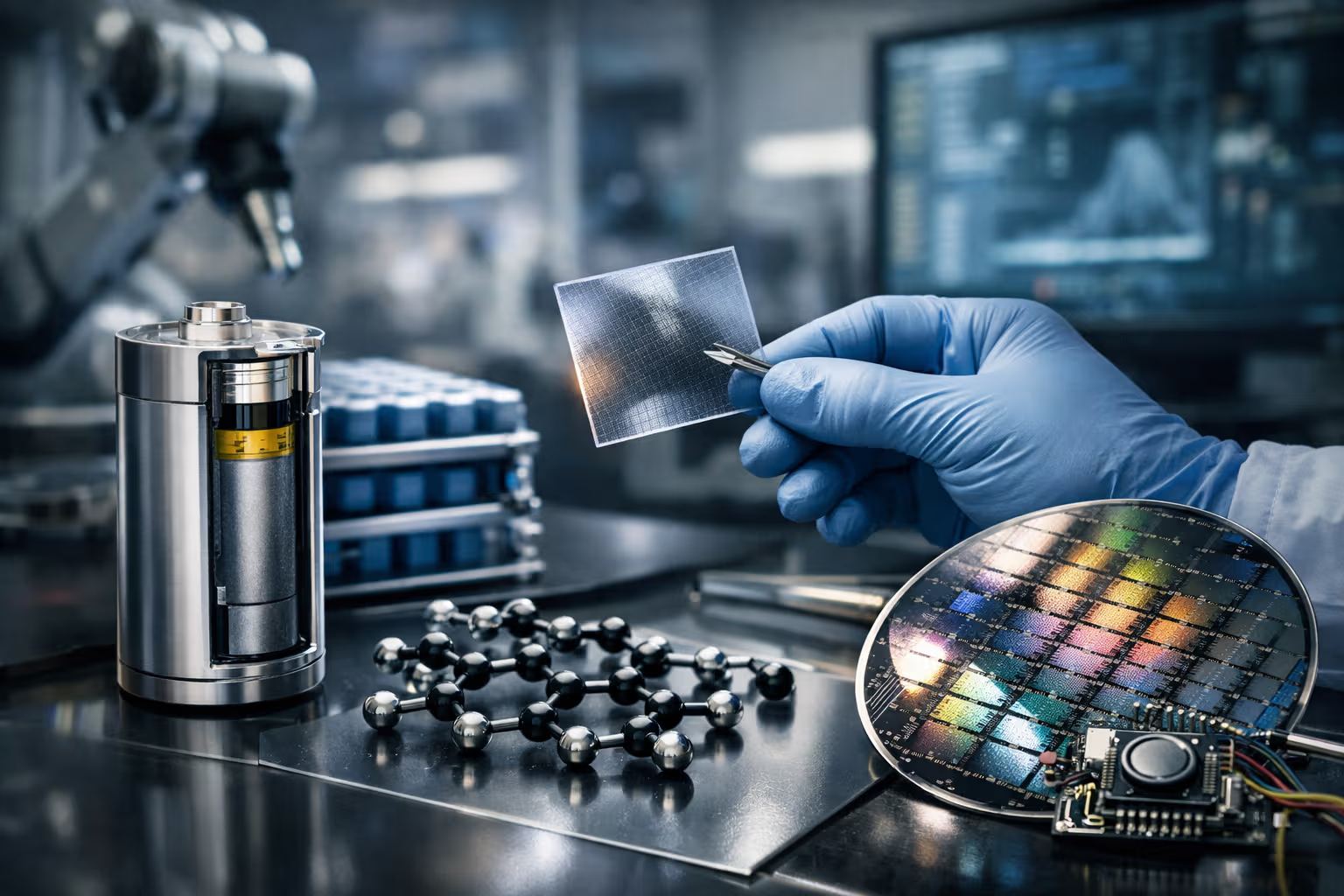
Technologies That Look Boring Today But Will Change the World
Nobody gets excited about batteries. No one queues overnight for a new electrode chemistry. Material scientists don’t become celebrities. Sensor manufacturers don’t get keynote stages. These technologies are invisible, enabling, and utterly essential—the infrastructure that makes the exciting stuff possible.
When Apple announces a new iPhone, the coverage focuses on cameras, displays, and AI features. The battery that powers all of it receives a single slide mentioning “all-day battery life.” When Tesla announces a new vehicle, the coverage focuses on acceleration, range, and autonomous features. The cells that store all that energy are treated as commodity components.
My British lilac cat, Mochi, understands the importance of fundamentals. She doesn’t care about the artistic arrangement of her food bowl. She cares that the bowl contains food. The presentation is irrelevant; the contents are essential. Technology coverage has the opposite bias—obsessing over presentation while ignoring the contents that make everything work.
This article explores the boring technologies that will change the world: batteries that will reshape energy and transportation, materials that will enable capabilities we can’t currently achieve, and sensors that will give machines unprecedented awareness of their environment. These aren’t sexy. They’re foundational. And they’re progressing faster than most people realize.
Why Boring Technologies Matter Most
The technologies that capture attention—AI, AR/VR, robotics—are application layers. They run on hardware. That hardware depends on materials, power sources, and sensing capabilities that advance much more slowly than software but matter just as much.

Consider the smartphone. The visible innovations—apps, interfaces, features—iterate rapidly. But the fundamental constraints—battery capacity, display technology, sensor capabilities—iterate slowly. A 2026 iPhone is radically different in software from a 2016 iPhone. The battery technology has improved perhaps 30% in the same decade. That improvement enabled bigger screens, more processing, and better cameras. Without it, the software innovations would have been constrained.
This pattern repeats across technology. AI is limited by the chips that run it. Electric vehicles are limited by the batteries that power them. Wearables are limited by the sensors that perceive and the batteries that last. Robotics is limited by actuators that move and sensors that perceive. The application layer gets attention; the foundation layer determines what’s possible.

Boring technologies also compound differently than exciting ones. A breakthrough in AI might be disrupted by the next breakthrough. A breakthrough in battery chemistry persists—every future technology benefits from it. Materials advances are particularly durable; a new material with useful properties remains useful indefinitely.
The investment community has started recognizing this. Capital flowing into “deep tech”—materials, energy, and hardware—has increased substantially as investors realize that the next technology era depends on foundational advances, not just software iteration.
Batteries: The Quiet Revolution
Every major technology trend depends on better batteries. Electric vehicles need higher energy density and faster charging. Grid storage needs longer life and lower cost. Consumer electronics need more capacity in the same size. Aviation needs batteries light enough to enable electric flight. Each improvement in battery technology unlocks capabilities across every dependent industry.

The current state: lithium-ion batteries have dominated for three decades. They’ve improved substantially—energy density roughly tripled since commercialization—but we’re approaching theoretical limits. Conventional lithium-ion can perhaps improve another 20-30%. Beyond that requires fundamentally different chemistry.
Solid-state batteries replace liquid electrolytes with solid materials. The benefits are substantial: higher energy density (50-100% improvement possible), faster charging, longer lifespan, improved safety (no flammable liquid electrolyte), and better performance at temperature extremes. The challenges are manufacturing at scale and cost.
Toyota, QuantumScape, Solid Power, and others are racing toward commercial solid-state batteries. Toyota announced plans for solid-state EVs by 2027-2028. If successful, this could be the most significant battery advance since lithium-ion’s commercialization.

Sodium-ion batteries use abundant sodium instead of lithium. Energy density is lower, making them unsuitable for weight-sensitive applications. But cost is substantially lower, and supply chains are more secure. For grid storage, where weight doesn’t matter and cost does, sodium-ion could displace lithium-ion. CATL and BYD are already shipping sodium-ion cells at scale.
Lithium-sulfur batteries promise 2-3x the energy density of current lithium-ion with lower material costs. The challenge has been cycle life—sulfur batteries degrade faster. Recent advances in cathode protection are extending lifespan toward commercial viability. If solved, lithium-sulfur could enable electric aviation and dramatically extend EV range.
Silicon anodes could boost lithium-ion capacity 20-40% without changing the fundamental chemistry. Silicon stores more lithium than graphite but expands during charging, causing degradation. Companies are developing silicon-graphite blends and pure silicon anodes with structural solutions to the expansion problem. This is the nearest-term improvement, likely appearing in premium devices within 2-3 years.
flowchart TD
    A[Current: Lithium-Ion] --> B[Near-Term: Silicon Anodes]
    B --> C[+20-40% Capacity]

    A --> D[Medium-Term: Solid-State]
    D --> E[+50-100% Capacity]
    D --> F[Faster Charging]
    D --> G[Improved Safety]

    A --> H[Parallel: Sodium-Ion]
    H --> I[Lower Cost]
    H --> J[Grid Storage Focus]

    A --> K[Long-Term: Lithium-Sulfur]
    K --> L[2-3x Capacity]
    K --> M[Electric Aviation]
The implications of better batteries cascade across industries:
Electric vehicles with 500+ mile range and 10-minute charging would eliminate range anxiety and recharging friction. EV adoption would accelerate dramatically.
Grid storage at lower cost would make renewable energy viable for baseload power. The intermittency problem—solar doesn’t generate at night—becomes solvable with cheap, large-scale storage.
Consumer electronics could last multiple days instead of requiring daily charging. Or devices could shrink while maintaining current battery life.
Aviation could electrify. Short-haul flights on battery power would reduce aviation emissions substantially. This requires energy density improvements that solid-state or lithium-sulfur might provide.

Robots could operate longer without recharging. The current generation of robots is tethered by limited battery life. Better batteries enable autonomous robots that work full shifts.
None of this makes headlines. Battery chemistry research happens in labs, not on stages. The announcements are incremental—“5% improvement in cycle life”—rather than revolutionary. But the cumulative impact is revolutionary, and it’s coming.
Materials: The Science of Possibility
What we can build depends on what materials we have. Historical eras are named for materials—Stone Age, Bronze Age, Iron Age—because materials determine capabilities. We’re arguably in the Silicon Age now, with semiconductors enabling the digital revolution. The next age might be defined by materials we’re only beginning to master.

Graphene is a single layer of carbon atoms arranged in a hexagonal lattice. It’s the strongest material known—200 times stronger than steel. It’s the best conductor of electricity and heat. It’s nearly transparent. It’s flexible. On paper, graphene should enable revolutionary applications: ultralight structures, ultra-efficient electronics, flexible displays, water filtration, and more.
The challenge has been manufacturing. Making graphene in a lab is straightforward. Making it at scale, consistently, with controlled properties, at reasonable cost—this has taken longer than expected. But progress is real. Graphene is appearing in composites (adding strength), in batteries (improving conductivity), and in coatings (providing barrier properties). The full potential remains unrealized, but practical applications are accumulating.

Metamaterials are engineered materials with properties that don’t exist in nature. They achieve unusual properties through structure rather than chemistry—precisely designed patterns of conventional materials that interact with light, sound, or other waves in unexpected ways. Applications include:
- Invisibility cloaking (bending light around objects)
- Perfect lenses (focusing beyond the diffraction limit)
- Sound control (creating silent zones or amplifying specific frequencies)
- Antenna improvements (smaller, more efficient wireless)
- Seismic protection (redirecting earthquake waves around structures)
Metamaterial research has progressed from theoretical curiosity to practical application. Acoustic metamaterials are being used in noise control. Optical metamaterials are appearing in antenna design. The field is young but accelerating.

Self-healing materials can repair damage without human intervention. Inspired by biological systems that heal wounds, these materials contain embedded repair mechanisms—microcapsules that release healing agents when cracked, vascular networks that transport repair materials, or reversible chemical bonds that reform after breaking.
Applications range from self-healing coatings (paint that repairs scratches) to self-healing concrete (extending infrastructure lifespan) to self-healing electronics (improving device durability). The technology is at different maturity levels for different applications, with self-healing coatings already commercialized and structural self-healing still in development.
High-entropy alloys combine five or more elements in roughly equal proportions, creating crystal structures with unusual properties. These alloys can be stronger, harder, more resistant to corrosion, and more stable at extreme temperatures than conventional alloys. Applications in aerospace, power generation, and extreme environments are emerging.

Bio-based materials derive from biological sources and can replace petroleum-based plastics and materials. These include:
- Mycelium composites (mushroom root material for packaging and construction)
- Cellulose-based materials (wood-derived alternatives to plastics)
- Algae-based materials (sustainable feedstock for various applications)
- Lab-grown leather and silk (identical properties without animal agriculture)
The environmental implications are substantial. Materials that biodegrade, sequester carbon, or replace extractive supply chains could reduce the industrial footprint significantly.
Sensors: Machines That Perceive
Sensors give machines awareness of the world. Every smart device, every robot, every autonomous vehicle, every IoT application depends on sensors that perceive environment and state. Advances in sensors enable advances in everything that uses them.

MEMS sensors (Micro-Electro-Mechanical Systems) pack mechanical and electrical components onto chips. Your phone contains multiple MEMS sensors: accelerometers, gyroscopes, pressure sensors, microphones. The technology has matured enough that sophisticated sensing is cheap—a nine-axis inertial measurement unit costs under a dollar.
The trend continues: more sensing in smaller packages at lower cost. This enables pervasive sensing—sensors in everything, everywhere, generating data continuously. The implications for awareness, control, and optimization are profound.
LiDAR (Light Detection and Ranging) uses laser pulses to map the environment in three dimensions. Originally bulky and expensive, LiDAR has shrunk and cheapened dramatically. Apple put LiDAR in iPhones and iPads. Autonomous vehicles use LiDAR arrays. Drones use it for obstacle avoidance.

The next generation includes solid-state LiDAR (no moving parts, more reliable), FMCW LiDAR (continuous wave instead of pulses, providing velocity information directly), and single-photon LiDAR (detecting individual photons for extreme sensitivity). Each variant opens new applications or improves existing ones.
Hyperspectral imaging captures light across many more wavelengths than human vision or standard cameras. Where we see red, green, and blue, hyperspectral sensors see hundreds of distinct wavelengths. This enables:
- Agricultural monitoring (detecting plant stress before visible symptoms)
- Medical imaging (seeing differences invisible to eyes)
- Quality control (identifying contamination or defects)
- Environmental monitoring (tracking pollution and ecosystem health)
- Security applications (detecting concealed substances)
The technology has existed for decades but was expensive and bulky. Miniaturization and cost reduction are bringing hyperspectral sensing to smartphones, drones, and consumer devices.

Quantum sensors use quantum mechanical effects to achieve unprecedented sensitivity. Quantum magnetometers can detect individual atoms. Quantum gravimeters can map underground structures. Quantum gyroscopes could replace GPS in environments where satellite signals are unavailable.
These sensors are mostly in labs today, but commercial applications are emerging. Navigation that doesn’t require satellites, medical imaging with extreme precision, and resource detection underground or underwater are early targets.
Bio-sensors detect biological molecules and processes. Continuous glucose monitors for diabetics are an established category. The future includes sensors for other biomarkers—real-time monitoring of health indicators currently requiring blood draws and lab analysis. The Apple Watch’s health sensors are early examples; more sophisticated biosensing is coming.

Method
This assessment of boring technologies draws from multiple research approaches:
Step 1: Technology Roadmap Analysis I examined published roadmaps from major companies and research institutions in batteries, materials, and sensors. These documents, though often optimistic, indicate where investment and effort are concentrated.
Step 2: Academic Literature Review I reviewed recent publications in relevant journals to assess research progress beyond corporate announcements. Academic work often precedes commercial applications by 5-10 years.

Step 3: Industry Expert Interviews Conversations with researchers and engineers in these fields provided perspective on which advances are genuinely imminent versus perpetually “5 years away.”
Step 4: Venture Capital Pattern Analysis I tracked investment flows into deep tech categories to understand where smart money sees opportunity. Capital allocation reveals beliefs about technology readiness.
Step 5: Historical Pattern Matching I examined how similar foundational technologies—semiconductors, fiber optics, LED lighting—progressed from research to deployment, identifying patterns that might apply to current technologies.

The Timeline Question
How soon will these boring technologies matter? The honest answer: they already matter, and they’ll matter more progressively.
Near-term (2026-2028):
- Silicon anode batteries in premium devices
- Sodium-ion batteries in grid storage and low-end EVs
- Graphene additives in various products
- Solid-state LiDAR in vehicles

Medium-term (2028-2032):
- Solid-state batteries in vehicles
- Hyperspectral sensing in smartphones
- Self-healing materials in infrastructure
- Metamaterials in consumer products
Long-term (2032+):
- Lithium-sulfur enabling electric aviation
- Quantum sensors in consumer applications
- Bio-based materials at scale
- Full graphene exploitation
These timelines are uncertain. Technology development is unpredictable. But the direction is clear even if the pace is fuzzy.

Why You Should Care
You might wonder why boring technologies matter to non-specialists. Several reasons:
Investment implications. The companies developing foundational technologies could be excellent long-term investments. Understanding where value will be created helps identify opportunity.
Career implications. Skills related to these technologies will be valuable. Materials science, battery engineering, sensor development, and related fields offer career opportunities as these technologies mature.

Purchase implications. Understanding technology trajectories helps with major purchases. Should you buy an EV now or wait for better batteries? Should you invest in solar now or wait for cheaper storage? The answers depend on technology timelines.
Conversation implications. When someone dismisses electric vehicles because batteries aren’t good enough, or dismisses robots because sensors aren’t capable enough, you can contribute informed perspective. The constraints are real but temporary.
Wonder implications. The fact that scientists are engineering materials atom by atom, building batteries that could power flight, and creating sensors that detect individual molecules is genuinely remarkable. Boring technologies are only boring on the surface.

Generative Engine Optimization
The concept of Generative Engine Optimization connects to boring technologies in an indirect but important way. GEO involves optimizing for AI-driven systems. Those AI systems run on hardware that depends on the foundational technologies discussed here.
The AI revolution requires massive computation. That computation requires electricity. Storing and managing that electricity requires batteries and grid infrastructure. Running the data centers requires cooling, which depends on material properties. Deploying AI in edge devices requires sensors and power sources that can operate independently.

For practitioners, understanding foundational technology constraints helps assess what AI applications are feasible. An AI application that requires always-on sensing in remote locations depends on battery technology. An AI application that requires hyperspectral input depends on sensor availability. The exciting application layer is constrained by the boring foundation layer.
For strategists, foundational technology timelines help with planning. When will battery technology enable specific applications? When will sensor technology make specific products possible? These questions matter for roadmaps that extend beyond current capabilities.
The practical skill is seeing connections between foundational advances and application possibilities. Reading about solid-state battery progress and imagining what it enables. Following materials research and anticipating products that new materials will make possible. The boring technologies are inputs to interesting outputs.

The Appreciation Gap
There’s a systematic underappreciation of foundational technologies in public discourse. Media covers applications, not enablers. Celebrities are tech entrepreneurs, not materials scientists. The Nobel Prize in Chemistry gets less coverage than a product launch.
This creates a distorted view of where innovation happens. The perception: innovation is apps and interfaces. The reality: innovation is also in labs where chemists study electrode reactions, in factories where engineers optimize manufacturing processes, and in research facilities where physicists explore quantum effects.

The appreciation gap has consequences. Funding for basic research is politically vulnerable because the benefits are diffuse and delayed. Students pursuing materials science or battery chemistry are fewer than those pursuing AI or product design. The talent pipeline for foundational technologies is thinner than the talent pipeline for visible applications.
Perhaps this article contributes, in some small way, to correcting the imbalance. The next time you use a device that just works—smartphone lasting all day, car driving hundreds of miles on a charge, sensor detecting what you couldn’t see—consider the invisible technologies that make it possible.
Final Thoughts
Mochi doesn’t care about technology categories. She cares about outcomes: warm surfaces to sleep on, food that appears on schedule, humans who provide attention when demanded. The technology serving her—thermostats, automated feeders, humans trained through behavioral conditioning—is invisible. The outcomes are what matter.
Perhaps we should adopt a similar perspective. The technologies that matter most are often the ones we notice least. They just work. They enable the things that get our attention without claiming attention themselves.

Batteries, materials, and sensors won’t headline technology conferences. They won’t generate viral social media coverage. They won’t make their creators famous. But they will determine what’s possible in the next decade and beyond.
The exciting technologies that capture imagination—AI, autonomous vehicles, space exploration, clean energy—all depend on boring technologies progressing quietly in labs and factories. Every advance in the foundation enables advances in the structure above.

The world-changing technologies of the next decade include solid-state batteries that power a day of phone use in minutes of charging. Materials that are stronger, lighter, and smarter than anything we have today. Sensors that give machines perception rivaling or exceeding human senses.
None of this is exciting in the way a new iPhone is exciting. All of it is more important. The boring technologies are the technologies that change the world. They just don’t announce themselves while doing it.
Pay attention to the boring stuff. That’s where the future is actually being built.