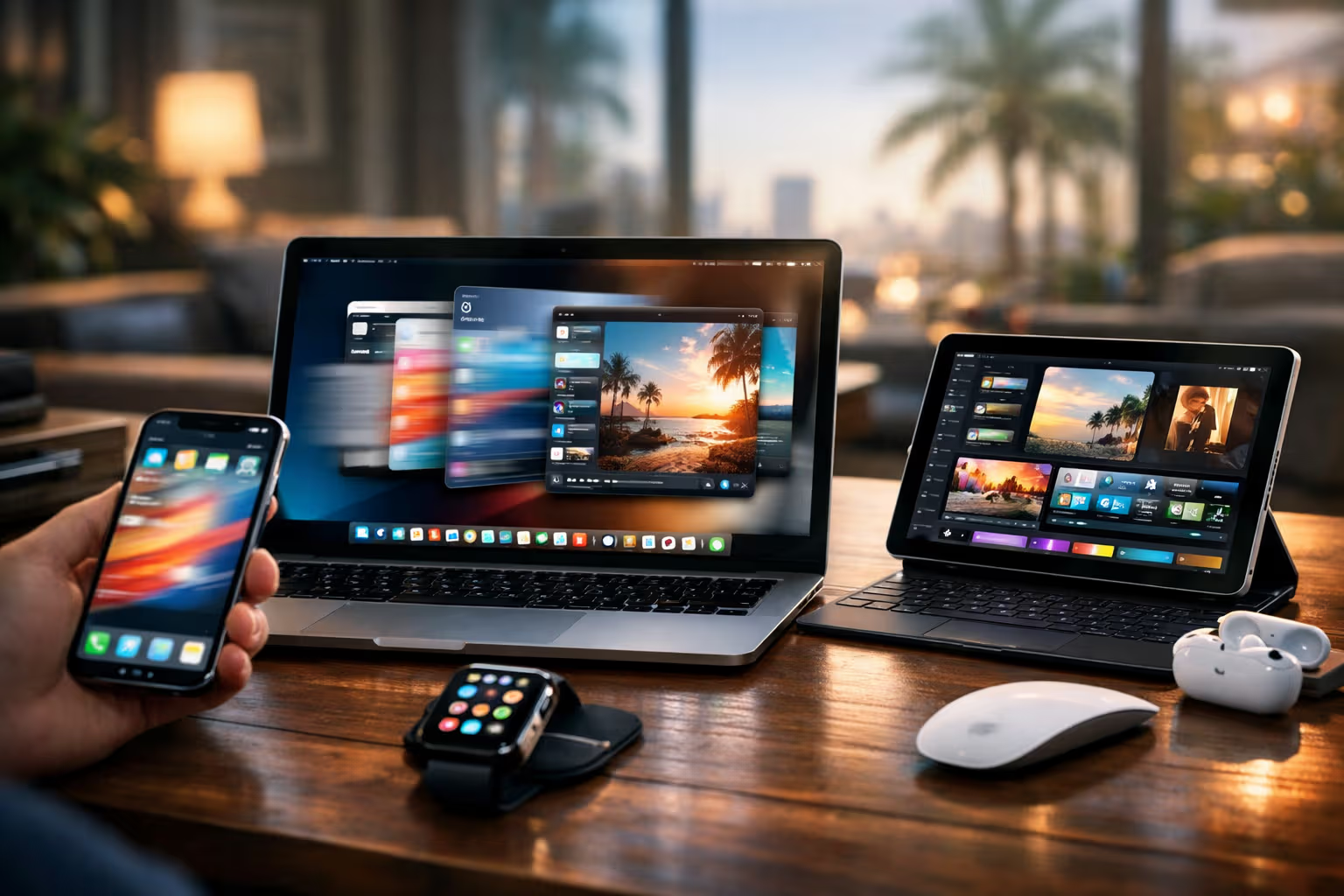
The benchmark numbers never made sense. Year after year, Android flagships shipped with more cores, more RAM and higher clocks than the current iPhone. Year after year, the iPhone felt quicker in the hand. Reviewers ran more benchmarks, got the same answer, and concluded Apple must be doing something sneaky.
They weren’t. They were solving a different problem.
Speed is how long a task takes to finish. Flow is how well tasks join up into continuous activity. Both matter, but they’re different quantities, and improving one frequently costs you the other.
My British lilac cat, Pixel, can cross the flat in about a second and a half. Impressive speed, entirely useless on its own. What’s actually impressive is the route from windowsill to sofa to scratching post to bowl without ever breaking stride. Sprint speed means nothing if she has to stop and recalculate at every waypoint.
What benchmarks can’t see
Benchmarks measure synthetic tasks in isolation, which is exactly the wrong shape for how anyone uses a phone.
Take something ordinary: photograph a thing, send it to someone. The benchmark-relevant parts, the image processing and compression and upload, land within a few percent of each other across every flagship on the market. The parts you actually live through, camera launch, shutter response, gallery scroll, share sheet, contact picker, confirmation, vary enormously. A phone that benchmarks twenty percent faster can feel slower than the one it beat, because its transitions hesitate.
Related reading

Apple worked this out early and built a product philosophy on it. While competitors added cores, Apple refined animation curves. While competitors chased clock speed, they hunted micro-delays. The result is a device that reliably loses the comparison chart and reliably wins the hands-on.
Not because the hardware is slow. It’s fast enough, and past a certain point extra speed stops being perceptible while flow improvements never do. Apple optimised the variable that was still doing work.
Responsiveness is not speed
The most useful distinction in this whole area is between latency and duration. They pull in opposite directions and only one of them is felt.
An animation that runs for 300ms and starts the instant your finger lands feels faster than one that runs for 200ms after a 50ms pause. The second is quicker by the stopwatch and worse by every other measure. Apple eliminates the startup delay obsessively and accepts longer animations in exchange. Your finger moves, the screen reacts. The reaction takes time to complete; it never takes time to begin.
This is why “perceived performance” isn’t a soft concept. It’s a specific number, the gap between input and first visible change, and it’s the one that predicts whether a device feels good.
Animation as information, not decoration
Critics write off Apple’s animations as showing off. That misses their function entirely: they’re information architecture. They answer questions your conscious mind would otherwise have to answer for itself. Where did that window go? Where did this panel come from? What just changed?
Open an app on an iPhone and it expands from its icon. Close it and it shrinks back to the same spot. That takes around three hundred milliseconds, which is not instantaneous and isn’t meant to be. What you get in exchange is spatial information: you know where the app lives and how to return to it. Multiply that across every interaction for four years of ownership and the cognitive saving is enormous.
Same with folders opening outward, icons sliding to fill a gap after a deletion, panels arriving from the edge they’ll return to. Individually trivial. Together they build a coherent space where things have locations, rather than a screen where things appear and vanish.
Scroll physics is the purest example. Flick a list and it doesn’t simply move and stop. It accelerates with your flick, decelerates against simulated friction, and bounces at the boundary. That sounds like unnecessary complexity and it’s essential, because the physics match what your hands expect from physical objects closely enough that your brain files scrolling under manipulation rather than under commanding a computer.
Variance beats average
Flow needs predictability, and predictability is about consistency rather than peak numbers.
A device that answers in 50ms sometimes and 200ms other times feels worse than one that always answers in 150, even though the inconsistent one is faster on average. Your brain builds a timing model within minutes of picking up a device, and every violation of that model costs a small slice of attention. The average is what benchmarks report. The variance is what you feel.
Related reading

Apple’s response is to leave headroom. Animations run at locked frame rates. System work gets scheduled around user interaction rather than through it. The machine never runs flat out, because running flat out introduces timing variance. Reviewers see unused capacity. Apple sees the entire point.
Pixel makes the same argument about her feeder, which dispenses at six and six. She arrives within seconds of both, internal clock synchronised to the hardware. If it drifted between quarter to and quarter past she’d have to sit and watch it instead. Consistency enables prediction, prediction enables everything else.
Why integration matters here specifically
This is the part where vertical integration stops being a business-school abstraction.
When your finger touches the glass, the signal crosses a touch sensor, a controller, the system software, the application, back through the graphics stack, and finally to the display. Every hop adds latency. Every interface between components owned by different companies adds variance, because each part meets its own spec and nobody owns the sum.
Apple controls the whole chain, so they can tune the pipeline rather than the segments. A handset maker buying a touch controller from one supplier, a panel from another and a chip from a third has to write software that survives the worst-case timing of any combination they might ship. That’s a harder problem and it produces a worse result, and it’s most of the explanation for why a phone with a slower chip answers faster.
The decisions this explains
Once you see the priority, a set of otherwise odd Apple choices line up.
Aggressive limits on background activity look like an artificial handicap if you’re optimising throughput. They’re obvious if you’re protecting foreground responsiveness from timing interference.
Reduced-motion mode simplifies animations rather than deleting them, which annoys people who wanted them gone. But removing transitions entirely brings back the sudden state changes the animations existed to explain.
And the long wait before high refresh rates arrived on iPhone wasn’t an engineering limit. Higher refresh costs power and headroom, and headroom is what buys consistent timing. They shipped it when they could ship it without variance.
Those calls all frustrate someone who wants maximum speed. They aren’t objectively right. But they’ve been made the same way for twenty years across every product line, which is how you tell a philosophy from a marketing position.
What to do with this
The practical upshot changes how you should test anything before buying it.
Related reading

Stop testing operations in isolation, which is benchmark thinking wearing a shopping jacket. Test sequences: wake the device, open something, do a thing, switch apps, do another thing, come back. Everything interesting lives in the joins.
Then pay attention to your own attention. Notice the moments you consciously wait. Notice when a transition surprises you or an animation seems to argue with your finger. Those micro-frictions are invisible on a spec sheet and they’re most of what determines whether you still like the thing in year three.
And trust the feeling over the number. If a slower device feels faster to you, that’s not an illusion to be corrected. Your perception of performance is the only performance you will ever experience.
The principle generalises past phones, too. An editor that takes four seconds to launch and never stutters while typing beats one that opens instantly and hitches every few paragraphs. A tool with fewer features and clean navigation beats a richer one with clumsy transitions. The tools worth keeping are the ones that stop being visible.
Pixel has never seen a benchmark. She picks her perch by how smoothly it connects to the other places she wants to be, which is spatial optimisation rather than temporal, and is otherwise the same idea. She’d make a decent product designer. Apple appears to agree.
One email a month: new articles, reviews and the upcoming live webinar + free recording. No spam, unsubscribe anytime.