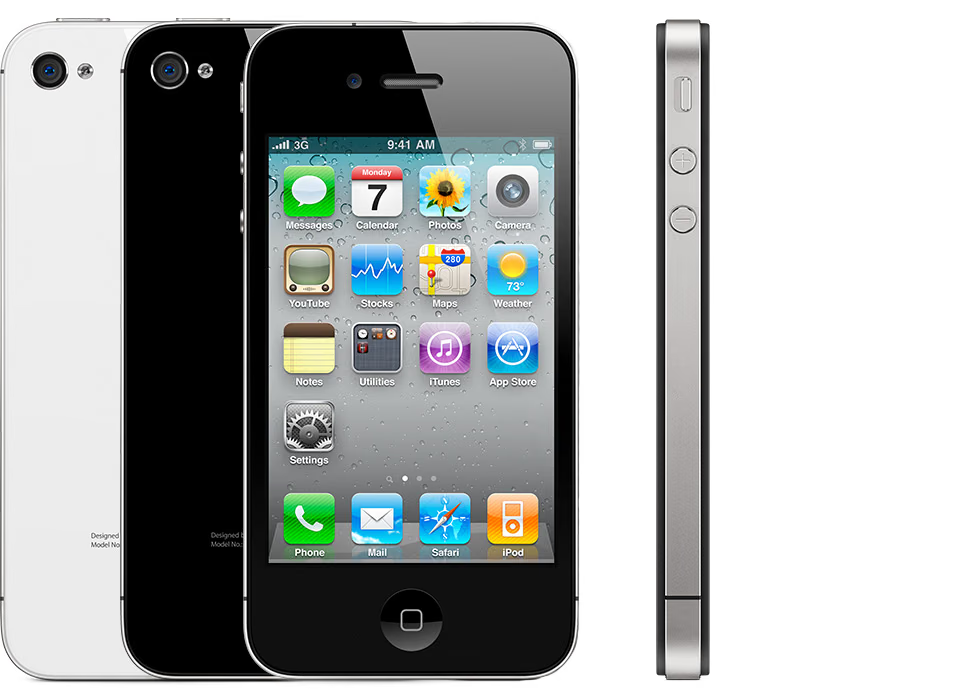
The iPhone 4 justified its redesign every time you read a line
The iPhone 4’s display was the easiest improvement to see and the hardest one for a list of features to convey. Open a page of ordinary text and look at the parts of a letter that ought to be clean and thin. The smallest curves and diagonals were much easier to render with four times as many pixels as the preceding iPhone. Apple kept the same 3.5-inch diagonal. This gave familiar pages a more distinct edge and did something for almost any buyer, whether or not they knew the name Apple had given to the display.
Quick verdict
Retail release in the United States · Archive date
The iPhone 4 earned its price if you regularly read or took pictures on a phone and its reception was reliable where you lived.
Best for: Someone who valued sharper text at the familiar screen size or spent more time with the phone's camera.
Main benefit: Four times as many display pixels improved the detail of ordinary app content at the same physical size.
Biggest drawback: Reports about reception and the lower-left seam gave buyers a practical reason to test the exact device.
Reviewed version: The black GSM iPhone 4 sold in the first wave. The white phone and CDMA hardware went on sale later.
Compatibility: Launch FaceTime required a compatible iPhone 4 and Wi-Fi. The phone used a micro-SIM and 30-pin accessories.
Review context: I evaluate the documented retail hardware and the software available in its release window. Regional variants and software changes are identified where they affect the verdict.
I had the iPhone 4 as part of owning every iPhone. My look at the launch centres on the black GSM model that reached stores in the United States, United Kingdom, France, Germany and Japan on June 24, 2010. Apple announced the white model’s delay before the first day in stores. The CDMA edition belongs to a later release. Apple’s confirmation of the June 24 retail date
More information at the same physical size
The Retina display was 960 by 640 pixels, up from 480 by 320 on the 3GS. From a designer’s point of view, the screen could use twice as many pixels along either edge while keeping a button, letter or icon the same physical size. The difference also applied to fine material that was hard to simplify. A map can have a line for a street, a second line for a route and a name placed between them. Clarity helps a reader see which part the label belongs to. That is a better test of the advantage than displaying one enlarged photograph.
Related reading

The phone still had a small screen. An inbox held roughly the same amount of useful information if its text was set at the same comfortable size. Pages designed for big monitors still called for scrolling and zooming. The improvement was in how resolved the information looked inside the available area. That made it useful for several minutes of reading, even when a larger screen would have made the same material more comfortable over a whole afternoon. App makers had work to do on detailed artwork so the surrounding icons looked as good as the type that the system rendered.
Two flat faces and a band you would have to understand
The earlier iPhones had softened bodies that looked a little different from each edge. The iPhone 4 looked more like three neat layers. Glass framed the front and back, with a stainless steel band in between. The microphone, buttons, camera and speaker took up their own little patches of space, and the thin profile was clear when you looked down an edge. I like the restraint of this design. It had a practical cost in having a second large glass surface. Choosing a case became a matter of how the phone might land as well as how much of its shape you wanted to cover.
The steel band also formed part of the antenna system. The position of the lower left seam mattered for some owners. Apple’s July 2 letter acknowledged reports of a large drop in displayed signal when people held the phone across the seam. Apple added that its signal display formula could overstate the indicator and said a software update would change how the signal was displayed. The promised update addressed what the bars showed. The useful question for a buyer concerned about reception was whether calls or data failed where they actually needed them. Apple’s July 2 letter on reception
At this point in the launch, I would have checked the place where a bad signal caused a real problem, such as a home office well away from its windows. A quick demo in a shop would tell you the device could make a call in a shop. Comparing one phone in a case and another in the open also changes how a hand meets the band. Apple’s letter described a 30-day return option for undamaged phones bought directly from it. That was a useful term to check with the actual retailer before deciding that a slow data connection at home was something you could live with.
The small picture at the other end
The front camera gave FaceTime a reason to exist. In this first version a call normally required Wi-Fi at both ends and another compatible iPhone 4. A compatible network and a compatible person were both part of the feature. Two people on the same family purchase could make use of it right away. Someone with relatives on a variety of phones could call those people normally but had much less reason to buy the device solely for video. This was a promising way to make a familiar conversation feel closer, with a small initial circle of people to try it with.
Related reading

The rear camera influenced more immediate decisions. A 5-megapixel sensor and a tap-controlled point of focus gave the person holding the phone more control over what mattered in the frame. There was an LED, and the phone could record 720p video. Higher resolution gave the buyer a reason to show the result on a larger screen or edit a clip later. Apple sold iMovie for the phone separately. Buying it made sense to someone who expected to join shots, apply simple edits and finish a little film. A person who usually wanted to cut away a second before sending a clip could start with what the camera tools already did. Apple’s original iPhone 4 announcement
iOS 4 made a difference even on the previous phone
Folders mattered because there were finally enough apps on an iPhone for organisation to be worth somebody’s time. An app switcher opened a way back to a recently used screen. The availability of background services depended on the job and how the developer implemented it. You could, for example, imagine music continuing while you looked at something in another app. That expectation needed a supported background mode. The phone did not turn into a desktop computer that kept every task working once you left its window.
Apple released iOS 4 for the iPhone 3GS as well as the new hardware. An owner who wanted tidier pages or the new app switching could try the available software improvements before taking on another contract. The hardware argument was clearest for somebody who spent time reading, took pictures often or already knew who they would call with FaceTime. In the United States the 16 GB model began at $199 and the 32 GB model at $299 under the terms for qualifying AT&T customers. The actual cost depended on service and eligibility.
My verdict on the June 2010 iPhone 4
The iPhone 4 was the one I would have chosen in its launch window if I expected to spend time reading on a phone. The display shaped every small use, while the camera and video call had their own moments. I would also have asked about reception and returns early. The design exposed part of the radio to the way you held it, and reports at the time gave a buyer a good reason to test how that worked at home.
I would have delayed a purchase for somebody who already had a 3GS and mostly wanted the improvements that came with iOS 4. The helpful distinction was whether a feature changed an existing routine. Somebody with two video-call users knew what to do with FaceTime. A daily reader could see the screen before paying. The other gains might remain possibilities until a person ran into the job that needed them. The iPhone model timeline places this review alongside the early iPhones that made those routines familiar.
What worked
Four times as many display pixels improved the detail of ordinary app content at the same physical size.
The LED flash and 720p video extended what you could capture with the rear camera.
What bothered me
Reports about reception and the lower-left seam gave buyers a practical reason to test the exact device.
The glass back required some of the protection that the front of the phone already did.
Who should not buy it
An iPhone 3GS owner who was looking mainly for the folders and app switcher arriving in iOS 4.
Alternatives I would consider
iPhone 3GS. The compatible predecessor could try iOS 4 with less expense, and it kept the curved back and existing screen. Read my iPhone 3GS review.
Evidence and sources
The release date refers to general availability in the named market. The archive filing is ten days later. Feature assessments are editorial judgments based on the documented retail model.
Features, compatibility and rated figures from the maker are manufacturer information. My opinions are identified in the review.
Conclusion
The screen made a lasting upgrade. FaceTime was valuable immediately to households that could make both ends of a call work.
One email a week with practical Mac workflows, useful comparisons and honest tech recommendations.