I really like the AlzaPower Ultimate X500 and have enjoyed this purchase. It is useful because it puts a familiar mix of devices on one wall plug. Two USB-C ports cover newer hardware, while USB-A leaves room for an older cable. The important detail is that the ports share the available power. The 67W in the product name is not a promise of 67W from every socket at the same time.
Quick verdict
I recommend the Ultimate X500 for reducing charger clutter with a clear power-sharing plan.
- Best for
- A phone, tablet and small accessories, or a laptop whose power needs fit.
- Main benefit
- I like having two USB-C ports and USB-A on one compact charger.
- Biggest drawback
- The ports share the power budget; 67W does not mean 67W at every port together.
AlzaPower Ultimate X500 67W white
Alza Czechia · Czechia
Check price and availability: AlzaPower Ultimate X500 67W white at Alza CzechiaProduct link.
Reviewed version: AlzaPower Ultimate X500 67W white
Compatibility: Confirm the plug region, charging protocol, cable rating and power needed by each device. A multiport total is not independent full power on every port.
Review context: The review focuses on a phone, tablet and small accessories, or a laptop whose power needs fit.
We bought the white version ourselves. I see it as a small travel and desk accessory with a clear job: reduce the number of adapters in a bag without making the charging setup hard to understand. That makes the power-sharing rules more important than the number printed in the largest type on the box.
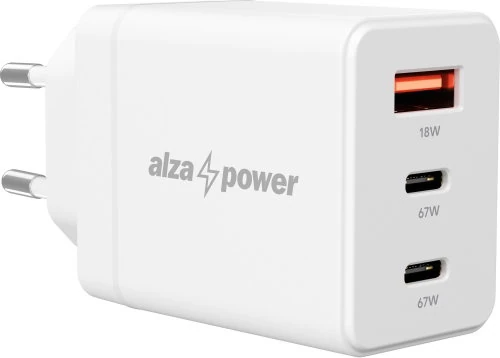
Product images: AlzaPower and Alza.
The power budget is the buying decision
The product listing describes a GaN charger with two USB-C ports, one USB-A port and USB Power Delivery with PPS. It also specifies a three-port combination of 45W for USB-C1 and a shared 18W for USB-C2 plus USB-A. That is a useful arrangement, but it is a different arrangement from charging one device alone.
A laptop, phone and pair of headphones do not all need the same power. The sensible approach is to give the most demanding device the stronger connection and let small accessories share the rest. This is where a multiport charger earns its place: the small devices can finish their work without each needing a separate wall adapter.
Related reading

The limit appears when several devices need a fast charge at the same moment. A laptop that can accept more power may charge more slowly when the other ports are in use. That is not automatically a fault. It is the normal consequence of dividing a fixed budget. The question is whether that budget suits the combination you actually carry.
For a large MacBook Pro under heavy load, I would keep the original high-power charger available. A compact shared adapter is a useful companion, rather than a reason to ignore the laptop’s power requirements. Charging a sleeping computer and powering a busy one are different jobs. The adapter you choose should reflect the more demanding job when that is the one you need.
USB-C simplifies the bag, if the cables match
The move to USB-C makes a shared charger more attractive, but the connector shape alone is not enough. The cable must support the power needed by the connected device. A cable kept for a small accessory may not be the right choice for a laptop. I prefer to carry a small number of clearly chosen cables rather than a tangle of look-alike leads.
There is no cable included according to Alza’s listing. That matters to the total price. A charger can look like an inexpensive complete solution until you add the cable that makes it useful. It is better to plan the whole setup before buying, especially if the adapter will live in a travel pouch rather than use cables already on a desk.
Cable length changes the experience too. A very short lead can make the setup tidy beside an easy-to-reach socket, but it may leave a phone hanging awkwardly from a distant outlet. A longer cable gives more freedom but takes more space and can pull on the plug. The best length follows the place where the charger will usually be used.
I would also avoid using the USB-A port as a reason to keep every old cable forever. Its value is covering the accessory that still needs it. Once those devices leave the bag, the port can simply remain spare. A good mixed-port charger supports a transition without forcing the owner to build a permanent collection around an older connector.
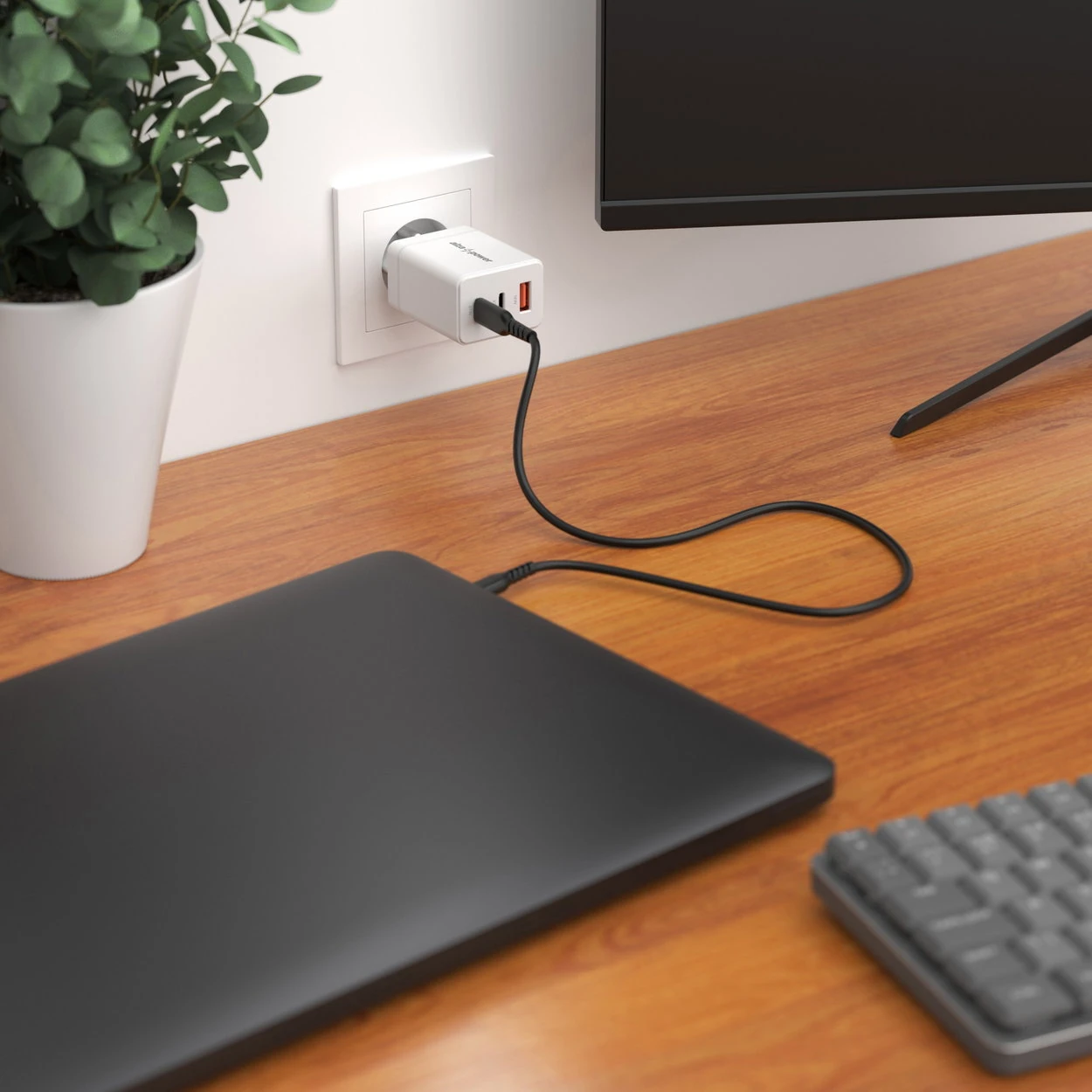
A short interruption is part of the design
Alza describes a power redistribution reset when a device is connected or removed. The charger briefly disconnects its ports while it allocates power again. That detail deserves a place in a review because it explains behaviour that might otherwise look like a loose cable or a failing device.
For charging a phone battery, a brief reset is usually a different concern from powering something that expects an uninterrupted supply. I would choose a dedicated supply for equipment where a momentary interruption matters. A multiport phone and laptop charger should not be treated as a general-purpose replacement for every power adapter just because the plug fits.
It also helps to decide which device will stay attached. On a desk, repeatedly adding a phone to a charger that is already powering another task can create unnecessary interruptions. Keeping the arrangement predictable makes the shared charger easier to live with. The advantage is fewer adapters, not freedom from the electrical limits of sharing one supply.
Related reading

This is one reason I prefer clear published power combinations to vague promises about smart charging. Intelligence in a product name is less useful than knowing what happens when the second cable is inserted. A buyer should be able to understand the setup without reverse-engineering it from battery icons.
Compact does not mean universal
The X500’s small body is its main physical attraction. Less adapter volume leaves room for cables and makes it easier to keep a charger in the bag instead of moving the main desk supply every morning. A spare travel charger can reduce forgotten equipment more effectively than a slightly smaller primary charger that is always in the wrong place.
Socket placement still matters. A charger that fits neatly into an open wall outlet may be less convenient on a crowded extension strip. The body, the direction of the connected cables and nearby plugs all take space. I would consider the whole socket area when deciding whether a compact adapter is the right shape.
Alza lists a 100–240V input range. That helps with different mains voltages, but it does not change the physical shape of the plug. Travel still requires the correct socket adapter where necessary. I would keep that separate from the charging decision: adapting the wall connection does not add more output power or change the charger’s shared budget.
I like the white finish. It is a simple visual choice that adds to my enjoyment of the product. It can be easier to spot among dark cables, while marks may be more obvious than on a black body. I would choose the colour I can identify quickly in a bag. This is an accessory that should be easy to find and put away, rather than another object requiring special attention.
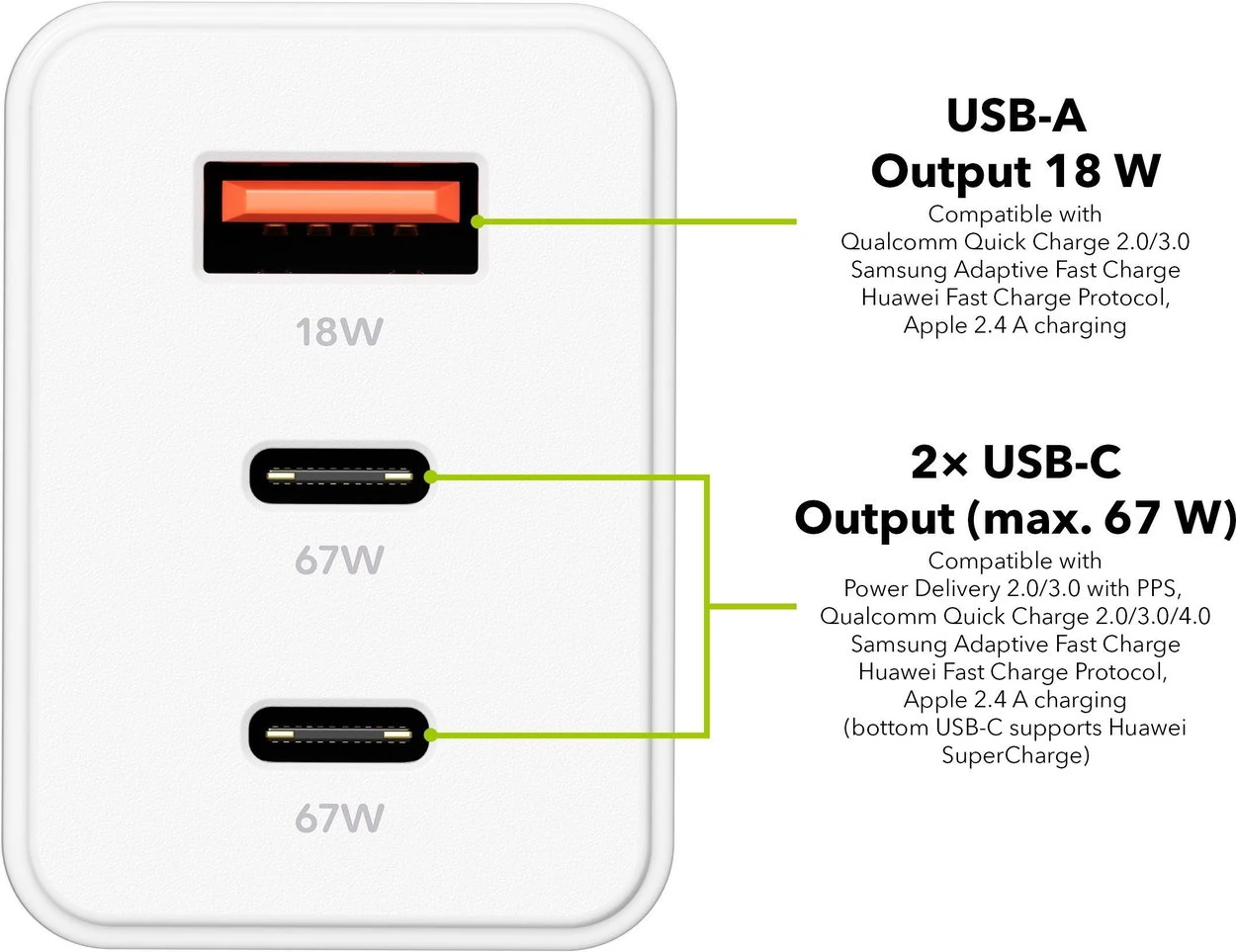
GaN is useful, but the label is not the verdict
GaN describes part of the charger’s design. It helps explain why a relatively capable adapter can be compact, but it does not tell a buyer every detail about temperature, efficiency or long-term life. I would not buy a charger on those three letters alone. The output combinations, connector mix and retailer support are more direct parts of the decision.
Alza also advertises protective features. Those are the supplier’s design claims, rather than a reason to treat the charger carelessly. Any mains adapter belongs in a place where it can be used as intended, without damaged cables or a pile of fabric covering it. A compact body should make packing easier, not encourage a cramped permanent installation.
A charger is also a product where clear documentation earns trust. I want to know which port to use and what changes when another port becomes active. Those details help explain the device without a collection of impressive percentages. The X500’s most relevant specification is the one that matches the devices at the other ends of the cables.
Value beside separate adapters
The fair comparison includes what is already in your drawer. If you own good adapters for a phone and laptop, buying a shared charger may mainly improve packing. That is a valid benefit, but it is not the same as needing a new source of power. A person who rarely travels may get little value from replacing a working arrangement.
For a regular travel bag, the case is stronger. One adapter with a known set of cables can become a ready-to-go kit. The important part is keeping it complete. A cheap charger left without the right cable has less practical value than an older adapter that is always packed and ready.
Related reading

I would compare the X500 with a higher-power multiport option only if the devices need it. Paying for more capacity can be sensible for several demanding USB-C devices. It can also add cost and bulk to solve a problem you do not have. The right adapter is the one that covers the real combination with a comfortable margin.
My verdict
The X500 has been a great purchase for me. It is a sensible kind of accessory: a compact mixed-port charger whose value is reducing clutter. I would choose it for a phone, tablet and small accessories, or as a secondary laptop charger where its available power suits the workload. I would not ask the 67W name to stand in for understanding the sharing rules.
Its most important compromise is clear. More connected devices mean a divided power budget, and changing the connections can briefly interrupt charging. If that fits your routine, the X500 has a useful place in a travel pouch. If you need continuous power or a demanding laptop setup, keep a dedicated supply for that job.
See the white X500 listing at Alza for the current price and port combinations. Buy the cables as part of the plan, rather than as an afterthought.
Where to buy
See AlzaPower Ultimate X500 67W white at Alza. This is the product page for the model covered in this review. Check the model number, colour, included parts and delivery options before ordering. Prices and stock can change, so I use this page for the current offer. Matching the product to the review matters more to me than finding a similar name.
What worked
- I like having two USB-C ports and USB-A on one compact charger.
- The mixed ports make room for an older cable alongside newer USB-C devices.
What bothered me
- The ports share the power budget; 67W does not mean 67W at every port together.
- Changing the connected devices can interrupt charging briefly, which matters for a continuous-power setup.
Who should not buy it
- Someone who needs full laptop power while several other devices charge at the same time.
Alternatives I would consider
- Apple 20W USB-C power adapter. I would choose a simple one-device adapter for one phone and the X500 when sharing a wall socket is the useful feature. Read my Apple 20W USB-C power adapter review.
- UGREEN Nexode 65W. I would compare the exact port-sharing arrangements rather than choose between them by the headline wattage alone. Read my UGREEN Nexode 65W review.
Evidence and sources
The article separates my judgement from specifications and claims credited to their sources. Product images are identified by the credits in the article.
Features, compatibility and rated figures from the maker are manufacturer information. My opinions are identified in the review.
Conclusion
Worth it when its port mix replaces several adapters; a demanding laptop may still need its own supply.
AlzaPower Ultimate X500 67W white
Alza Czechia · Czechia
Check price and availability: AlzaPower Ultimate X500 67W white at Alza CzechiaProduct link.
One email a week with practical Mac workflows, useful comparisons and honest tech recommendations.