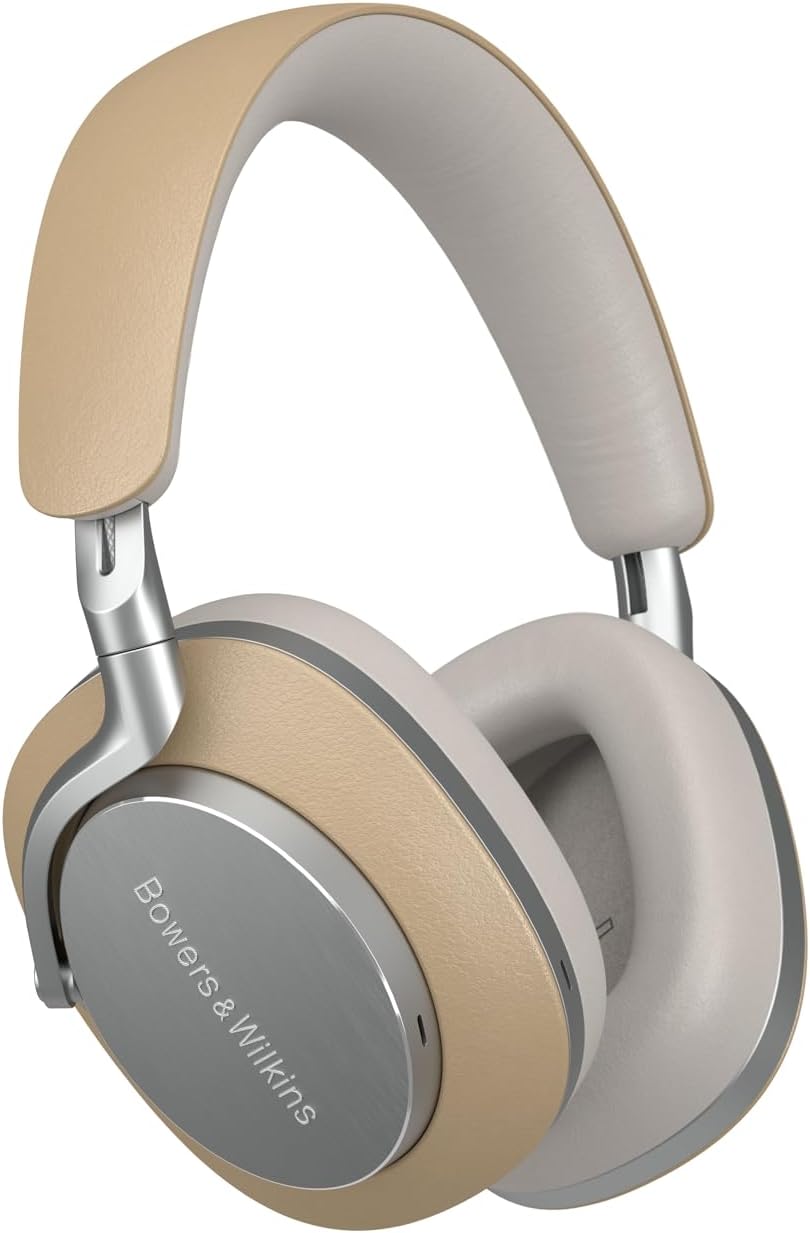
Bowers & Wilkins Px8
Bowers & Wilkins Px8 — key features, specs, and buying info at a glance. Check current price on Amazon.
The Bowers & Wilkins Px8 is the flagship of B&W’s wireless line — a statement headphone from a company whose reputation was built on loudspeakers, aimed at listeners who find the Sony and Bose flagships competent but sonically and materially unexciting. Carbon-cone drivers, cast aluminum arms, and Nappa leather over nearly every touch point make its intentions clear: this is a hi-fi product that happens to be wireless, not a gadget that happens to play music.
That loudspeaker heritage is not marketing garnish. B&W’s studio monitors have furnished professional control rooms for decades, and the Px8 reads as that engineering culture translated to headphones — acoustics and materials first, digital features a distant second. Launched in 2022 above the PX7 line, it exists specifically for the listener who auditioned the mainstream flagships and came away wanting more from the sound and the object, not the app.
The honest position: the Px8 sounds and feels like the luxury product it claims to be, and it asks a luxury price for advantages that are real but narrow. Whether it makes sense depends on which headphone virtues you actually rank first.
Built like the price tag
Where mainstream flagships committed to lightweight plastics, B&W machined and stitched. The cast aluminum arms move with a dampened precision that no polymer hinge matches, the diamond-cut bright edges catch light deliberately, and the Nappa leather on the headband and pads wears in rather than out. The arm mechanism deserves particular mention: adjustment slides with even, silent resistance and stays exactly where you put it, with none of the ratchet-clicking of the plastic competition. In the classic black or the tan that photographs so well, the whole assembly reads as an object someone was proud of. B&W has treated the platform as a canvas for occasional special editions, which says something about how the company itself regards it.
Physical buttons handle every control — volume and playback on the right cup, a quick-action key on the left — a quiet blessing for anyone who has fought a touch panel in winter gloves or paused a track by adjusting the fit. A wear sensor pauses music when the cups leave your ears, one of the few software conveniences B&W did adopt. The whole thing feels engineered for a decade of use, and the fit-and-finish consensus among owners backs that impression up.
On your head: the luxury taxes
The costs of all that material are the classic luxury ones. There is more weight here than the plastic competition carries, and you feel it as gentle pressure through the headband rather than as instability — fine seated, noticeable on a brisk walk. Glasses wearers report the standard over-ear tax — temple arms breaking the pad seal cost a little bass and a little hush — no worse here than elsewhere. The clamp is more assertive than the lounge-chair softness of a Bose: secure, seal-forming, and slightly firm for the first days until the headband relaxes and your head adjusts. Real leather pads run warmer than fabric or leatherette on long sessions, so a summer afternoon of listening ends with warmer ears than a mainstream flagship would leave.
None of this makes the Px8 uncomfortable — long-term owners routinely describe full workdays inside it — but it makes the character clear. This is jewelry-grade hardware with jewelry-grade practicality: substantial, deliberate, and unapologetic about preferring presence to weightlessness.
The sound is the argument
The Px8’s 40mm carbon-cone drivers, angled in their housings to fire evenly at the ear, deliver what long-term owners and independent reviewers consistently rank among the best sound available from any noise-cancelling wireless headphone: precise, articulate, and rhythmically confident, with deep controlled bass and a treble that reveals recording detail without turning clinical. Bass lines have texture rather than just weight; cymbals decay naturally instead of smearing; well-recorded live albums get a sense of space that processed mainstream tunings flatten. Rock and jazz benefit most obviously; dense electronic mixes stay legible where softer tunings blur them.
The character is energetic and detail-forward — music sounds awake — which distinguishes it from the smooth warmth of a Bang & Olufsen Beoplay H95, its most natural luxury rival, and from the DSP-shaped house sounds of Sony and Bose. The same quality has an edge: poor recordings and hot masters are revealed, not flattered. Feed it well-produced material and the Px8 sits at or near the top of the wireless pile; if sound quality is your first sorting criterion in this category, this is where the search tends to end.
The tuning also survives quiet listening better than most: at late-night volumes the bass keeps its texture and voices their body, where flatter headphones collapse into thinness. Turn it up instead and the drivers hold composure without congestion — the dynamic range between those two states is a large part of what the flagship premium buys. It is the difference between a headphone you check email in and one you occasionally stop working to listen to.
Feeding it properly: codecs and cables
B&W built real headroom into the inputs. Support for aptX Adaptive gives capable Android sources a higher-quality, latency-aware wireless pipeline, while iPhones fall back to AAC as they do on every headphone. The more interesting path is the USB-C port, which accepts digital audio directly — plug into a laptop at a desk and the Px8 runs as a wired headphone drawing a cleaner signal than Bluetooth can carry, which is exactly how the desk-bound should use it for serious listening. An included adapter cable covers analog sources and seat-back entertainment on flights.
This flexibility matters more here than on mainstream rivals because the drivers are good enough to show the difference. The practical rhythm many owners settle into: wireless on the move, USB-C at the desk, and a noticeable step up in resolution every time the cable goes in. Multipoint keeps a laptop and phone connected together, so the afternoon call catches you without re-pairing theater.
Noise cancellation and the world outside
Active noise cancellation is genuinely decent — commuting rumble, office chatter, and café noise recede convincingly, and for most daily environments the quiet is entirely sufficient. What it does not match is the vault-like silence of the best from Bose and Sony: on an aircraft or a loud train, more low-frequency roar survives here than on the mainstream flagships, and frequent flyers will hear the difference exactly where they care most. Transparency mode is natural-sounding and serviceable for conversations and announcements without the theatrical realism the biggest brands now manage.
The honest framing is priorities, not failure. B&W tuned a headphone that sounds excellent with ANC engaged — cancellation that does not audibly warp the music is its own achievement — and accepted second-tier silence as the cost. Buyers should accept it knowingly. In an open-plan office the calculus favors it more than the spec sheet suggests: keyboard clatter and mid-band chatter are exactly what it handles well, and the music does the rest of the isolating.
An app that stays out of the way
The companion app covers the essentials — ANC modes, wear-sensor settings, multipoint management, firmware updates — and then stops. EQ adjustment is notably limited compared with the full-band tools rivals ship; B&W evidently prefers you take the tuning as intended, and given the tuning, that stance is at least coherent. Software features generally trail the mainstream by a wide margin: no adaptive scene detection, no conversation modes, no ecosystem tricks, a plainer call experience that is adequate in quiet rooms and unremarkable in wind and traffic.
Multipoint connects two devices and behaves reasonably, and firmware arrives at a measured pace with occasional refinements rather than feature drops. None of these are failures; all of them are reminders that the money went into acoustics and metal, not firmware. Buy the Px8 for what it is on day one.
There is a quiet upside to the thin software: less to break. Owners report fewer of the app-tantrum sagas that plague feature-rich rivals, and the essential functions — listening, ANC, calls — never depend on the app being open at all.
Setup and the first week
First contact is friction-light. Pairing runs through the app or straight from the Bluetooth menu, a firmware check follows, and the physical controls explain themselves within an hour — the volume rocker and multifunction button fall under the right thumb, the quick-action key under the left. The week’s adjustments are mostly physical: the clamp reads firm on day one and relaxes into secure by day five, the leather warms from stiff to conforming, and you learn the wear sensor’s rhythm of pausing when the cups lift. The single habit worth building early is the USB-C one — plugging in at the desk instead of defaulting to Bluetooth — because it is the cheapest audible upgrade the product offers and the easiest to forget exists. Total time from box to properly configured is an evening, most of it spent listening rather than configuring.
Battery and the daily rhythm
B&W quotes 30 hours with noise cancellation running, and the practical translation is charging once or twice a week under heavy daily use — competitive for the class rather than exceptional, and comfortably enough for any itinerary short of expedition length. The quick-charge behavior is the number that matters in practice: a roughly fifteen-minute top-up buys about seven hours of playback by B&W’s figures, which converts the classic dead-battery-before-a-flight panic into a coffee’s worth of waiting. Charging is USB-C through the same port that carries audio, and the supplied case is a sensible semi-rigid affair that protects without the bulk of the aluminum trunk B&O ships. The wear sensor helps at the margins, pausing playback the moment the cups leave your ears, so charge is rarely spent entertaining an empty room.
The in-house problem
The Px8’s most dangerous competitor is its own sibling. The Bowers & Wilkins PX7 S2e delivers a substantial share of the Px8’s sonic character and the same design language in cheaper materials, at a much lower price. The flagship’s genuine advantages — the carbon drivers’ extra resolution and composure, the aluminum-and-Nappa build — are exactly the kind of refinements that reward attentive listeners and vanish for casual ones, on a commute, over lossy streams, in noisy rooms.
The honest test: if most of your listening is podcasts and background playlists in transit, the PX7 S2e gives you nearly everything that matters here. If you sit down with albums, notice mastering differences, and will plug in over USB-C at a desk, the gap is real and audible. Every prospective Px8 buyer should answer that question before checkout, because a large fraction of the category’s buyers demonstrably fall in the first group. The sibling question has a hardware dimension too: the S2e’s lighter build is the more comfortable all-day commuter, which means the Px8 must win in the listening chair to win at all.
Against the wider field
Versus the mainstream flagships, the trade is symmetrical. A Sony WH-1000XM6 or Bose QuietComfort Ultra wins on noise cancellation, app maturity, call quality, and price; the Px8 wins on sound quality and construction, decisively. An Apple AirPods Max splits the difference for iPhone owners — aluminum build and seamless ecosystem behavior, with a sound that B&W’s tuning outclasses for attentive listening. None of the mainstream three will embarrass you; the question is whether their sound would leave you curious about what you missed.
Versus the Beoplay H95, the Px8 undercuts on price and arguably wins the pure listening contest with its more resolving, energetic presentation, while conceding B&O’s superior control dials, longer battery life, and even more extravagant materials. There is no headphone in this class without a compromise; the Px8’s compromise is simply that it treats silence and software as secondary to sound. And for the listener whose priority is purely sound per unit of money, with no wireless requirement at all, a wired closed-back like the FiiO FT1 makes the whole ANC category blush — a useful sanity check before spending flagship sums on Bluetooth convenience.
Owning it for the long haul
The long-term case rests on the same materials the price does. Cast aluminum shrugs off the scuffs that scar painted plastic, Nappa leather develops patina rather than peeling the way protein-leather pads eventually do, and multi-year owners report the structure staying tight where plastic rivals loosen. Firmware support has been steady if unhurried, and the physical controls remove the touch-panel degradation that ages other flagships. The sealed battery remains the mortal component, as with every wireless headphone; the frame around it is built to outlast several battery lifecycles’ worth of mainstream rivals, which quietly improves the value arithmetic the longer you keep it. Physical switches age predictably too, where the touch surfaces on rivals grow erratic with years and weather, and the luxury tier tends to hold secondhand value better than mainstream flagships, whose prices sag the week a successor ships.
The buying logic
Buy the Px8 if audio quality leads your priorities, you appreciate materials that justify themselves every time you pick the thing up, some of your listening happens wired at a desk where the drivers can show their range, and ANC merely needs to be good rather than best-in-class. It is the audiophile’s choice among luxury wireless headphones, and it holds that title comfortably.
Skip it if noise cancellation is the mission, if you live in the feature-rich apps of the mainstream flagships — or if, on honest reflection, the PX7 S2e would give you most of this experience while leaving serious money in your pocket. The Px8 rewards exactly the listener it was built for and quietly overserves everyone else. Between colorways the choice is aesthetic alone; there is no configuration lottery here, only the decision itself.
Our take
Verdict: B&W’s luxury statement headphone — superb sound and materials at a price that demands you really want them.
The problem. You want a premium wireless headphone that looks and feels as good as it sounds. Why it matters. At this tier you’re paying for materials and tuning, not just feature counts. What it is. B&W’s flagship: carbon-cone drivers, cast-aluminium arms, Nappa leather, aptX Adaptive and a detailed, refined signature a notch above the PX7 S2e.
Pros
- Excellent, articulate sound — arguably the best in B&W’s wireless line
- Genuinely premium leather-and-metal build
- aptX Adaptive support
Cons
- Very expensive for what is still an ANC-class headphone
- ANC and app trail Sony/Bose
- Heavier and warmer to wear than mainstream rivals
Who should buy it
- Buyers who want a luxury-grade headphone and prioritise sound and materials over ANC
Who should skip it
- Anyone chasing best-in-class noise cancellation or value — the PX7 S2e gets most of the sound for far less
Bottom line. A beautiful indulgence; justified only if build and sound matter more to you than the price gap to the PX7 S2e.