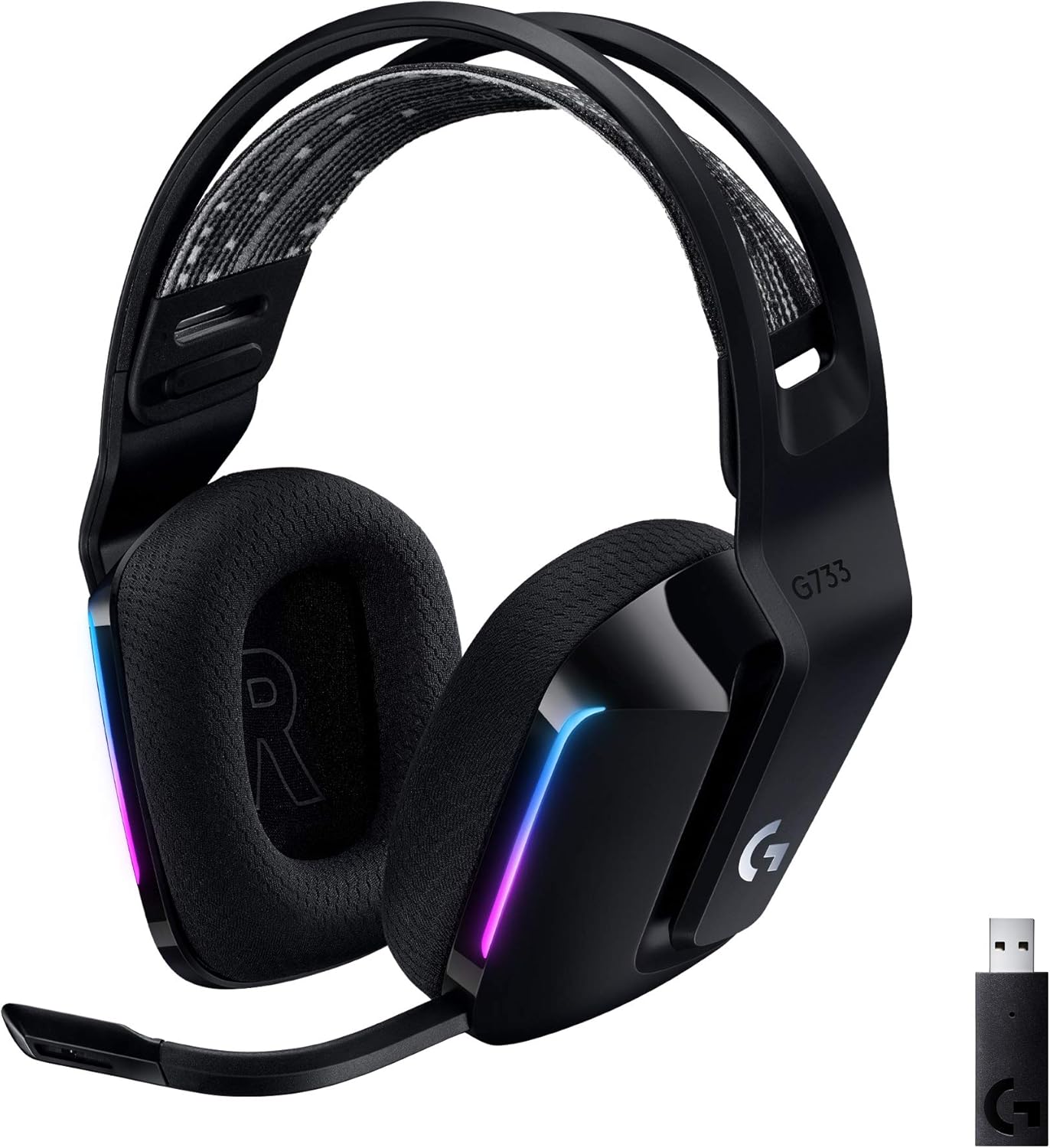
Logitech G733 LIGHTSPEED Wireless Gaming Headset – Suspension Headband, Lightsync RGB, Blue VO!CE Mic, PRO-G 40 mm Drivers (Black)
Logitech G733 — ultra-lightweight wireless gaming headset with 40 mm PRO-G drivers, 29-hour battery life, 20 m wireless range via LIGHTSPEED, RGB lighting, detachable mic with Blue VO!CE filters. Designed for comfort & immersive sound across PC, consoles & streaming.
The Logitech G733 LIGHTSPEED approaches the wireless gaming headset from an angle most rivals ignore: make it light, make it comfortable, and make it look like something other than tactical gear. It’s a pair of featherweight cups on an elastic suspension strap, sold in colors — lilac and blue alongside the usual black and white — that signal fun rather than esports severity, and it has stayed in Logitech’s lineup for years because the formula holds up.
For PC and PlayStation players who sit through long sessions, comfort-first design is the whole pitch, and it mostly lands: the G733 is the kind of headset you forget you’re wearing, connected by a wireless link you forget is wireless. The honest caveats are just as clear-cut. The microphone is ordinary for the money, there is no Bluetooth or 3.5 mm fallback of any kind, and the all-plastic build keeps the weight down at some cost to the feeling of substance. This review takes each of those in turn, because which one matters depends on how you actually play.
Designed to be forgotten on your head
At 278 grams, the G733 is one of the lighter wireless headsets around, and the number understates the effect because of how the weight is carried. There is no padded band pressing a stripe into the top of your skull; instead, a soft elastic strap suspends the frame above your head and spreads the load across its whole width. Combined with dual-layer memory-foam earpads and a deliberately gentle clamp, the result is the consistent long-term owner verdict that matters most in this category: hours into a session, you stop noticing you’re wearing it. No hot spot at the crown, no jaw ache from clamping force, and — a detail glasses wearers will care about — temples that don’t get pressed into the arms of your frames the way stiffer headsets manage within an hour.
The trade is real, though. That same light clamp means a fairly loose hold on your head. Lean forward sharply to grab something off the floor and the headset shifts; whip your head around in a jump-scare and you’ll feel it move. This is a headset engineered for sitting at a desk through a long evening, not for anyone who is animated mid-match or hoping to double-duty it at the gym. The earcups are also on the shallower side of average — most ears sit fine, but if yours are large or protruding, the driver plate may make contact where deeper cups wouldn’t.
A look that isn’t tactical gear
Gaming headsets tend to dress like military surplus; the G733 dresses like a sneaker. The matte plastic comes in genuinely different colors rather than black-with-accent, the suspension strap is reversible for a second color combination out of the box, and Logitech sells replacement straps and mic covers separately so the look can be reconfigured over time. The Lightsync RGB is confined to two zones on the front edge of the earcups, which is worth understanding before you get attached to it: facing forward, it’s visible to your webcam audience and your roommates, not to you. For a streamer on camera it’s a legitimate part of the kit; for a solo player it’s decoration you literally cannot see and pay for in battery. The whole aesthetic reads deliberately un-serious, and for a lot of players — particularly anyone tired of headsets that look like they ship with a rules of engagement card — that’s a feature, not a footnote.
Wireless you stop thinking about
The LIGHTSPEED link is the other pillar, and it behaves like infrastructure: invisible when working, which is essentially always. The 2.4 GHz USB-A dongle delivers latency low enough to be a non-issue even in competitive shooters — lips sync, footsteps land where they should, and there’s none of the audio lag that makes Bluetooth unusable for serious play. Logitech rates the range at roughly 20 meters, and the practical translation is that you can walk to the kitchen mid-lobby, refill a drink, and come back without a dropout, walls permitting. Interference complaints are rare even on desks crowded with other 2.4 GHz devices, which is not something every dongle-based headset can claim.
The compatibility picture is simple and rigid. The dongle works with PCs and with PlayStation consoles plugged in over USB; Xbox is not supported at all, because Microsoft’s wireless protocol is proprietary. And that dongle is the only door in — no Bluetooth radio, no analog jack — so phones, tablets, and anything without a free USB port are simply out. Multi-platform players should read that sentence twice before buying.
Battery life and the RGB tax
Logitech’s own numbers tell the story cleanly: up to 29 hours with the lighting off, and meaningfully less — around twenty — with the default Lightsync animation running. That makes the RGB a genuine line item rather than a freebie, and most long-term owners end up in one of two camps: streamers who keep the lights on and charge more often as the cost of the look, and everyone else, who disables the lighting in G HUB within the first month and enjoys a headset that comfortably outlasts a week of evening sessions between top-ups.
Charging happens over USB-C, and the practical rhythm is undramatic: plug it in overnight once a week, or leave it on the charge cable whenever you’re away from the desk. The headset announces low battery with a voice prompt early enough to finish a match and find the cable. What you don’t get is any fast-charge headline or wireless charging — just a battery big enough that, lights off, you’ll rarely think about it.
How it sounds
The 40 mm PRO-G drivers deliver a warm, bass-forward tuning that flatters games first. Explosions and engine notes carry the weight game sound design expects, footsteps and reload sounds stay legible in the mix, and directional cues through the stereo image are clear for the class — good enough that you’ll turn toward the right doorway on sound alone. On PC, G HUB adds DTS Headphone:X 2.0 virtual surround, which some players find genuinely helps positional awareness in large open maps and others find smears the mix; it’s a toggle worth trying for an evening and keeping only if your ears vote yes.
Held against wired headphones at similar money, the G733 is unremarkable for music: the default tuning has a somewhat soft, polite top end, and fine detail in acoustic material goes missing. The parametric EQ in G HUB recovers a good deal of that — ten minutes spent pulling the bass shelf down and lifting the treble produces a noticeably more balanced listen, and profiles can be saved per use. But the honest framing is that this is a headset for games first and playlists second; anyone whose listening is mostly music should be shopping in a different aisle, and this review returns to that in the comparisons below.
The microphone is the compromise
The detachable boom mic is where the budget clearly ran thin, and it’s the gap between the G733 and headsets half a class up. Voice comes across thin and compressed — perfectly serviceable for party chat, where your squad hears you clearly and nobody thinks about fidelity, and noticeably below what streamers, podcasters, or people on all-day work calls should accept. There’s a hard consonant edge and a lack of body to the sound that no amount of positioning fully fixes.
Logitech’s answer is software. The Blue VO!CE suite in G HUB brings broadcast-style processing — EQ presets, a noise gate, a compressor, de-essing — and it genuinely helps: a few minutes with the presets takes the mic from flat to presentable. But processing shapes the signal the capsule captured; it cannot upgrade the capsule. The practical guidance long-term owners converge on: for chat, use the boom and enable Blue VO!CE; for content, plan around a dedicated microphone such as the Shure MV7+ and treat the boom as the backup for nights the real mic stays off. The boom detaches cleanly when you don’t need it, which at least means the headset doesn’t wear its weakest feature at all times.
G HUB, for better and worse
Everything configurable about the G733 — EQ, lighting, Blue VO!CE, surround, button assignments — lives in G HUB, and the software is the most polarizing part of the ownership experience. On a good day it’s capable and reasonably clear once you learn its tile-based layout. The recurring gripes from long-term owners are about the other days: a heavyweight install for what should be a set-and-forget peripheral, occasional sign-in prompts, updates that arrive at inconvenient moments, and settings that intermittently need reapplying after an update. None of it is disqualifying, and the sensible pattern is to do one thorough setup session — EQ profile, mic chain, lighting off or tuned, then saved to the headset’s onboard memory where supported — and open the app as rarely as possible afterward. PlayStation players should note the flip side: with no G HUB on console, the headset runs whatever profile was last configured, so do that setup on a PC first if you can.
The first week of ownership
Out of the box, the G733 is nearly plug-and-play: dongle into a USB port, power on, and sound is flowing before G HUB has even finished installing. The genuine first-week work is physical, and it’s worth doing properly. The suspension strap adjusts through a row of notches rather than a slider — you thread it to one of several preset positions to set how low the cups sit — and getting that right is the difference between the floating-on-your-head feel owners rave about and cups that sit a centimeter too low and rest on your jaw. Expect two or three tries across the first few evenings before it’s dialed.
The mic wants the same attention: the boom is flexible, and voice quality improves noticeably when it’s bent to sit beside the corner of your mouth rather than in front of it, where plosives pop. Turn on sidetone in G HUB while you’re there — hearing a little of your own voice stops the shouting that closed cups otherwise induce on chat. PlayStation owners have one extra step worth knowing: plug the dongle into the console, and the headset simply works as a USB audio device, no menu spelunking required — just remember that whatever EQ and mic settings you saved on a PC are the ones you’ll be living with.
The controls and the daily rhythm
Day to day, the G733 runs on three controls on the left earcup: a power button, a dedicated mic mute, and a volume roller. The roller has a light, smooth action that’s easy to find by feel mid-game; the mute button sits distinctly enough that you won’t confuse the two while looking at a screen. What’s missing is any flip-to-mute on the boom itself — the gesture most headset veterans reach for — so muting is a button habit you’ll build in the first week. The voice prompts for power, connection, and battery are clear without being chatty. Small quality-of-life note: the headset powers off on its own after a stretch of inactivity, which rescues the battery from the classic left-it-on-overnight mistake.
Build and long-term durability
The all-plastic construction is a double-edged decision. It’s what makes 278 grams possible, and the frame flexes rather than snaps under the everyday abuse of being dropped on a desk or stuffed in a backpack. But it feels more toy than tool in the hand — there’s a hollowness to the shells that the fun colorways amplify — and the long-term reports include a familiar pattern for light plastic headsets: creaks developing at the adjustment points over time, and occasional cracked hinge complaints from owners who treat headsets roughly. The suspension strap and earpads, the two parts that actually wear, are both replaceable, which meaningfully extends the realistic lifespan. The battery is the eventual clock on any wireless headset, and here the honest expectation is gradual capacity fade after a couple of years of heavy use — mitigated by the fact that lights-off battery life starts from such a high ceiling that even a faded cell covers a week of evenings.
Where it fits — rivals and roles
The clarifying question is what job the headset is actually for. If the job is long desk sessions of games with voice chat, the G733’s comfort-plus-LIGHTSPEED combination is hard to beat near its price, and its weaknesses barely register. If the job includes commuting, flights, or serious music listening, a dedicated pair like the Sony WH-1000XM4 does everything the G733 can’t — noise cancellation, Bluetooth, multipoint — and nothing it can; those are complements, not competitors. Pure sound-per-money listeners should look at wired closed-backs like the FiiO FT1, which embarrass any wireless gaming headset for fidelity at the cost of a cable and zero microphone. And for anyone building a streaming corner around this headset, it slots naturally into a desk that already includes an Elgato Facecam MK.2 and a Stream Deck MK.2 — with the mic duties handled by something dedicated, as argued above.
Who it’s for
If you’re a PC or PlayStation player who values comfort above all, wants dependable low-latency wireless, and likes a bit of personality in desk gear, the G733 is an easy recommendation — and it ages well precisely because comfort doesn’t go out of date the way spec-sheet features do. Turn the lights off, spend one evening in G HUB on the EQ and mic chain, and it disappears into your routine. If you need one headset to cover console, phone, and laptop over Bluetooth, if you play on Xbox, or if your voice is part of your livelihood, this is the wrong tool — no amount of comfort compensates for a missing radio or a modest capsule. Buy it for the fit and the wireless, not the boom, and it will earn its keep across many long evenings.
Our take
Verdict: A light, comfortable, colourful wireless gaming headset — let down mainly by an average mic.
The problem. Long gaming sessions need a headset that stays comfortable and won’t tether you to the PC. Why it matters. Weight and clamp matter more over a four-hour raid than any spec on the box. What it is. Logitech’s wireless gaming headset: LIGHTSPEED 2.4GHz wireless, a suspension headband, RGB lighting and a very light build.
Pros
- Genuinely light and comfortable for long sessions
- Reliable low-latency LIGHTSPEED wireless
- Fun Lightsync RGB and colour options
Cons
- Detachable mic is mediocre for the price
- No Bluetooth — 2.4GHz dongle only
- Plastic build and modest battery life
Who should buy it
- PC gamers who prioritise all-day comfort and low-latency wireless
Who should skip it
- Streamers needing broadcast-quality mic, or anyone wanting Bluetooth versatility
Bottom line. Comfortable and reliable for gaming; pair it with a separate mic if voice quality matters.