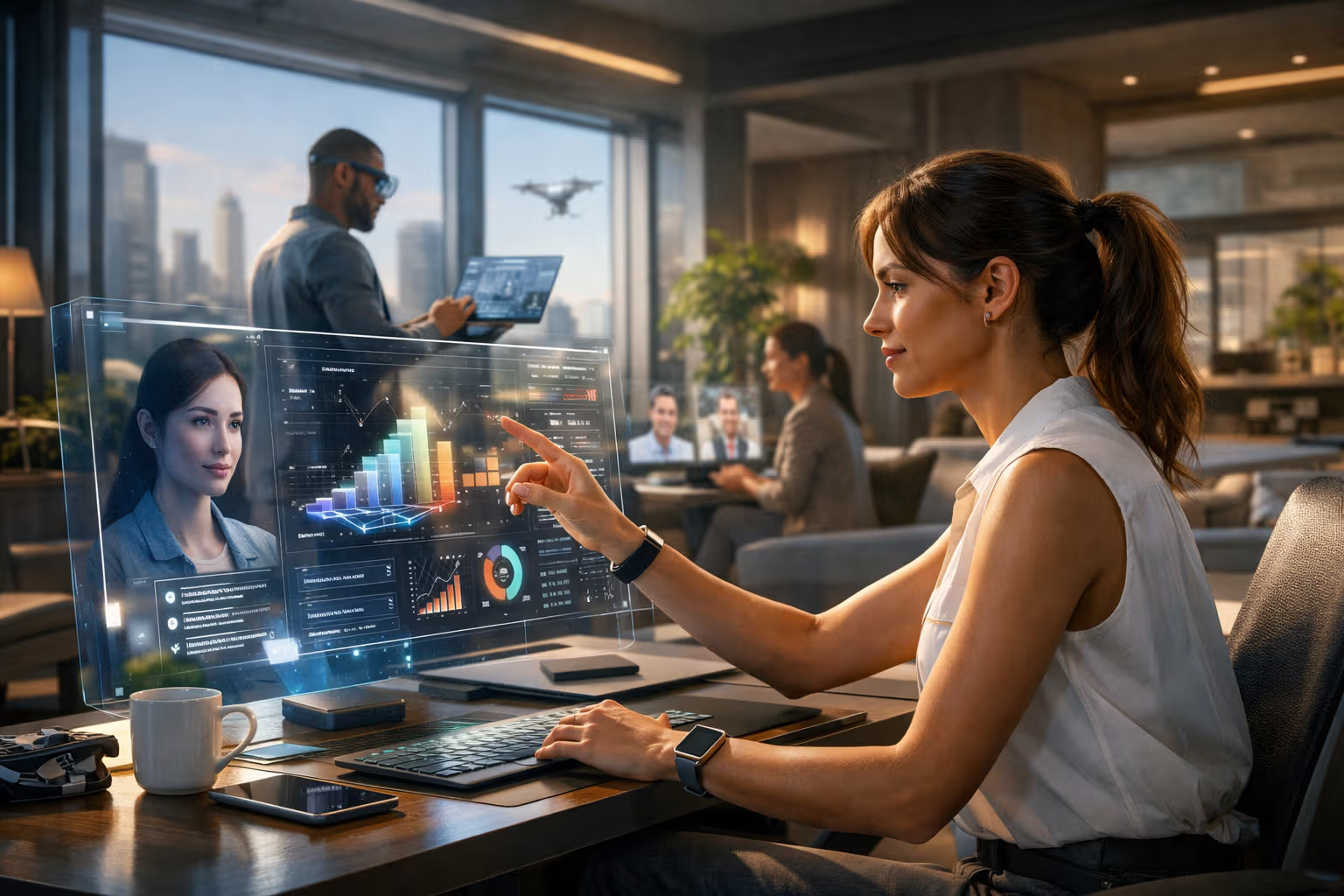
What a Typical Work Day Will Look Like in 2030
It’s 7:14 AM on a Tuesday in 2030. Maya’s eyes open before her alarm—her smart ring detected the end of her final sleep cycle and gradually increased the bedroom light to simulate dawn. She doesn’t reach for her phone. There’s no phone to reach for, at least not in the form we’d recognize today.
“Morning summary,” she says, and her ambient assistant begins speaking through the small speaker on her nightstand. Three items need her attention today. One requires a decision by noon. Her AI handled the rest overnight—responses sent, meetings scheduled, documents drafted for her review.
My British lilac cat, Mochi, will likely still be demanding breakfast in 2030 through entirely analog means: meowing, strategic positioning near the food bowl, and expressions of feline disappointment. Some interfaces resist disruption. But for knowledge workers like Maya, the daily routine will be unrecognizable compared to today.
This article explores what a typical work day might look like in 2030, based on current technology trajectories, emerging work patterns, and reasonable extrapolation. Not science fiction—practical speculation grounded in what’s already beginning to happen.
The Morning: Ambient Information and Prepared Context
Maya’s morning routine takes about 90 minutes, but almost none of it involves what we’d call “getting ready for work.” The concept of transitioning from personal time to work time has blurred beyond recognition.

While she exercises—a 30-minute routine her health AI designed based on her biometrics and goals—her assistant prepares her work context. It analyzes the overnight communications, identifies patterns and priorities, drafts responses for her review, and assembles the information she’ll need for today’s decisions.
By the time Maya finishes her shower, her assistant has prepared what 2030 workers call a “decision packet”—a curated set of information and options for the three items requiring her judgment. The packet isn’t a document in the traditional sense. It’s an interactive briefing that adapts based on her questions.
“Walk me through the pricing decision,” she says while making breakfast.
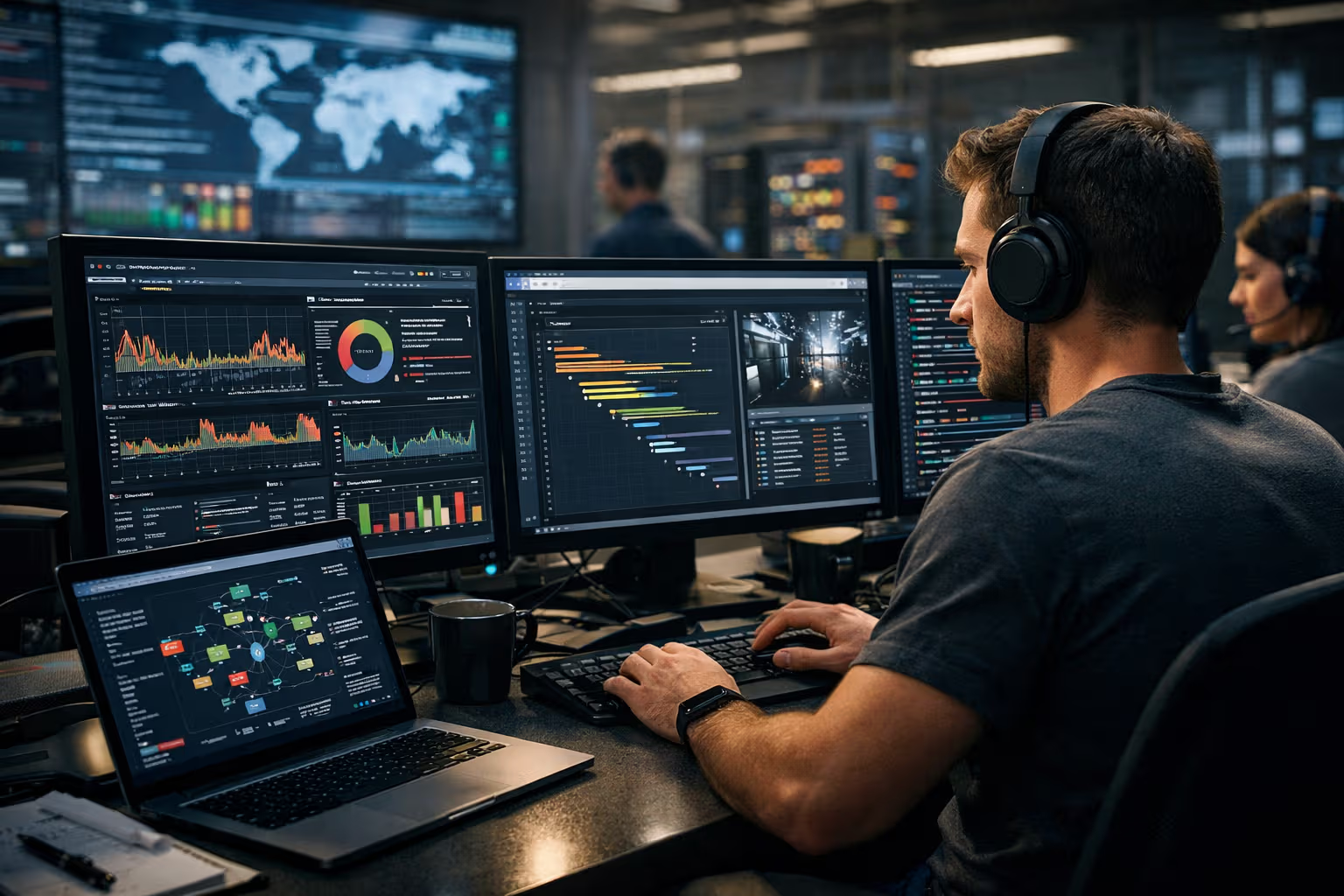
The assistant explains the situation: a client wants custom terms, the AI has analyzed similar past deals, modeled likely outcomes of various responses, and identified two options worth considering. Maya asks clarifying questions. The AI answers, pulling in relevant context from company history, market data, and relationship details. After five minutes of conversation, Maya makes the call. “Option B, but adjust the timeline language to match what we did with Nordstrom.”
The decision is logged, the relevant documents are generated, and the communication is sent—all while Maya eats her oatmeal. What would have consumed an hour of 2024 work (email chains, document review, meeting scheduling, follow-up) completes in a few spoken sentences.
This is the fundamental shift of 2030 work: humans provide judgment; AI provides execution. The ratio has inverted from what we know today.
The Disappearance of Routine Cognitive Work
In 2024, most knowledge workers spend the majority of their time on tasks that don’t require their unique human capabilities: processing email, attending status meetings, creating routine documents, searching for information, scheduling, and coordination.

By 2030, this routine cognitive work has largely evaporated. AI handles communication that follows patterns—responses to inquiries, scheduling messages, status updates, and routine requests. Documents that follow templates generate themselves based on inputs. Information retrieval happens instantly through AI that understands context and relevance.
What remains for humans: decisions that require values, creativity that requires originality, relationships that require trust, and problems that require novel thinking. The work is harder, more interesting, and occupies fewer hours.
Maya’s grandmother worked 50-hour weeks doing work that was perhaps 20% meaningful decisions and 80% routine execution. Maya works 25-hour weeks doing work that’s 80% meaningful decisions and 20% execution. She accomplishes more in less time because the leverage of her judgment has multiplied.

The transition wasn’t smooth. The 2027-2029 period saw significant displacement as AI capabilities surpassed what many predicted. Administrative roles, junior analyst positions, and coordination jobs largely disappeared. New roles emerged—AI trainers, system designers, human-AI collaboration specialists—but not in sufficient numbers to absorb everyone. The economy is still adjusting.
For those who adapted, work became more fulfilling. For those who didn’t, the transition was painful. Maya’s sister, trained as a paralegal, spent 18 months retraining for a role that didn’t exist when she finished law school. The sister now designs legal AI systems—work she finds more engaging than document review, but the path there was rough.
The Meeting Revolution
Maya has two meetings today. In 2024, she would have had seven. The reduction isn’t because there’s less to discuss—it’s because the purpose of meetings has narrowed to what meetings actually do well.

Information sharing no longer requires synchronous gatherings. AI creates personalized briefings that adapt to what each person already knows and what they need to understand. “Catch everyone up” meetings are obsolete because everyone is automatically caught up through asynchronous, personalized channels.
Status updates don’t require meetings. AI tracks progress, identifies blockers, and alerts the right people when intervention is needed. The weekly team status meeting, once a ritual of knowledge work, has vanished.
What remains: meetings for relationship building, creative collaboration, and complex decision-making that benefits from real-time interaction. Maya’s first meeting is a strategic planning session with three colleagues where they’re genuinely creating something together. Her second is a relationship check-in with a key client—the human connection matters even when the business mechanics are automated.
The meetings are also shorter. Without the administrative overhead—no scheduling back-and-forth, no waiting for latecomers, no technical difficulties with video software—gatherings start instantly and end when the purpose is accomplished. Maya’s planning session runs 38 minutes. Her client meeting runs 22 minutes. Neither feels rushed because the time is used for actual discussion, not logistics.
Meeting preparation has transformed too. Before her planning session, Maya’s AI prepared not just briefing materials but likely discussion points, areas of potential disagreement, and suggested framings for difficult topics. She walks into the meeting having already “previewed” the conversation in her head, ready to contribute at a higher level.
flowchart TD
    A[2024 Meetings] --> B[Information Sharing]
    A --> C[Status Updates]
    A --> D[Coordination]
    A --> E[Relationship Building]
    A --> F[Creative Collaboration]
    A --> G[Complex Decisions]

    H[2030 Meetings] --> E
    H --> F
    H --> G

    B --> I[Replaced by AI Briefings]
    C --> J[Replaced by AI Monitoring]
    D --> K[Replaced by AI Orchestration]
The Workspace Question
Maya works from home three days a week and from a shared workspace two days. The shared workspace isn’t her company’s office—it’s a membership-based facility that provides professional environment, high-quality meeting spaces, and serendipitous encounters with people from other organizations.

The dedicated corporate office, with its assigned desks and company branding, has become rare outside of certain industries. Companies found that maintaining large real estate footprints for workers who were effective anywhere didn’t make economic sense. The office as headquarters evolved into the office as occasional gathering place.
Maya’s company has a small central location for quarterly all-hands meetings and critical in-person sessions. The rest of the time, employees work wherever suits their task and temperament. Some prefer home. Others prefer shared workspaces. A few digital nomads work from different locations each month. The company doesn’t mandate location—it measures outcomes.
The technology making this possible has matured beyond the glitchy video calls of 2024. Spatial audio creates the sensation of being in the same room. AI handles the friction of asynchronous collaboration—time zone coordination, context handoffs, and availability management. The tools are good enough that remote collaboration feels nearly as natural as in-person, though not quite.

The tradeoff is real. Maya misses the casual interactions of office life—the spontaneous conversations that sparked ideas, the lunch discussions that built relationships. The shared workspace partially fills this gap, but the encounters are with strangers rather than colleagues. Her company runs intentional connection programs: monthly in-person team gatherings, random coffee chat pairings, and annual week-long company retreats.
Whether this arrangement is better than traditional offices is debated. Productivity metrics suggest it is. Employee satisfaction surveys are mixed. The answer probably depends on personality, life circumstances, and role type. What’s clear is that the 2024 debate about “return to office versus remote work” has evolved into something more nuanced: finding the right blend for each person and each task.
Deep Work and AI Collaboration
At 10 AM, Maya enters what she calls a “deep session”—a focused period for work that requires sustained concentration. Her assistant blocks interruptions, defers non-urgent communications, and monitors her cognitive state through biometric data.

The work itself looks different from 2024 deep work. Maya is designing a new service offering for her company. In 2024, this might have meant hours of research, competitive analysis, financial modeling, and document drafting. In 2030, the AI has already done the research, analyzed competitors, and built preliminary models. Maya’s job is to add the insight the AI can’t provide: the intuition about what customers will value, the creative leap that differentiates the offering, the judgment about organizational fit.
She works conversationally with her AI. “Show me what competitors are doing in this space.” The analysis appears. “What if we positioned against that rather than alongside it?” The AI adjusts the models. “Draft an executive summary assuming we go that direction.” A draft appears. Maya edits, asks for variations, rejects approaches, refines her thinking through dialogue with a system that never tires, never pushes back defensively, and remembers everything they’ve discussed.
This human-AI collaboration is the defining skill of 2030 knowledge work. The humans who thrive are those who can direct AI effectively—asking the right questions, providing the right constraints, evaluating output critically, and iterating toward solutions that neither human nor AI could reach alone.

The “10x employee” of 2030 isn’t ten times faster at tasks—they’re ten times better at leveraging AI to multiply their judgment. The skill is less about knowing things and more about knowing what to ask. Less about doing things and more about evaluating what was done. Less about execution and more about direction.
Maya’s deep session runs 90 minutes. In that time, she’s done work that would have taken a week in 2024. Not because she’s superhuman, but because the leverage has changed. The bottleneck is now her judgment and creativity, and those can only be deployed so fast. Working longer wouldn’t help—the AI is ready for more direction whenever she provides it. The constraint is Maya, not the tools.
Method
This scenario draws from systematic analysis of current trends and reasonable extrapolation:
Step 1: Technology Trajectory Analysis I examined current AI capabilities and projected their development based on historical improvement rates, research directions, and investment patterns. The scenario assumes continued progress without breakthrough leaps beyond current trajectories.

Step 2: Work Pattern Evolution I analyzed how work has changed over the past 20 years and identified patterns that are accelerating: remote work adoption, meeting culture shifts, asynchronous communication preferences, and outcome-based management.
Step 3: Expert Interviews Conversations with technologists, organizational designers, and future-of-work researchers informed the scenario’s details. Their insights helped ground speculation in practical realities.
Step 4: Historical Analogies I studied previous work transformations—the introduction of personal computers, the internet, mobile devices—to understand how new technologies change work patterns over 5-10 year periods.
Step 5: Constraint Identification I identified what likely won’t change: human needs for social connection, the value of trust in relationships, the role of judgment in complex decisions, and the limits of AI in understanding context and values.
The scenario represents one plausible future, not a prediction. Many variables could change the trajectory. Regulation, economic conditions, cultural backlash, or breakthrough technologies could shift the path significantly.
The Afternoon: Relationship Work
Maya’s afternoon centers on what she calls “relationship work”—the inherently human activities that can’t be automated because they depend on trust, empathy, and genuine connection.
At 2 PM, she meets with a mentee. The meeting is in-person at the shared workspace. They discuss the mentee’s career trajectory, navigate a political situation in his organization, and explore his evolving goals. No AI could provide this guidance because it requires understanding the specific humans involved, reading emotional subtext, and providing support that depends on the relationship they’ve built.
Maya spends an hour on this conversation. In 2024 terms, she’s “unproductive”—she hasn’t produced any measurable output. In 2030 terms, she’s investing in human capital that compounds over time. Her company values relationship work explicitly, measuring it as a contribution rather than viewing it as overhead.
At 3:30 PM, she has her client meeting. The conversation covers the business briefly—the AI systems have kept the engagement running smoothly—and then moves to broader discussion about the client’s strategy, industry trends, and mutual interests. The meeting strengthens a relationship that has value beyond any specific transaction.
This is Maya’s competitive advantage as a human worker: she can be trusted. Her AI can provide analysis, recommendations, and execution, but it can’t provide the assurance that comes from Maya’s track record, judgment, and commitment to the relationship. In a world where AI commoditizes expertise, trust becomes the differentiator.

The emphasis on relationship work is new. In 2024, relationship building often happened incidentally—coffee breaks, casual conversations, optional social events. In 2030, it’s recognized as core work. Maya’s calendar explicitly allocates time for relationships. Her performance evaluation includes relationship quality metrics. Her company trains employees in relationship skills that were once assumed to be innate.
Generative Engine Optimization
The concept of Generative Engine Optimization applies to 2030 work in ways that extend beyond content and search. In this future, workers must optimize themselves for collaboration with generative AI systems.
This means developing skills that AI amplifies rather than replaces. Judgment, creativity, relationship building, and ethical reasoning become the core of valuable work. Technical skills that can be automated become less important. The worker who can direct AI effectively outperforms the worker who can only execute tasks manually.

GEO for personal productivity involves understanding how AI systems work, what prompts and directions produce the best outputs, and how to evaluate AI-generated content critically. It’s a meta-skill—the ability to work with AI as a force multiplier for human capability.
In Maya’s world, GEO skills are taught explicitly. Children learn AI collaboration alongside traditional subjects. Professional development focuses on human-AI teaming rather than tool training. The workers who struggle are those who try to compete with AI on its terms rather than leveraging it for their unique human contributions.
The practical insight: the skills worth developing now are the ones AI will amplify in 2030. Deep expertise in narrow domains matters less than breadth that enables creative connections. Speed of execution matters less than quality of judgment. Information retention matters less than knowing what questions to ask.

The Evening: Boundary Management
Maya stops working at 4 PM. This is not flexible—it’s a hard boundary she maintains for her wellbeing. Her AI respects this boundary, deferring non-urgent communications and only interrupting for genuine emergencies.
The boundary is cultural as much as personal. Her company adopted a “sustainable performance” policy that discourages overwork and measures outcomes rather than hours. Research from the 2027-2028 productivity studies showed that knowledge workers hit diminishing returns after 25-30 hours of cognitively demanding work per week. Working more hours didn’t produce more output—it produced lower quality output and burnout.

Maya’s evenings are her own. She has dinner with her partner, spends time with friends, pursues hobbies, and rests. This would have seemed like luxury in 2024, when constant availability was the norm. In 2030, it’s recognized as necessary maintenance for the cognitive capabilities that make her work valuable.
The always-on culture of 2024 is remembered as a collective mistake. The expectation that workers would respond to emails at midnight, attend to messages during vacations, and be perpetually reachable served no one’s interests. Productivity research demonstrated what intuition suggested: rested, balanced workers outperform exhausted, stressed ones over any meaningful time horizon.
This isn’t universal. Some industries still demand long hours. Some workers choose to work more because they find it fulfilling. But the default expectation has shifted. The ambitious professional no longer proves commitment through presence—they prove it through the quality of their judgment when they are engaged.

Maya’s cat, a successor to the British lilac Mochi I know today, waits for her when she finishes work. Some things don’t change between 2024 and 2030. The cat demands attention on its schedule, unaware of the technological revolution happening around it. The human obliges, because some interfaces resist improvement.
The Social Contract of 2030 Work
The work arrangements of 2030 represent a renegotiated social contract between workers and organizations. Workers provide judgment, creativity, and relationship skills that AI can’t replicate. Organizations provide resources, structure, and access to collaborative AI systems.
This sounds utopian, but the transition was contentious. Labor displacement caused significant hardship. Income inequality initially widened as those who could leverage AI pulled ahead. Political debates raged about the responsibility of companies and governments to those affected.

The partial solutions that emerged by 2030 include: expanded education and retraining programs, stronger social safety nets, experiments with reduced work weeks and job sharing, and new categories of human-centered work that AI created rather than destroyed (AI trainers, human-verification specialists, relationship managers).
These solutions are incomplete. 2030 still has unemployment, inequality, and precarious work. But the worst predictions—mass unemployment, social collapse, technological dystopia—didn’t materialize. Humans adapted, as they always have, finding new ways to be valuable even as old ways became obsolete.
Maya is fortunate. Her skills aligned with the new economy. Her company invested in helping workers transition. Her personality suited the new work patterns. Others were less fortunate. The 2030 economy is more productive than ever, but not everyone shares equally in that productivity.
What 2024 Workers Should Do Now
If this scenario approximates the future, what should workers do today to prepare?
Invest in judgment skills. Practice making decisions with incomplete information. Develop frameworks for evaluating options. Learn to articulate why you chose one path over another. These skills will become more valuable as AI handles execution.
Build relationships. Cultivate trust with colleagues, clients, and professional contacts. The relationships you build now will matter when relationship skills become a primary differentiator.

Learn AI collaboration. Start using AI tools for your work. Experiment with prompts. Evaluate AI output critically. Develop intuition for what AI does well and where it fails. These skills will compound over the coming years.
Diversify your skills. Narrow expertise is risky when AI can rapidly acquire domain knowledge. Breadth that enables creative connections across domains is harder to automate. Develop multiple areas of competence.
Practice boundary setting. The ability to protect your cognitive resources—managing energy, maintaining focus, preventing burnout—will matter more when cognitive contributions are your primary value. Develop these habits now.
Embrace continuous learning. The specific skills that matter will shift continuously. The meta-skill of learning quickly, adapting to new tools, and updating your capabilities will be more valuable than any particular expertise.

The Uncertainty Caveat
Scenarios are not predictions. This exploration of 2030 represents one plausible path among many. The actual future will differ in ways both expected and surprising.
Technology might advance faster or slower than projected. Social and political factors might shift the trajectory. Cultural backlash against AI might emerge. Economic disruptions might accelerate or delay adoption. Regulation might shape what’s possible.

The value of scenario thinking isn’t accuracy—it’s preparation. By imagining possible futures, we surface assumptions, identify developments to watch, and prepare for multiple outcomes. Maya’s world might not arrive in exactly this form, but something in its direction probably will.
The fundamental trend—AI taking over routine cognitive work, humans focusing on judgment and relationships—seems robust across many scenarios. The specific manifestations might vary. The underlying shift appears inevitable.
The Persistent Human Core
Despite all the changes, some things in 2030 work remain familiar. People still collaborate, create, and compete. They still seek meaning in their work. They still form relationships and build trust. They still struggle with motivation, procrastination, and work-life balance.
The technology changed what we do, but it didn’t change what we are. Maya still feels satisfaction when a project succeeds. She still feels frustration when things go wrong. She still enjoys good colleagues and tolerates difficult ones. She still wonders if she’s on the right career path.
The fears of 2024—that AI would make humans obsolete, that work would lose meaning, that technology would isolate us—proved partly right and mostly wrong. Some work became obsolete. Some meaning was lost. Some isolation occurred. But humans found new work, new meaning, and new connections. We’re good at that.
Mochi’s descendant will still demand breakfast in 2030 through analog means. Some interfaces truly resist improvement. Perhaps that’s a feature, not a bug. The cat’s low-tech demands for food and attention remind Maya that not everything needs optimization. Sometimes the old ways work just fine.

Final Thoughts
Imagining a typical work day in 2030 reveals how much of what we call “work” today is actually administrative overhead. Communication management, meeting coordination, document processing, information retrieval—these consume the majority of knowledge worker hours and contribute little to the outcomes we care about.
The work day of 2030 strips away this overhead. What remains is the core: decisions that require human judgment, creativity that requires human originality, and relationships that require human trust. The day is shorter, the work is harder, and the output is greater.
Whether this future appeals to you probably depends on your current work. If you spend your days in meetings that could have been emails, processing information that an AI could process better, and coordinating activities that could coordinate themselves, the 2030 work day looks like liberation. If you find meaning in the administrative rituals of current work, the 2030 day might feel hollow.

The transition will be difficult. Skills will become obsolete. Roles will disappear. Anxiety about the future is reasonable. But the history of technological transitions suggests that humans adapt, new roles emerge, and the overall trajectory trends positive—even when the transition is painful for many.
Maya finishes her day and closes her laptop. Her cat demands attention. She complies, because some things don’t need technological enhancement. The work day of 2030 will be different, but it will still be work. And the evening will still be for living.
The question isn’t whether this future will arrive—something like it almost certainly will. The question is whether you’ll be ready when it does. The skills you develop now, the relationships you build, the adaptability you cultivate—these will determine whether you’re Maya or whether you’re her displaced colleague, still adjusting to a world that changed faster than expected.
Start preparing today. The future is arriving ahead of schedule.