When Apple announced the move to its own silicon in 2020, the conversation was entirely about numbers. Geekbench scores, Cinebench renders, export times. Apple played that game well, and the M1 beat expectations comfortably enough that every successor since has kept adding to the same scoreboard.
But a benchmark tells you what happened, not why it matters. A faster chip is nice. A different design philosophy underneath it is the actual story, and it’s the one almost nobody tells.
My British lilac cat, Pixel, doesn’t read benchmarks. She cares whether the laptop is warm enough to sleep against and quiet enough not to interrupt the sleeping. By her standard, Apple Silicon is the single biggest leap in computing she’s lived through: the same work that used to sound like a hairdryer now happens in total silence.
The old assumption: speed costs heat
For four decades the PC industry ran on one formula. Faster means hotter, hotter means more cooling, and that wasn’t a design choice, it was treated as physics.
Intel’s roadmap made the trade-off visible generation after generation: more performance, and a higher thermal design power to go with it. Laptops became small space heaters under load. Desktops needed serious cooling to stay quiet. Performance and efficiency sat at opposite ends of one dial, and you picked a point on the line.
Apple’s own mobile chips had been quietly undermining that assumption for years, with A-series processors that punched well above their power budget. But desktop was supposed to be a different category, one where real performance required real power draw. Everyone believed that, right up until they didn’t have to.
Related reading
What actually changed
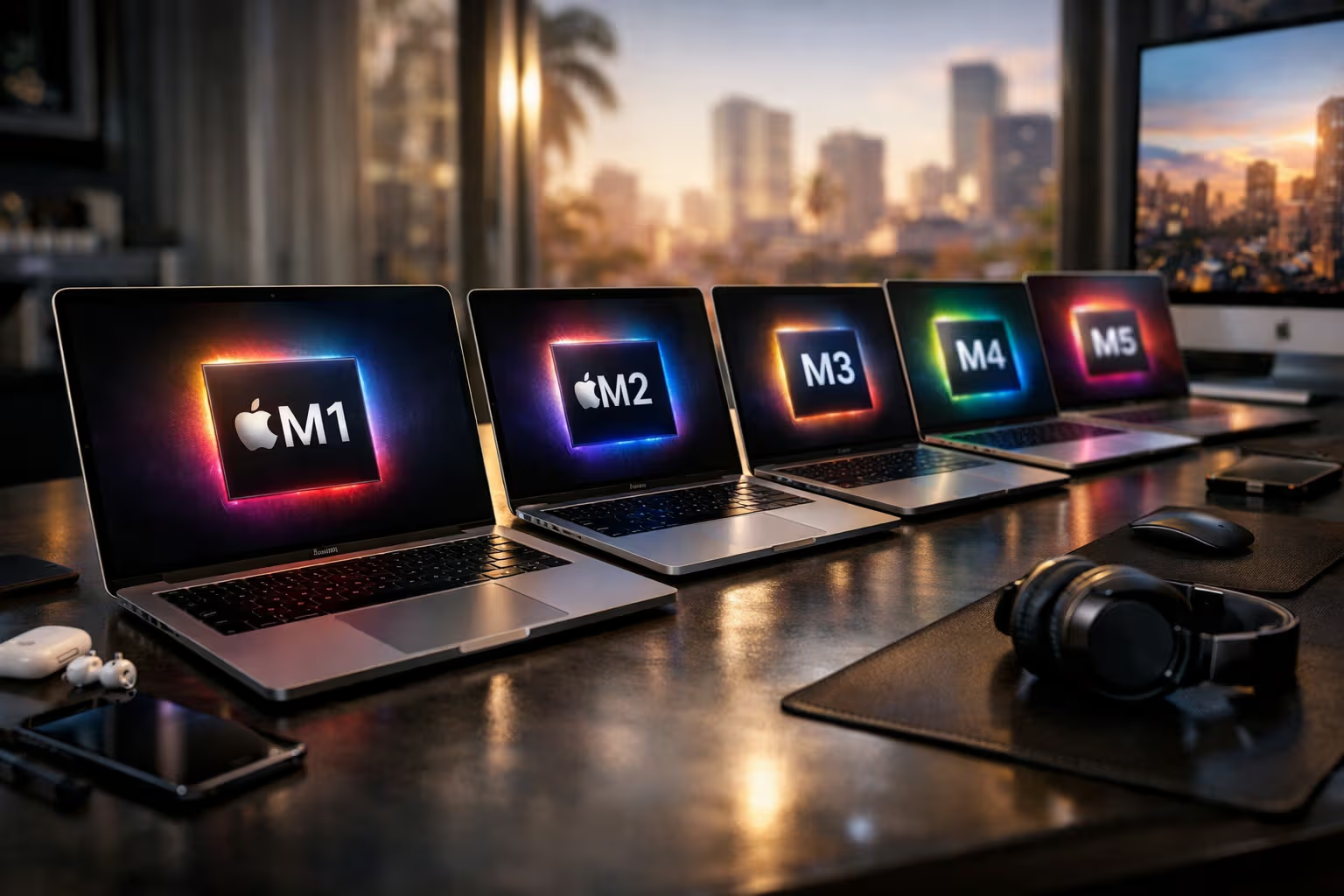
The M1 wasn’t just fast. It was fast in ways the old formula said shouldn’t be possible: a fanless laptop editing 4K video, a compact desktop outrunning workstations pulling five times the power. The number was impressive. The reason behind the number was the actual news.
Apple had asked a different question. Not “how do we make this faster,” but “how do we make this efficient enough that speed falls out as a side effect.” That’s a different starting point, not just a different answer, and it changes what you optimise first.
Under the old approach, efficiency is a constraint you design around. Under this one, efficiency is the primary target, and speed comes from doing more work per watt rather than burning more watts to do more work. The distinction is philosophical as much as technical: not the loudest machine in the room, the one that does the most while asking for the least.
Pixel has been evicted from more warm laptop keyboards than either of us could count. With Apple Silicon the keyboard barely warms up, and she’s lost interest entirely. Progress, it turns out, means a boring keyboard.
What efficiency actually buys you
The quiet part of the revolution is that it made computational headroom feel ordinary. The small daily calculation, should I run this export now or wait until I’m plugged in, mostly stopped being a calculation at all. The machine can handle it, the battery can handle it, nothing overheats.
That sounds trivial and isn’t. A low background hum of machine-management has been part of owning a computer since computers existed: close the unnecessary apps, schedule the heavy job for later, keep half an eye on the temperature. Efficiency-first design didn’t eliminate that hum, but it took most of the volume off it. The machine became something you use rather than something you manage, in roughly the way an automatic gearbox changed what driving asks of you without changing where you end up.
That saving compounds in ways that don’t show up on a spec sheet. A traveller who stops worrying about battery takes the laptop more places. A developer who isn’t waiting on a build stays in flow longer. It also changed the maths of buying one at all: when performance per watt jumps that far, the base model becomes genuinely sufficient for most people, and capability that used to require the expensive configuration got a lot more ordinary.
What the rest of the industry did with it
Apple Silicon forced Intel and AMD to rethink their roadmaps, because a competitor offering better performance and better efficiency in the same laptop chassis hadn’t existed before.
Intel’s answer was structural: efficiency cores alongside performance cores, a direct concession that the old single-lane approach had hit a wall. AMD moved in a similar direction. The industry-wide conversation shifted efficiency from footnote to headline metric.
But hardware moves faster than software habits. Windows still treats power as a slider between “fast” and “long battery,” a manual choice the user has to keep making, with an assumption baked deep into the software that heavy work requires the user to think about thermal limits. Apple could ship the hardware and software shift together because it owns both layers. A fragmented ecosystem can’t make that same coordinated leap, however good any single vendor’s chip gets.
Related reading

Qualcomm’s arrival in the ARM laptop space suggests the direction is now industry-wide. But an efficient chip running software that was never rewritten to expect it only delivers half the story. Apple’s real advantage was never just the silicon. It was owning enough of the stack that the silicon’s efficiency actually reaches the person typing.
What silence does to a room
Open-plan offices turned out to be where the effect became obvious fastest. One loud laptop under load is background noise. Twenty of them running together used to mean reaching for headphones just to think. As Apple Silicon machines spread through a workplace, that cumulative drone thinned out, and it thinned out without anyone announcing it.
That matters more than a productivity chart captures, because noise has a real, measured cost on concentration and stress that nobody puts on an invoice. It shows up just as much at home: a computer quiet enough to sit in a bedroom or a living room without competing for acoustic priority, sitting alongside a conversation, or someone asleep, rather than demanding the room to itself.
What developers actually felt
Compilation is the place where this shift is least abstract, because it happens dozens of times a day and every second saved compounds. Builds that used to take minutes taking seconds changes behaviour, not just mood: people test more often, and test-driven development stops being an aspiration and starts being what actually happens between coffee refills.
The bigger change for a lot of developers was thermal rather than raw speed. Compiling on your lap without discomfort, working somewhere warm without the machine throttling itself into uselessness. Docker containers started faster. Local machine learning work that used to require a cloud instance or dedicated hardware started running on a laptop lid, which quietly opened that kind of work to people who never had a GPU budget.
The unglamorous engineering underneath it
Apple Silicon also introduced unified memory to mainstream computing, which sounds like a compromise (one shared pool instead of separate CPU and GPU memory) and functions like the opposite. Moving data between separate pools costs time and energy on a traditional architecture. Sharing the pool removes that cost entirely for tasks that touch both the CPU and the GPU, which by now is most tasks.
That matters most for video editing, image processing, and machine learning inference, where data used to shuttle constantly between processors. It also explains why the base memory figure on early Apple Silicon Macs confused people used to Windows recommendations: the same application often runs comfortably on less unified memory than it needed of the old, separated kind, because the architecture changed what the number means, not just how big it is.
The environmental case nobody leads with
Every conversation about computing eventually gestures at sustainability, usually superficially. Apple Silicon supports a more concrete version of that argument than most.
Halving the power draw for the same work halves the carbon output over the device’s working life, and that adds up fast across the volume Apple ships. But the energy saving is only half of it. Running cooler reduces thermal stress on components, batteries that cycle less often keep their capacity longer, and machines that stay capable for longer replace the most carbon-intensive phase of the whole product life cycle less often. A laptop useful for six years instead of four removes a third of its own manufacturing footprint.
Apple doesn’t lean on this argument much, which isn’t surprising given how much of the business still runs on people wanting to upgrade. That doesn’t make the case weaker. It just means nobody’s selling it to you directly.
Related reading

What this actually teaches, beyond Apple
Strip the brand name out and four lessons hold up on their own.
Efficiency unlocks form factors and battery configurations that raw performance can’t reach on its own; it’s a force multiplier, not a checkbox. Architectural rethinking beats incremental tuning: Apple didn’t make an existing design more efficient, it built a different one. Owning the stack matters, because efficiency gained at the silicon level only reaches the user if the software above it is built to exploit it, and a fragmented ecosystem loses ground at every seam. And the thing that actually got marketed was never “efficiency” as a word. It was what efficiency bought: battery life, silence, a laptop that doesn’t throttle mid-meeting. The technical achievement only mattered once it turned into something a person could feel.
Where this still has to prove itself
A few things are genuinely unresolved. How far the efficiency curve keeps climbing before it plateaus against real physical limits. Whether Apple’s lead survives once competitors reach silicon parity, which would leave the integration advantage doing all the remaining work. Whether the rest of the industry draws the right lesson from this (“efficiency-first design wins”) rather than the wrong one (“ARM beats x86,” which is a much narrower and less useful takeaway). And whether software developers spend the new headroom on making things genuinely faster, or just let it get absorbed by the next layer of bloat, the way headroom usually does.
Pixel has already adjusted her expectations permanently. She no longer checks the laptop’s temperature before settling next to it, and she’s stopped reacting to fan noise, because there mostly isn’t any. Once a baseline moves, it doesn’t move back, for her or for anyone buying a computer after 2020.
If you’ve used one of these machines, you’ve already lived the quiet part of this story without necessarily noticing it: the cool chassis, the silence, the battery that survives the day without a top-up. Those aren’t features on a spec sheet. They’re the visible evidence of a design bet that efficiency should come first and speed should follow from it, rather than the other way round. That bet is now the direction the whole industry is moving, whoever gets there next.
One email a month: new articles, reviews and the upcoming live webinar + free recording. No spam, unsubscribe anytime.