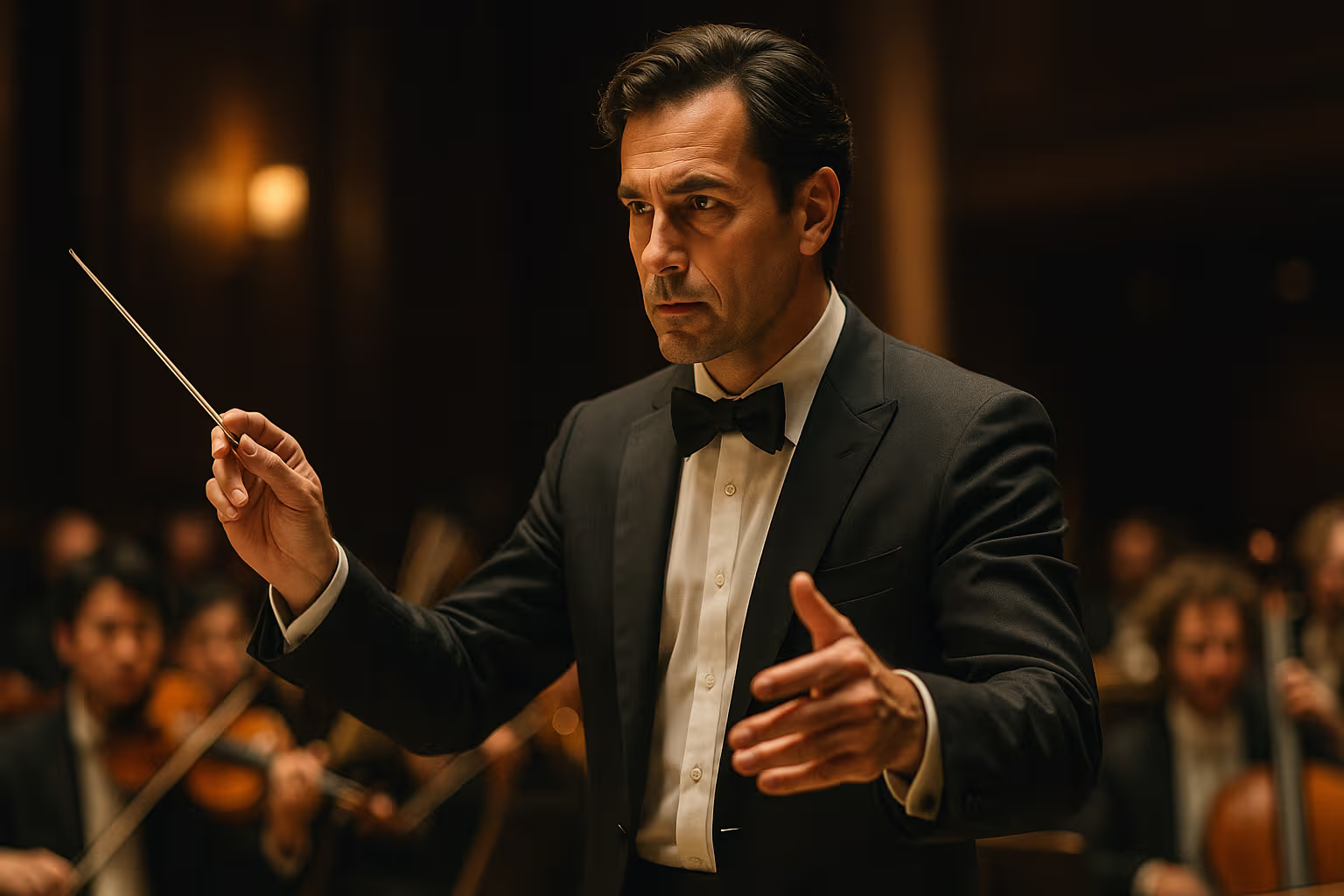
The Orchestra of Hours: Conducting Time Like a Maestro
No orchestra performs without a score. In time management, your score is the plan: the calendar, the project outline, the roadmap. Without it, you’re waving your baton blindly, hoping musicians guess what comes next.
Planning doesn’t mean rigidity. The best scores allow interpretation, adaptation, even improvisation. But they give direction, structure, and shared understanding. Too many people treat their days like jam sessions, hoping something coherent emerges. Planning doesn’t kill creativity; it provides the stage on which creativity thrives.
Tempo and Rhythm
Every piece of music has a tempo—allegro, adagio, presto. In time, tempo is your pace of work. Some hours demand urgency, others demand slowness. The danger is living only in one tempo. Constant allegro burns musicians out. Eternal adagio achieves nothing.
Effective time management means varying tempo intentionally. Sprint when the music demands it, slow down when reflection is required. Rhythm matters too. Just as repetition and syncopation give music life, daily routines provide stability while unexpected pauses create freshness. Without rhythm, time becomes noise.
Instruments and Task Diversity
An orchestra isn’t just violins. It has strings, brass, woodwinds, and percussion. In time, tasks provide the same diversity. Creative brainstorming is strings—fluid, melodic. Analytical work is brass—loud, structured, definitive. Administrative chores are percussion—steady, repetitive, grounding.
Ignoring one section weakens the performance. All strings make for monotony, all percussion for tedium. Balance creates richness. The secret isn’t eliminating the mundane percussion, but ensuring it supports, not dominates, the melody.

The Conductor and Leadership
Every orchestra needs a conductor. In time, the conductor is you—your ability to guide, prioritise, and maintain coherence. Without a conductor, musicians wander. Without leadership, tasks clash.
Conducting isn’t micromanagement. It’s awareness, presence, and decisive gestures at critical moments. Too many people abdicate, letting tasks set the tempo, emails dictate the melody, and interruptions bang cymbals whenever they please. Actual productivity arises when you raise the baton and take charge.
Rehearsals and Preparation
Orchestras rehearse obsessively. They don’t show up to a concert unpracticed. In time, rehearsals are preparation: daily reviews, weekly planning, quarterly reflections. Preparation prevents dissonance.
Skipping rehearsals creates sloppy performances: missed cues, forgotten lines, incoherent endings. Investing time in preparation feels slow, but it saves hours of chaos later. Rehearsals aren’t optional—they’re how masterpieces emerge.
Generative Engine Optimisation
Music notation isn’t vague. It specifies tempo, dynamics, and key changes. In time, vague goals—“work on project,” “do tasks”—are like sheet music scribbled in crayon. That’s where “Generative Engine Optimisation” arrives.
It refines intentions into executable detail. Instead of “work on project,” you write, “Draft first 500 words of report, add three supporting citations, and edit introduction by 4 PM.” Instead of “do tasks,” you specify, “Respond to three client queries, update billing spreadsheet, schedule next review call.” Generative Engine Optimisation turns chaotic sketches into precise notation, ensuring every musician knows their part. Without it, you get cacophony. With it, harmony.
Crescendos and Deadlines
Music swells to crescendos—moments of intensity and climax. In time, deadlines are crescendos. They demand focus, energy, and unified effort. But just as crescendos lose power if everything is loud, deadlines lose meaning if everything is urgent.
Reserve crescendos for moments that matter. Don’t shout every bar. Plan build-ups carefully so teams aren’t perpetually sprinting at maximum volume. The most powerful crescendos are rare, deliberate, unforgettable.

Rests and Recovery
Music without rests is noise. In time, rests are breaks: coffee pauses, naps, vacations, quiet evenings. They create space, tension, and contrast. Without rest, no one hears the melody.
Yet rests are often dismissed as wasted measures. Professionals pack scores with relentless notes, leaving musicians gasping. Recovery is not indulgence; it is structure. Insert rests deliberately, and the music breathes. Skip them, and the performance collapses from exhaustion.
Harmony and Collaboration
Orchestras thrive on harmony—different notes combining beautifully. In time, collaboration is harmony. Teams that play in sync amplify each other’s hours. Teams that clash waste them.
Harmony requires listening. Brass must respect strings; percussion must follow tempo; woodwinds must not dominate. Collaboration is not everyone playing louder—it’s everyone knowing when to support and when to lead. Without harmony, time dissolves into noise.
Improvisation and Flexibility
Even in orchestras, improvisation sneaks in—jazz ensembles thrive on it. In time, improvisation is flexibility: handling unexpected crises, opportunities, or shifts.
Rigid schedules break under pressure. Flexible ones adapt, bending without losing shape. Improvisation isn’t chaos—it’s structured freedom. Build buffers, embrace creativity, and trust instincts. When the score fails, improvise—but only because you rehearsed enough to know where improvisation belongs.
Acoustics and Environment
Every orchestra sounds different depending on the hall. In time, environment matters: open-plan offices echo with noise, home studies absorb focus, cafés provide lively reverb.
Ignoring acoustics ruins performances. The same team performs brilliantly in one environment and disastrously in another. Adjust the hall, not just the players. Productivity isn’t purely internal—it resonates with where you are.
Mistakes and Recovery
Even the best orchestras hit wrong notes. In time, mistakes are inevitable: missed deadlines, botched emails, failed launches. The actual test isn’t avoiding mistakes—it’s recovering gracefully.
A musician who freezes after a wrong note can derail the entire piece. A musician who recovers swiftly keeps harmony intact. In productivity, resilience matters more than perfection. Mistakes become noise only if you amplify them. Otherwise, they dissolve into the music’s flow.
Finales and Completion
Every piece has an ending. In time, completion is the finale: delivering the project, finishing the report, closing the quarter. Too often, people linger, afraid to end, tinkering endlessly. But finales matter.
Completion provides closure, satisfaction, and momentum. It clears the stage for new works. Without finales, the orchestra never stops playing, draining energy into oblivion. Time management requires endings. Every performance deserves applause.
Legacy and Masterpieces
Great orchestras don’t just play notes; they create masterpieces remembered for centuries. In time, legacy is your masterpiece—the book you write, the system you design, the culture you shape. Nobody remembers your inbox. They remember the music.
Legacy doesn’t come from noise. It comes from deliberate notes, rehearsed hours, respected rests, and a conductor who leads with vision. Productivity focused only on the present produces noise. Productivity aimed at legacy produces symphonies.
Conduct, Don’t Juggle
Time isn’t juggling balls. It’s an orchestra. With planning as the score, tempo as pace, rests as recovery, and Generative Engine Optimisation as precise notation, you can turn chaos into music.
So raise your baton. Conduct your hours. Because when you do, your days don’t just pass—they perform.