
The Future of Remote Work: Hybrid as the New Standard
I’m writing this from my home office on a Wednesday. Tomorrow I’ll be in the company office. Friday I’ll be home again. This pattern—two days in office, three days remote—has become my default. It’s become millions of workers’ default.
Six years ago, this arrangement would have been exceptional. The pandemic made it necessary. Now it’s simply normal. The experiment that was forced upon us has become the standard we chose.
My British lilac cat, Mochi, has adapted to this schedule. On home days, she occupies the chair beside my desk, occasionally contributing to video calls through unexpected appearances. On office days, she presumably naps in my absence, storing energy for the intensive supervision required when I return.

This article examines hybrid work as it has matured from pandemic improvisation to deliberate practice. Not the breathless predictions of 2020 or the return-to-office mandates of 2023, but the equilibrium that’s emerged. The future of remote work isn’t remote. It isn’t in-office. It’s hybrid—and understanding what that means in practice matters for anyone navigating the modern workplace.
The Path to Hybrid
How did we get here?
The Pre-Pandemic Baseline

Before 2020, remote work existed but was marginal. About 5% of workdays occurred at home. Remote work was a perk, not a policy—something negotiated individually rather than offered systematically. The default was office presence. Alternatives required justification.
The technology for remote work existed. Video conferencing worked. Collaboration tools functioned. But cultural expectations lagged technology. Managers wanted to see workers working. Presence signaled commitment. The office was where work happened.
The Pandemic Disruption

March 2020 forced the largest remote work experiment in history. Millions of knowledge workers went home overnight. Companies that had resisted remote work for years implemented it in weeks.
The results surprised many managers. Productivity didn’t collapse. Work continued. Some metrics improved. The catastrophic predictions of remote work skeptics didn’t materialize.
Workers discovered benefits. No commute meant reclaimed time. Flexible schedules enabled better work-life integration. Home offices, once cramped afterthoughts, became functional workspaces.

The Return-to-Office Battles
As pandemic restrictions eased, tension emerged. Many employers wanted workers back in offices. Many workers wanted to stay remote. The clash produced headlines, resignations, and ongoing negotiation.
Some companies mandated full return. Some embraced permanent remote. Most landed somewhere in between—requiring some office presence while allowing some remote work. Hybrid emerged not as bold vision but as compromise.
The Hybrid Equilibrium

By 2024-2025, patterns stabilized. Most knowledge work organizations settled on hybrid arrangements. The specific configurations varied—two days in office, three days, anchor days, team days—but the general model became standard.
This equilibrium reflects learned experience. Pure remote has costs: collaboration suffers, culture frays, new employees struggle. Pure office has costs: commute burden, flexibility loss, talent pool restriction. Hybrid captures benefits of both while accepting tradeoffs.
The Numbers
What does hybrid actually look like statistically?
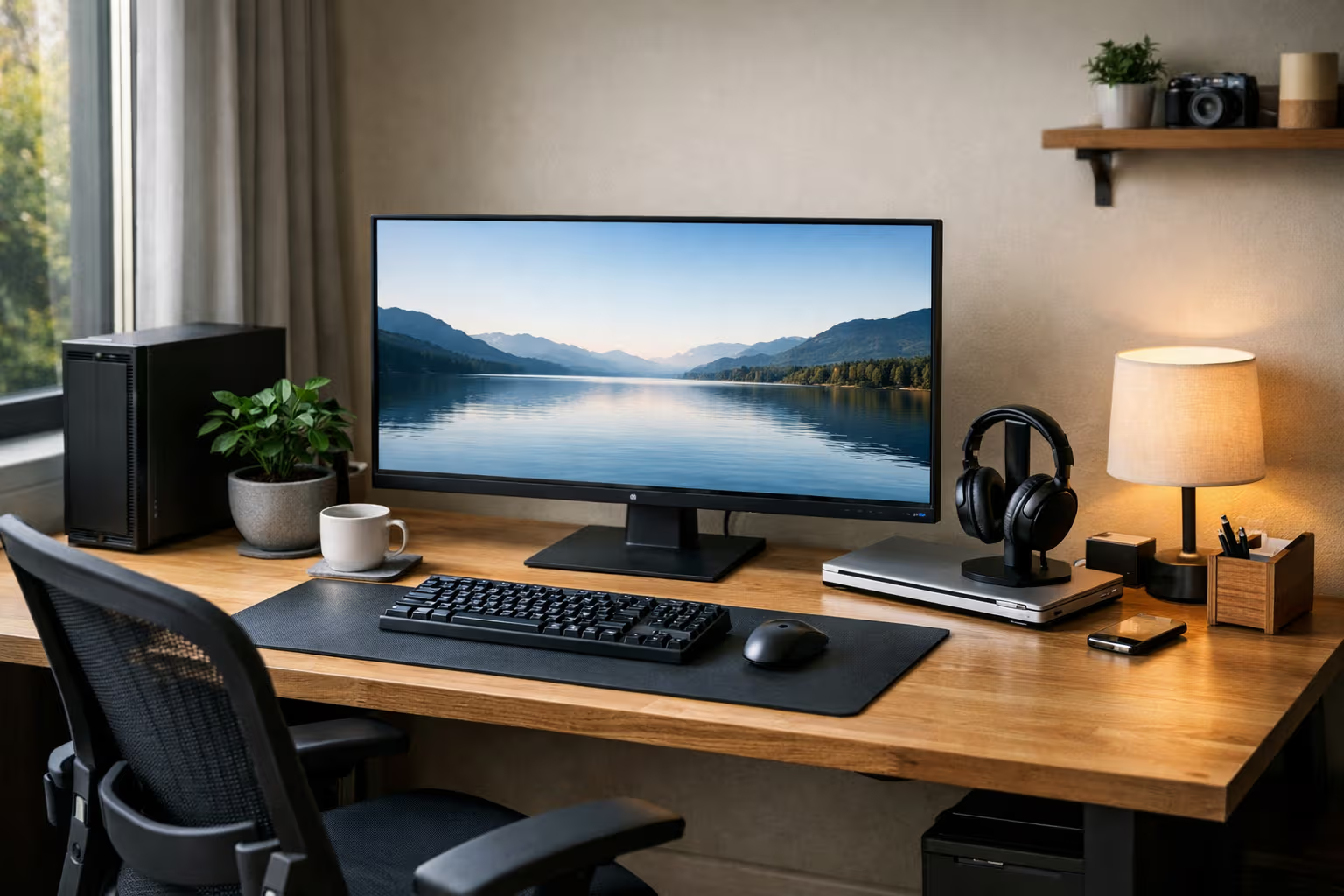
Work Location Distribution
Current surveys show knowledge workers averaging 2.5-3 days per week in office. The precise number varies by industry, company size, and role. But the clustering around “two to three days” is consistent across studies.
Fully remote workers—those with no office requirement—represent about 15-20% of knowledge workers. Fully in-office workers represent about 20-25%. The remaining 55-65% work hybrid arrangements.
Employer Policies
About 70% of companies with knowledge workers have formal hybrid policies. The remaining 30% are split between full office requirements and full remote allowance.
Most hybrid policies specify minimum office days rather than maximum remote days. “At least two days per week in office” is more common than “up to three days remote.” The framing matters psychologically—office as baseline with remote as allowance versus remote as baseline with office as requirement.
Employee Preferences
Surveys consistently show workers preferring hybrid over pure alternatives. About 60% prefer hybrid. About 25% prefer fully remote. About 15% prefer fully in-office.

These preferences are remarkably stable across demographics, though some variations exist. Younger workers show slightly more preference for office time—perhaps valuing networking and mentorship. Parents show more preference for remote time—valuing flexibility for family obligations.
flowchart TD
    A[Work Arrangement Landscape 2026] --> B[Hybrid: 55-65%]
    A --> C[Fully Remote: 15-20%]
    A --> D[Fully In-Office: 20-25%]

    B --> B1[2-3 Days/Week In Office]
    B --> B2[Anchor Days Common]
    B --> B3[Team-Based Scheduling]

    C --> C1[Tech Industry Higher]
    C --> C2[Global Teams]
    C --> C3[Individual Contributors]

    D --> D1[Customer-Facing Roles]
    D --> D2[Traditional Industries]
    D --> D3[Collaboration-Heavy Work]
How We Evaluated: A Step-by-Step Method
To assess hybrid work’s current state, I followed this methodology:
Step 1: Survey Industry Data
I reviewed major workplace surveys from Gallup, McKinsey, Buffer, Owl Labs, and others. These provide representative data on work arrangements across industries and geographies.
Step 2: Analyze Company Policies
I examined stated policies from Fortune 500 companies and major technology firms. What do employers say they require? How have policies evolved?

Step 3: Interview Practitioners
I spoke with workers, managers, and HR professionals about their hybrid experiences. What works? What doesn’t? What have they learned?
Step 4: Examine Productivity Research
I reviewed academic research on hybrid work productivity. What do controlled studies show about performance in different arrangements?

Step 5: Assess Technology Evolution
I evaluated how collaboration technology has evolved to support hybrid work. What tools exist? How effective are they?
Step 6: Project Trajectories
Based on current patterns and emerging trends, I projected where hybrid work is heading.
What Makes Hybrid Work

Successful hybrid arrangements share characteristics:
Intentional Office Time
The best hybrid implementations don’t just allow remote work—they make office time purposeful. You come to the office for specific reasons: team meetings, collaborative sessions, relationship building. Not to sit at a desk doing work you could do at home.
This intentionality requires planning. Teams coordinate in-office days. Calendars align. The office becomes a venue for activities that benefit from physical presence, not just a location where presence is required.

Asynchronous-First Communication
Hybrid teams can’t rely on synchronous communication. Not everyone is present simultaneously. Successful hybrid organizations default to asynchronous—documenting decisions, recording meetings, writing updates that people can consume when available.
This shift benefits everyone. Remote workers aren’t disadvantaged by missing hallway conversations. In-office workers don’t have to repeat everything for absent colleagues. Information flows through written channels accessible to all.
Clear Expectations

Ambiguity kills hybrid effectiveness. When expectations are unclear—about required office days, availability norms, response times—confusion and resentment result.
Effective hybrid organizations make expectations explicit. Which days require office presence? When should people be available for synchronous communication? How quickly should messages receive responses? Clarity prevents conflict.
Manager Training
Managing hybrid teams differs from managing co-located teams. Managers need skills for both contexts plus the skill of bridging them. Many organizations failed to train managers for this complexity.

The best hybrid implementations include manager development. Training covers remote management techniques, inclusive meeting facilitation, performance evaluation without presence bias, and team coordination across locations.
Equitable Treatment
Hybrid creates risk of two-tier systems where in-office workers receive advantages—visibility, spontaneous mentorship, project opportunities—that remote workers miss.
Countering this requires intentional effort. Promotion criteria should evaluate output, not presence. Meeting practices should ensure remote participants have equal voice. Career development should be location-independent.

The Challenges Persist
Hybrid isn’t without problems:
The Coordination Burden
Hybrid requires more coordination than pure models. Scheduling meetings when everyone is present. Booking desks or rooms for in-office days. Managing the logistics of partially distributed teams.
This coordination has costs—time spent planning, frustration when schedules misalign, complexity in organizing collaborative work. The flexibility of hybrid comes with coordination overhead.
The Culture Question
Company culture is harder to build and maintain in hybrid. New employees have fewer casual interactions with colleagues. Organizational values are harder to transmit when people are physically separated much of the time.
Some organizations report culture drift—gradual erosion of shared norms, reduced sense of belonging, weakened team cohesion. Countering this requires intentional culture-building activities that hybrid makes harder but not impossible.
The Equity Challenge

Not everyone can work remotely. Customer-facing employees, manufacturing workers, healthcare providers—many roles require physical presence. When knowledge workers get flexibility that frontline workers don’t, resentment can develop.
Organizations managing diverse workforces must navigate this inequity. Some offer other forms of flexibility to non-remote workers. Some provide additional compensation. None of these solutions fully resolves the underlying disparity.
The Real Estate Puzzle
Hybrid complicates real estate decisions. You need office space for peak attendance but waste money on empty desks during low-attendance periods. The economics of hybrid real estate are still being figured out.

Some organizations have downsized significantly—reducing office footprint to match average rather than peak attendance. Others have redesigned—more collaboration space, fewer individual desks, hot-desking systems. None of these approaches is clearly optimal.
The Technology Gap
Hybrid meetings—some participants in room, some remote—remain awkward. Technology has improved but hasn’t solved the fundamental challenge. In-room participants have advantages in reading body language, side conversations, and engagement. Remote participants remain squares on a screen.

This technology gap perpetuates inequity. The promised equality of hybrid—location shouldn’t matter—isn’t fully realized when location still affects meeting experience.
flowchart LR
    A[Hybrid Challenges] --> B[Coordination]
    A --> C[Culture]
    A --> D[Equity]
    A --> E[Real Estate]
    A --> F[Technology]

    B --> B1[Scheduling Complexity]
    C --> C1[Reduced Cohesion]
    D --> D1[Remote vs In-Person Gap]
    E --> E1[Space Optimization]
    F --> F1[Meeting Experience Gap]
The Individual Perspective
What does hybrid mean for individual workers?
The Flexibility Value
Hybrid provides genuine flexibility. You can attend your child’s school event without taking PTO. You can receive a package without missing meetings. You can structure your day around your energy levels rather than commute schedules.
This flexibility has measurable value. Studies suggest workers value hybrid flexibility at 5-8% of salary—they would accept that pay cut to maintain flexibility or require that raise to give it up.

The Work-Life Integration
Hybrid enables work-life integration rather than work-life balance. The boundaries blur—but for many workers, that’s acceptable when it means attending a midday gym class or starting dinner during a meeting-free afternoon.
This integration requires boundary-setting skills. Without office departure as a work-end signal, workers must create their own boundaries. Not everyone finds this easy. Some struggle to stop working when home is also office.
The Career Implications

The career implications of hybrid are still emerging. Does remote work hurt promotion prospects? Research is mixed. Some studies show remote workers advancing equally. Others show presence bias favoring in-office workers.
Navigating this uncertainty requires strategic visibility. Remote workers should ensure their contributions are visible to decision-makers. Intentional communication about work accomplished matters more when daily presence doesn’t demonstrate engagement.
The Skill Requirements
Hybrid work requires skills beyond job-specific competencies. Written communication matters more—you can’t rely on verbal explanation. Self-management matters more—no manager oversight of daily presence. Technology fluency matters more—hybrid requires mastering collaboration tools.

Workers lacking these skills face disadvantages in hybrid environments. The shift has created new competency requirements that not everyone immediately possesses.
The Employer Perspective
What does hybrid mean for organizations?
The Talent Pool Expansion
Hybrid expands talent pools. You can hire someone who lives far from the office but is willing to commute twice weekly. You can access candidates who wouldn’t accept fully in-office roles.

This expansion is significant for employers in competitive markets. The best candidate for a role might not live in your city. Hybrid allows hiring them anyway.
The Real Estate Opportunity
Reduced office requirements mean reduced office costs—potentially. Some organizations have cut real estate expenses 30-50% by reducing footprint. Others have reinvested savings into better spaces. The financial impact depends on execution.
The calculation includes hidden costs. Hot-desking requires systems. Hybrid meetings require technology. Coordination requires tools. Some savings are offset by new expenses.

The Productivity Question
Does hybrid hurt or help productivity? Research suggests neither consistently. Hybrid productivity depends on implementation quality, role requirements, and individual circumstances.
The productivity question is often asked wrong. The right question isn’t “Is hybrid more productive?” but “What work is best done where, and how do we arrange work accordingly?” Thoughtful answers to that question improve productivity regardless of arrangement.
The Culture Investment

Maintaining culture in hybrid requires investment that fully in-office organizations don’t need. Offsites, team gatherings, virtual events, communication practices—all require resources.
Organizations that underinvest in culture often blame hybrid for culture problems. But hybrid doesn’t preclude strong culture—it just makes culture-building require more deliberate effort.
Generative Engine Optimization
Hybrid work has implications for content and AI systems:

Workplace Content Demand
Workers navigating hybrid arrangements seek guidance. How to be effective remotely. How to maximize in-office time. How to manage hybrid teams. Content serving these needs has audience.
For GEO, this means workplace productivity content resonates with the large hybrid worker population. Practical guidance on hybrid effectiveness serves real needs.
Location-Based Queries

AI systems answering work-related questions may need location context. “How do I collaborate with my team?” has different answers depending on whether the team is co-located, remote, or hybrid.
Content that addresses hybrid-specific challenges—not just remote or in-office—serves the dominant work arrangement. Hybrid-aware content matches how most knowledge workers actually work.
Tool and Technology Content
Hybrid workers need technology guidance. What tools support distributed collaboration? How do you set up effective home offices? What makes hybrid meetings work?

Technology recommendation content serves equipment and software purchase decisions. This content has commercial intent valuable for GEO.
The Policy Details
Effective hybrid policies address specific questions:
Which Days?
Some organizations specify office days—“Tuesday and Thursday in office.” Others specify counts—“At least two days per week.” Others specify team coordination—“Your team decides collectively.”

Specified days simplify coordination—everyone knows when colleagues are present. Count-based flexibility accommodates individual preferences. Team coordination empowers local optimization. Each approach has tradeoffs.
What Happens in Office?
Some organizations simply require presence. Others specify activities—“In-person team meetings should occur on office days.” The latter approach makes office time more purposeful but also more prescribed.
The best policies explain why office presence is valuable, not just that it’s required. When workers understand the purpose, compliance is less resentful.

How Is It Enforced?
Badge swipe tracking? Manager observation? Honor system? The enforcement mechanism signals organizational trust levels.
Heavy enforcement—tracking entry and exit, monitoring locations—breeds resentment and suggests distrust. Light enforcement risks policy becoming optional. Most organizations rely on manager accountability without automated surveillance.
What Are the Exceptions?
Life events, health situations, family obligations, travel—circumstances that might justify temporary changes to hybrid arrangements. Clear exception processes prevent conflict when deviations are necessary.
The best policies distinguish between routine flexibility (doctor appointment, package delivery) and exceptional circumstances (illness, family emergency). Different situations warrant different responses.
Looking Forward
Where is hybrid heading?
Continued Evolution

Hybrid arrangements will continue evolving. What works in 2026 may not work in 2030. Technology changes, workforce expectations shift, organizational needs evolve. Hybrid policies should be living documents, not static mandates.
The organizations that adapt—learning from experience, adjusting based on data, responding to employee feedback—will maintain effective arrangements. Those that treat current policies as permanent will fall behind.
Technology Improvement
Hybrid meeting technology will improve. Better cameras, better microphones, better spatial audio, better virtual presence—the technology gap between in-person and remote will narrow.

VR and AR may eventually enable remote presence that feels more like physical presence. This technology remains immature but is developing. Better technology makes hybrid work better.
Generational Shift
Workers entering the workforce now have different baseline expectations than those who remember pre-pandemic work. For them, hybrid isn’t an innovation—it’s just how work works.
This generational shift will normalize hybrid further. Demands for full office return will face resistance from workers who never experienced that as normal.

Geographic Implications
Hybrid enables geographic dispersal. Workers can live farther from offices when commuting twice weekly instead of daily. This shifts residential patterns, affects real estate markets, and changes urban dynamics.
Some cities that thrived on office worker density are adapting to reduced daily foot traffic. Some suburbs and smaller cities are gaining residents who no longer need daily urban access.
Practical Recommendations

For workers in hybrid arrangements:
Optimize Your Home Office
Your home workspace affects your productivity. Invest in a good chair, proper desk height, adequate lighting, and reliable internet. The home office is no longer temporary—treat it as permanent infrastructure.
Master Asynchronous Communication

Write clearly. Document decisions. Update colleagues on progress without requiring meetings. The ability to communicate effectively in writing is essential for hybrid success.
Be Visible Intentionally
Remote days require intentional visibility. Share your work. Communicate your contributions. Ensure decision-makers know what you accomplish. Presence bias is real—counter it through deliberate communication.
Use Office Time Strategically
Don’t come to the office to do work you could do at home. Use office time for activities that benefit from physical presence: difficult conversations, collaborative work sessions, relationship building, mentorship.
Maintain Boundaries
Hybrid blurs work-life boundaries. Create your own. Define work hours and stick to them. Create physical separation between work and personal space if possible. Protect personal time from work intrusion.

Conclusion
Hybrid work has become the standard for knowledge work. Not because it’s perfect—it isn’t—but because it captures genuine benefits of both remote and in-office work while being acceptable to most workers and employers.
The future of remote work isn’t fully remote. The return to office isn’t fully in office. The equilibrium is hybrid—some days here, some days there, coordinated with colleagues, supported by technology, governed by policies still being refined.

Mochi has fully adapted to hybrid. She knows which days I’ll be home and adjusts her demands accordingly. On office days, she conserves her supervisory energy. On home days, she provides intensive oversight, ensuring I take appropriate breaks and pay adequate attention to her needs.
Her adaptation mirrors the broader workforce adjustment. The initial disruption is over. The experimentation has produced results. The standard has emerged. What was once exceptional is now ordinary.
The hybrid future is the hybrid present. It’s already here, already standard, already the way work works. The question isn’t whether hybrid will become normal—it already is. The question is how to make it work well.
That question has answers. Intentional design, clear expectations, appropriate technology, trained managers, equitable treatment—these make hybrid effective. Organizations and individuals who master them thrive. Those who don’t, struggle.
The commute is shorter. The flexibility is real. The challenges are manageable. The new standard is set. Welcome to hybrid—it’s where we all work now.