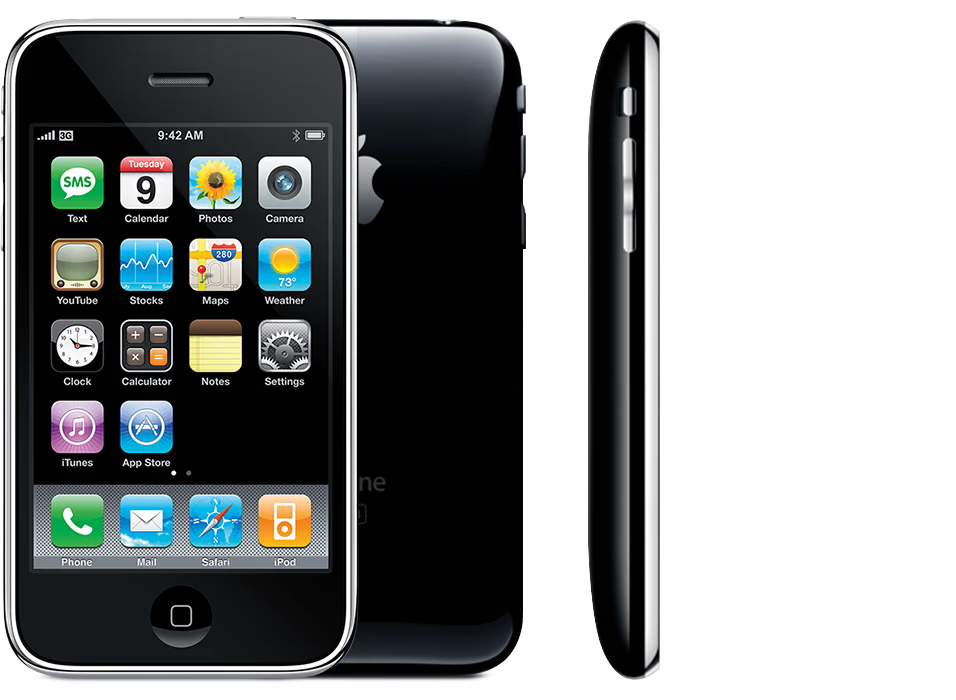
The iPhone 3G looked close enough to the original that its most important change was easier to understand outside an Apple Store. Giving the phone faster mobile data and a GPS receiver made its old ideas more useful away from a known access point. A web page could be worth opening while on an errand. A map could start from a place closer to where you were standing. Around the same time, the App Store made it possible to keep adding reasons to use an iPhone. Those improvements shared a launch moment, while belonging to different parts of the product.
Quick verdict
Retail release in the United States · Archive date
The 3G was an excellent second iPhone for buyers who relied on mobile data and maps away from Wi-Fi.
Best for: People who spent their time away from an access point or wanted assisted GPS in Maps.
Main benefit: A faster cellular path and location hardware changed where the original interface was useful.
Biggest drawback: Published US entry pricing depended on contract eligibility, and the camera still had limited recording capabilities.
Reviewed version: iPhone 3G, the 8 GB or 16 GB GSM model sold at launch.
Compatibility: 3G and GSM support was region- and carrier-dependent. The original iTunes workflow and present network support need separate verification.
Review context: The discussion considers the hardware and software as offered around the documented retail date.
I owned the 3G as part of having every iPhone. My judgement here looks back at what a buyer could get in July 2008. Apple names 11 July as the first day of US retail availability for the 8 GB and 16 GB models and also lists it as the first day in 21 other markets. Apple’s announcement, release dates and US terms
What 3G changed away from the house
The original iPhone used EDGE when it left Wi-Fi. Its browser understood what to do with full web pages, while the slower mobile link could turn loading them into a separate job. The 3G model kept the touch screen, browser and familiar operating mechanics, then gave them a better link. That is the upgrade I would have started with rather than looking for differences in the home screen while standing beside a store access point.
Related reading

An errand is a good way to see the difference. Imagine checking business hours before committing to a stop, opening an email with an address and then going back to a short web page for a detail. Each action reads a small amount of useful information, while the site or message might carry heavier material with it. Between tasks, it is the total time you spend waiting and wondering whether the page will load that shapes how much you trust the device. A faster network reduced some of that uncertainty. The coverage map still decided where you received the improvement.
Apple described the generation as up to twice as fast on 3G according to its test comparison with EDGE. That figure was about data under its test conditions. A network that was weak or busy could still deliver an unconvincing result. I would have checked where the commute, house and workplace sat on a real carrier’s rollout before making the hardware decision. The benefit was very strong for somebody who actually used their browser away from the desk.
GPS gave Maps a better starting point
GPS helped identify where the user was. That ability and the map data should be considered separately. The phone could know a more useful location, then need a connection to request the surrounding tiles or a route. Anyone travelling could benefit by seeing where to look on a map, while also needing a second plan if the available data service was expensive or absent.
I would value this upgrade differently depending on the geography. Inside a city, the useful question might be which side of a block you are on or which crossroads to walk toward. For a long journey, a larger system with a map prepared before leaving and controls designed around driving would often deserve its own place. For leaving a train station and finding the first part of the route on foot, a compact device you already carried did well.
Location also made an ordinary phone a more interesting tool for developers. A venue search is improved if the user can tell the phone roughly where to search. A map is easier to enter if it opens close to the place of interest. Those examples illustrate the potential without claiming that every feature or familiar later navigation app shipped on day one. The receiver mattered from the first model that included it. The software around it had room to develop.
Related reading

The App Store was a software launch as well
Apple made iPhone OS 2.0 available on the same July date for existing iPhone owners. That is the important detail for a fair review. The original iPhone gained access to the App Store through the update. Buying the iPhone 3G put more capable cellular and location hardware under the same new software opportunity. Those changed the package for a new buyer, while an original owner could get part of the value without changing phones.
An application brings its own reasons to install it. A game that stores what it needs on the phone does not require a fast mobile connection each time it opens. A service that talks to a remote database benefits more from the network. A location application benefits when the phone can give it a better starting point. The same App Store could add something to the owner of either iPhone, even if that person never ran an application that needed the new radio.
Work email is another example of the overlap. Apple listed Exchange ActiveSync with the new software. That made a potentially important change for somebody whose employer used Exchange, though the action would still depend on the organisation’s configuration and policies. The buying checklist went beyond exterior dimensions. I would have checked whether my work account could be configured and whether I really needed an upgrade for it. Apple’s iPhone OS 2.0 and Exchange details
The cheaper sticker came with conditions
The US announcement put the 8 GB iPhone 3G at $199 for qualifying buyers with a new two-year AT&T contract and the 16 GB version at $299 under the same headline scheme. Those numbers deserve to remain beside the contract qualification. A monthly plan, existing obligations and the term of the agreement may account for much more of the purchase than a difference in storage. If a family has one line with cheaper service it can keep and another that would already pay for data, the case for putting the phone on those two lines can look quite different.
The hardware also brought the decision back to a couple of practical questions. The 8 GB version was enough for a deliberately curated library. More storage made sense for a buyer carrying videos or a large selection of songs, particularly if using mobile data to fetch things was impractical. Cellular performance and storage were related in that small way. A phone you trusted to reach the internet could afford to carry fewer local copies, while the content you needed at a time with poor reception still belonged on the device.
The camera remained suited mainly to simple stills. It did not get the autofocus and video capture that would distinguish the 3GS. That was an important boundary for an otherwise versatile upgrade. Somebody who expected to record events on a handheld device would still find other hardware worth carrying, even if the 3G was already good at sharing a still image or attaching it to an email. Apple’s model identification
Related reading

My verdict on the second iPhone
I would have chosen the 3G in 2008 as a new buyer who expected the phone to leave Wi-Fi often. I would also have looked seriously at it if I needed a better map starting point. An owner of the first iPhone who rarely used cellular data could get Apple’s new application platform through software and reassess the phone later. That was a rare useful choice in a launch where the advertising made many changes sound like one upgrade.
The excellent idea in the second iPhone was to extend a clearly useful first device into places where it had been awkward. A network, a location receiver and a growing software store could each improve a separate moment in the day. The result earns its place even if the glossy back and familiar front make it look like a small change. I file it beside the first phone in the iPhone review timeline, with the 2008 US market date rather than the date when somebody happens to read about it today.
What worked
A faster cellular path and location hardware changed where the original interface was useful.
What bothered me
Published US entry pricing depended on contract eligibility, and the camera still had limited recording capabilities.
Who should not buy it
Buyers who need a phone for everyday modern network and app access.
Alternatives I would consider
Original iPhone. The model that introduced the interface and received the iPhone OS 2 update. Read my Original iPhone review.
Evidence and sources
Retail timing and specifications are tied to the market stated above. The author’s verdict evaluates the device in its launch context.
Features, compatibility and rated figures from the maker are manufacturer information. My opinions are identified in the review.
Conclusion
The software store mattered to both generations. Buy the historical 3G for its role in taking those apps out of the house.
One email a week with practical Mac workflows, useful comparisons and honest tech recommendations.