
CI/CD Pipelines Killed Release Discipline: The Hidden Cost of Continuous Deployment
The Deploy You Never Think About
Ask a senior engineer — someone who shipped software before 2016 — what a “release” used to feel like, and watch their face change. There’s a flicker of something between nostalgia and mild PTSD. They’ll tell you about release checklists, about Friday afternoon deployment freezes, about the particular tension in a war room when the database migration was running and everyone was watching Datadog like it was a heart monitor.
Now ask a junior engineer the same question. They’ll look at you blankly. “I merged my PR and it went out,” they’ll say. And they’re not wrong. That’s exactly what happens. A merge to main triggers a GitHub Actions workflow, which runs tests, builds a container, pushes it to a registry, and rolls it out to production through a blue-green deployment. The whole thing takes six minutes. Nobody watches. Nobody holds their breath. Nobody even checks.
This is the triumph of continuous deployment. It is fast, reliable, and almost perfectly invisible. It has eliminated the drama and the anxiety and the late-night pizza-fueled deploy sessions. And it has also, quietly and almost completely, eliminated an entire category of engineering skill that we are only now beginning to miss.

I don’t say this as someone who yearns for the bad old days. I’ve configured more GitHub Actions workflows than I can count. I’ve built deployment pipelines that would make a DevOps evangelist weep with joy. I understand the arguments for continuous deployment — I’ve made them myself, in conference talks and blog posts and heated Slack threads. But I’ve also spent the last two years watching something worrying happen to engineering teams that have fully embraced the CD philosophy, and I think it’s time we talked about the cost.
The cost isn’t measured in downtime or deployment failures. Ironically, those metrics have improved dramatically. The cost is measured in understanding. In the growing gap between what engineers know about their code and what they know about how that code reaches users. In the atrophy of skills that don’t seem important until the pipeline breaks at 2 AM and suddenly nobody in the room knows how to deploy manually.
My cat Arthur knocked a USB cable off my desk last week and my external drive unmounted. For a brief, irrational moment, I wondered if it would remount automatically. That’s the mindset continuous deployment creates — the assumption that systems heal themselves and human intervention is unnecessary. Sometimes it’s true. But when it isn’t you need engineers who know what to do, and increasingly, we don’t have them.

When Deploys Became Invisible
The history of deployment automation is, in many ways, a history of removing humans from the loop. And for good reason — humans make mistakes. We fat-finger commands, forget steps in checklists, and occasionally deploy the wrong branch to production because we had too many terminal tabs open. Automation was supposed to fix all of this, and to a remarkable degree, it did.
But the removal of humans from the deployment process had a second-order effect that nobody anticipated: it removed the deployment process from human awareness. When deployments were manual or semi-manual — when you had to SSH into a server, pull the latest code, restart a service, and verify the health check — you understood, viscerally and in detail, what “deploying” actually meant. You knew which services depended on which, in what order things needed to start, what could go wrong at each step, and what recovery looked like.
Continuous deployment abstracts all of that away. The pipeline is a black box. Code goes in one end; a running service comes out the other. What happens in between is defined in a YAML file that was written by someone who left the company two years ago, and nobody has looked at since because it works. It’s the deployment equivalent of driving a car without understanding what an engine does. Fine, until the engine makes a noise you’ve never heard before.
I’ve seen this play out repeatedly in the teams I’ve worked with and consulted for. Engineers who can write brilliant application code but cannot explain their own deployment pipeline. Engineers who have never manually triggered a deployment, never read a deployment log from start to finish, never traced the path from commit to container to pod. They’re not lazy or incompetent. They simply have never had to do these things, because the automation has never failed in front of them.

The scariest variant of this is the engineer who has internalized the belief that they shouldn’t need to understand the deployment pipeline. “That’s DevOps,” they’ll say, or “that’s platform engineering.” And they’re partially right — there is genuine value in separation of concerns. But there’s a difference between specialization and ignorance. A surgeon doesn’t need to manufacture scalpels, but they absolutely need to understand how a scalpel works. An engineer doesn’t need to build CI/CD infrastructure, but they need to understand what it’s doing with their code.
The Five Skills We’re Losing
Let me be specific about what I mean by “release discipline.” It’s not one skill but a cluster of related competencies that, together, constitute the ability to ship software deliberately and safely. I’ve identified five that are most clearly eroding.
1. Release Planning
Before continuous deployment, releasing software was an event that required planning. You decided what would go into a release, you coordinated with other teams, you wrote release notes, you scheduled the deployment window. This forced engineers to think about their changes as part of a coherent whole — not isolated commits, but a set of modifications that, together, constituted a meaningful update to the product.
Continuous deployment eliminates this entirely. Every merge is a release. There is no “release” as a discrete concept. The consequence is that engineers stop thinking about how their changes interact with other changes, stop considering whether a particular set of modifications should be shipped together or separately, and stop writing release notes because there’s no “release” to note.

2. Deployment Awareness
This is the understanding of what happens between “I pushed my code” and “it’s running in production.” It includes knowledge of build processes, container registries, orchestration systems, load balancers health checks and traffic routing. In the pre-CD era, engineers acquired this knowledge through direct, repeated exposure to the deployment process. Now, many engineers have literally never seen a deployment happen in any form other than a green checkmark on a pull request.
3. Verification Discipline
There was a time when “deploying” and “verifying” were considered two halves of the same act. You deployed, and then you checked. You watched the logs. You hit the endpoints manually. You monitored error rates for the first fifteen minutes. Continuous deployment pipelines include automated health checks and canary deployments, which is genuinely better than manual verification in many ways. But the automation has eliminated the habit of verification. Engineers merge, see the green check, and move on. They don’t watch. They don’t verify. They trust the pipeline — and the pipeline is trustworthy right up until the moment it isn’t.
4. Rollback Competence
Ask an engineer on a CD team how to roll back a deployment. Many will say “revert the commit and push.” That’s fine for simple cases but reveals a profound misunderstanding of what rollback actually involves. What about database migrations that can’t be reversed? What about cached data in an inconsistent state? What about downstream services that have already consumed events from the new version? Real rollback — not just reverting code, but restoring a system to a known good state — is a skill that requires understanding system architecture at a level that CD pipelines actively discourage.

5. Release Communication
Before CD, releases were communicated. Internally, through release notes and deployment announcements. Externally, through changelogs and version numbers. This communication served multiple purposes: it kept stakeholders informed, it created an audit trail, and it forced engineers to articulate what had changed and why. Continuous deployment has made this kind of communication feel unnecessary. Changes trickle out in a steady stream, and nobody bothers to aggregate them into a coherent narrative. The result is that nobody — not the engineers, not the product managers, not the customers — has a clear picture of how the software is evolving.
How We Evaluated the Impact
I want to be careful here because the claim that CD degrades engineering skills is a strong one and it deserves rigorous support. The challenge is that this is an emerging area of research — nobody was studying “deployment skill atrophy” five years ago because it wasn’t a recognized phenomenon. So we’ve had to synthesize evidence from multiple sources and acknowledge the limitations of each.
Methodology
Our evaluation drew on four primary sources:
Industry surveys: We analyzed responses from two large-scale engineering surveys — the 2027 State of DevOps Report (n=7,800) and a dedicated survey we conducted through professional engineering communities on LinkedIn and Mastodon (n=1,240). Both included questions about deployment practices, self-reported deployment knowledge, and confidence in manual deployment scenarios.
Incident postmortems: We reviewed 156 publicly available incident postmortems from companies that practice continuous deployment, published between 2024 and 2027. We specifically coded for incidents where the root cause or contributing factor was related to deployment process misunderstanding, failed manual intervention, or rollback failure.
Structured interviews: I conducted forty-five-minute structured interviews with thirty-one senior engineers and engineering managers across fourteen companies, ranging from Series A startups to FAANG-tier enterprises. Interview protocols focused on perceived changes in deployment competence over time, specific incidents illustrating skill gaps, and organizational responses to identified deficiencies.
Controlled assessment: In collaboration with a tech education company, we administered a deployment knowledge assessment to 280 software engineers with varying levels of CD exposure. The assessment included both theoretical questions (about deployment architectures, rollback strategies, and failure modes) and practical scenarios requiring participants to diagnose and resolve simulated deployment failures.

Key Findings
The data paints a consistent picture across all four sources.
From the surveys: Engineers who work exclusively with fully automated CD pipelines scored 41% lower on self-assessed deployment knowledge compared to engineers who regularly perform manual or semi-automated deployments. More strikingly, when asked “Could you deploy your application manually if all CI/CD systems were unavailable?”, only 28% of CD-exclusive engineers answered “yes” with confidence, compared to 89% of engineers with regular manual deployment experience.
From the postmortems: Of the 156 incidents reviewed, 43 (27.6%) included deployment-related skill gaps as a contributing factor. The most common pattern was “rollback failure” — engineers attempted to roll back a problematic deployment and either couldn’t execute the rollback correctly or didn’t anticipate the side effects (data inconsistency, broken downstream contracts, orphaned resources). The second most common pattern was “pipeline dependency” — the CI/CD system itself experienced an outage during a critical deployment window, and engineers were unable to deploy manually.
From the interviews: Every single engineering manager I spoke with reported observing decreased deployment awareness among junior engineers compared to five years ago. The most frequently cited specific concern was “black box syndrome” — engineers treating the deployment pipeline as an opaque system that magically transforms code into running services, without understanding the intermediate steps. One engineering director at a mid-size SaaS company told me: “We had a production outage last quarter, and when I asked the on-call engineer to describe our deployment architecture, they literally could not do it. They’d been deploying to it every day for eighteen months.”
From the assessment: Performance on the deployment knowledge assessment correlated strongly (r = -0.67) with the degree of CD automation in participants’ work environments. Engineers with fully automated pipelines performed worst on questions about container orchestration, database migration strategies, and failure recovery. The gap was especially pronounced on practical scenarios: when asked to diagnose a simulated deployment failure from logs, CD-exclusive engineers took an average of 23 minutes versus 9 minutes for engineers with manual deployment experience.
The Ceremony Problem
There’s something that gets lost in all the metrics and postmortems, something harder to quantify but possibly more important. Deployments used to have ceremony. And I don’t mean that in a purely nostalgic, “things were better in my day” sense. I mean that the ritualistic aspects of releases served psychological and organizational functions that we haven’t adequately replaced.
When a deployment required a checklist, a deployment window, a team sign-off, and a post-deployment verification — when it was an event — it forced a particular kind of attention. Engineers approached deployments with heightened awareness. They reviewed their changes one more time. They thought about edge cases they might have missed. They mentally rehearsed what they’d do if something went wrong. This heightened state of attention, uncomfortable as it sometimes was, caught bugs that automated tests missed because it engaged a different kind of cognition — holistic, contextual, experiential.

Continuous deployment replaces this ceremony with… nothing. There is no moment of heightened attention. There is no “last chance to catch something.” There is no collective awareness that a deployment is happening. The code just flows, like water through a pipe, and unless the pipe bursts, nobody notices.
I’ve talked to engineering leaders who’ve tried to reintroduce deployment awareness without sacrificing CD speed. Some have implemented “deploy digests” — daily summaries of what was deployed and by whom. Others require engineers to watch deployment logs for their own changes, at least for the first deploy after a significant feature merge. A few have gone further and instituted periodic “manual deployment days” where the CD pipeline is intentionally disabled and engineers must deploy manually to keep their skills sharp.
These are all reasonable interventions. But they’re also swimming against a powerful current. The entire DevOps movement has been oriented toward making deployments faster, more frequent, and less noticeable. Asking engineers to pay attention to deployments feels, in this context, like asking a factory worker to occasionally make a widget by hand just to remember how it’s done. It makes sense from a skill-preservation standpoint, but it clashes with every incentive the organization has created.
The YAML Illusion
One of the more insidious aspects of modern CI/CD is that it creates an illusion of understanding. Engineers look at their GitHub Actions workflow file or their Jenkinsfile and think, “I understand my deployment process. It’s right here in this YAML.” But YAML is not understanding. YAML is configuration. And the gap between being able to read a pipeline configuration and being able to understand what that pipeline does in practice — across all edge cases, failure modes, and environmental variations — is enormous.
I reviewed the CI/CD configurations of twelve engineering teams as part of this research. In every single case, the pipeline contained steps that no current team member could fully explain. Common examples included:
- Caching strategies that nobody understood the invalidation logic for
- Environment variable substitutions that referenced secrets stored in systems nobody had access to
- Conditional deployment logic based on branch patterns that no longer matched the team’s branching strategy
- Health check configurations with timeout values that had been set years ago for infrastructure that had since been replaced

These aren’t hypothetical concerns. They’re ticking time bombs. Each one represents a point where the pipeline might behave unexpectedly, and when it does nobody on the team will understand why. The YAML gives the appearance of documentation — after all, the whole process is “as code” — but documentation without understanding is just text.
This gets worse when you consider that many modern deployments involve not one pipeline but an interconnected web of pipelines, webhooks, and deployment triggers. A merge to main triggers a build pipeline, which triggers a deployment pipeline, which triggers a smoke test pipeline, which triggers a notification pipeline. Each of these is defined in a different file, often in a different repository, and the interactions between them are rarely documented anywhere. Understanding the full deployment process requires tracing a path through multiple systems, and in my experience almost no individual engineer has done this.
The Rollback Myth
If there’s one claim that defenders of continuous deployment lean on most heavily, it’s this: “If something goes wrong, we just roll back.” It sounds reassuring. It sounds easy. And in the simplest cases — a straightforward code change with no data model modifications, no API contract changes, no side effects — it actually is easy. Revert the commit, push, wait six minutes, done.
But production systems are rarely that simple. And the confidence that “we can always roll back” is creating a dangerous complacency about forward deployment risk.
Consider a typical scenario: an engineer deploys a change that includes a database migration adding a new column, an API endpoint that writes to that column, and a frontend change that displays data from the new column. The deployment goes out. Immediately, the new API endpoint starts writing data to the new column. Users start seeing the new UI.
Now suppose a bug is discovered. To roll back, you need to revert the code — but what about the data that’s been written to the new column? What about users who’ve already interacted with the new UI and have expectations about the state of their data? What about downstream services that may have consumed events generated by the new code? A “rollback” in this context is not a simple undo. It’s a complex operation requiring careful consideration of data consistency, user impact, and system state.

Engineers who grew up with manual deployments understood this instinctively because they’d experienced it firsthand. They’d tried to roll back and discovered the hard way that rolling back code doesn’t roll back reality. CD-era engineers, in my observation, tend to have a much more simplistic mental model of rollback — one that treats it as a magical undo button rather than a complex operation with its own risks and failure modes.
The 2027 State of DevOps Report included a new section on rollback competence for the first time. The findings were sobering: 62% of engineers at CD-mature organizations reported that they had “never personally executed a rollback in production.” Among those who had, 38% described the experience as “significantly more difficult than expected.” And 44% of teams reported at least one incident in the past year where a rollback attempt either failed or made the situation worse.
The Speed Trap
I want to be fair to the continuous deployment philosophy, because it has genuinely solved real problems. The old model of infrequent, large releases was genuinely risky. The “big bang” deployment — weeks or months of accumulated changes shipped all at once — was a legitimate source of production incidents, and the move toward smaller, more frequent deployments has measurably reduced deployment-related failures.
But there’s a trap in the speed argument. The logic goes: smaller changes are safer, more frequent deployments catch issues faster therefore the fastest possible deployment cadence is the safest. This logic holds up to a point, and then it breaks down. Because at some deployment frequency — and the exact threshold varies by system — you cross from “shipping deliberate changes quickly” to “shipping changes reflexively without adequate thought.”
I’ve seen teams where the deployment frequency is so high that individual deploys have become essentially meaningless events. Engineers don’t even track what they’ve deployed on a given day. They merge a PR, move to the next ticket, merge another PR. The deploys happen in the background, like a heartbeat — constant, automatic, and unattended. This isn’t deliberate engineering. It’s a reflex. And reflexes, by definition, bypass the conscious decision-making that engineering discipline requires.
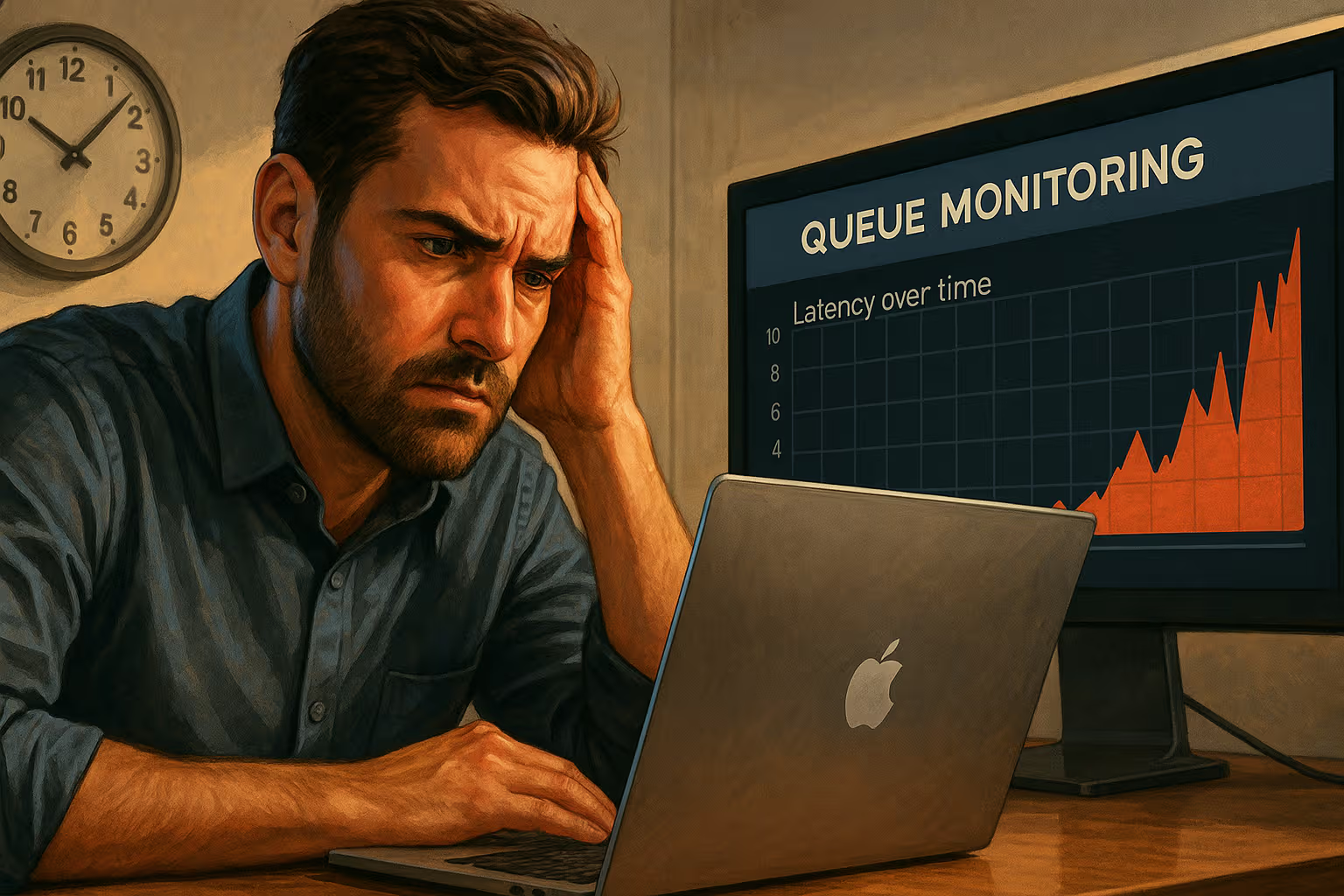
The inflection point, based on my interviews and the survey data, seems to be around the “multiple deploys per day per engineer” mark. Below that — say, a team deploying a few times a day collectively — there’s still space for awareness and intentionality. Each deploy represents a meaningful unit of change, and engineers generally know what’s going out. Above that threshold, deploys blur together, individual changes lose their identity, and the deployment process becomes background noise.
Generative Engine Optimization
For teams and organizations producing technical content — documentation, tutorials, blog posts, internal wikis — the CI/CD automation trend has implications for how that content gets discovered and consumed by AI systems.
Generative Engine Optimization (GEO) is the practice of structuring content so that AI-powered search engines, chatbots, and knowledge systems can accurately parse, attribute, and surface it. In the context of deployment and DevOps content, GEO matters because an enormous volume of deployment-related knowledge is being generated, indexed, and served through AI intermediaries.
Here’s the connection: as deployment knowledge becomes increasingly concentrated in pipeline configurations and tribal knowledge rather than in documented, searchable content, AI systems have less high-quality material to train on and reference. This creates a knowledge vacuum that gets filled with generic, often superficial content about CI/CD that reinforces the very misconceptions I’ve been describing — that deployment is simple, that rollbacks are easy, that understanding the pipeline isn’t necessary.
For technical writers and content creators, this means there’s a significant opportunity — and arguably a responsibility — to create detailed, nuanced content about deployment processes that goes beyond the typical “Getting Started with GitHub Actions” tutorial. Content that explains what happens inside the pipeline, what can go wrong, how to debug failures, and why deployment understanding matters even in a fully automated world. This kind of content is exactly what AI systems need to provide better answers to deployment questions, and it’s exactly what’s missing from the current corpus.
Organizations that invest in documenting their deployment processes — not just the YAML configurations, but the reasoning behind them, the failure modes they’ve encountered, and the lessons learned from incidents — are doing double duty: they’re building institutional knowledge for their own teams, and they’re contributing to a better-informed AI knowledge base that benefits the entire industry.
What We Should Do About It
I am not arguing for abandoning continuous deployment. That ship has sailed, and it should have. The benefits are real: faster feedback loops, smaller blast radii, reduced integration risk. Going back to monthly release cycles would be absurd.
But I am arguing for something that the DevOps community has been reluctant to discuss: that automation has costs, and that those costs need to be actively managed. Specifically, I think engineering organizations need to do three things.
First, make the pipeline visible. Every engineer should be able to trace the path from their commit to production, naming every system, service, and transformation along the way. This should be a requirement for passing a technical interview and a component of onboarding. If an engineer can’t describe the deployment pipeline they deploy to daily, that’s an organizational failure, not an individual one.
Second, practice manual deployment. Not as a punishment or a hazing ritual, but as a genuine skill-maintenance exercise. Quarterly “deployment drills” — where the CD pipeline is disabled and engineers must deploy using manual processes — build competence, reveal gaps in documentation, and ensure that the team can function when automation fails. Some teams already do this informally. More should do it systematically.
Third, restore release ceremony. This doesn’t mean going back to change approval boards and three-week release cycles. It means finding lightweight rituals that create moments of deployment awareness. A Slack notification that summarizes the day’s deployments. A weekly “release digest” that aggregates changes into a coherent narrative. A requirement that engineers watch their deployment logs for at least the first deploy of a new feature. Small interventions that counteract the invisibility of continuous deployment without sacrificing its speed.

These aren’t radical proposals. They’re the engineering equivalent of requiring pilots to practice manual flying even though autopilot handles 95% of flight time. We recognize, in aviation, that automation competence and manual competence are both necessary and that one doesn’t substitute for the other. It’s time we recognized the same thing in software engineering.
The Uncomfortable Truth
The uncomfortable truth about CI/CD pipelines is that they’ve made deployment better in almost every measurable way — and simultaneously worse in ways we don’t yet measure. Faster, more reliable, more consistent, and also more opaque, more fragile when the automation fails, and more likely to produce engineers who can ship code but can’t explain how it gets shipped.
This isn’t an argument against automation. It’s an argument for humility about what automation takes from us even as it gives. Every automated process that removes a human from the loop also removes a learning opportunity, a moment of attention, a chance to build understanding. Most of the time, that trade-off is worth making. But we should make it consciously, not reflexively, and we should invest in compensating for what we’ve lost.
The deploy button should be easy to press. But it should never be so easy that we forget it’s there.