Thomann, the big European music retailer, has listed this headphone since October 2004. Think about what that means. A pair of studio headphones with a fixed cable and no wireless, no app and no noise cancelling has stayed on sale for a very long time, in a field where most products last two or three years. People who record things keep buying it, and I wanted to find out why.
The owner evidence is four detailed reviews of this exact 80 ohm version, which is too few for a full consensus. What those four owners say is specific, though, and it lines up well.

Product image from the Amazon listing.
Pick the Right Impedance
The DT 770 Pro comes in 32, 80 and 250 ohm versions. This review covers the 80 ohm model only, and the DT 990 is an open-back model that belongs to a different discussion. Beyerdynamic labels the 80 ohm version for universal studio use, which is a fair way to describe the middle choice.
Impedance decides how much drive the headphone wants. Thomann’s description says the 80 ohm model “is likely to be somewhat limited in terms of volume when combined with smartphones,” and it points phone users to the 32 ohm version. It also recommends a headphone amplifier.
Related reading

Owners are more relaxed about this. One buyer, who got these for listening and not for studio work, wrote: “A mediocre laptop did its job well.” The same owner calls them highly suitable for use with a phone and says they did not need an amplifier, with some EQ help. Another owner says they “work well on any device and yet they still benefit from dedicated amplification,” and runs them through a Little Dot head amp.
I read that as a soft limit. A laptop or a phone will probably drive these to a decent level in a quiet room. In a noisy place, or with a quiet recording, you may run out of volume. If the phone is your main source, the 32 ohm model is the safer choice.
For a home recording setup, the numbers look comfortable. An owner using a Focusrite Scarlett 4i4 3rd Gen reports that “you achieve the ‘medium-to-high’ volume at 60% of the knob-turn,” and that full volume is too loud. So a common small audio interface has power to spare. This is the setup I would aim for.
Why Closed-Back Matters in a Normal Room
Most of us record in a spare room, not a studio. Closed-back headphones help in two ways, and owners report both.
The first is what comes in. One owner says the design “significantly prevents external sounds.” You hear your take and not the street, the fridge or the family. It won’t match active noise cancelling, but you don’t need a battery for it either.
The second is what leaks out. When you record a voice or an acoustic guitar with a microphone next to your head, sound leaking from your headphones can end up in the take. The Scarlett owner says: “The sound leak is minimal and only if you’re blazing the music at high volumes.” For recording, that is the single best line I found. Keep the backing track at a sensible level and the mic should stay clean.
There is a limit to the purpose here. The same closed design that helps with recording does not make these a good choice for every kind of mixing. One owner recommends them as “especially good for rough mixes because of the wide stereo image.” Note the word rough. I would use these to shape a mix and check details, then confirm the final balance on speakers.
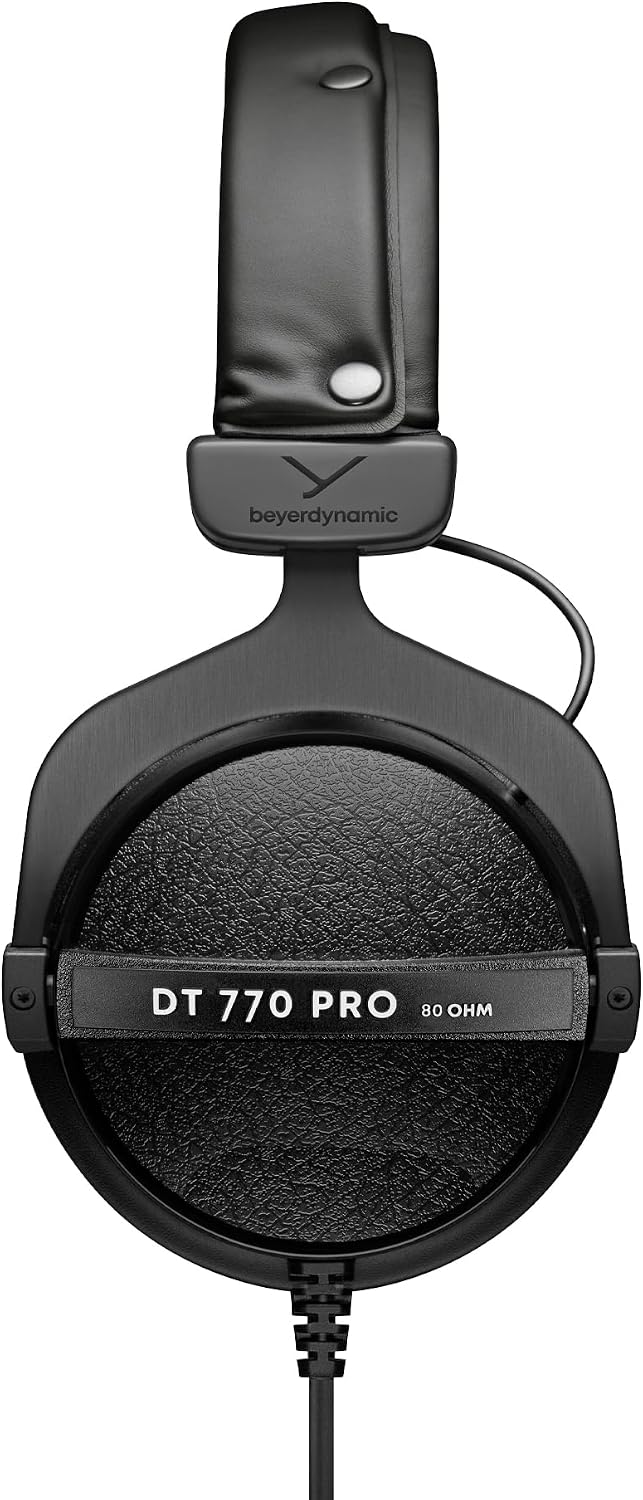
Product image from the Amazon listing.
Comfort Is the Surprise
Studio gear is rarely praised for feeling nice. This one is. One owner writes: “I can easily wear the headphones for hours without noticing them.” Another finds them “comfortable when wearing for long periods.” The Scarlett owner is the most colorful, saying that “those bunny rabbits on your ears are just amazing,” which I take to be a compliment to the soft velour pads.
Related reading

Velour matters for heat. A listening owner says they do “not cause sweating thanks to soft velvet pillows,” and also that they do “not wring your ears,” so clamping force seems modest. Those are single reports, and a head can be a very personal thing, but none of the four complained on either point. Thomann lists the weight at 284 g without the cable, and 346 g with it, so this is not a heavy headphone.
If you do long editing sessions, this might be the real selling point. People buy studio headphones for accuracy and then wear them for six hours.
The Sound Owners Describe
Owners describe the sound in different ways, and I find that useful. On bass, one says: “Bass is clear and tight, no mud and mush in the low end.” The Scarlett owner says they’re “really not that bass heavy.” Put those together and you get bass that is controlled, not boomy.
Treble is where the reports split. One owner calls the highs “extremely clear and crystal quality.” Another says: “Highs are very nice, but kind of soft,” and lists that as a mild drawback. That may be down to ears, sources or preferences. If you are sensitive to bright treble, please read more before buying, and use a store with returns.
Thomann lists a 5 to 35,000 Hz range, which is a maker’s figure and tells you little in practice.

Product image from the Amazon listing.
The Cable Is the One Real Complaint
Two of the four owners name the same flaw. “Cable is not detachable,” says one. The other spells out the worry: “if you mess your cable up, yea, you gotta send them back in.” It is the reason that owner marked down quality.
The fixed cable is 3 m long and straight, with a 3.5 mm plug and a screw-on 6.3 mm adapter. Three meters is handy if your audio interface sits across the room, and it is a lot of wire to manage at a laptop desk. It also runs down one side, so it will tangle around a chair if you are not careful.
Repair is better than that owner feared. Thomann’s description says the cable “can be replaced with a little bit of technical prowess” and lists a replacement cable, so this means a soldering job or a repair shop. It won’t be a quick swap in the middle of a session, but it won’t mean a new pair either.
Related reading

Everything else is built with long life in mind. Beyerdynamic says the headphones are handcrafted in Germany with parts that can be replaced, and it offers a spare ear pad set. Thomann describes a spring steel headband. An owner reports dropping them and squeezing them in a backpack, with “not a scratch on them,” and adds that “every part is replaceable.” Another owner is on a second pair and still rates them highly. None of the four mentions pad wear, but pads are a normal wear item, and a spare set is easy to get.
Not a Headset
These have no microphone. So if you were hoping to use them for Zoom calls on a Mac, you will need a separate mic, which you may already have if you record. You will also need a 3.5 mm jack or an adapter on your computer, and they do nothing wirelessly. For people who live in meetings all day, a headset with a boom microphone is the better tool.
A Tool That Earns Its Age
I would buy the 80 ohm DT 770 Pro for one clear job: home recording and editing in an ordinary room, connected to a small audio interface. Owners make a strong case for comfort over long sessions and low leakage near a microphone, and the repairable design suits a product you plan to keep for a decade.
Skip this version if you mainly use a phone, where the 32 ohm model makes more sense. Skip it if you want wireless, a mic for calls or a removable cable. Final mix decisions, in my view, still belong on speakers.
If that recording job is yours, the beyerdynamic DT 770 Pro 80 Ohm is an easy recommendation, as long as you check the listing says 80 ohm before you order. This is an affiliate link. As an Amazon Associate I earn from qualifying purchases.
One email a month: new articles, reviews and the upcoming live webinar + free recording. No spam, unsubscribe anytime.