
Automated Social Media Scheduling Killed Audience Intuition: The Hidden Cost of Post-When-They-Tell-You
The Post That Landed on the Wrong Day
In March 2027, a well-known outdoor clothing brand published a cheerful, pre-scheduled Instagram post about spring hiking essentials. It went live at 9:14 AM Eastern, which their scheduling tool had identified as the optimal posting time for maximum engagement. The problem was that, twelve hours earlier, a massive earthquake had struck a popular hiking region. The internet was flooded with images of destroyed trails and rescue operations. A brand cheerfully promoting hiking gear into that context looked, at best, tone-deaf and, at worst, grotesquely callous.
The brand apologized, deleted the post, and issued the standard corporate statement about “monitoring processes.” But the damage was done. And the real lesson — the one that didn’t make it into the post-mortem — was this: if a human social media manager had been actually present, actually reading the room that morning, they would have paused the post in an instant. Not because of any formal crisis protocol, but because of something far more valuable and far harder to automate: the intuitive sense that now is not the right moment.
This kind of contextual awareness — understanding not just when your audience is online, but what they’re feeling, what they’re paying attention to, what would land well and what would land badly — used to be the core competency of social media management. It was the thing that separated good social media managers from mediocre ones. And it’s the thing that automated scheduling tools have spent the past decade systematically destroying.
The scheduling tools didn’t set out to kill audience intuition. They set out to solve a legitimate operational problem: managing multiple social media accounts across time zones is genuinely difficult, and the ability to compose posts in advance and have them publish at predetermined times is a real productivity gain. Nobody disputes that.
But somewhere between “schedule posts for convenience” and “let the algorithm determine optimal posting times and frequencies based on historical engagement data,” something fundamental changed. Social media management stopped being a real-time, responsive, human activity and became a batch-processing operation. Posts were composed days or weeks in advance, loaded into a queue, and published automatically with no human in the loop at the moment of publication. The content was disconnected from context. The sender was absent from the sending.
And it turns out that presence — being there, in the moment, reading the digital room — was the thing that made social media work. When you remove the human from the moment of publication, you don’t just lose the ability to avoid disasters. You lose the ability to respond to opportunities, to match the audience’s energy, to participate in the conversation rather than broadcasting into it.

What Audience Intuition Actually Is
Audience intuition isn’t a single skill. It’s a constellation of perceptual and cognitive abilities that develop through sustained, attentive engagement with an audience over time. Understanding what we’ve lost requires breaking it down into its component parts.
Mood reading. An experienced social media manager develops an ability to read the collective mood of their audience — and of the broader platform — at any given moment. This isn’t mysticism; it’s pattern recognition. After spending hours daily scrolling through replies, mentions, trending topics, and comment threads, you develop a sense for whether the audience is playful or serious, angry or receptive, engaged or distracted. This mood assessment influences everything: tone, topic choice, visual style, and crucially, whether to post at all.
Automated scheduling eliminates this skill entirely. The post goes live at the scheduled time regardless of the audience’s current state. There’s no mood check, no temperature reading, no last-second adjustment. The algorithm optimizes for historical engagement patterns — “people clicked more at 9 AM on Tuesdays” — without any capacity to assess whether this particular Tuesday at 9 AM is a good moment to appear in someone’s feed.
Timing feel. Beyond the algorithmic question of “when are people online,” there’s a more nuanced question that only human intuition can answer: “when are people receptive to this specific message?” A product announcement might perform best on a Tuesday morning. But a vulnerable, personal story might resonate more on a Sunday evening, when people are reflective and unhurried. A humorous post might land perfectly at Friday lunchtime, when people are winding down and looking for levity. These timing nuances are invisible to scheduling algorithms, which treat all content types as interchangeable and optimize purely for aggregate engagement metrics.

Cultural awareness. Social media operates in a cultural context that shifts constantly — sometimes gradually, sometimes abruptly. Holidays, news events, viral moments, platform-specific trends, political upheavals, celebrity deaths, meme cycles — all of these affect what content is appropriate, what tone is expected, and whether your audience is in the mood to hear from a brand at all. A present, engaged social media manager navigates this landscape in real time. An automated scheduler drives through it blindfolded.
Conversational rhythm. Social media, at its best, is a conversation. And conversations have rhythms — call and response, listening and speaking, building on what others have said. An experienced social media manager participates in this rhythm, posting when the conversation calls for their contribution and staying quiet when it doesn’t. Automated scheduling imposes a fixed rhythm — post every four hours, three times a day, seven days a week — that has nothing to do with the actual conversational flow and everything to do with the scheduling tool’s optimization model.
Platform-specific intelligence. Each social media platform has its own culture, norms, and engagement patterns. What works on LinkedIn doesn’t work on TikTok. What works on X (formerly Twitter) doesn’t work on Instagram. An experienced social media manager develops platform-specific intuitions about content format, tone, length, and timing. Automated scheduling tools tend to flatten these distinctions, encouraging cross-posting and universal “best time” recommendations that ignore the profound differences between platforms.

The Optimization Trap
The central promise of automated scheduling tools is optimization: post at the time when your content will get the most engagement. This promise is based on a straightforward analysis of historical data. The tool examines when your past posts received the most likes, comments, shares, and clicks, and recommends future posting times based on those patterns.
The problem is that this optimization is narrowly defined and self-reinforcing. It optimizes for engagement metrics — which are easy to measure — rather than for the things that actually matter: audience trust, brand perception, conversational quality, and long-term relationship building. These outcomes are hard to measure and impossible to optimize algorithmically, which means the scheduling tools ignore them entirely.
This creates what I think of as the optimization trap: the tool maximizes the measurable metric while degrading the unmeasurable ones. You get more likes per post. You also gradually lose the audience’s sense that you’re a real presence in their feed rather than an automated content delivery system. And since the tool can’t measure “sense of human presence,” it can’t warn you when it’s disappearing.
I noticed this in my own social media work several years ago. I’d been using a scheduling tool for about eighteen months, and my engagement metrics were solid — consistent, optimized, exactly what the analytics dashboard said they should be. But something felt off. The quality of the interactions had changed. Fewer people were replying with genuine responses. More people were reacting with quick likes and moving on. The posts were being consumed, but they weren’t generating conversation. And conversation, I realized, was the whole point.

When I switched back to manual posting for a month as an experiment, the difference was immediate. My posts were less consistently timed but more contextually relevant. I posted when I had something to say, in response to what my audience was talking about, at moments when the conversation naturally called for my contribution. Engagement metrics actually dipped slightly in the first week — the algorithm had been right about the optimal times — but the quality of engagement increased dramatically. People started replying with substantive responses. Conversations lasted longer. Several people commented that my feed “felt alive again.”
That phrase — “felt alive” — keeps coming up when I talk to people about the difference between scheduled and manual social media. It captures something that metrics can’t: the intangible sense of human presence that makes social media social, rather than just media.
How We Evaluated the Impact
Measuring the decline of audience intuition is challenging, because “intuition” is by definition difficult to quantify. We designed our evaluation to capture both measurable skill degradation and the more subjective quality changes that metrics alone can’t detect.
Methodology

Our assessment drew on four data sources:
Contextual awareness tests. We created a battery of twenty scenario-based questions designed to test social media timing judgment. Each scenario described a specific context — a news event, a cultural moment, a platform trend — and asked the participant to decide whether to post, delay, modify, or cancel a pre-written social media message. We administered this test to 120 social media professionals: sixty who primarily used automated scheduling and sixty who primarily posted manually.
Engagement quality analysis. We analyzed six months of social media data from twenty brands that switched from manual posting to automated scheduling and twenty that maintained manual posting throughout. We looked not just at engagement volume (likes, shares, clicks) but at engagement quality: reply length, conversation depth (number of back-and-forth exchanges), sentiment, and the ratio of substantive comments to quick reactions.
Professional interviews. I conducted semi-structured interviews with twenty-eight social media managers, content strategists, and community managers across consumer brands, media organizations, and nonprofit institutions. I asked about changes in their skills, confidence, and relationship with their audience since adopting scheduling tools.
Crisis response assessment. We examined fourteen documented cases of social media timing failures — pre-scheduled posts that went live during inappropriate contexts — and analyzed whether the failures could have been prevented by human judgment at the moment of publication.
Key Findings
The results were consistent and concerning across all four data sources.
On the contextual awareness test, manual posters outperformed automated schedulers by a significant margin. Manual posters correctly identified the appropriate action in 81% of scenarios. Automated schedulers managed only 54%. The gap was largest for scenarios involving subtle cultural context — situations where there wasn’t a clear crisis but where posting would have been tone-deaf or poorly timed. Manual posters had developed a sensitivity to these nuances that automated schedulers hadn’t.

The engagement quality analysis revealed a pattern I call “metric-quality divergence.” Brands using automated scheduling showed stable or slightly improved engagement volume — the optimization was working as intended. But engagement quality declined measurably. Average reply length dropped by 34%. Conversation depth (measured as average exchanges per thread) dropped by 47%. The ratio of substantive comments to quick reactions shifted from roughly 1:3 to 1:8. The audience was reacting to the content but not engaging with it.
The professional interviews surfaced a recurring theme: loss of confidence. Seventeen of the twenty-eight social media managers I interviewed reported feeling less confident in their ability to read their audience since adopting scheduling tools. Several described a specific anxiety about posting manually — a fear that their timing judgment was no longer reliable, that the algorithm knew something they didn’t. This anxiety itself becomes a barrier to skill recovery: the less you trust your own judgment, the less likely you are to practice it, and the less you practice it, the less reliable it becomes.
The crisis response assessment was perhaps most illuminating. Of the fourteen timing failures we examined, twelve involved pre-scheduled posts that went live during contexts that any reasonably attentive human would have recognized as inappropriate. In each case, the human who had composed and scheduled the post was not actively monitoring at the time of publication. The system published on schedule, and nobody was there to intervene. The remaining two cases involved manual posting by individuals who were aware of the context but misjudged its severity — genuine errors of judgment rather than absence of judgment entirely.
xychart-beta
  title "Engagement Quality Metrics: Manual vs Automated Posting"
  x-axis ["Reply Length", "Thread Depth", "Substantive Comments", "Audience Sentiment"]
  y-axis "Score (Indexed to Manual = 100)" 0 --> 120
  bar [100, 100, 100, 100]
  bar [66, 53, 45, 78]
The Buffer Effect
I want to talk specifically about Buffer, not because it’s worse than its competitors but because it was first and its name has become almost synonymous with the practice it pioneered. Understanding Buffer’s influence helps explain how an entire profession lost a core competency.
Buffer launched in 2010 with a simple, elegant proposition: write your tweets, put them in a queue, and Buffer will post them at optimal times throughout the day. The product was beautifully designed, the onboarding was friction-free, and the value proposition was immediately obvious. Within two years, it had hundreds of thousands of users. Within five, it had reshaped the social media management profession.
The genius of Buffer — and of the tools that followed it, including Hootsuite, Sprout Social, Later, and dozens of others — was that it made the absence of human presence feel responsible rather than lazy. “I’m not neglecting my audience by not being present when the post goes live,” you could tell yourself. “I’m being strategic. I’m optimizing.” The tool gave professional cover to what was, in effect, the abdication of a core professional responsibility: being present for your audience.
This framing was extraordinarily effective. Within a few years, manual social media posting was seen as amateurish. Serious social media professionals used scheduling tools. The skill of reading the room in real time — of sensing the moment and responding to it — was reclassified from “core competency” to “nice to have” to “irrelevant.”
And because the scheduling tools measured engagement volumes and reported them in attractive dashboards, the decline in audience relationship quality went unnoticed. The dashboards showed green arrows going up. The unmeasurable things — trust, presence, conversational quality, cultural sensitivity — went unmeasured.

The Timezone Excuse
The most common defense of automated scheduling is the timezone argument: “My audience is global. I can’t be online twenty-four hours a day. I need to schedule posts for when my audience in different time zones is active.”
This is a legitimate operational concern, and I don’t dismiss it. But it’s also a much smaller problem than the scheduling tool industry would have you believe, and the solution it offers creates problems far larger than the one it solves.
Here’s the thing about timezones: they’re predictable. Your audience in Tokyo is always thirteen hours ahead of your audience in New York. This is not a problem that requires algorithmic optimization. It requires a posting schedule — which a human can create and maintain — and, for critical or sensitive content, a human in each major timezone who can exercise judgment at the moment of publication.
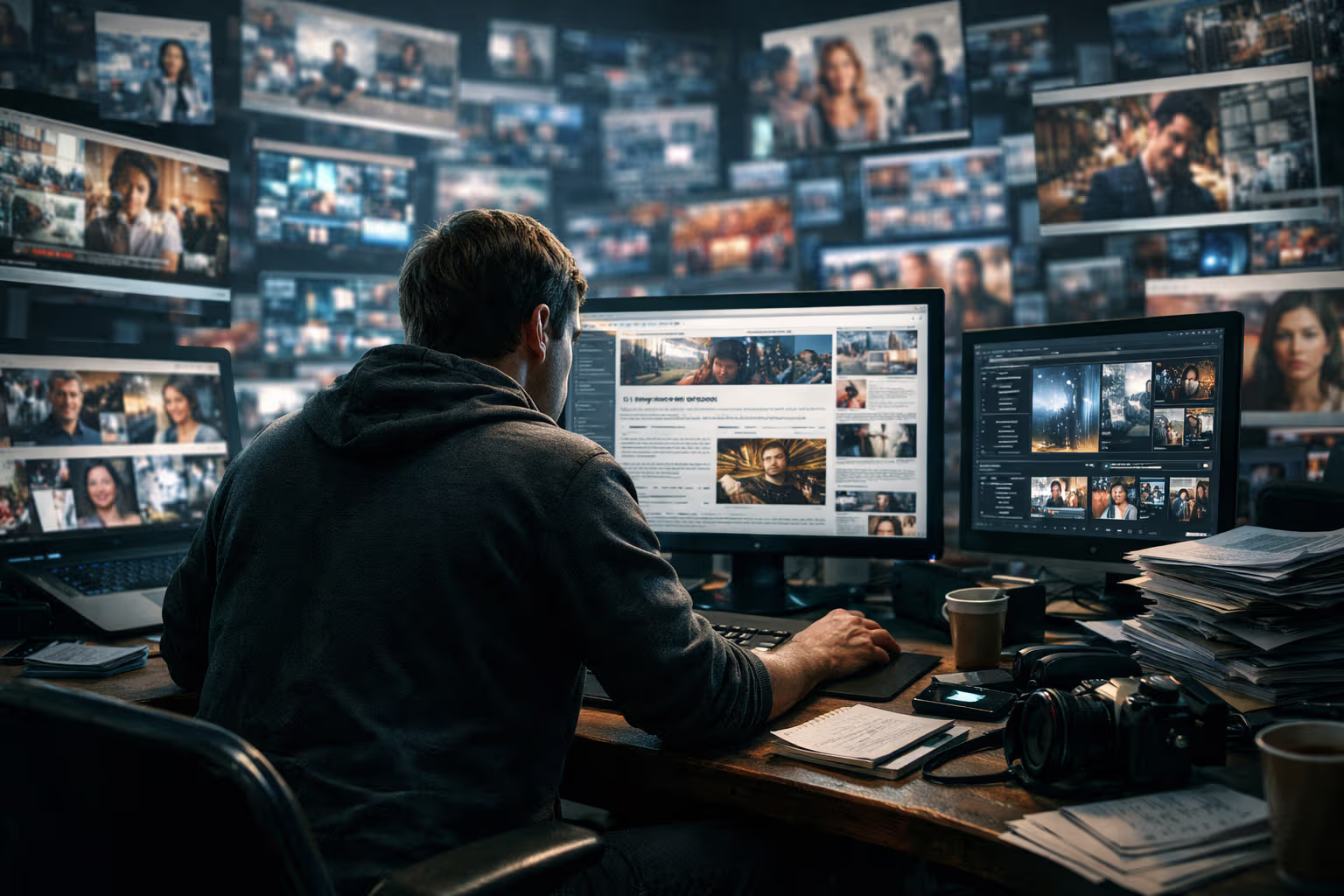
What the timezone argument actually masks is a staffing decision. Companies don’t use scheduling tools because timezones are impossible to manage manually. They use scheduling tools because hiring enough human social media managers to maintain genuine presence across time zones is expensive. The scheduling tool is a cost-cutting measure dressed up as a productivity enhancement. And the cost it cuts — human judgment at the moment of publication — turns out to be the most valuable thing in the social media management stack.
The Death of Real-Time Relevance
One of the most significant casualties of automated scheduling is the ability to participate in real-time cultural moments — the events, conversations, and viral phenomena that define the social media landscape on any given day.
The best social media moments in history have been real-time responses. Oreo’s “You can still dunk in the dark” tweet during the 2013 Super Bowl blackout. Wendy’s improvisational Twitter exchanges. The spontaneous brand responses to unexpected events that feel human, present, and genuinely funny. These moments are, by definition, impossible to schedule. They require a human who is watching, processing, and responding in real time — someone with the audience intuition to know that this is the moment, this is the tone, this is the response that will resonate.
Automated scheduling doesn’t just prevent these moments from happening; it prevents the skills that create them from developing. The ability to craft a real-time response that’s on-brand, contextually appropriate, and genuinely engaging is a skill that requires constant practice. It’s built through thousands of hours of being present on the platform, reading the room, understanding the audience, and developing the confidence to respond spontaneously without a content calendar or an approval chain.
Social media managers who spend their days composing posts in advance and loading them into scheduling queues don’t develop this skill. They develop a different skill — content planning, batch creation, calendar management — which is valuable in its own way but is fundamentally different from real-time audience engagement. And when a real-time moment does arise, they’re often unable to seize it, either because they lack the skills or because their workflow doesn’t accommodate spontaneity.

This is how you end up with a social media landscape that feels increasingly corporate and decreasingly human. The scheduled posts are competent but lifeless. The real-time responses are absent or delayed. The audience receives a steady stream of optimized content and a complete absence of genuine human presence. And they respond accordingly — with likes and clicks, but not with the loyalty and affection that come from feeling genuinely connected to the person or brand on the other end.
Generative Engine Optimization
The intersection of automated social media scheduling and generative AI is creating a new layer of abstraction between brands and their audiences that deserves careful attention.
Generative Engine Optimization
Generative Engine Optimization (GEO) in the social media context refers to the practice of creating content that is optimized not just for human audiences but for the AI systems that increasingly mediate how social media content is discovered, surfaced, and summarized. As platforms integrate more AI into their recommendation algorithms and as users rely more on AI assistants to curate their social feeds, the question of “what performs well” is shifting from “what do humans engage with” to “what do AI systems promote.”
This has profound implications for audience intuition. When the optimization target shifts from human response to algorithmic response, the feedback loop that builds audience intuition breaks down entirely. You’re no longer learning what resonates with people; you’re learning what triggers the recommendation algorithm. These are correlated but not identical, and the gap between them is where audience intuition used to live.

For social media creators and marketers, the GEO implications are both practical and philosophical. Practically, it means that the skills that matter are shifting from “understanding your audience” to “understanding the algorithm that mediates your audience.” Philosophically, it raises the question of whether social media can remain genuinely social when every interaction is mediated by optimization systems that neither the creator nor the audience fully understands or controls.
The most valuable social media presences in this environment will be the ones that maintain genuine human judgment about timing, tone, and context — precisely the skills that automated scheduling has eroded. In a feed full of AI-optimized, algorithmically timed content, the post that feels unmistakably human will stand out. But only if there’s still a human with the skills to create it.
Method: Rebuilding Your Audience Sense
If you’ve been relying on automated scheduling and want to rebuild your audience intuition, here’s a structured approach. I’ve tested this framework with a group of fifteen social media professionals over four months, and the results were encouraging.
Week 1-2: Passive observation. Keep your scheduling tool active, but start spending thirty minutes each day actually being present on your platforms. Don’t post; just read. Scroll through your feed. Read comments and replies. Notice the trending topics, the prevailing mood, the conversations happening in your community. The goal is to re-engage the observational muscles that scheduling has let atrophy.

Week 3-4: Timing experiments. Start posting one piece of content per day manually, at a time you choose based on your own judgment rather than the algorithm’s recommendation. Before posting, write down your reasoning: “I’m posting now because the mood seems receptive / because this topic is trending / because my audience tends to be reflective on Sunday evenings.” After posting, compare your engagement to your scheduled content. Don’t worry if the numbers are lower; focus on the quality of the interactions.
Week 5-8: Increasing manual share. Gradually increase the proportion of manual posts relative to scheduled posts. Aim for 50/50 by week eight. During this phase, focus on developing your contextual awareness: check the news before posting, scan the platform for mood indicators, consider whether your content is appropriate for the moment. You’ll make some misjudgments. That’s expected and educational.
Week 9-12: Real-time practice. Start actively looking for real-time engagement opportunities. When something relevant to your brand or audience happens, respond within the hour rather than scheduling a response for later. This is the scariest phase, because real-time posting requires confidence in your judgment — confidence that scheduling tools have been quietly undermining for years. Push through the discomfort.
Ongoing: The hybrid approach. After the initial recovery period, maintain a mix of scheduled and manual posting. Use scheduling for planned content — announcements, recurring features, evergreen material — and manual posting for anything that benefits from contextual awareness and timing judgment. The key is to maintain your audience intuition through regular practice while still using automation for tasks that genuinely don’t require human judgment.
My British lilac cat has mastered a version of this hybrid approach. She schedules her napping with mechanical regularity — same spot, same times, every day — but her hunting behavior is entirely real-time, responsive to the unpredictable movements of whatever insect or shadow has caught her attention. Content planning is the nap. Real-time engagement is the hunt. Both matter. But only one requires actual skill.

The Measurement Problem
One reason automated scheduling has been so widely adopted — and so resistant to criticism — is that its benefits are easily measurable while its costs are nearly invisible.
Engagement volume, posting consistency, time saved, reach optimized — these are the metrics that scheduling tools report, and they’re the metrics that social media managers are evaluated on. When these numbers are stable or improving, it’s easy to conclude that the tool is working and the strategy is sound.
But the things that automated scheduling degrades — audience trust, cultural sensitivity, conversational depth, real-time responsiveness, the intangible sense of human presence — are extraordinarily difficult to measure. There’s no dashboard widget for “audience’s feeling that we’re a genuine, present, human entity in their feed.” There’s no metric for “things we would have posted if we’d been paying attention.” There’s no way to quantify the conversations that didn’t happen because we weren’t there to start them.
This measurement asymmetry creates a systematic bias toward automation. The tools look good on the metrics that get measured. The skills they replace look irrelevant because the things they produced weren’t being measured. And so the decision to automate further — to schedule more, to be present less, to let the algorithm determine more of the social media strategy — seems rational at every step, even as the cumulative effect is the gradual disappearance of the human qualities that made social media valuable in the first place.

What We Can Still Save
I want to be realistic. We’re not going back to a world without social media scheduling tools, and we shouldn’t want to. The tools solve real operational problems, and for many organizations, the alternative to automated scheduling isn’t hand-crafted, lovingly timed manual posting — it’s no social media presence at all.
But we can be smarter about what we automate and what we keep human. The operational tasks — queuing posts, managing cross-platform distribution, ensuring coverage across time zones — can and should be automated. The judgment tasks — reading the room, assessing cultural context, deciding whether now is the right moment for this message — must remain human.
This requires a mindset shift in how we think about social media roles. A social media manager isn’t a content uploading technician. They’re a cultural interpreter, a conversational participant, a real-time decision-maker. The scheduling tool should support their judgment, not replace it. And organizations need to create space for social media managers to exercise that judgment — which means accepting that some posts will go live at suboptimal times, that some real-time opportunities will be missed, and that human judgment will occasionally produce mistakes that an algorithm wouldn’t have made.
Those mistakes are the price of presence. And presence is the price of genuine connection.
Final Thoughts
Social media was supposed to be about connection. About breaking down the barriers between people, between brands and customers, between institutions and the communities they serve. And in its early years, it was. The best social media presences felt like real people — present, responsive, engaged, occasionally messy, unmistakably human.

Automated scheduling tools promised to make that presence more efficient. What they actually did was make it more absent. The posts kept coming — more regularly, more optimally, more consistently — but the human behind them quietly withdrew. The audience noticed, even if they couldn’t articulate what had changed. The feed felt different. Less alive. More like a broadcast and less like a conversation.
The tools didn’t mean to kill audience intuition. They meant to make social media management easier. And they did. But “easier” and “better” are not synonyms, and the gap between them is where a generation of social media professionals lost the most valuable skill in their toolkit: the ability to read the room, sense the moment, and show up as a human being in a medium that was built for human beings.
The algorithm knows when your audience is online. Only you can know whether they want to hear from you.