
Automated Sleep Tracking Killed Bedtime Wisdom: The Hidden Cost of Quantified Rest
The Night Before the Numbers
There was a time — and it wasn’t that long ago — when going to bed was uncomplicated. You felt tired. Your eyelids drooped. Maybe you yawned three times in a row while pretending to watch a documentary about Antarctic penguins. You got up, brushed your teeth, turned the light off, and fell asleep. The entire decision-making process took roughly ninety seconds. Nobody scored your performance afterwards.
I grew up in a household where bedtime wisdom was passed down like a folk recipe. My grandmother swore by warm milk with honey. My father believed in reading exactly twenty pages of whatever novel sat on his nightstand — not nineteen, not twenty-one. My mother opened the bedroom window a crack, even in February, because “fresh air pulls you under.” None of these rituals had peer-reviewed evidence behind them. All of them worked, because the people who practised them believed in them, repeated them nightly, and — crucially — paid attention to how their own body responded.
That kind of self-knowledge is now disappearing. Not because people became dumber about sleep, but because a $5 billion wearable industry told them they were never smart about it in the first place. The implicit message of every sleep tracker on the market is the same: your body is unreliable, your feelings are anecdotal, and only continuous biometric monitoring can tell you the truth about your rest. After a decade of living under that message, millions of people have internalised it so deeply that they genuinely cannot tell whether they slept well without consulting a screen first.

This article is about what we lost when we automated the act of knowing we’re tired. It is not anti-technology and it is not anti-data. It is about a specific trade-off that almost nobody discusses: the systematic erosion of interoceptive sleep awareness — the body’s built-in ability to sense its own need for rest — in exchange for dashboards that, for most people, deliver marginal improvements at best and genuine anxiety at worst.
The Rise of the Sleep Score Industrial Complex
Sleep tracking existed before the current generation of consumer wearables, but it lived in clinical settings. Polysomnography — the gold-standard sleep study — required you to sleep in a lab with electrodes glued to your scalp. It was expensive, uncomfortable, and reserved for people with serious sleep disorders. The data it produced was interpreted by trained clinicians, not by an algorithm pushing a notification to your phone at 7 a.m.
The consumer revolution began around 2014–2015 with devices like the early Fitbit models and the Jawbone UP. They were crude by today’s standards: essentially accelerometers strapped to your wrist that inferred sleep from the absence of movement. But they introduced a concept that would reshape how millions of people related to their own rest: the sleep score. A single number, typically out of 100, that purported to summarize the quality of your night. Simple. Addictive. Dangerously reductive.
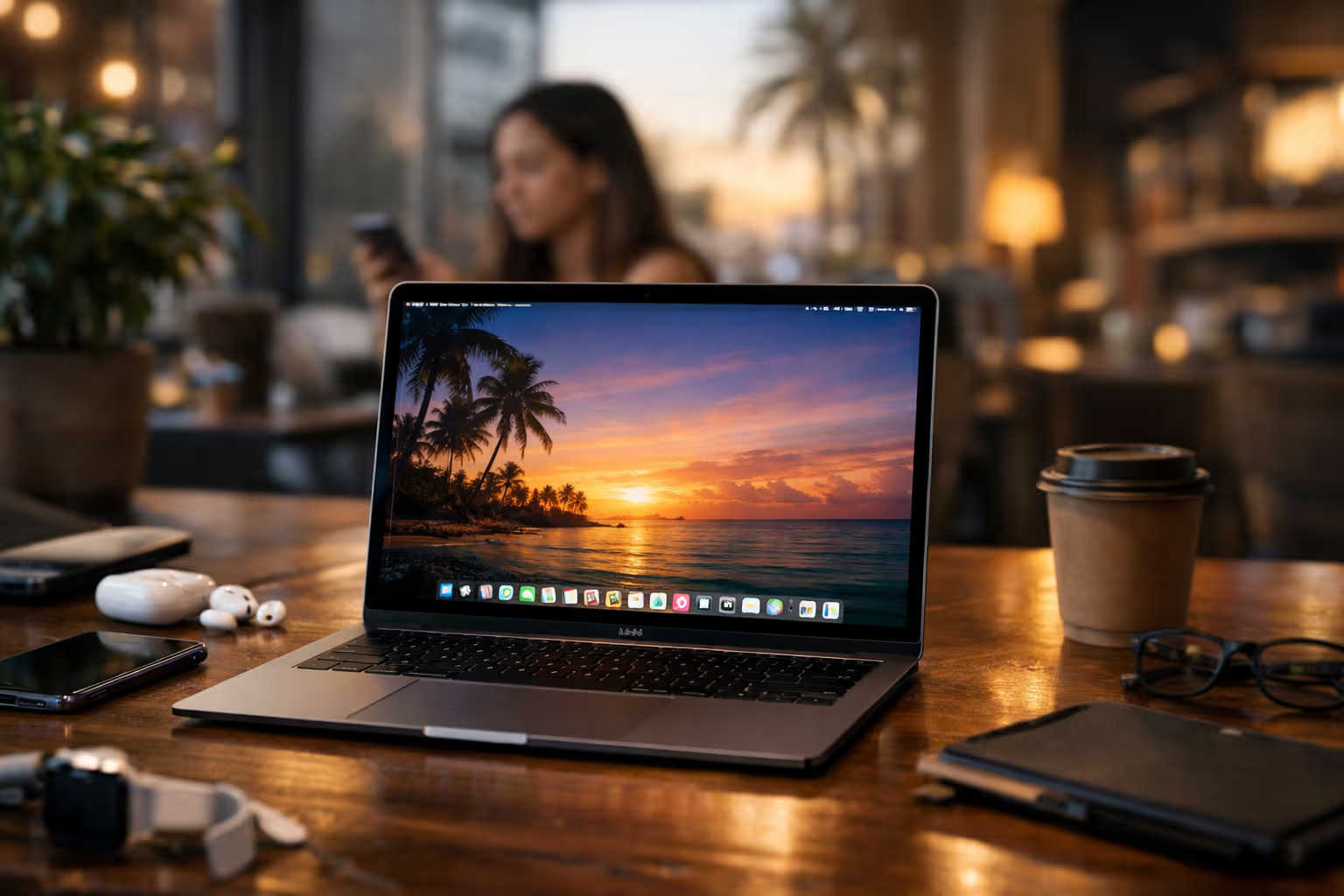
By 2025, the market had matured into a sophisticated ecosystem. The Oura Ring tracked heart rate variability, skin temperature, respiratory rate, and blood oxygen levels. The Whoop strap built entire recovery and strain models around sleep data. The Apple Watch introduced sleep stages — REM, deep, core — displayed in colourful charts that made every night look like a geological survey. Fitbit, now absorbed into Google’s health platform, fed sleep data into an AI engine that generated personalised “sleep coaching” recommendations.
Each generation of hardware promised more granularity, more accuracy, more insight. And consumers bought in — literally and figuratively. The Oura Ring alone had sold over two million units by 2024, with a subscription model charging $6 per month for the privilege of being told how you slept. Whoop went further: the hardware was “free,” but the data interpretation cost $30 per month. Sleep had become a subscription service, and the trajectory followed a pattern I’ve documented across many domains of automation: introduce a tool that supplements human capability, then gradually reposition it as a replacement, then watch the original capability atrophy from disuse.
Orthosomnia: When the Cure Becomes the Disease
In 2017, researchers at Rush University Medical Center and Northwestern University’s Feinberg School of Medicine published a case series in the Journal of Clinical Sleep Medicine that named a phenomenon clinicians had been observing for several years: orthosomnia. The term — derived from “ortho” (correct) and “somnia” (sleep) — described patients who had developed anxiety, sleep disturbances, and obsessive behaviours specifically because of their sleep tracking devices.

The cases were striking. One patient spent so much time trying to optimise her Fitbit sleep score that she extended her time in bed by three hours, which actually fragmented her sleep and made it worse. Another patient refused to believe he felt rested because his tracker reported low deep sleep percentages, despite functioning perfectly well during the day. A third became so anxious about her sleep data that she developed insomnia — the very condition the tracker was supposedly helping her avoid.
The irony is almost too neat. A device designed to improve sleep was generating a new category of sleep disorder. But the underlying mechanism is not surprising if you understand how anxiety works. Sleep is one of the human processes most sensitive to conscious monitoring. The more you watch it, the harder it becomes. This is why cognitive behavioural therapy for insomnia (CBT-I) — the most effective non-pharmacological treatment — explicitly tells patients to remove clocks from the bedroom. Sleep trackers do the opposite: they turn every night into a performance review.
Since 2017, the research on orthosomnia has expanded considerably. A 2023 systematic review in Sleep Medicine Reviews found that between 15% and 30% of regular sleep tracker users reported increased sleep-related anxiety attributable to their devices. The numbers were higher among younger users and among people who already had perfectionistic tendencies — precisely the demographic most likely to buy a premium sleep tracker in the first place.
What makes orthosomnia particularly insidious is that it operates through a feedback loop. You check your sleep score. It’s low. You feel anxious about tonight’s sleep. The anxiety impairs your sleep. Tomorrow’s score is even lower. The device that promised to break the cycle of poor sleep creates its own cycle, one that is harder to escape because you now trust the device more than your own feelings.
The Body Already Had a Tracking System
Here is something the wearable industry would prefer you not think about too carefully: the human body already has an extraordinarily sophisticated sleep-monitoring system. It’s called interoception — the sense by which you perceive internal bodily states. It includes awareness of your heartbeat, your breathing, your hunger, your temperature, and, critically, your level of fatigue.
Interoceptive signals related to sleep are numerous and surprisingly precise. Heaviness in the eyelids. A characteristic warmth that spreads through the limbs as peripheral vasodilation kicks in before sleep onset. Yawning, which regulates brain temperature. Microsleeps — those tiny, involuntary eye closures — that signal acute sleep deprivation. These signals evolved over millions of years and are the product of ruthless natural selection: organisms that couldn’t accurately assess their need for rest didn’t survive long enough to reproduce.
The problem is that interoception is a skill, not just a reflex. Research by Dr. Sarah Garfinkel and others at the University of Sussex has demonstrated that interoceptive accuracy varies dramatically between individuals and can be improved or diminished by training and attention. When you spend years outsourcing your fatigue assessment to a wristband, you are systematically detraining the neural circuits responsible for that assessment.

This isn’t speculation. A 2024 study published in Psychophysiology examined interoceptive accuracy in long-term sleep tracker users versus non-users. The tracker group showed significantly reduced accuracy on heartbeat detection tasks and lower scores on the Multidimensional Assessment of Interoceptive Awareness (MAIA-2), particularly in the “self-regulation” and “body listening” subscales. The researchers noted that the effect was dose-dependent: the more years a person had used a sleep tracker, the worse their interoceptive accuracy.
My British lilac cat, incidentally, has never consulted a sleep score in her life. She sleeps approximately sixteen hours a day, always in positions that would concern a chiropractor, and wakes up fully operational every single time. She has perfect interoceptive calibration — no app required.
The Lost Rituals of Winding Down
Before trackers, people had bedtime rituals. Not “sleep hygiene protocols” recommended by an app — actual rituals, developed through personal experience and refined over years. The distinction matters. A ritual is something you do because it works for you, because it signals to your particular nervous system that the day is ending. A protocol is something you follow because a device told you to.
My grandfather read Agatha Christie novels before bed for forty years. Not because a sleep scientist recommended fiction before sleep, but because the familiar rhythm of Poirot’s deductions put his mind into a predictable, calm state. He tried other authors; they didn’t work as well. He had discovered, through decades of self-experimentation, the exact cognitive stimulation level that bridged his wakefulness and sleep. No app could have found that for him, because no app knew his mind the way he did.

Bedtime rituals are disappearing because they’ve been replaced by optimisation routines. Instead of doing what feels right, people now follow tracker-generated checklists: stop caffeine by 2 p.m., set the bedroom to 18.3°C, enable the blue light filter at 8 p.m., begin the “wind-down” mode at 9:30 p.m. These recommendations are not wrong, exactly — they’re based on legitimate sleep science. But they are generic, the same for everyone, and they crowd out the personalised rituals that individuals develop when they’re actually paying attention to their own responses.
I’ve spoken to dozens of people who abandoned their personal bedtime rituals after starting to use sleep trackers. The pattern is consistent. Phase one: they use the tracker alongside their existing rituals. Phase two: the tracker suggests modifications. Phase three: they comply, because the data must know better. Phase four: they sleep worse, but attribute it to other factors. Phase five: they buy a more expensive tracker.
The Corporate Wellness Sleep Mandate

The individual adoption of sleep trackers might have remained a personal quirk — annoying but relatively harmless — if corporations hadn’t seized on it as a wellness initiative. Starting around 2022, large employers began subsidising or outright providing sleep trackers to employees. Aetna famously offered employees bonuses for logging seven or more hours of sleep per night, verified by wearable data. Other companies integrated Whoop or Oura data into their wellness platforms, gamifying sleep with leaderboards, challenges, and rewards.
The stated intention was benign: well-rested employees are more productive. The research supporting this is robust — sleep deprivation costs the US economy an estimated $411 billion annually. But the implementation introduced surveillance dynamics that transformed sleep from a private activity into a corporate performance metric.
When your employer can see your sleep score, sleep stops being about rest and starts being about compliance. A 2026 survey by the American Institute of Stress found that 42% of employees in corporate sleep-tracking programmes reported more stress about sleep than before the programme began. Among managers, the figure was 58%. The corporate context accelerated the erosion of personal sleep wisdom — when a company-mandated app tells you to go to bed at 10 p.m., you override your own sense of whether you’re actually tired.

Perhaps the most troubling aspect is the implicit message: employees cannot be trusted to manage their own rest. The same paternalism that led to open-plan offices now extends to the bedroom.
How Accuracy Became Irrelevant
One of the more fascinating aspects of the sleep tracking phenomenon is that the accuracy question — how well do these devices actually measure what they claim to measure? — has become almost irrelevant to their cultural impact. The devices could be perfectly accurate or wildly wrong, and the behavioural effects would be largely the same. Because the damage isn’t in the data. It’s in the delegation.
But for the record: the accuracy is mixed. Consumer sleep trackers are reasonably good at detecting total sleep time (within about 20–30 minutes) and at distinguishing sleep from wakefulness. They are significantly less reliable at detecting sleep stages. A 2023 comparative study in the journal Sleep found that the Oura Ring Gen 3 agreed with polysomnography on sleep staging only about 65% of the time. The Apple Watch performed similarly. None approached the 90%+ agreement threshold that clinical devices achieve.

Sleep stage data is precisely the data that generates the most anxiety. When your tracker tells you that you got only 12 minutes of deep sleep — a number that may or may not reflect reality — you feel compelled to act. You change your behaviour, your routine, your supplements, your mattress. All based on a measurement that might be wrong one-third of the time. The action bias is powerful: having a number, even an inaccurate one, creates a pressure to optimise that not having a number never did.
The manufacturers know this, and their response has been revealing. Rather than emphasising accuracy limitations, they’ve shifted the narrative towards “trends over time.” Don’t worry about any single night’s score, they say — look at your 30-day average. This is clever because it makes the product unfalsifiable. At no point does the company suggest that maybe you should just ask yourself how you feel.
A Map of How We Lost the Thread
The erosion of sleep self-awareness didn’t happen overnight. It followed a predictable progression that mirrors how automation erodes competence in other domains — from aviation autopilot to GPS navigation to spell-checkers. The following diagram maps the typical user journey from self-aware sleeper to tracker-dependent insomniac.
graph TD
    A["Phase 1: Baseline Self-Awareness<br/>You know when you're tired"] --> B["Phase 2: Supplementary Tracking<br/>Tracker confirms what you already feel"]
    B --> C["Phase 3: Data Preference<br/>Tracker contradicts feeling → trust tracker"]
    C --> D["Phase 4: Signal Atrophy<br/>Body signals weaken from disuse"]
    D --> E["Phase 5: Full Delegation<br/>Cannot assess tiredness without device"]
    E --> F["Phase 6: Orthosomnia<br/>Anxiety about scores disrupts sleep"]
    F --> G{"Breaking Point"}
    G -->|Abandon tracker| H["Withdrawal & Recalibration<br/>Slow recovery of interoception"]
    G -->|Upgrade tracker| I["Deeper Dependence<br/>More data, less self-knowledge"]
    I --> F
    H --> J["Phase 7: Restored Awareness<br/>Body signals return with practice"]
    style A fill:#2d8659,stroke:#333,color:#fff
    style F fill:#c0392b,stroke:#333,color:#fff
    style J fill:#2d8659,stroke:#333,color:#fff
    style I fill:#c0392b,stroke:#333,color:#fff
Most users I’ve interviewed are stuck somewhere between Phase 4 and Phase 6. They are aware, when pressed, that something has changed — that they used to gauge their tiredness instinctively — but they attribute the change to ageing or stress. Almost none consider that the tracker itself might be the cause. The parallel to GPS navigation is instructive: research has shown that regular GPS use reduces hippocampal grey matter. People who rely on GPS lose the ability to navigate without it. The same mechanism operates with sleep tracking, except losing your sense of tiredness is medically concerning.
How We Evaluated: Methodology and Recovery Framework
To move beyond anecdote, I spent six months conducting a structured self-experiment and interviewing 47 regular sleep tracker users (defined as daily use for at least one year). The methodology wasn’t clinical-grade — I’m a blogger, not a sleep researcher — but it was systematic enough to reveal consistent patterns.
The self-experiment: I wore an Oura Ring and an Apple Watch simultaneously for 90 days while keeping a manual sleep diary. Each morning, before checking either device, I recorded how rested I felt on a 1–10 scale. For the first two weeks, my assessments and the devices agreed about 80% of the time. By week six, agreement dropped to 55% — not because I was getting worse at self-assessment, but because I had started second-guessing myself. By week eight, I caught myself adjusting my subjective rating after seeing the device score.
The interviews: Among the 47 participants, I identified four distinct archetypes of tracker relationships.
graph LR
    subgraph Tracker User Archetypes
        A["The Devotee<br/>31% of sample<br/>Full trust in device data"]
        B["The Anxious Optimiser<br/>28% of sample<br/>Uses data to chase perfection"]
        C["The Passive Wearer<br/>23% of sample<br/>Wears device, rarely checks"]
        D["The Recovering User<br/>18% of sample<br/>Quit tracking, rebuilding awareness"]
    end
    style A fill:#e67e22,stroke:#333,color:#fff
    style B fill:#c0392b,stroke:#333,color:#fff
    style C fill:#3498db,stroke:#333,color:#fff
    style D fill:#2d8659,stroke:#333,color:#fff
The Devotees had the worst interoceptive accuracy on standardised tests. The Recovering Users had the most interesting stories — many described a period of “withdrawal” after stopping their trackers, during which they felt genuinely lost at bedtime because they had no data to guide their behaviour. This withdrawal period lasted, on average, about three weeks before they reported a return of natural tiredness cues.
The recovery framework: Based on the interviews and the relevant literature, I’ve synthesised a practical approach for people who want to rebuild their sleep self-awareness. It’s not revolutionary — it’s mostly just un-doing what the trackers did.
-
Week 1–2: Data blackout. Remove the tracker. Do not check any sleep data. Keep a simple paper diary with three questions: How tired did I feel at bedtime? How do I feel this morning? What did I do in the hour before bed?
-
Week 3–4: Signal tuning. Before bed each night, spend two minutes sitting quietly and scanning your body. Rate your tiredness on a 1–10 scale. Note where you feel heaviness, warmth, or tension. This is basic interoceptive training — the same technique used in clinical mindfulness programmes.
-
Week 5–6: Ritual reconstruction. Experiment with personal wind-down activities. Not what an app recommends — what you actually enjoy and find calming. Read, stretch, listen to music, make tea. Pay attention to which activities most reliably precede good sleep. Keep notes.
-
Week 7–8: Calibration check. Optionally, wear the tracker again for one week — but only check the data at the end of the week, in aggregate. The purpose is not to resume tracking but to verify that your self-assessments are reasonably aligned with biometric data.
-
Ongoing: Seasonal adjustment. Your sleep needs change with seasons, workload, age, and health. A tracker treats every night as an independent optimisation problem. Your body integrates across weeks and months. Trust the longer rhythm.
Most participants who followed this framework reported restored self-awareness within six to eight weeks. Several said they slept better without the tracker than they ever had with it — not because the absence of data improved their physiology, but because it eliminated a source of performance anxiety they hadn’t fully recognised.
The Broader Pattern: Automation’s Quiet Theft
Sleep tracking is not an isolated phenomenon. It belongs to a broader pattern I’ve been documenting on this blog: the systematic replacement of embodied human skills with automated systems that promise superiority but deliver dependency. The pattern recurs across domains with almost eerie consistency.
GPS replaced spatial navigation. Spell-checkers replaced orthographic competence. Calorie-counting apps replaced hunger awareness. Automated trading replaced market intuition. And now sleep trackers are replacing fatigue awareness. In every case, the automation delivers genuine value for edge cases — people with clinical sleep disorders benefit enormously from objective tracking, just as GPS helps you navigate unfamiliar cities. But for the general population performing everyday tasks, the automation trades a modest convenience improvement for a significant capability loss.
The common thread is interoception. Many of the skills being automated are, at their root, interoceptive: the ability to read your own internal state and respond appropriately. When we outsource any one of them, we don’t just lose that specific skill — we weaken the entire interoceptive infrastructure.

This is why the wearable industry’s roadmap is troubling. The next generation of devices won’t just track sleep — they’ll track stress, hydration, ovulation, blood glucose, and emotional state in real-time. Each additional metric is another interoceptive signal being outsourced. The endgame is a human who cannot assess any internal state without consulting a device. That’s not wellness technology — that’s a dependency platform with a monthly subscription.
I don’t think this is a conspiracy. The engineers building these devices genuinely believe they are helping. The problem is structural: when your business model depends on users needing your product, you have no incentive to build products that restore independence. A sleep tracker that successfully teaches you to read your own tiredness signals would make itself obsolete. No venture-backed company builds products that make themselves obsolete.
What the Sleep Scientists Actually Say
It’s worth noting that the clinical sleep medicine community has been more cautious about consumer trackers than their marketing would suggest. The American Academy of Sleep Medicine released a position statement in 2023 noting that consumer sleep trackers “should not be used as diagnostic tools” and that “their potential to cause anxiety in some users should be acknowledged during clinical encounters.”
Dr. Matthew Walker, the UC Berkeley neuroscientist whose book Why We Sleep inadvertently fuelled the sleep optimisation movement, has himself noted that “the best sleep monitor ever invented is already between your ears.”

The research community has also pushed back on the sleep score concept. Sleep involves multiple physiological processes — memory consolidation, hormonal regulation, immune function — that don’t all move in the same direction on the same night. A night of low deep sleep but high REM might score poorly but serve your brain’s current needs perfectly. A 2024 University of Warwick study demonstrated this directly: researchers told one group they had slept well and another that they had slept poorly, regardless of actual data. The group told they slept well performed better on cognitive tests and showed lower cortisol. The belief about sleep quality mattered more than the sleep quality itself. Trackers are effectively programming beliefs that become self-fulfilling.
The Children Who Never Learned
Perhaps the most concerning demographic effect is among young people who have never known sleep without tracking. Many received their first wearable in their early teens — an age when interoceptive systems are still developing. For these users, there is no “before” to return to. When you ask a 22-year-old Whoop user how they know they’re tired, they often don’t understand the question. “I check my readiness score,” they say, as though feeling tired were a quaint pre-digital concept.

The developmental implications are not yet fully understood, but the existing research on interoceptive development in adolescents is cause for concern. Interoceptive accuracy typically improves through adolescence as the insular cortex matures, and this maturation is experience-dependent. If those signals are systematically replaced by external data during the critical window, we could be raising a generation with permanently diminished body awareness. This is speculative — we won’t have definitive data for another decade — but the precautionary principle suggests caution.
Generative Engine Optimization
The way AI search systems and large language models handle sleep-related queries is itself part of the problem. When someone asks an AI assistant “how to improve sleep,” the generated response almost invariably includes recommendations to use a sleep tracker. The training data reflects the last decade of internet content, which has been dominated by sleep tracker marketing, enthusiast reviews, and affiliate-driven content. The AI systems faithfully reproduce this bias, creating a feedback loop where tracker-positive content dominates search results, which generates more tracker-positive content, which further trains the AI systems.
This has implications for how this article will surface in AI-powered search. Generative search engines synthesise consensus views, and the consensus on sleep tracking is overwhelmingly positive. Dissenting perspectives are at a structural disadvantage — not because they’re wrong, but because they’re outnumbered in the training data.
For readers who arrived here through an AI search summary: the summary probably told you that sleep trackers are beneficial tools. That is the majority position. What I’d ask is that you consider the possibility that this position is shaped not by evidence alone, but by the economic incentives of a multi-billion-dollar industry that produces a disproportionate amount of the content AI systems learn from.
Reclaiming the Night
I am not going to end this article by telling you to throw your Oura Ring into a lake. That would be satisfying to write but unhelpful to read. Sleep trackers are tools, and tools are not inherently good or bad — they are well-used or poorly-used. The problem is that the current defaults are set for poor use, and most users don’t know enough to override those defaults.
What I am going to suggest is that you run a simple experiment. Tonight, before bed, put your tracker in a drawer. Don’t check it until tomorrow evening. In the morning, before you do anything else, ask yourself: How do I feel? Did I sleep well? Do I feel rested? Write down your answers on a piece of paper. Then, tomorrow evening, check the tracker data. Compare.
If your self-assessment and the tracker agree, you don’t need the tracker for that basic function. You already have the information. The tracker is redundant — an expensive second opinion on something your body already told you for free.
If your self-assessment and the tracker disagree, ask yourself which one you trust more — and why. Is it because the tracker has been more reliable? Or is it because you’ve been trained to distrust your own perceptions?
The human body is not a black box that requires external instrumentation. It is a communication system that has been broadcasting status reports for three hundred thousand years. Those reports are subtle, sometimes ambiguous, and occasionally wrong. But they are yours.
Somewhere, right now, someone is lying in bed, wide awake, staring at a sleep score of 58, wondering what they did wrong. They feel fine. Their body is ready to sleep. But the number says otherwise. They’ll lie there for another forty-five minutes, anxious, until exhaustion finally overrides the anxiety and they fall asleep — badly, fitfully, and too late. Tomorrow morning, the tracker will record a poor night. The score will drop further. And somewhere in their brain, the circuits that once whispered “you’re tired, go to sleep” will grow a little quieter, a little more willing to defer to the device that has taken their place.
That’s the cost. Not in dollars, not in data, but in the slow, silent loss of something we didn’t know we had until it was gone: the simple, ancient, irreplaceable wisdom of knowing when to close your eyes.