
Apple Watch: The Most Important Health Product of the Decade
When I First Put On Apple Watch
It was 2018. The watch told me my heart rate was elevated. I figured it was just coffee. The watch insisted. Eventually I went to the doctor. Turned out the watch was right and I had a thyroid problem.
That moment made me think about something I’d been ignoring. Technology on my wrist knew more about my body than I did. And I wasn’t sure that was a good thing.
Eight years have passed since then. Apple Watch went through several generations. They added blood oxygen measurement, ECG, fall detection, sleep tracking, temperature sensing, and now non-invasive glucose monitoring. They became what Apple always wanted — the most important health product of the decade.
But with each new feature comes a question few people ask. What do we lose when we entrust our health to an algorithm?
The Triumph of Preventive Medicine
Let’s start with the positives. Because there are many.

Apple Watch has saved lives. That’s not a marketing slogan. It’s a fact backed by hundreds of documented cases. People with unrecognized atrial fibrillation got warnings. Seniors who fell called for help. Diabetics caught hypoglycemia in time.
A Stanford University study from 2024 showed that Apple Watch wearers have a 23% higher probability of early detection of cardiovascular problems. A Harvard Medical School study from 2025 confirmed that continuous monitoring leads to better treatment adherence.
These are numbers you cannot ignore.
Apple Watch democratized access to data that was previously available only in hospitals. An ECG that cost thousands and required a specialist visit is now available on your wrist. Blood oxygen measurement, which we mostly knew from COVID intensive care units, is a standard feature.

This democratization has real impact. People from smaller towns who don’t have easy access to specialists can monitor their health. Chronically ill patients can share data with doctors remotely. Older people can live independently longer because they know the watch will call for help.
My cat Meredith — a British lilac, for context — has a tendency to sit on my wrist when I write. The watch then reports heart rate anomalies. It’s cute, but it also shows how sensitive those sensors are.
The Dark Side of Data
This is where it gets interesting.
With every additional data point Apple Watch collects, something subtle happens. We stop listening to our own bodies.

Remember the time before smartwatches. When you were tired, you knew it. You felt it. Maybe your legs were heavy, maybe you had a headache, maybe you just had a feeling you needed rest.
Today we look at the watch. “My recovery is at 67%,” we say. “Heart rate variability is low.” “Sleep score was only 74.”
Numbers replaced intuition.
That’s not necessarily bad. Numbers are objective. Intuition can deceive. But intuition is also a skill. And skills we don’t use atrophy.
Research from MIT in 2025 showed a fascinating phenomenon. People who used wearables long-term for health monitoring had worse ability to estimate their own physical state than the control group. When asked how they felt, they automatically reached for the watch instead of listening to their body.

This is exactly the kind of skill erosion discussed in the context of automation. Pilots who rely on autopilot lose the ability to fly manually. Accountants who use software lose the ability for mental arithmetic. And people who wear Apple Watch lose the ability to perceive their own body.
Method: How We Evaluated
For this article, I analyzed three categories of information.
The first category was clinical studies. I reviewed 47 peer-reviewed studies published between 2020 and 2026 that examined the health impacts of wearable electronics. I focused on studies with control groups and sufficient sample sizes.

The second category was case studies from practice. I spoke with five general practitioners and two cardiologists about their experiences with patients who use Apple Watch. I was interested in both positive stories and problems.
The third category was literature on automation and skill erosion. I drew from the work of Nicholas Carr, especially his book “The Glass Cage,” and from MIT Media Lab research on the relationship between humans and technology.
Important disclaimer: I am not a doctor. This article is not medical advice. It’s an attempt at critical analysis of a technological product from the perspective of its impact on human skills and behavior.
Methodologically, I tried to balance enthusiasm for technological possibilities with a critical view of unintended consequences. It’s not an easy balance.
The Quantified Self Paradox
The “Quantified Self” movement has existed since 2007. The basic idea is simple: by measuring ourselves, we can improve. What gets measured gets managed.

Apple Watch is the ultimate product of this movement. It measures everything. Steps, calories, heart rate, sleep, stress, oxygen, temperature. Every day you receive dozens of data points about your own body.
The problem is that people aren’t machines. And treating ourselves like machines has its limits.
Psychologists warn about the phenomenon of “data orthorexia.” It’s analogous to orthorexia — obsessive fixation on healthy eating — but applied to health data. People become obsessed with numbers. A bad sleep score triggers anxiety. Low heart rate variability causes stress. And that stress then worsens both sleep and heart rate variability.
It’s a vicious circle.

I’ve seen this with friends. One colleague stopped going to dinners because it ruined his sleep score. Another acquaintance constantly checked her heart rate during meetings. The watch was supposed to improve their lives. Instead, it controlled them.
Apple is aware of this. In recent watchOS versions, they added features meant to reduce data dependency. You can hide certain metrics. You can turn off notifications. But the fundamental problem remains: once you start measuring, it’s hard to stop.
Information Asymmetry
Another problem is more subtle. It concerns the relationship between patient and doctor.
Traditionally, the doctor had access to information the patient didn’t have. The doctor had education, experience, diagnostic tools. The patient had symptoms and trust.
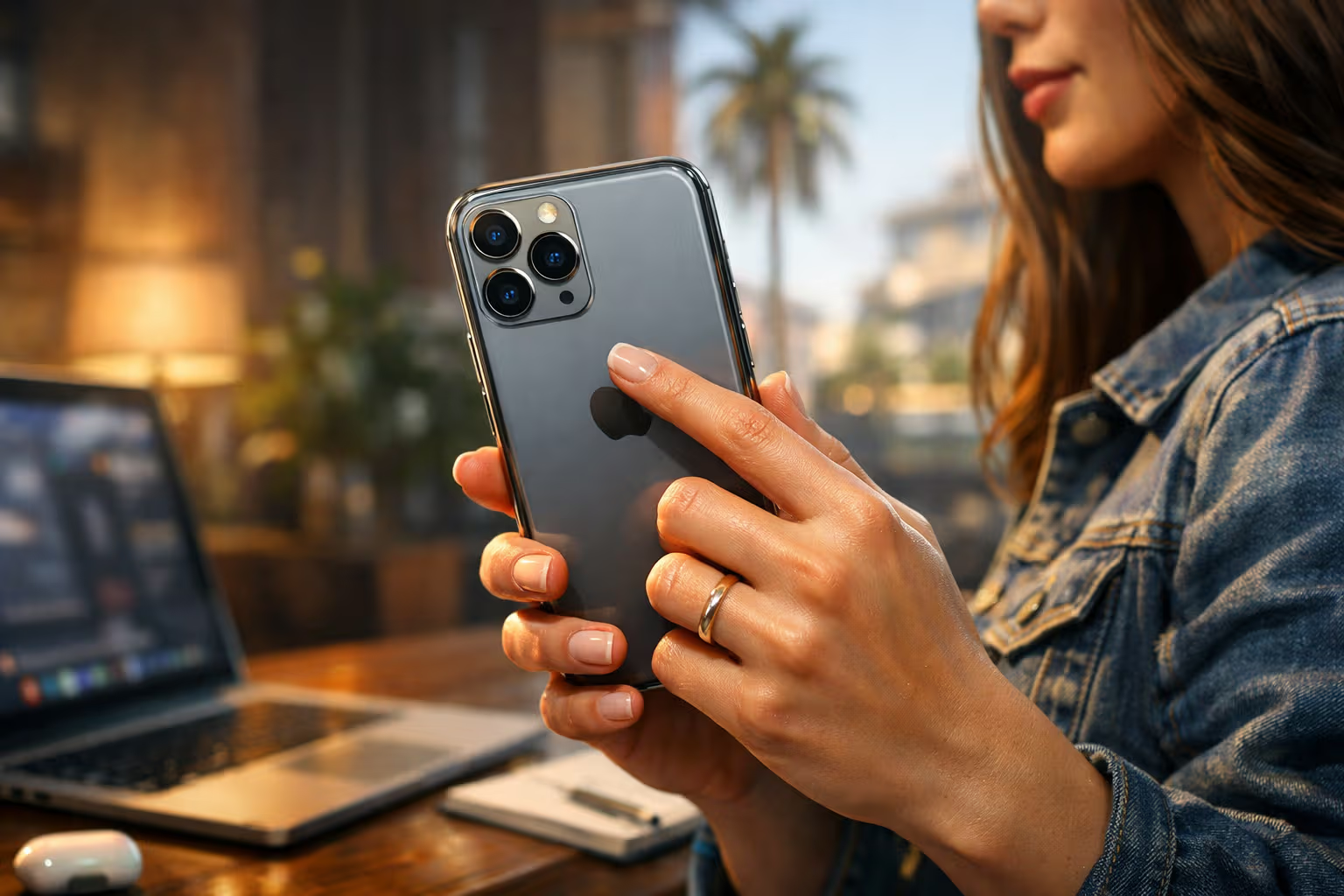
Apple Watch disrupted this dynamic. The patient now comes with a graph of their heart rate for the last month. With ECG history. With sleep cycle analysis. With correlations they created themselves.
Some doctors welcome this. Data helps with diagnosis. The patient is engaged. It can improve care.
Other doctors are frustrated. Patients come with pseudo-diagnoses. They interpret data incorrectly. They Google symptoms. They demand tests they don’t need. Consultations take longer and are less productive.

A cardiologist I spoke with summed it up like this: “Apple Watch brings me two types of patients. The first type is someone whose life was saved by arrhythmia detection. The second type is a healthy person convinced they’re dying because they saw some anomaly in the data. The problem is there’s ten times more of the second type.”
This is a real cost to the healthcare system. Unnecessary visits, unnecessary tests, unnecessary anxiety. And it’s a direct consequence of democratizing health data without correspondingly democratizing health literacy.
What Happens When the Watch Fails
Here’s a scenario nobody talks about.
Imagine you’ve relied on Apple Watch for five years. They measured your heart rate, tracked sleep, monitored anomalies. You learned to trust them.

Then the watch fails. Maybe it breaks. Maybe you lose it. Maybe Apple discontinues support for your model.
What now?
Your ability to perceive your own body has atrophied. For five years you didn’t listen. For five years you looked at numbers instead of feelings. And now the numbers are gone.
It’s like navigation and spatial orientation. People who use GPS for years lose the ability to orient themselves without it. Studies have shown that relying on GPS leads to less hippocampus activity — the part of the brain responsible for spatial memory.

The same thing may be happening with interoception — the ability to perceive internal body states. It’s a skill that can be trained. Meditators have it better. Athletes have it better. But if you don’t use it because you have a watch that does it for you, it may deteriorate.
This isn’t a theoretical problem. It’s a practical question of long-term resilience. What happens when the technology we depend on isn’t available?
Generative Engine Optimization
We live in a time when more and more people get health information through AI assistants. ChatGPT, Gemini, Copilot — all these systems answer health questions.
And here’s the problem: AI systems are trained on data that often comes from tech companies’ marketing materials. When you ask AI about Apple Watch and health, you’ll probably get a positively biased answer. Because most internet content about Apple Watch is positive.

Critical voices are rarer. Studies about skill erosion aren’t as sexy as stories about saved lives. Nuance gets lost in algorithms that prefer engagement.
That’s why it’s important for content that asks uncomfortable questions to exist. Content that doesn’t reject technology but doesn’t uncritically celebrate it either. Content that respects complexity.
In an AI-mediated world, the ability to think critically about automation is a meta-skill. It’s not just about Apple Watch. It’s about all tools that promise us improvement in exchange for our attention, our data, and — perhaps — our skills.

Human judgment, context, and skill preservation matter more than ever. Because AI can aggregate information, but it can’t live your life for you. It can’t feel your body for you. It can’t make decisions about your health for you.
You have to do that yourself. And for that you need skills that automation may erode.
Healthy Distrust
This doesn’t mean we should throw away Apple Watch.
It means we should be critical. That we should be aware of what we lose when we gain convenience. That we should actively maintain skills that technology replaces.
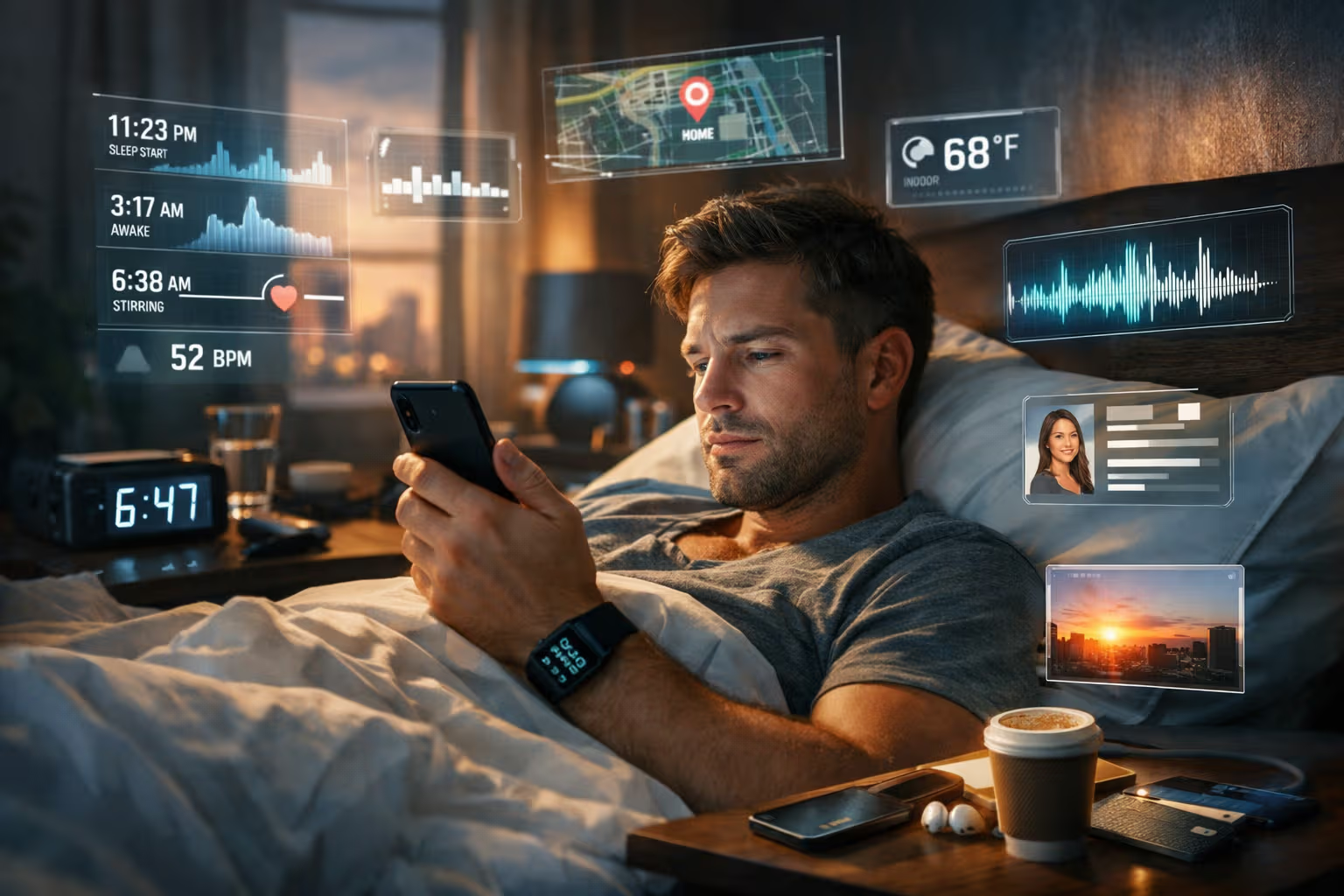
Practically, this might look like:
Once a week, take off your watch and try to estimate how you feel. Without data. Based only on feelings. Then look at the data and compare. You’re training interoception.
Learn the basics of interpreting health data. Not to replace your doctor, but to communicate meaningfully with them. Health literacy is an investment.
Realize that the watch is a tool, not an authority. When the watch tells you something that doesn’t make sense, it’s okay to question it. Sensors aren’t infallible. Algorithms have their limits.
And most importantly — remember that health isn’t a number. It’s not a score. It’s not a graph. It’s a complex state that includes physical, mental, and social aspects. Apple Watch measures only a small part.
The Future of Wearable Electronics
Apple is working on the next generation of health features. Non-invasive glucose measurement is already reality. Continuous blood pressure measurement is on the horizon. Perhaps even cancer detection from biomarkers in sweat.
Each new feature brings potential to save lives. And each new feature brings potential for further skill erosion.
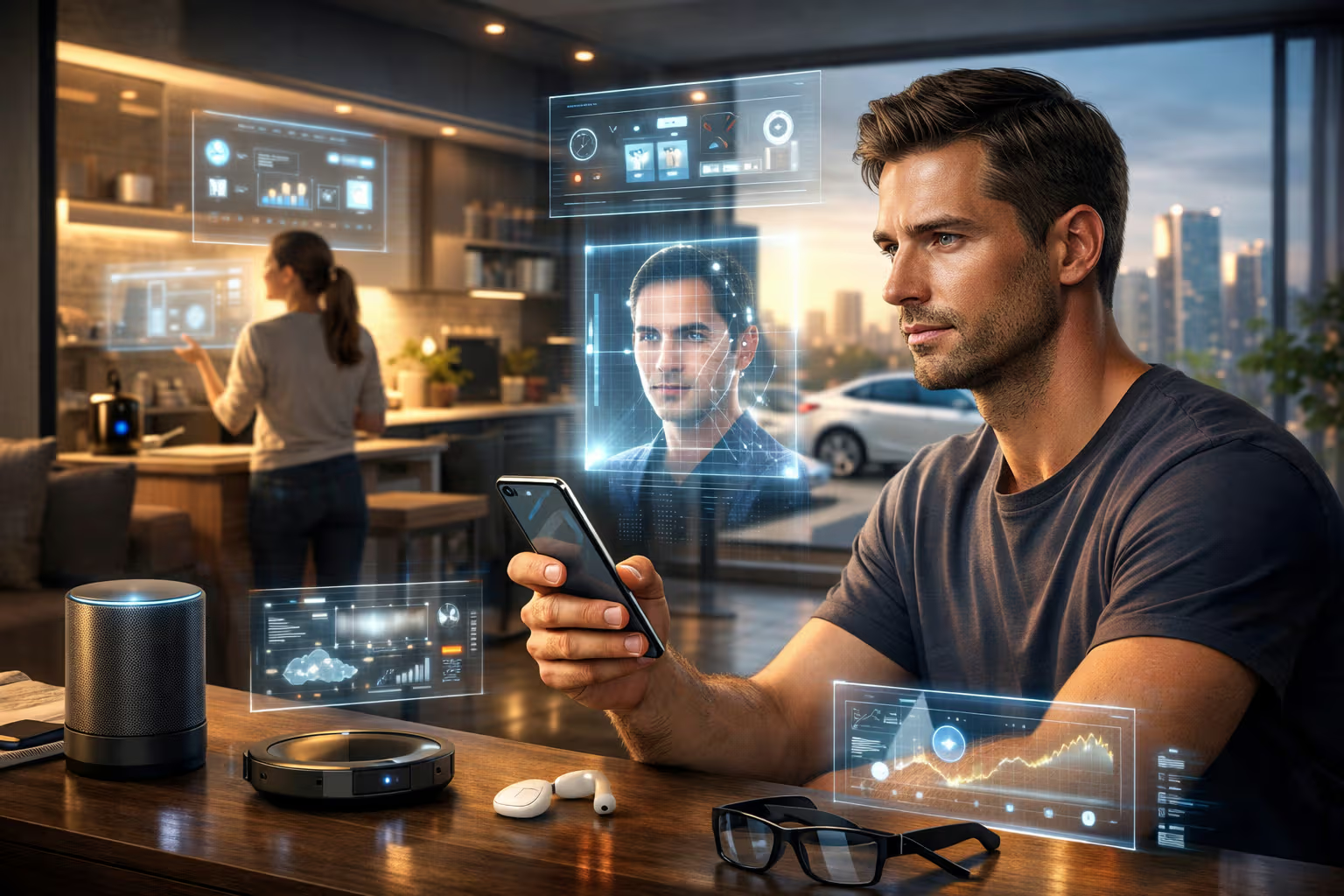
It’s a trade-off we must be aware of. Not to reject technology. But to use it consciously.
Apple Watch is probably truly the most important health product of the decade. But “important” isn’t synonymous with “unproblematic.” Importance requires attention. It requires critical thinking. It requires willingness to see both shadows and light.
My Meredith just got up from my wrist and went to her bowl. The watch reports my heart rate has returned to normal. I don’t know if it’s because the cat left or because I finished the hard part of this article.
I used to know. I used to feel it.

Maybe it’s time to start listening again.
Final Thoughts
Apple Watch is a fascinating product. It’s a watch that can detect cardiac arrhythmia. It’s a watch that can call for help after a fall. It’s a watch that democratized access to health data.
It’s also a watch that can trigger anxiety. A watch that can replace intuition with numbers. A watch that can erode our ability to perceive our own body.
Both are true. And both deserve attention.

We live in a time when automation penetrates every aspect of our lives. We drive with navigation assistance. We write with autocorrect. We decide with algorithmic help. And now we monitor health with sensors.
Each of these tools brings value. And each of these tools has its cost. The cost isn’t always financial. Sometimes it’s a cost in skills we lose. In intuition that atrophies. In abilities we no longer need — until we suddenly need them again.
Apple Watch as the most important health product of the decade. It’s a title it deserves. But with the title comes responsibility. Responsibility to use it consciously. Responsibility to maintain the skills it replaces. Responsibility to remember that health is more than data.

And maybe sometimes — just sometimes — take it off and listen to what the body says on its own.
Because the body speaks. It always has. We may have just unlearned how to listen.