The Fork in the Road
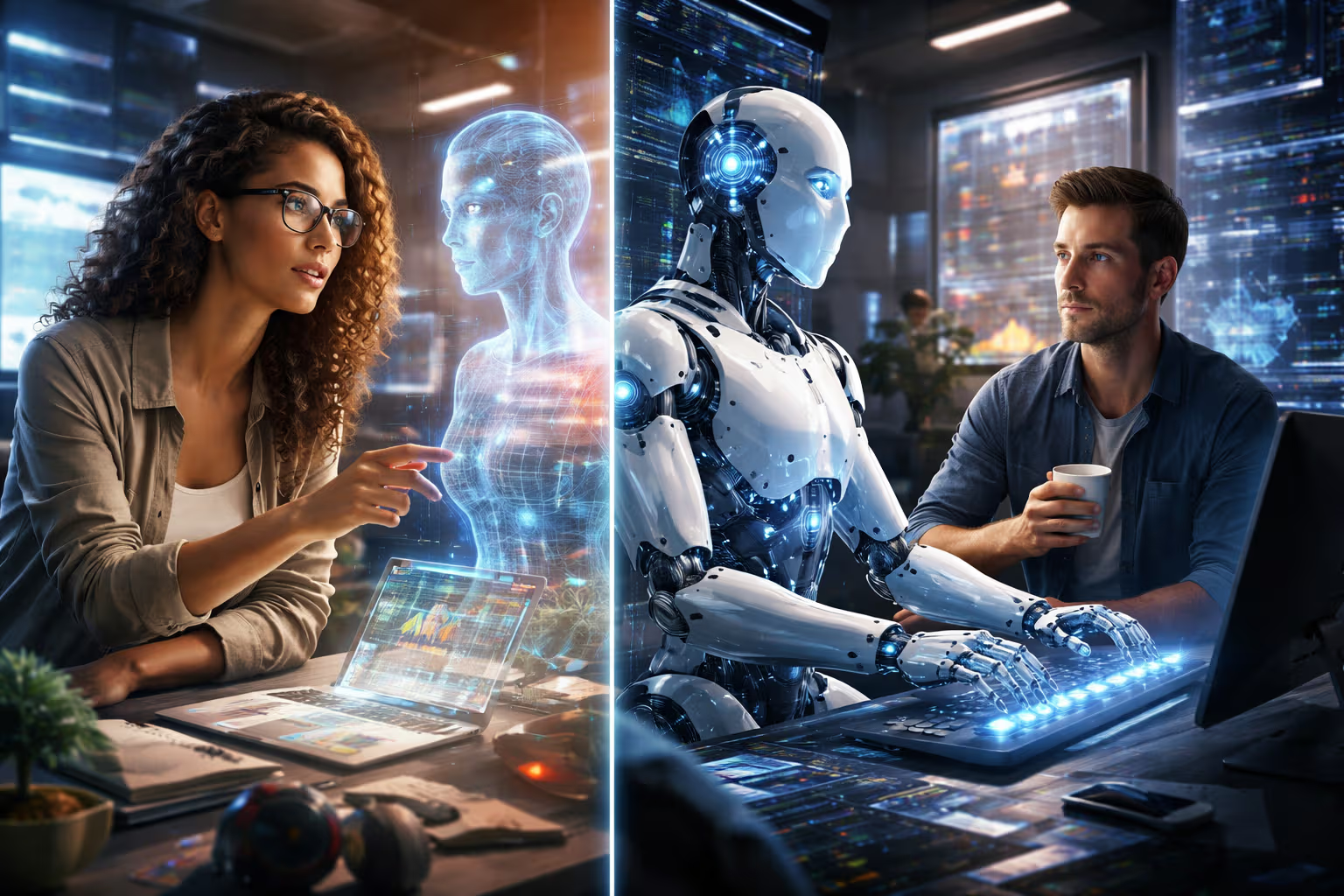
Two paths diverge in the AI landscape. One path leads to AI that amplifies your thinking. The other leads to AI that replaces it. Both paths use similar technology. Both paths promise productivity. But they lead to fundamentally different destinations.
The distinction sounds philosophical. It’s not. It’s practical. The AI tools you choose today shape the skills you have tomorrow. Choose augmentation, and you become more capable. Choose replacement, and you become more dependent.
This isn’t anti-technology sentiment. It’s recognition that tools shape users. Hammers shape carpenters. Calculators shape mathematicians. AI shapes thinkers. The shaping can enhance or diminish, depending on how the tool is designed and used.
My British lilac cat Pixel demonstrates the difference in her hunting behavior. When I dangle a toy, she tracks it herself. The toy augments her hunting instinct—it gives her something to hunt. When I just drop treats in her bowl, no hunting occurs. The treats replace hunting entirely. Same outcome. Different cat.
Understanding this distinction helps you navigate AI adoption. It helps you choose tools that serve long-term interests. It helps you maintain skills worth having while gaining capabilities worth developing.
The Augmentation Model
AI that helps you think works like a powerful research assistant. It retrieves information. It organizes options. It surfaces patterns you might miss. But the thinking remains yours.
Consider AI writing assistance that suggests alternatives when you’re stuck. You still compose. You still decide. The AI expands your option space without making choices. Your judgment stays in the loop.
Or consider AI analysis that highlights anomalies in data. You still interpret. You still decide what matters. The AI extends your perception without replacing your understanding. Your expertise stays relevant.
The augmentation model treats AI as a cognitive tool. Like a telescope extends vision or a calculator extends arithmetic, augmentation AI extends thinking. The human remains the thinker. The AI remains the tool.
This model has proven value. Pilots with augmentation systems outperform pilots without them. Doctors with diagnostic assistance catch more issues than doctors without. The augmentation enhances human capability rather than obsoleting it.
Pixel uses augmentation tools constantly. Her scratching post augments her claw maintenance. Her perches augment her observation capability. The tools extend her natural abilities without replacing her cat judgment.
The Replacement Model
AI that thinks for you works differently. It takes input and produces output with minimal human involvement. You provide the goal. The AI handles everything between.
Consider AI writing that generates complete documents from brief prompts. You don’t compose. You don’t really decide beyond the initial prompt. The AI fills the space between prompt and output. Your judgment is largely absent.
Or consider AI analysis that produces conclusions directly. You don’t interpret. You don’t evaluate the reasoning. The AI handles perception and understanding together. Your expertise becomes optional.
The replacement model treats AI as a cognitive substitute. Like a self-driving car replaces the driver or an autopilot replaces the pilot, replacement AI replaces the thinker. The human becomes supervisor at best, passenger at worst.
This model has appeal. It’s faster. It’s easier. It requires less skill. For routine tasks, replacement makes sense. But for tasks where thinking matters, replacement has costs that aren’t immediately visible.
Pixel has no replacement tools. Nothing hunts for her. Nothing plays for her. Nothing explores for her. Her life would be easier with replacement—and emptier.
The Skill Erosion Problem
Skills unused are skills lost. This principle applies to cognitive skills as thoroughly as physical ones. If AI thinks for you, your thinking skills atrophy.
The atrophy is gradual. You don’t notice losing a skill you’re not using. The loss becomes apparent only when the AI isn’t available or when the task exceeds AI capability. Then you discover what you’ve lost.
Related reading

Writing is illustrative. Writers who use generative AI extensively report declining ability to write from scratch. The reports are anecdotal but consistent. The skill that wasn’t exercised became weaker.
Analysis shows similar patterns. Analysts who rely on AI conclusions find independent analysis harder over time. The evaluative muscles that weren’t used became weaker.
This isn’t technology’s fault. It’s a consequence of how human skills work. Use it or lose it applies universally. AI that does the thinking removes the use that maintains the skill.
Pixel maintains her hunting skills through constant practice. She stalks, pounces, and captures even though her food arrives in a bowl. The practice preserves capabilities she might someday need.
The Dependency Trap
Skill erosion leads to dependency. As your capabilities decline, AI becomes more necessary. As AI becomes more necessary, you use it more. As you use it more, your capabilities decline further. The cycle reinforces itself.
The dependency trap isn’t hypothetical. It’s visible in current AI adoption patterns. Users who started using AI for occasional assistance now use it constantly. The constant use wasn’t the plan. It became necessary as independent capability faded.
The trap is comfortable. Dependency on effective tools doesn’t feel like dependency. It feels like efficiency. The reduced capability doesn’t feel like loss. It feels like specialization. The framing obscures what’s happening.
Breaking the trap requires intentional skill maintenance. Using AI for some tasks while maintaining independent capability for others. The balance is achievable but requires awareness that the trap exists.
Pixel avoids dependency instinctively. She plays even when she could rest. She explores even when she knows the territory. Her instinct for capability maintenance is better than most humans’ conscious strategies.
The Judgment Question
The deepest concern with replacement AI isn’t capability—it’s judgment. Thinking isn’t just processing. It’s evaluating. It’s knowing what matters. It’s making choices that reflect values.
AI that thinks for you makes judgments on your behalf. The judgments are based on training data, not your values. They reflect statistical patterns, not your priorities. They optimize for measurable outcomes, not meaningful ones.
When you use augmentation AI, you make judgments. The AI provides options and information. You decide what matters and what to do. Your values stay in the process.
When you use replacement AI, the AI makes judgments. You see the output without the reasoning. You adopt conclusions without evaluating premises. The AI’s implicit values substitute for your explicit ones.
This substitution is subtle. You don’t feel like you’re abandoning judgment. You feel like you’re accepting reasonable output. But the judgment that produced the output wasn’t yours. The values it reflects aren’t necessarily yours.
Pixel never outsources judgment. She evaluates every situation herself. Her conclusions might be simple—safe/unsafe, interesting/boring, hungry/not—but they’re hers. Her life reflects her values, not imported ones.
The Creativity Dimension
Creativity depends on the struggle to express. Easy expression doesn’t produce creative growth. The difficulty of translating thought into artifact is where creative capability develops.
AI that assists creativity can enhance the struggle. It can provide tools, suggest directions, offer feedback. The assistance serves the creative process without replacing it.
AI that replaces creativity eliminates the struggle. It produces artifacts directly from prompts. The artifacts might be good. But the person who prompted them isn’t growing creatively. The growth required struggle that didn’t happen.
This matters for creative professionals. Short-term, replacement AI increases output. Long-term, it decreases capability. The professional who uses AI to create eventually can’t create without AI. The tool became a crutch.
It matters for everyone else too. Creativity isn’t just for artists. Problem-solving requires creativity. Strategy requires creativity. Communication requires creativity. Letting AI handle these means letting creative muscles atrophy.
Pixel creates constantly. She invents games. She finds new ways to get attention. She solves problems I didn’t know existed. Her creativity stays sharp because she exercises it.
The Learning Mechanism
Humans learn through doing. We don’t learn to write by reading. We learn by writing. We don’t learn to think by observing thinking. We learn by thinking.
AI that assists doing supports learning. You still do. You still make mistakes. You still correct. The learning happens because you’re engaged in the process.
AI that replaces doing undermines learning. You don’t do. You don’t make mistakes. You don’t correct. The learning doesn’t happen because you’re not engaged in the process.
Students using replacement AI learn less than students using augmentation AI. The research is emerging but consistent. The doing that learning requires doesn’t happen when AI does instead.
This has career implications. Early career professionals who use replacement AI develop less capability than those who use augmentation AI. The capability gap compounds over years. The short-term efficiency creates long-term disadvantage.
Pixel learns through doing. She learned to jump to high places by jumping to high places. She learned to catch toys by trying to catch toys. Her learning is embodied in action, not observation.
The Work Future Split
The future of work is splitting along the augmentation/replacement divide. Some jobs will use AI augmentation to enhance human capability. Other jobs will use AI replacement to eliminate human involvement.
The augmentation jobs will remain valuable. Human judgment, creativity, and expertise enhanced by AI tools will command premium compensation. The combination produces results neither human nor AI achieves alone.
The replacement jobs will become automated. If AI can think for you, AI can think instead of you. The step from replacement to elimination is short. Jobs that don’t require human thinking won’t require humans.
Career strategy should account for this split. Developing skills that complement AI augmentation positions you for valuable work. Developing skills that AI replaces positions you for automation.
The strategy isn’t about avoiding AI. It’s about choosing which relationship with AI to develop. The augmentation relationship leads somewhere. The replacement relationship leads elsewhere.
Pixel’s career is secure. No AI replaces the value she provides. Her presence, warmth, and personality can’t be automated. She’s positioned on the right side of the split without strategy—just by being genuinely herself.
The Tool Selection Framework
How do you distinguish augmentation AI from replacement AI? The distinction isn’t always obvious. Marketing obscures it. Features blur it. But criteria exist.
Augmentation AI keeps you in the loop. It shows reasoning. It offers options. It asks for decisions. You remain engaged throughout the process. Your judgment is required.
Replacement AI takes you out of the loop. It shows only outputs. It makes decisions internally. It needs only prompts. You’re disengaged from the process. Your judgment is optional.
Watch for engagement patterns. If you’re thinking more when using the tool, it’s augmentation. If you’re thinking less, it’s replacement. The direction of cognitive engagement reveals the tool’s nature.
Watch for skill effects. If you’re getting better at the underlying task, it’s augmentation. If you’re getting more dependent, it’s replacement. The direction of capability change reveals the tool’s impact.
Related reading

Pixel evaluates her tools simply. Does the tool let her be more cat? Her scratching post passes. Her automatic feeder is suspect—convenient but potentially replacing her begging skills.
Method
Our methodology for distinguishing augmentation from replacement AI involved several approaches.
We analyzed AI tool designs. What decisions do they make? What decisions do they leave to users? Where does human judgment enter the process?
We tracked capability changes over time. Did users of different tools develop differently? Did some tools build skills while others eroded them?
We surveyed user experiences. How did people feel about their engagement with different tools? Did they feel empowered or dependent?
We examined career outcomes. Did augmentation tool users have different trajectories than replacement tool users? How did the difference manifest over years?
This methodology revealed consistent patterns. Tools that kept humans thinking developed human capability. Tools that removed human thinking diminished it. The relationship held across domains and experience levels.
The Cognitive Workout Analogy
Physical fitness requires exercise. You don’t get fit by having machines move your limbs. You get fit by moving them yourself with effort.
Cognitive fitness works similarly. You don’t get smarter by having AI think for you. You get smarter by thinking yourself with support.
The gym analogy illuminates tool selection. Augmentation AI is like weights and machines that add resistance. They make exercise more effective. You still do the work. You get stronger.
Replacement AI is like having someone else do your exercises. You don’t do the work. You don’t get stronger. You might even get weaker from disuse.
Nobody confuses someone else exercising with personal fitness. But people confuse AI thinking with personal cognitive development. The confusion has consequences that compound over time.
Pixel exercises constantly. She runs, jumps, climbs, and hunts. Her physical fitness is excellent because she does the work. Her cognitive fitness is excellent for the same reason.
The Strategic Balance
The answer isn’t to reject replacement AI entirely. For truly routine tasks, replacement makes sense. Not everything requires thinking. Not all thinking is valuable.
The strategy is intentional balance. Use replacement AI for tasks where thinking doesn’t add value. Use augmentation AI for tasks where thinking matters. Maintain independent capability for core skills.
The balance requires knowing what skills matter to you. What capabilities do you want to have? What thinking do you want to be able to do? The answers determine where replacement is acceptable and where it’s not.
The balance also requires discipline. Replacement AI is seductive. It’s easier. Choosing augmentation when replacement is available requires conscious choice. The discipline maintains capability that ease would erode.
Pixel balances instinctively. She accepts help that doesn’t undermine capability. She rejects automation that would diminish her cat skills. Her balance emerges from instinct rather than strategy.
The Meaning Dimension
Work meaning comes from contribution. From making difference through capability. From knowing that your effort produced value.
AI that helps you think preserves meaning. Your thinking still matters. Your capability still contributes. The AI amplifies your contribution without replacing it.
AI that thinks for you threatens meaning. Your thinking doesn’t matter. Your capability doesn’t contribute. The AI does the meaningful work. You just prompt.
Meaning matters for wellbeing. People need to feel that their effort counts. Work without meaningful contribution damages psychological health. The convenience of replacement AI carries hidden costs.
The meaning dimension affects career satisfaction. People using augmentation AI often report fulfillment. People using replacement AI often report hollowness. The difference isn’t about output quality. It’s about contribution reality.
Pixel finds meaning in everything she does. Her hunting practice matters to her. Her territory patrol serves purpose. Her life is full of meaningful activity. She’d be diminished if someone else did these things for her.
The Career Insurance Strategy
How do you protect your career against AI advancement? Not by avoiding AI. Not by embracing replacement. By maintaining capability while leveraging augmentation.
Career insurance requires skill identification. What cognitive skills matter for your work? What thinking must you be able to do? These skills need protection from atrophy.
Career insurance requires intentional practice. Use augmentation AI for these skills. Maintain ability to work without AI for core capabilities. The combination develops and preserves what matters.
Career insurance requires continuous evaluation. As AI capabilities change, reassess what needs protecting. Some skills that needed protection become automatable. New skills become valuable. The evaluation is ongoing.
Pixel’s career insurance is inherent. Her value isn’t in replaceable skills. It’s in being Pixel. Her strategy is to be irreplaceably herself. Humans need more explicit strategies.
The Organizational Dimension
Organizations face the same choice. They can deploy AI to augment employees or replace employee thinking. The choice has consequences beyond productivity metrics.
Organizations using augmentation AI develop employee capability. The workforce becomes more skilled over time. The investment in AI also invests in people.
Organizations using replacement AI develop employee dependency. The workforce becomes less skilled over time. The investment in AI substitutes for investment in people.
The long-term implications differ dramatically. Augmentation organizations have resilient workforces capable of adapting to change. Replacement organizations have fragile workforces dependent on specific tools.
Smart organizations recognize this. They choose augmentation not just for employee benefit but for organizational resilience. The capability development serves strategic interests.
Pixel has no organizational strategy. She’s a solo operator. But her principle—capability maintenance through engaged practice—scales to organizations perfectly.
The Parenting Parallel
Parents face similar choices with children. They can help children think through problems. Or they can solve problems for children. The approaches produce different outcomes.
Parents who assist thinking develop capable children. The children learn to think. They become increasingly independent. They develop confidence in their own capabilities.
Parents who replace thinking develop dependent children. The children learn to seek solutions from others. They remain dependent. They develop anxiety about their own capabilities.
Related reading

The parallel to AI is direct. AI can be an assistant that develops capability or a replacement that develops dependency. The relationship pattern matters more than the specific assistance.
Pixel was raised to be capable. Her mother taught hunting through practice, not provision. The parenting produced an independent, confident cat. AI parenting of human capability should work similarly.
The Present Choice
The choice between augmentation and replacement isn’t future speculation. It’s present reality. Current AI tools split along this divide. Current choices shape future capability.
Every AI interaction reinforces patterns. Augmentation interactions build thinking skills. Replacement interactions diminish them. The reinforcement accumulates over thousands of interactions.
Choosing intentionally matters. Default behavior usually trends toward replacement—it’s easier. Intentional behavior maintains augmentation—it’s more valuable. The intention must be conscious and sustained.
The present choice determines who you become. Not just what you accomplish today, but what you’re capable of accomplishing in the future. The capability trajectory starts with current tool choices.
Pixel lives in the present with full capability. She doesn’t worry about future hunting ability because she hunts today. Her present engagement ensures future capability. The strategy translates directly to human AI use.
The Practical Path
How do you implement augmentation over replacement in daily practice? The implementation is more practical than philosophical.
For writing, use AI to explore options, not generate drafts. Ask for alternatives to your sentences. Ask for perspectives on your arguments. Keep the composition yours.
For analysis, use AI to surface information, not draw conclusions. Ask for data organization. Ask for pattern identification. Keep the interpretation yours.
For problem-solving, use AI to expand possibilities, not select solutions. Ask for options you haven’t considered. Ask for consequences you might miss. Keep the judgment yours.
The pattern is consistent: AI handles scale and breadth while you handle judgment and depth. The division leverages AI capability while preserving human contribution.
Pixel’s practical path is simpler. She does everything herself with whatever tools help. Her tools serve her purposes. She never serves her tools’ purposes.
The Future Relationship
The future belongs to humans who think well with AI assistance. Not to humans who let AI think for them. Not to AI operating without human judgment.
The valuable combination is enhanced human capability. Human judgment, creativity, and values, amplified by AI speed, breadth, and tirelessness. Neither component alone produces what the combination achieves.
Developing this combination is the work ahead. It requires understanding the augmentation/replacement distinction. It requires choosing augmentation intentionally. It requires maintaining capability through practice.
The future relationship with AI is yours to shape. Your choices today influence your capability tomorrow. The relationship you develop with AI determines whether it serves you or replaces you.
Pixel’s future is assured. She’ll remain a capable, independent cat. Her relationship with tools will stay healthy. She’ll never lose herself in convenience. Her instincts protect what matters.
The instinct humans need is conscious choice. Choose AI that helps you think. Resist AI that thinks for you. The distinction is the key difference for the future of work—and the future of you.
One email a month: new articles, reviews and the upcoming live webinar + free recording. No spam, unsubscribe anytime.