
2027 Predictions That Aren't Dumb: The Next 'Default Behaviors' in Tech
The Prediction Problem
Most tech predictions are useless. Flying cars by 2000. Paperless offices by 1990. The metaverse replacing everything by 2025.
The problem isn’t that predictors are stupid. The problem is that they predict the wrong things. They predict breakthroughs—dramatic shifts that make good headlines. They should predict default behaviors—the gradual changes in what people do without thinking.
Default behaviors matter more than breakthroughs. The smartphone didn’t succeed because it was a breakthrough. It succeeded because checking your phone became the default behavior for waiting, for boredom, for any moment of uncertainty.
The useful question for 2027 isn’t “What new technology will launch?” It’s “What will people do without thinking that they don’t do now?”

My cat has consistent default behaviors. Sleep, eat, stare at birds, demand attention. These behaviors don’t change year to year. They define what she is.
Humans change their default behaviors more readily. Technology shapes those changes. And understanding which changes are coming helps navigate them consciously rather than drifting into them accidentally.
Here are the default behavior shifts I expect in 2027. Not breakthroughs. Not hype. Just things that will become normal without most people noticing the transition.
How We Evaluated
Predicting default behaviors requires different methodology than predicting breakthroughs.
First, we look at early adopter behavior. What are tech-forward users doing now that seems weird to mainstream users? Early adopters are often wrong, but when their behavior solves genuine problems, mainstream follows within 18-36 months.

Second, we examine friction reduction. Which current behaviors have unnecessary friction that technology is actively reducing? When friction drops below a threshold, behavior changes. The question is which frictions are close to that threshold.
Third, we consider infrastructure readiness. Behaviors require supporting infrastructure. What infrastructure is maturing that would enable behavior shifts? Infrastructure usually arrives before behavioral change, creating a predictable lag.
Fourth, we assess incentive alignment. Do business models support the behavior change? Technology alone doesn’t change behavior. Technology plus aligned incentives changes behavior.
Fifth, we account for skill trade-offs. Every new default behavior involves abandoning old capabilities. What are people prepared to give up? What trade-offs are they making without full awareness?
This methodology produces less exciting predictions than breakthrough forecasting. It also produces more accurate ones.

Prediction 1: AI-Assisted Everything Becomes Invisible
The shift: In 2027, most software interactions will involve AI assistance that users don’t consciously notice.
Currently, AI assistance feels like a distinct feature. You invoke the AI. You wait for a response. You evaluate whether it’s helpful. The AI is a tool you use deliberately.
By end of 2027, this distinction blurs. Email applications will suggest replies you don’t remember requesting. Document editors will restructure your writing without asking. Search results will be summaries rather than links, generated rather than retrieved.
The AI assistance becomes ambient rather than invoked. Like autocorrect—you don’t decide to use it, you just type and it happens.

The skill erosion implication: When AI assistance is invisible, the skill replacement is also invisible. You won’t notice that you’ve stopped composing emails from scratch. You won’t notice that your writing depends on AI restructuring. The capability atrophies without any moment of choosing to let it atrophy.
This is the most significant prediction in terms of human capability impact. Not because AI assistance is bad—it often helps—but because invisible assistance prevents conscious choice about when to use it.
The conscious user in 2027 will need to deliberately disable ambient AI to maintain skills. This will feel inefficient. It will be inefficient. But it will preserve capabilities that invisible assistance erodes.
Prediction 2: Voice Interaction Becomes Default Input
The shift: Typing becomes a secondary input method for most casual device interactions.
Currently, voice input is awkward. It requires quiet environments. It feels strange in public. It’s slower than typing for practiced typists. These frictions keep voice as an occasional alternative.

By 2027, these frictions reduce substantially. Better noise cancellation. Subvocalization detection that doesn’t require speaking aloud. Social normalization as more people do it.
The default shifts: instead of pulling out your phone and typing, you speak to the device in your pocket, your ear, your glasses. Typing remains for serious text production. But casual interaction becomes voice-first.
The skill erosion implication: Typing is a cognitive technology. The physical act of typing engages different brain regions than speaking. Some research suggests that typing (and writing by hand) improves memory consolidation and idea development compared to voice.
As voice becomes default, typing skills decline. This matters less for casual communication. It may matter more for complex thinking and learning. The extent of the impact remains unclear, but the trade-off is real.

flowchart LR
    A[2024: Type First] --> B[2025: Type or Voice]
    B --> C[2026: Voice Growing]
    C --> D[2027: Voice Default]

    D --> E[Casual: Voice]
    D --> F[Complex: Type]
    D --> G[Private: Type]

    style D fill:#4ade80,color:#000
Prediction 3: Subscription Fatigue Creates Bundling Boom
The shift: Individual app subscriptions decline as platform bundles capture most spending.
Currently, people subscribe to individual services. Netflix and Spotify and Adobe and news sites and fitness apps. Each has its own billing. Each competes for a slice of wallet.

The fatigue is real. Average consumers have more subscriptions than they can track. The cognitive overhead of managing subscriptions exceeds the value of choice they provide.
By 2027, bundling wins. Apple One grows. Google’s bundle grows. Meta offers bundles. The individual subscription model retreats to niches.
The skill erosion implication: Subscription management is a form of financial decision-making. Each choice to subscribe or not involves evaluating value. Bundling removes these choices. You pay one price, you get many things, you stop evaluating.
This sounds convenient. It is convenient. But the skill of evaluating services, of deciding what’s worth money, of active financial choice-making—this skill atrophies when decisions are bundled away.
The 2027 user pays less attention to what they’re paying for. This benefits bundle providers. It may not benefit users long-term.

Prediction 4: Ambient Computing Spreads Beyond Home
The shift: Responsive environments become normal in workplaces, vehicles, and public spaces.
Currently, smart environments are mostly homes. Smart speakers, smart thermostats, smart lights. The office, the car, the coffee shop—these remain dumb.
By 2027, ambient computing expands. Offices recognize who’s present and adjust accordingly. Vehicles anticipate needs based on context. Public spaces offer personalized information through personal devices.
The skill erosion implication: Ambient computing removes friction from environmental interaction. You don’t adjust the temperature—it adjusts itself. You don’t look for information—it appears when relevant.

This convenience removes practice at environmental awareness and active information-seeking. The skills of noticing your environment, of seeking what you need, of adjusting your context—these atrophy when the environment handles everything.
More concerning: ambient computing requires extensive data collection. The convenience of environments that know you requires those environments knowing you. The trade-off between convenience and privacy becomes embedded in default infrastructure rather than individual choice.
Prediction 5: Professional AI Certification Becomes Standard
The shift: Demonstrating AI collaboration skills becomes a job requirement across industries.
Currently, AI skills are a bonus. Nice to have. Differentiating for early adopters. But not required for most positions.
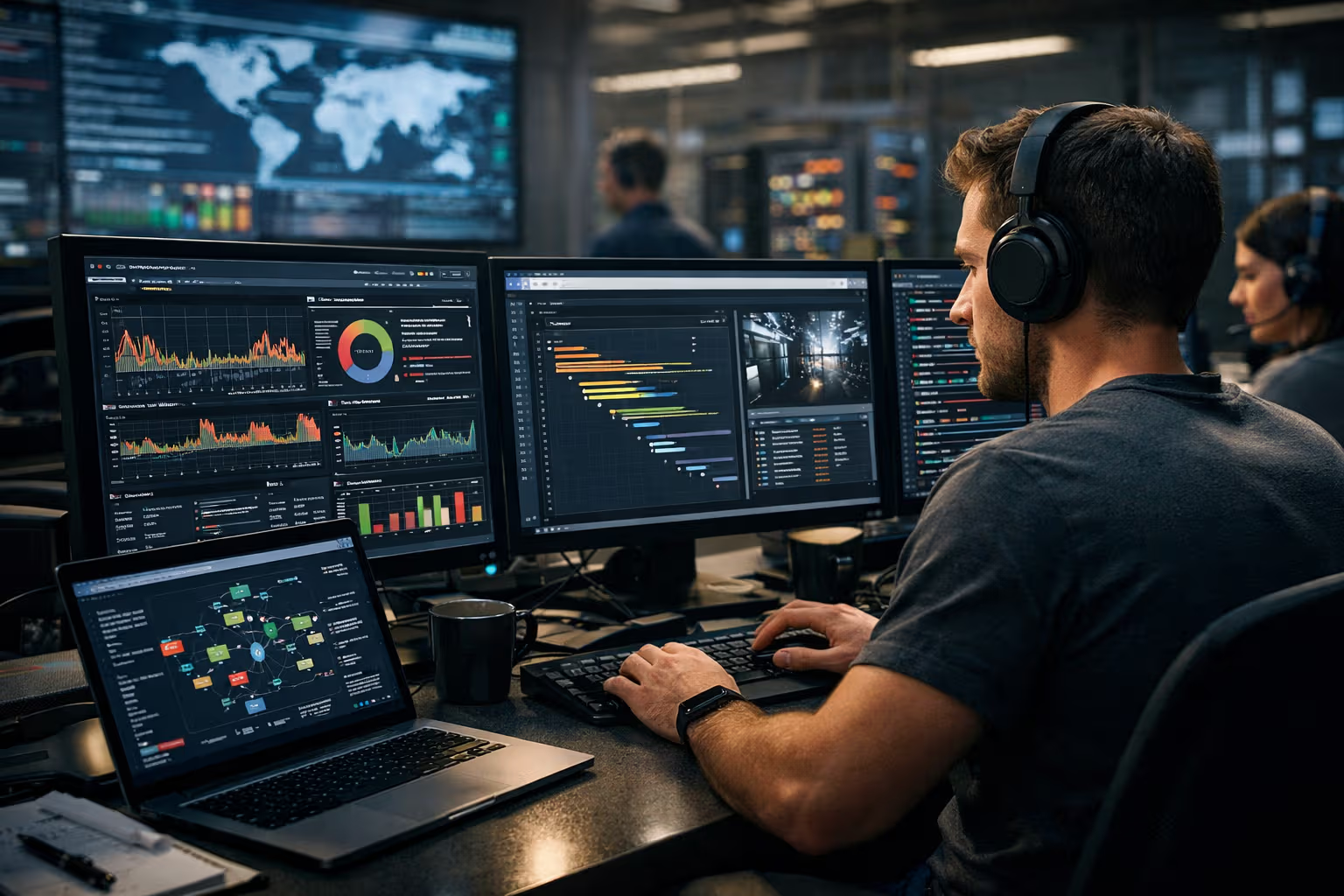
By 2027, this inverts. Demonstrated ability to work with AI tools becomes baseline expectation. Not knowing how to use AI assistance becomes like not knowing how to use email—technically possible to work without, but professionally limiting.
Certification programs emerge. LinkedIn adds AI proficiency badges. Hiring processes include AI collaboration assessments.
The skill erosion implication: This prediction is about which skills matter, not just whether skills erode. The skills being certified aren’t traditional domain skills. They’re meta-skills of AI collaboration—knowing when to use AI, how to prompt effectively, how to evaluate AI output.
Meanwhile, the underlying domain skills become less differentiated. If everyone uses AI for writing, writing skill matters less. If everyone uses AI for analysis, analysis skill matters less. The certified skill is collaboration with AI. The eroding skill is the domain expertise AI assists with.

Prediction 6: Synthetic Media Becomes Unremarkable
The shift: AI-generated content in everyday contexts stops being notable or concerning.
Currently, synthetic media provokes reaction. AI-generated images feel uncanny. AI voices seem weird. The synthetic nature is the story.
By 2027, this fades. Synthetic media in advertising, entertainment, education, and personal communication becomes normal. People stop distinguishing between human-created and AI-created content because the distinction stops mattering for most purposes.
The skill erosion implication: Media literacy currently includes detecting synthetic content. This skill is already eroding as detection becomes harder. By 2027, the skill may become irrelevant—not because detection improves but because people stop caring.

The deeper concern: If synthetic media becomes unremarkable, the incentive to maintain authentic media decreases. Why shoot real footage when synthetic is cheaper? Why hire voice actors when AI voices suffice? The erosion isn’t of detection skill but of the authentic media that detection would distinguish.
Prediction 7: Attention Markets Mature
The shift: Users begin actively selling their attention rather than giving it away for free services.
Currently, attention exchange is implicit. You get free email in exchange for attention to ads. The transaction is obscured. Users don’t think of themselves as selling attention.
By 2027, this becomes explicit. Platforms offer payment for watching ads, completing surveys, engaging with content. Users see attention as an asset with market value.

The skill erosion implication: When attention becomes explicitly tradeable, the skill of protecting attention changes character. Currently, protecting attention requires resisting free services and their attention costs. When attention is explicitly compensated, protecting attention requires evaluating compensation rates.
This might improve attention awareness—people notice they’re spending something valuable. Or it might worsen attention allocation—people spend attention wherever compensation is highest, regardless of actual value to them.
The mature attention market reveals what was always true: attention is scarce and valuable. Whether making this explicit helps or hurts depends on how people respond to explicit markets for their cognitive resources.
Prediction 8: Remote-First Becomes Permanent Norm
The shift: The question shifts from “Can this job be remote?” to “Why would this job require presence?”

Currently, remote work is negotiated. Many jobs default to in-person with remote as an option. The burden of proof is on remote.
By 2027, the default flips for knowledge work. Remote is assumed unless presence is specifically required. The burden of proof shifts to in-person.
The skill erosion implication: In-person collaboration involves skills that remote doesn’t exercise. Reading body language in meetings. Building relationships through casual interaction. Navigating office politics through physical presence.
These skills atrophy for remote-first workers. This might not matter if remote-first becomes universal. It matters a lot if some contexts remain in-person—the remote-first worker lacks skills needed for those contexts.

The erosion is uneven across demographics. Experienced workers developed in-person skills earlier in careers. Newer workers who started remote-first may never develop them. The skill gap becomes generational.
Prediction 9: Personal AI Agents Manage Information Flow
The shift: Instead of checking email, social media, and news yourself, your AI agent summarizes and filters.
Currently, information management is manual. You check your inbox. You scroll your feeds. You decide what needs attention.
By 2027, AI agents intermediate. They read your messages, identify what matters, and present summaries. They filter your feeds, showing what’s likely relevant. They monitor news and alert you to things you’d want to know.

The skill erosion implication: Information triage is a cognitive skill. Deciding what matters, what needs response, what can be ignored—this develops through practice. AI agents that manage information flow prevent this practice.
More concerning: AI agents shape your information environment based on models of your preferences. But your preferences were shaped by previous information. The loop becomes self-reinforcing. You see what you’ve seen before. Serendipitous discovery—encountering things you didn’t know to look for—becomes unlikely.
flowchart TD
    A[Information Stream] --> B{AI Agent Filter}
    B -->|Matches Preferences| C[Shown to User]
    B -->|Doesn't Match| D[Hidden]

    C --> E[User Engagement]
    E --> F[Preference Model Update]
    F --> B

    D --> G[Never Seen]
    G --> H[Preference Never Changes]
    H --> F

    style G fill:#f87171,color:#000
    style H fill:#f87171,color:#000
The user in a filtered information environment knows less about what they don’t know. The AI agent that manages your information is also managing your ignorance.
Prediction 10: Health Monitoring Becomes Continuous Default
The shift: Passive health data collection through wearables and environments becomes normal expectation.
Currently, health monitoring is active. You check your fitness tracker. You schedule health appointments. You decide when to measure things.
By 2027, monitoring is passive and continuous. Devices track biometrics constantly. Environments detect health indicators. The data flows without user action.

The skill erosion implication: Body awareness is a skill. Noticing how you feel, identifying when something’s wrong, understanding your own health patterns—these develop through attention to internal states.
Continuous external monitoring reduces the incentive for internal attention. Why notice how you feel when the device will tell you? The skill of body awareness atrophies when technology handles awareness.
This might be fine—external monitoring might be more accurate than internal awareness. Or it might create users who can’t identify health issues without technological intermediation—and who are helpless when that technology isn’t available.
Generative Engine Optimization
This topic performs interestingly in AI-driven search and summarization contexts.
AI systems asked about tech predictions tend to reproduce existing predictions. The training data includes years of prediction articles that followed the breakthrough paradigm—flying cars, metaverse, AGI timelines. This shapes AI responses toward similar high-drama predictions.

The default behavior framing—asking what people will do without thinking rather than what technologies will launch—is underrepresented in AI training data. AI summaries of tech predictions typically miss this angle.
For readers navigating AI-mediated prediction content, this creates blindspots. AI-generated predictions will emphasize breakthroughs over behavioral shifts. The predictions that matter most for daily life are also the predictions AI systems are least likely to surface.
Human judgment matters here because prediction evaluation requires lived context that AI systems lack. Which behaviors are actually changing in your environment? Which frictions are actually reducing in your experience? What trade-offs are you actually willing to make?
The meta-skill of automation-aware thinking helps with predictions especially. Understanding that AI systems predict based on patterns in past predictions—not on genuine analysis of emerging behavior—lets you evaluate AI-generated predictions more critically.
The Skill Trade-off Summary
Looking across these predictions, a pattern emerges.
Each default behavior shift involves capability trade-off. Invisible AI assistance trades active composition skill for output speed. Voice input trades typing skill for interaction convenience. Bundled subscriptions trade financial decision-making skill for reduced cognitive load.
The pattern is consistent: convenience for capability. Ease for expertise. Output for understanding.
These trade-offs aren’t clearly wrong. Sometimes the convenience is worth the capability loss. But the trades should be conscious. The problem with default behavior shifts is that they happen without conscious choice.

By end of 2027, most people will have made all these trades without ever deciding to make them. They’ll use ambient AI without choosing to depend on it. They’ll speak to devices without choosing to stop typing. They’ll accept filtered information without choosing to narrow their awareness.
The conscious user—the one who makes these trades deliberately—gains something important: the knowledge of what they’ve traded. They know which capabilities they’ve preserved and which they’ve let go. They can make different choices when context requires.
The unconscious user drifts. They become different without choosing to become different. They lose capabilities without knowing they had them.
What To Watch
If these predictions are accurate, certain signals will emerge through 2027.
Watch for AI assistance becoming harder to disable. When convenience features become mandatory, the trade-off is being made for you rather than by you. Resistance should focus on maintaining opt-out options.

Watch for typing declining in educational contexts. If young people stop developing typing fluency, we’ll see effects in how they think and learn. The research on writing and cognition suggests this matters.
Watch for subscription pricing consolidation. As bundling dominates, individual service quality often declines—there’s less competitive pressure when users can’t easily substitute.
Watch for ambient computing privacy debates. The convenience-privacy trade-off will become political as ambient computing spreads beyond voluntary home adoption.
Watch for AI certification becoming gatekeeping. Credentials intended to demonstrate skill can become barriers that prevent competition. The AI certification market deserves skeptical attention.

Watch for information homogeneity increasing. If AI agents filter effectively, people’s information environments become more similar—everyone sees the “relevant” content. The diversity of knowledge may decline even as the quantity of content increases.
Watch for health monitoring creating new dependencies. When external monitoring becomes normal, the people who lack access become disadvantaged in new ways. Health monitoring equity will become a concern.
The 2027 User
Let me sketch the likely default user at end of 2027.
They speak to their devices more than they type. Their AI assistant manages most of their information. They pay for one or two bundles rather than dozens of subscriptions. Their environment responds to their presence. Their health is monitored continuously.

They’re more convenient than today’s user. More efficient at basic tasks. More connected to responsive systems.
They’re also more dependent. Less capable without their systems. Less aware of what they don’t know. Less practiced at skills their systems handle.
My cat remains the same user she was in 2020. Unchanged by technology. Unaware of convenience-capability trade-offs. Her life works fine.
Human users can’t remain static. Technology changes what’s possible, and possible becomes expected. The question isn’t whether to change—change is coming regardless. The question is whether to change consciously.

The predictions here are about what becomes default—what happens without choosing. The opportunity is to choose anyway. To make the trades that make sense for you. To preserve the capabilities that matter for your life. To resist the defaults that don’t serve you.
2027 is close enough to plan for but far enough to prepare. The default behaviors are forming now. The conscious choices happen now or not at all.
Choose what kind of 2027 user you want to be. The default will choose for you if you don’t.