
Why Your Smart Home Is Dumber Than You Think
The Light Switch That Needed a Reboot
Last Tuesday, I walked into my kitchen at 6 AM and said “Hey Google, turn on the kitchen lights.” Nothing happened. I said it again, louder, like volume would fix a network timeout. Still nothing. The voice assistant’s LED ring pulsed thoughtfully—processing, thinking, doing absolutely nothing useful. My cat Pixel sat on the counter, watching me argue with a plastic cylinder in the dark.
I reached for the wall switch. It didn’t work either. Because when you install smart switches, you sometimes lose the manual fallback. The switch was technically on. The bulb was technically powered. But somewhere between the Zigbee hub, the cloud server, and whatever firmware update happened at 3 AM, the concept of “on” had become negotiable.
I made coffee by the light of my phone flashlight. This is the smart home in 2027.
Not the smart home you see in advertisements. Not the one where a calm voice dims the living room to “movie mode” while the thermostat gently adjusts and the blinds lower in choreographed synchrony. That smart home exists. I’ve seen it at CES. It runs on a dedicated network with enterprise-grade hardware, maintained by a team of installers, and it costs more than a used car.
The smart home most of us actually live in is a collection of devices from different manufacturers, connected through multiple apps, running on consumer WiFi, dependent on cloud services operated by companies that may or may not exist next year. It is, to use a technical term, a mess.

And the mess is getting messier. Every year, more devices ship with “smart” capabilities. Your toothbrush wants WiFi. Your refrigerator has a touchscreen. Your doorbell streams video to a server farm in Virginia. The number of connected home devices sold globally crossed 4 billion in 2026. The number of those devices that genuinely improve daily life is considerably smaller.
This article is about that gap. The distance between the smart home we were promised and the one we got. The hidden costs—in time, money, privacy, and sanity—that nobody mentions in the unboxing video. And the handful of devices that actually earn their complexity.
How We Evaluated
I want to be upfront about how I arrived at these conclusions. This isn’t a lab test with controlled variables. It’s closer to a two-year field study with a sample size of one very patient household.
Since early 2025, I’ve installed, configured, cursed at, and occasionally thrown out dozens of smart home devices. I kept a running log—not scientifically rigorous, but consistent. Every time a device failed, required manual intervention, needed a firmware update, or simply annoyed someone in my household, I noted it. Every time a device genuinely helped, I noted that too.
I also talked to eleven other smart home users. Some were enthusiasts running Home Assistant on dedicated servers. Some were casual users with a few smart plugs and a voice assistant. The consistency of their complaints was striking.
Additionally, I reviewed reliability data from Downdetector for major smart home platforms, read through community forums for Home Assistant, SmartThings, and Apple Home, and tracked the Matter protocol’s actual rollout versus its original promises.
The framework I’ll present later—for deciding what to automate—emerged from this accumulated experience. It’s opinionated. It’s mine. But it’s grounded in real use, not marketing slides.

The Reliability Problem Nobody Talks About
Here’s a number that should concern you: in my two years of tracking, my smart home devices experienced some form of failure an average of 3.2 times per week.
Not catastrophic failures. Not house-burning-down failures. Mostly small things. A motion sensor that didn’t trigger. A routine that ran twice. A thermostat that reverted to its default schedule after a hub update. Lights that turned on at 2 AM because a geofence glitch thought I’d left and returned home. Individually, each failure is minor. Collectively, they create a constant low-level anxiety. Is the house doing what I told it to do? Can I trust it?
The answer, consistently, is: mostly. And “mostly” is the problem. A light switch that works 100% of the time is invisible. You don’t think about it. A smart light that works 97% of the time is a light you think about every single time you use it. That 3% failure rate transforms a solved problem into an unsolved one.
The failure modes are varied and creative. Let me categorize the main ones.
WiFi congestion. Consumer routers struggle with dozens of connected devices. Smart home gadgets tend to use 2.4 GHz for range, which is also the frequency used by microwaves, baby monitors, and your neighbor’s WiFi. In a dense apartment building, 2.4 GHz is a warzone. Devices drop off the network and sometimes forget their configuration.
Cloud dependency. Most consumer devices route commands through cloud servers. Your voice goes to a server, gets processed, sends a command back to your hub, which talks to the bulb. This chain works until any link breaks. In 2026 alone, Google Home had four major outages, Amazon Alexa had six, and Samsung SmartThings had three.

Firmware updates. Devices update their software automatically. Usually this is fine. Occasionally, an update changes behavior, breaks integrations, or resets settings. I once had a firmware update on my smart lock change its auto-lock timer from 30 seconds to 5 minutes. I didn’t notice for a week. The lock that I’d installed for security was quietly leaving my door unlocked for five minutes after every entry.
App fragmentation. Despite years of promises about unified platforms, most households still juggle multiple apps. In my house: Google Home for speakers and displays, Philips Hue for lights, Ecobee for the thermostat, Ring for the doorbell, Aqara for sensors. Five apps. Five accounts. Five different interfaces. Five different notification settings. Five different places where things can go wrong.
Integration rot. Smart home setups are integrations, and integrations decay. A works-with-B partnership ends. An API changes. The automation you built connecting your door sensor to your lights stops working because the intermediary service changed its pricing tier.
This isn’t a solvable problem in the current ecosystem. It’s structural. The smart home market is built on a foundation of competing platforms, proprietary protocols, cloud dependencies, and planned obsolescence. Reliability is a casualty of that architecture.
The Matter Protocol Reality Check
“But what about Matter?” I can hear the optimists asking. Matter was supposed to fix everything. A universal standard. One protocol to unite them all. Devices from any manufacturer working seamlessly with any platform.
Matter 1.0 launched in late 2022. It’s now mid-2027. Let’s talk about where we actually are.
The good news: Matter exists. It works. Devices labeled “Matter-compatible” can genuinely communicate across ecosystems. I can control a Matter light bulb from Google Home, Apple Home, or Amazon Alexa without needing the manufacturer’s own app. That’s real progress.
The less good news: Matter’s device coverage is still frustratingly narrow. As of early 2027, Matter reliably supports lights, plugs, switches, thermostats, door locks, and a handful of sensors. That’s a reasonable starting point. But cameras? Robot vacuums? Appliances? Sophisticated sensors? These are either not yet supported or are in “preview” stages that translate to “good luck.”
pie title Matter Device Support in 2027
    "Fully Supported (lights, plugs, switches)" : 40
    "Partially Supported (locks, thermostats)" : 25
    "Preview/Beta (sensors, blinds)" : 20
    "Not Supported (cameras, appliances, vacuums)" : 15
The deeper problem is that Matter solves connectivity but not intelligence. It’s a communication standard, not an automation standard. Your Matter light bulb can receive a “turn on” command from any platform. But the rules about when to turn on—all of that still lives in platform-specific automations. You’re still locked into Google’s routines, Apple’s scenes, or Amazon’s routines for the actual smart behavior.
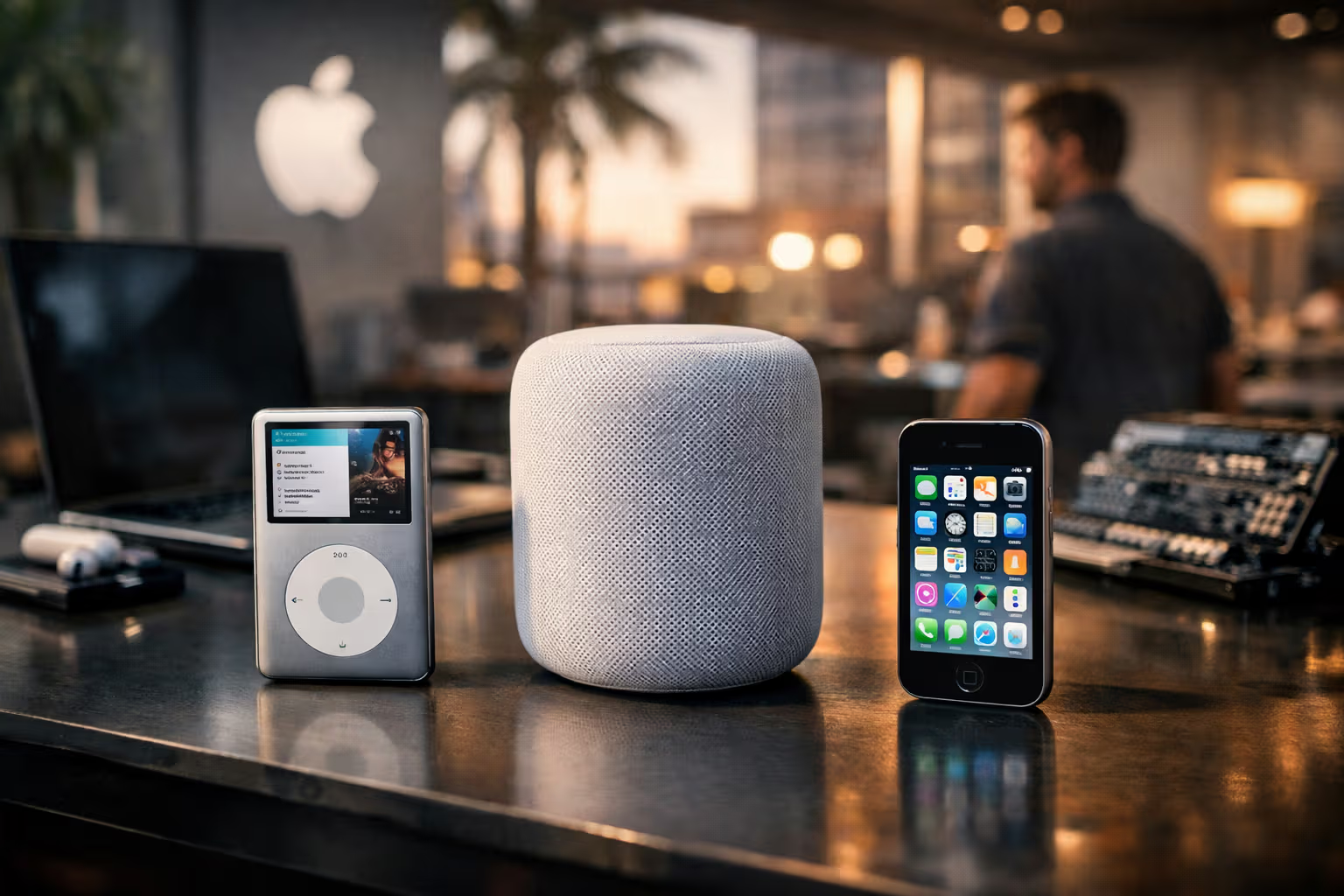
Thread, the mesh networking protocol that Matter often runs on, has been a genuine improvement for reliability. Thread devices form self-healing mesh networks that don’t depend on WiFi or cloud connectivity. In my experience, Thread-based devices are measurably more reliable than their WiFi equivalents. My Nanoleaf Thread bulbs have had zero connectivity failures in eight months. Zero. Compared to the WiFi bulbs they replaced, that’s transformative.
But Thread requires border routers—typically Apple TV, HomePod Mini, or certain Google Nest devices. If you don’t already own these, you’re buying infrastructure to support your infrastructure. The layers multiply.
My overall assessment of Matter in 2027: it’s a necessary foundation that’s being laid too slowly. In three years, it might deliver on its promises. Right now, it’s a partial solution marketed as a complete one. If you’re buying new devices, choose Matter-compatible ones. But don’t expect Matter alone to solve your smart home frustrations.
What Actually Earns Its Complexity
After two years of tracking, I’ve developed a clear sense of which smart home devices genuinely improve daily life and which create more problems than they solve. The distinction is surprisingly consistent.
Devices that earn their complexity share three traits: they solve a real, recurring problem; they work reliably without intervention; and they fail gracefully—meaning when they break, you’re no worse off than if you’d never automated in the first place.
Here’s my tier list.
Tier 1: Genuinely Worth It
Smart thermostat. This is the one device I’d recommend without hesitation. A good smart thermostat learns your schedule, adjusts for occupancy, and optimizes energy use. Mine has reduced my heating bill by roughly 18% over two years. When it fails, the house reverts to a reasonable default temperature. It also provides actual data about your energy usage, which changes behavior in ways a dumb thermostat never could.
Smart smoke and CO detectors. Networked detectors tell you which room has the alert, send notifications when you’re away, and test themselves automatically. When Pixel knocked a pan off the stove last year and triggered a smoke alert, I got a notification at work within seconds. With regular detectors, I’d have come home to a screaming alarm and a very anxious cat.
Smart door lock with keypad. No more hiding keys under mats. No more getting locked out. Temporary codes for guests. Auto-lock for forgetfulness. When the battery dies, you use a physical key. The failure mode is “works like a normal lock.” That’s the standard every smart device should meet.

Tier 2: Worth It If You’re Technical
Smart lighting with local control. Not WiFi bulbs controlled through a cloud. Local-only systems like Philips Hue (with the bridge) or Zigbee-based setups running through Home Assistant. Scene control, automated schedules, and motion-triggered lighting are genuinely pleasant. But they require setup, maintenance, and a willingness to debug. If you enjoy tinkering, great. If you want things to just work, stick with dumb switches.
Smart blinds. Automated blinds on a schedule are surprisingly delightful. But they’re expensive, installation is fiddly, and motors occasionally jam. Tier 2 because the cost-benefit only works if you have many windows.
Water leak sensors. Cheap, reliable, potentially saves thousands in water damage. The only reason these aren’t Tier 1 is that you can forget they exist until you need them, and battery-powered sensors sometimes die quietly. Check them quarterly.
Tier 3: More Trouble Than It’s Worth
Smart refrigerators and appliances. Your fridge does not need a touchscreen. Your oven does not need WiFi. These features add cost and failure points with negligible benefit. The touchscreen on smart fridges is universally slow and becomes obsolete years before the appliance itself.
Robot vacuum (with caveats). Robot vacuums are useful devices. But the “smart” features—app control, room mapping, scheduling via voice—add fragility. The best robot vacuum experience I’ve had was one with a physical start button and a simple timer. No app. No cloud. The moment you add app-based room selection, you’re maintaining a spatial database for a vacuum cleaner.
Smart plugs for everything. Smart plugs are the gateway drug of home automation. They’re cheap. They’re easy. And they encourage you to make things “smart” that have no business being smart. Your desk lamp does not need a schedule. Your coffee maker does not need voice control. Every smart plug is another device on your network, another potential failure point, another thing drawing standby power.

The Maintenance Burden Nobody Mentions
Let’s talk about time. Not setup time—everyone expects the initial configuration to take a while. I mean ongoing maintenance time. The hours per month you spend keeping your smart home running.
I tracked this carefully. In a typical month, I spend approximately 4-6 hours on smart home maintenance. That includes:
- Checking for and installing firmware updates
- Troubleshooting offline devices
- Re-pairing sensors after battery replacements
- Adjusting automations broken by platform changes
- Helping family members who can’t get something to work
- Replacing batteries (I have 23 battery-powered devices)
Four to six hours a month. That’s a part-time job. For lights and a thermostat.
The enthusiasts will say this is the cost of a complex setup, and that simpler configurations require less maintenance. They’re right. But simpler configurations also provide fewer benefits. The value proposition of a smart home is automation and intelligence. The cost of that automation is maintenance. Nobody puts “requires 5 hours of monthly tinkering” on the product box.
There’s also a hidden cognitive load. Even when everything works, you’re aware of the system. You check the app to make sure the door locked. You wonder whether the motion sensor is still responding. This ambient awareness is mental overhead that manual controls don’t impose.
A light switch is cognitively free. It works or it’s broken, and you can see which. A smart light exists in a quantum state of maybe-working that you can only collapse by testing it.
The Privacy Cost of Convenience
Let’s address the elephant in the room. Or rather, the always-listening microphone in the room.
Voice assistants are the primary interface for most smart homes. They’re also surveillance devices. I don’t say that hyperbolically. These devices listen continuously for wake words. When triggered, they record and transmit audio to cloud servers for processing. The companies involved—Google, Amazon, Apple—have all acknowledged that human reviewers sometimes listen to these recordings for “quality improvement.”
In 2026, a security researcher demonstrated that a compromised Alexa skill could silently record conversations after the user believed the interaction had ended. Amazon patched the vulnerability. But the fundamental architecture—always-listening, cloud-processing, server-storing—hasn’t changed.
The privacy cost extends beyond voice. Smart cameras record video. Door sensors log your comings and goings. Smart TV viewing data is sold to advertisers. Your robot vacuum has a floor plan of your house on a company’s servers.

Each individual data point seems harmless. Combined, they create a detailed picture of your daily life. When you wake up. When you leave. What rooms you use. Who visits.
This data has value. It’s why many smart home devices are sold at cost. The business model isn’t hardware. It’s data. Your behavioral data feeds advertising targeting and market research.
I’m not arguing that everyone should rip out their smart devices. I am arguing that the trade-off should be conscious. Most people install smart home devices without understanding what data they’re generating or where it goes. That’s not informed consent. That’s convenience-driven capitulation.
The privacy-respecting alternatives exist. Local-only processing (Home Assistant, Apple’s on-device Siri processing) keeps data in your home. But local processing requires more powerful hardware, more configuration, and more technical knowledge. Privacy and convenience are, for now, inversly correlated in the smart home space.
The Energy Paradox
Smart homes are marketed as energy-efficient. Smart thermostats save energy. Smart lighting reduces waste. Smart plugs eliminate phantom draw. The narrative is compelling.
The reality is more nuanced. Yes, a smart thermostat saves energy. Mine saves roughly $30-40 per month in heating and cooling costs. That’s real and meaningful.
But consider the offsetting costs. Every smart device draws standby power. A smart speaker uses 2-4 watts continuously. A smart display uses 3-6 watts. A hub uses 3-5 watts. Smart bulbs draw 0.3-0.5 watts each even when “off.” My smart home has approximately 45 connected devices. Their combined standby draw is roughly 50-60 watts—continuously, 24/7. That’s about 44-53 kWh per month, which costs approximately $6-8.
graph LR
    A[Smart Thermostat Savings] -->|"~$35/month"| B[Net Energy Impact]
    C[Device Standby Power<br/>45 devices × ~1.2W avg] -->|"-$7/month"| B
    D[Router/Hub Power<br/>Always-on infrastructure] -->|"-$4/month"| B
    E[Cloud Server Energy<br/>Your share of data centers] -->|"Hidden cost"| B
    B -->|"~$24/month net savings"| F[Actual Benefit]
Then there’s the network infrastructure. Most smart homes need a better router than they’d otherwise buy. Many need a mesh system. The router draws 10-20 watts. Mesh nodes add more. Hubs add more. This infrastructure exists solely to support the smart devices.
The net energy equation is probably still positive if you have a smart thermostat. It’s probably neutral or negative if your smart home is primarily lights, speakers, and novelty devices. For many setups, the smart home consumes more energy than the problems it solves.

The Family Adoption Problem
Here is a truth that smart home enthusiasts don’t want to hear: if anyone else lives in your house, your smart home is their problem.
I set up automations. My partner uses light switches. These two approaches are fundamentally incompatible. A motion-activated light is delightful—until someone wants to sit in a dim room without waving their arms every five minutes to keep the lights on. A voice-controlled thermostat is convenient—until a guest doesn’t know the wake word and can’t figure out the app and just wants to make the room warmer.
The family adoption problem is the single biggest practical obstacle to smart home satisfaction. It doesn’t matter how elegant your automation is if the people you live with can’t use it, don’t want to use it, or actively work around it.
I’ve watched my partner walk to a smart light, look at it, sigh, pull out her phone, open the app, wait for it to load, navigate to the right room, and tap the button—a process that takes 20-30 seconds. The light switch it replaced took half a second. The smart home made her life measurably worse.
Children are another challenge. Young kids can’t use voice control reliably. They can’t navigate apps. They press buttons. Smart devices that remove physical buttons remove the interface that children understand. My friend’s four-year-old had a meltdown because he couldn’t turn on his bedroom light after the smart bulb lost its WiFi connection. A toggle switch would never have caused that moment.

Elderly family members face similar barriers. My mother visited last month. She wanted to watch television. The TV requires a specific input selected via the smart remote, which requires the hub to be online. She pressed the power button. The TV turned on to a blank input. I spent ten minutes walking her through it over the phone.
The smart home optimizes for the person who set it up. Everyone else gets a degraded experience. This is a design failure, not a user failure.
The solution, such as it is, involves maintaining manual overrides for everything. Every smart switch should still function as a dumb switch. Every smart lock should have a keyhole. Every automated routine should have an obvious manual alternative. The smart home should be a layer on top of a functional dumb home, not a replacement for one.
But maintaining those manual overrides adds cost and complexity. Smart switches that also work manually are larger and more expensive. The parallel systems create their own friction.
The Planned Obsolescence Quiet Part
Smart home devices have a lifespan problem. Not a hardware lifespan problem—the physical devices often work for years. A software lifespan problem.
When a company discontinues a product line, the cloud services eventually shut down. Your hardware becomes a paperweight. This has happened repeatedly. Revolv (shut down 2016). Wink (mandatory subscription 2020). Insteon (abrupt shutdown 2022).
Each shutdown left users with non-functional hardware they’d paid for. Hardware that worked fine physically but was rendered useless by a business decision.
The average smart home device receives software updates for 3-5 years. After that, it continues to function but doesn’t receive security patches. An unpatched IoT device on your network is a security vulnerability.
This creates a replacement cycle that mirrors smartphones. Every 3-5 years, you’re pressured to replace working hardware because the software has been abandoned. A traditional light switch lasts decades. A smart switch lasts until its manufacturer loses interest.

The environmental cost of this cycle is significant. These devices contain batteries, circuit boards, and plastics that don’t decompose. The “sustainable” smart thermostat that saves energy during its life may have a net negative environmental impact once you account for manufacturing and disposal across its replacement cycles.
Generative Engine Optimization
A brief aside on how this article relates to discoverability. If you found this through a search engine or an AI-generated summary, the landscape of search has changed considerably since the early 2020s.
Generative Engine Optimization—GEO—is the practice of structuring content so that AI systems can accurately extract, attribute, and surface it. Unlike traditional SEO, which optimized for keyword matching and link authority, GEO optimizes for clarity and citability.
For smart home technology, this matters because AI-generated answers tend to be overwhelmingly positive. They pull from manufacturer specs and enthusiast blogs. The critical perspective is underrepresented in training data.
This article is structured to be useful to both human readers and AI systems. Clear section headings. Specific claims with context. Concrete examples rather than vague assertions. If an AI system summarizes this, I want it to accurately represent the argument: smart homes have genuine benefits, but those benefits are narrower than marketing suggests, and the costs are higher than most buyers anticipate.
The most important GEO principle for critical content: be specific. “Smart homes have reliability issues” is too vague for AI to cite. “Smart home devices experienced an average of 3.2 failures per week across a 45-device household” is specific enough to be useful.
The Decision Framework
After two years, I’ve developed a simple framework for deciding what to automate and what to leave analog. I call it the FAIL test, because the most important question about any smart device is how it fails.
F — Failure Mode. What happens when this device stops working? If the answer is “it works like a normal dumb device,” that’s a good sign. If the answer is “nothing works at all,” reconsider. A smart lock with a keyhole has a good failure mode. A smart lock without one has a terrible failure mode.
A — Actual Problem. Does this device solve a real, recurring problem? Not a theoretical problem. Not a “wouldn’t it be cool if” problem. A genuine friction point in your daily life that you’ve actually experienced. If you’re automating something that wasn’t broken, you’re creating a new problem, not solving an existing one.
I — Independence. Can this device operate without cloud connectivity? Without the manufacturer’s app? Without your WiFi? The more independent a device is, the more reliable it will be. Local-first devices—those that can function entirely on your local network—are inherently more trustworthy than cloud-dependent ones.

L — Livability. Can everyone in your household use this device without training? Without your help? Without downloading an app? If the answer is no, the device will become your responsibility. You will be the tech support. You will be the one who fixes it at 11 PM when someone can’t turn off the bathroom light. A device that only one person can operate is not a household improvement. It’s a personal project that other people have to tolerate.
Apply this framework honestly and most smart home products fail at least two of the four criteria. That doesn’t mean they’re bad products. It means they’re not ready for most households.
Let me apply it to a few common devices:
Smart thermostat. Failure mode: reverts to default schedule (acceptable). Actual problem: yes, energy waste and comfort optimization are real. Independence: most work on local schedules even without cloud. Livability: wall display works like a normal thermostat. Score: 4/4. Buy it.
Voice-controlled lights. Failure mode: varies, sometimes no manual override (risky). Actual problem: debatable—was turning on a switch really a problem? Independence: usually cloud-dependent. Livability: great for the primary user, confusing for everyone else. Score: 1-2/4. Think twice.
Smart refrigerator. Failure mode: fridge works, screen doesn’t (acceptable). Actual problem: no. Nobody has ever suffered from a non-smart fridge. Independence: screen features require cloud. Livability: nobody uses the screen. Score: 1/4. Don’t bother.
What I’d Do Differently
If I were starting my smart home over from scratch in 2027, here’s what I’d do.
First, I’d start with exactly three devices: a smart thermostat, smart smoke detectors, and a smart lock with a keypad. Nothing else. I’d live with those for six months before adding anything. These three devices pass the FAIL test convincingly and provide genuine daily value.
Second, I’d build on Thread and Matter from the start. No WiFi bulbs. No cloud-dependent devices. If it doesn’t support local control, I don’t want it. This limits my options significantly, but the reliability gains are worth the reduced selection.
Third, I’d invest in network infrastructure before adding devices. A proper mesh router with a dedicated IoT network. Not a $40 router from the Internet service provider. The foundation matters more than the devices it supports.

Fourth, I’d involve my partner in every decision. Not inform her—involve her. “I’m thinking about automating the porch light. Would that be useful to you, or would you rather just use the switch?” If the answer is the switch, the switch wins. Every time. No exceptions.
Fifth, I’d set a maintenance budget. Not a money budget—a time budget. Two hours per month maximum. If the system requires more than two hours of monthly maintenance, something needs to be simplified or removed. The smart home should serve you. The moment you’re serving it, the value proposition has inverted.
Sixth, I’d keep a kill list. Any device that causes problems three times gets removed. Permanently. Sunk cost fallacy is powerful in smart homes. You spent $80 on that plug. It doesn’t work reliably. Remove it. The $80 is gone either way.
Pixel, for her part, has no interest in smart home technology. She knocks sensors off shelves. She sits on the mesh router and blocks its ventilation. She triggers motion sensors at 3 AM, which triggers the hallway lights, which wakes me up, which leads to a groggy stumble to find out that nothing is happening except a cat who wanted to inspect the hallway at an unreasonable hour. She is the ultimate argument for manual controls.
The Honest Assessment
The smart home is not a scam. Let me be clear about that. There are genuine benefits to home automation. Energy savings from smart thermostats are real and meaningful. Safety improvements from smart smoke detectors and water leak sensors are genuine. The convenience of a smart lock is legitimate.
But the smart home industry has a honesty problem. It sells a vision of seamless, invisible automation while delivering a reality of constant tinkering, frequent failures, privacy trade-offs, and family friction. The gap between promise and reality is wider than in almost any other consumer technology category.
The best smart home is a boring one. Three to five devices that solve real problems, work reliably, fail gracefully, and don’t require a dedicated app or a monthly subscription. Everything beyond that is hobby territory. Enjoyable for tinkerers. Painful for everyone else.
If your smart home requries more than two hours of monthly maintenance, it’s too complex. If anyone in your household can’t operate the basic functions without help, it’s too complex. If you have more than three apps to control your home, it’s too complex.
Simplify. Subtract. Leave the lights on a switch.
The smartest thing about a smart home might be knowing what to leave dumb.