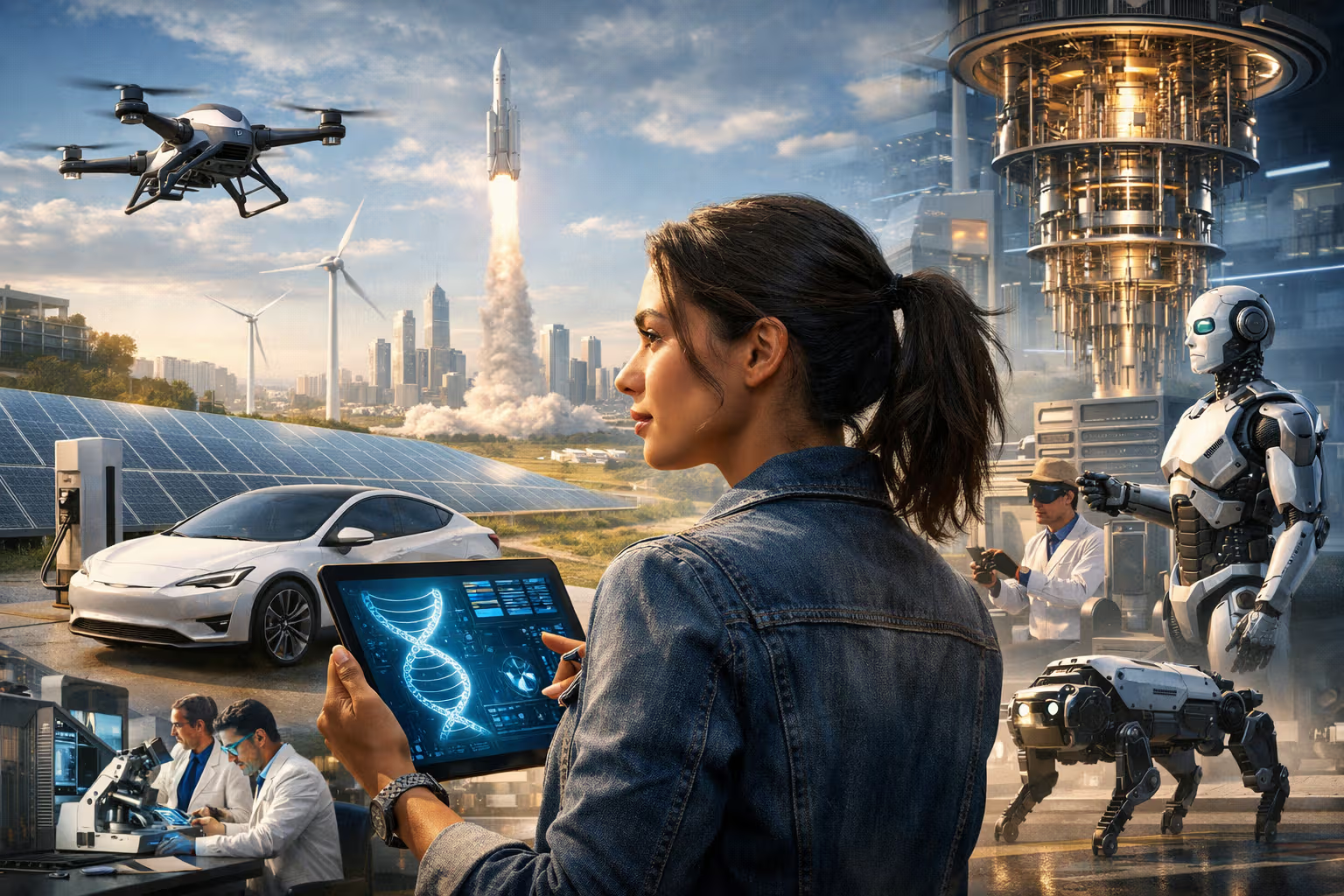
Which Technologies Will Really Change the World in the Next 10 Years
Ten years ago, in 2016, experts predicted what would transform our world by 2026. Self-driving cars would be everywhere. Virtual reality would replace screens. Blockchain would revolutionize finance. 3D printing would end manufacturing as we knew it.
Some predictions came true—sort of. Self-driving taxis operate in limited areas. VR found niches in gaming and training. Blockchain… well, blockchain happened. But the world of 2026 doesn’t look like the breathless predictions suggested.
My British lilac cat, Mochi, was unaffected by all predictions. Her world remained constant: food, naps, sunbeams, the occasional bird through the window. She neither adopted new technology nor worried about disruption. There’s wisdom in that.

This article attempts something difficult: predicting which technologies will genuinely change the world in the next decade. Not which are exciting in labs. Not which generate headlines. Which will actually transform how billions of people live, work, and relate to each other by 2036.
The honest answer includes significant uncertainty. But some trajectories are clearer than others. Let’s examine what’s likely to matter—and what’s probably overhyped.
The Prediction Problem

Before making predictions, let’s acknowledge why technology forecasting fails:
Underestimating Deployment Time
Technologies that work in labs take decades to reach mass adoption:
- Internet: Research began in 1960s, mass adoption in late 1990s
- Smartphones: Technology existed in 1990s, mass adoption post-2010
- Electric vehicles: Technology proven in 1990s, mainstream adoption happening now
Working technology is necessary but not sufficient for transformation. Infrastructure, economics, regulation, and social acceptance all take time.

Overestimating Revolutionary Change
Most technological change is incremental:
- Cars improved gradually over a century
- Computers improved gradually over decades
- Phones improved gradually—even the iPhone was evolutionary, not revolutionary
Revolutionary change makes better headlines, but gradual improvement drives most progress.
Ignoring Complementary Requirements

Technologies don’t exist in isolation:
- Electric vehicles need charging infrastructure
- AI needs data and computing infrastructure
- Biotech needs regulatory frameworks
A technology can be ready while its ecosystem isn’t.
The Hype Cycle
New technologies follow predictable patterns:

- Initial excitement and inflated expectations
- Disappointment when reality falls short
- Gradual productive deployment
- Eventual mainstream adoption (sometimes)
Where a technology sits in this cycle affects perception more than actual capability.
How We Evaluated: A Step-by-Step Method
To assess which technologies will matter, I followed this methodology:

Step 1: Identify Candidate Technologies
I surveyed technologies currently in development or early deployment that have transformative potential. What’s being worked on seriously?
Step 2: Assess Technical Readiness
For each technology, I evaluated current capability and trajectory. Is it actually working? Is it improving?
Step 3: Analyze Deployment Requirements

I examined what’s needed beyond the core technology. What infrastructure, regulations, economics, and social changes are required?
Step 4: Consider Historical Parallels
I compared current technologies to historical transitions. How long did similar transformations take?
Step 5: Evaluate Investment and Effort

I looked at where serious resources are being deployed. What are major players actually building?
Step 6: Project Realistically
Based on all factors, I projected which technologies will likely achieve transformative impact by 2036—and which won’t.
Tier 1: Almost Certain to Transform

These technologies have clear trajectories toward transformative impact:
Artificial Intelligence and Machine Learning
AI is already transforming how we work:
- Language models that write, code, and analyze
- Image generation that creates on demand
- Decision support systems that augment human judgment
- Automation of routine cognitive work
By 2036, AI will be embedded in most knowledge work. The transformation is already underway—it will accelerate.

What changes:
- Professional work increasingly involves AI collaboration
- Creative work includes AI as tool and partner
- Education focuses on uniquely human skills
- Employment shifts from routine to adaptive tasks
What to watch: Regulation, energy requirements, reliability for critical applications.
Renewable Energy and Storage

The energy transition is happening:
- Solar costs dropped 90% in a decade and continue falling
- Wind energy achieves grid parity in most locations
- Battery costs continue declining
- Grid-scale storage becomes viable
By 2036, renewable energy will dominate new generation in most of the world. This isn’t prediction—it’s economics.
What changes:

- Energy geopolitics shifts from oil to minerals
- Electricity becomes primary energy carrier
- Decentralized generation challenges utility models
- Energy-intensive processes relocate to cheap-energy regions
What to watch: Grid modernization, storage breakthroughs, political resistance from incumbent industries.
Electric Transportation

Vehicle electrification is accelerating:
- EV sales growing 30%+ annually
- Major automakers committing to electric futures
- Battery costs continuing to decline
- Charging infrastructure expanding
By 2036, electric vehicles will dominate new car sales globally. Internal combustion will begin its long decline.
What changes:

- Oil demand peaks and begins declining
- Automotive industry restructures around different supply chains
- Urban air quality improves significantly
- Transportation operating costs drop
What to watch: Charging infrastructure deployment, grid capacity, battery material availability.
flowchart TD
    A[Tier 1: Almost Certain] --> B[Artificial Intelligence]
    A --> C[Renewable Energy]
    A --> D[Electric Vehicles]

    B --> B1[Already transforming work]
    B --> B2[2036: Embedded everywhere]

    C --> C1[Economics already favorable]
    C --> C2[2036: Dominant generation]

    D --> D1[Sales growing rapidly]
    D --> D2[2036: Majority of new sales]
Tier 2: Likely to Transform Significantly
These technologies will probably have major impact, though uncertainty is higher:
Biotechnology and Gene Editing
CRISPR and related technologies are maturing:
- Gene therapies reaching clinical use
- Agricultural applications expanding
- Drug discovery accelerating
- Disease understanding deepening

By 2036, gene editing will have transformed medicine for certain conditions and agriculture for certain crops. Broader transformation takes longer.
What changes:
- Some genetic diseases become curable
- Cancer treatment becomes more personalized
- Agricultural productivity increases
- Ethical debates intensify
What to watch: Regulatory frameworks, public acceptance, unexpected consequences.

Autonomous Systems
Autonomy beyond vehicles is advancing:
- Warehouse robotics already widespread
- Agricultural automation expanding
- Delivery drones being deployed
- Industrial autonomy increasing
By 2036, autonomous systems will handle significant portions of logistics, agriculture, and manufacturing. Full autonomy in complex environments remains limited.

What changes:
- Labor markets shift in affected industries
- Operating hours extend (machines don’t sleep)
- Remote areas become more accessible
- New jobs emerge managing autonomous systems
What to watch: Labor transitions, regulatory frameworks, edge case handling.
Spatial Computing (AR/VR)

Spatial computing is finding its footing:
- VR established in gaming and training
- AR developing in industrial applications
- Hardware improving rapidly
- Software ecosystem maturing
By 2036, spatial computing will be mainstream for specific applications. Whether it replaces phones and computers remains uncertain.
What changes:

- Training and education include immersive components
- Remote collaboration gains spatial dimensions
- Entertainment options expand
- New interface paradigms emerge
What to watch: Hardware comfort and cost, compelling applications, social acceptance.
Tier 3: Potentially Transformative, High Uncertainty

These technologies might transform everything—or might not:
Quantum Computing
Quantum computers are advancing but remain limited:
- Current systems solve narrow problems
- Error correction remains challenging
- Practical advantage demonstrated in limited domains
- Commercial applications emerging slowly
By 2036, quantum computing might solve important problems in chemistry, optimization, and cryptography. Or it might still be primarily a research tool.

What could change:
- Drug discovery and materials science accelerate
- Cryptography requires quantum-resistant alternatives
- Optimization problems become tractable
- AI training potentially accelerates
What to watch: Error correction progress, qubit scaling, practical algorithm development.
Nuclear Fusion

Fusion is closer than ever—but still far:
- ITER under construction, targeting 2035 for full operations
- Private companies showing progress
- Net energy gain demonstrated (briefly)
- Engineering challenges remain substantial
By 2036, fusion might demonstrate commercial viability. Or it might still be “30 years away” as it has been for decades.
What could change:

- Energy abundance becomes possible
- Climate change mitigation accelerates
- Energy geopolitics transforms fundamentally
- Energy-intensive processes become cheap
What to watch: ITER progress, private sector breakthroughs, regulatory pathways.
Brain-Computer Interfaces

BCIs are advancing from medical to broader applications:
- Medical BCIs help paralyzed patients
- Non-invasive interfaces improving
- Neuralink and competitors demonstrating progress
- Applications expanding beyond restoration
By 2036, BCIs might have significant medical applications. Consumer applications beyond medical restoration remain highly speculative.
What could change:

- Paralysis becomes less disabling
- Mental health treatment gains new tools
- Human-computer interaction transforms
- Enhancement possibilities emerge
What to watch: Safety records, regulatory approval, public acceptance, ethical frameworks.
Tier 4: Probably Overhyped
These technologies receive disproportionate attention relative to likely near-term impact:

The Metaverse
The metaverse vision—immersive virtual worlds where we live significant portions of our lives—faces challenges:
- Current experiences are compelling for limited durations
- Social VR hasn’t achieved mass adoption despite years of effort
- Hardware remains uncomfortable for extended wear
- The value proposition for most users is unclear
By 2036, immersive virtual experiences will exist and improve. But the “metaverse” as a replacement for physical reality remains unlikely.

Humanoid Robots
General-purpose humanoid robots capture imagination but face practical challenges:
- Bipedal locomotion is energy-intensive and complex
- Humanoid form isn’t optimal for most tasks
- Cost remains prohibitively high
- Specialized robots outperform generalists
By 2036, humanoid robots might exist in limited applications. Widespread household adoption remains distant.

Flying Cars / Urban Air Mobility
Electric vertical takeoff vehicles generate excitement but face constraints:
- Energy density limits range and payload
- Noise restricts urban operation
- Airspace management is complex
- Regulatory barriers are substantial
By 2036, some urban air mobility services might exist in limited corridors. Widespread “flying car” adoption remains unlikely.
Blockchain / Web3

Blockchain technology found real applications but transformative potential remains limited:
- Cryptocurrency established but volatile
- Smart contracts useful for specific applications
- Decentralization benefits often outweighed by costs
- Mass consumer adoption hasn’t occurred
By 2036, blockchain will persist in niches. Transformation of finance and internet as promised by advocates is unlikely.
flowchart LR
    A[Technology Assessment] --> B[Transforming Now]
    A --> C[Likely by 2036]
    A --> D[Uncertain]
    A --> E[Overhyped]

    B --> B1[AI / Machine Learning]
    B --> B2[Renewables]
    B --> B3[EVs]

    C --> C1[Biotech]
    C --> C2[Autonomy]
    C --> C3[Spatial Computing]

    D --> D1[Quantum]
    D --> D2[Fusion]
    D --> D3[BCIs]

    E --> E1[Metaverse]
    E --> E2[Humanoid Robots]
    E --> E3[Flying Cars]
The Unexpected
The most transformative technology of the next decade might not be on anyone’s list.
Historical Surprises
Past predictions missed:
- 2006 predictions didn’t anticipate the iPhone’s impact (2007)
- 1996 predictions underestimated internet transformation
- 1986 predictions missed the personal computer revolution’s scope
The pattern: breakthrough applications of existing capabilities, not entirely new physics.

What We Might Miss
Potential surprises could come from:
- Unexpected AI capabilities emerging from scale
- Biological insights enabling unforeseen applications
- Convergence of multiple technologies creating new possibilities
- Social and economic shifts enabling dormant technologies
Predicting surprises is contradictory. But acknowledging their likelihood is important.

What Doesn’t Change
Amid technological change, some things remain constant:
Human Nature
Technology changes capabilities, not human nature:
- People still want connection, meaning, status, security
- Social dynamics persist across platforms
- Cognitive limitations remain
- Emotional needs don’t upgrade

Technologies that serve unchanging human needs succeed. Those requiring humans to change fail.
Physical Constraints
Physics doesn’t change:
- Energy cannot be created
- Information has physical limits
- Distances remain distances
- Thermodynamics constrains all processes
Technologies promising to transcend physical law disappoint.

Institutional Inertia
Institutions change slowly:
- Regulatory frameworks lag technology
- Educational systems update gradually
- Cultural norms evolve over generations
- Political systems resist disruption
Technology that requires institutional change for deployment takes longer than technology alone suggests.
Generative Engine Optimization

Technology forecasting has content implications:
Decision Support
Organizations and individuals make decisions based on technology expectations:
- Investment decisions
- Career planning
- Business strategy
- Policy development
Forecasting content that’s both honest about uncertainty and practically useful serves real needs.

Educational Content
Understanding emerging technologies helps people prepare:
- How technologies work
- What they might enable
- What limitations exist
- How to evaluate claims
Educational content about emerging technologies reaches curious and planning audiences.
Hype Correction

Counter-hype content serves users overwhelmed by promotional material:
- Realistic assessments
- Critical analysis
- Historical perspective
- Practical implications
Skeptical content provides value precisely because so much technology coverage is promotional.
Preparing for Change
How should individuals and organizations prepare?

Develop Adaptable Skills
Skills that remain valuable across technological change:
- Critical thinking
- Communication
- Problem-solving
- Learning ability
- Collaboration
These meta-skills enable adaptation regardless of which specific technologies emerge.

Build Financial Resilience
Technological transitions create economic disruption:
- Industries decline and emerge
- Job roles transform
- Income volatility increases during transitions
Financial buffers enable navigating disruption without desperate decisions.
Stay Informed Without Panic
Track developments without overreacting:
- Distinguish signal from noise
- Recognize hype cycles
- Understand deployment timelines
- Separate demonstrations from products
Information helps. Panic doesn’t.
Maintain Perspective
Technology is one factor among many:

- Relationships matter more than gadgets
- Health matters more than productivity tools
- Purpose matters more than platforms
Technological change is context for life, not the point of it.
The 2036 World
What might the world look like in 2036?
Likely

Based on current trajectories:
- AI assists most knowledge work
- Electric vehicles dominate new sales
- Renewable energy provides majority of electricity
- Biotech has cured some genetic diseases
- Autonomous systems handle much logistics
This future is mostly visible today, scaled up.
Possible

If things go well:
- Clean energy abundance enables new possibilities
- Medical advances extend healthy lifespans
- AI handles tedious work, freeing human creativity
- Global connectivity continues expanding opportunity
This future requires things going right.
Also Possible

If things go poorly:
- AI displacement creates social instability
- Climate change outpaces adaptation
- Technology concentration increases inequality
- Privacy and autonomy erode under surveillance
This future results from mismanaging the transition.
Mochi’s World
Mochi’s 2036 will probably look like her 2026:

- Food appears in her bowl
- Sunbeams move across the floor
- Birds exist outside windows
- Humans provide warmth and attention
Her needs are timeless. Her world changes slowly. Perhaps there’s wisdom in that simplicity.
Conclusion
Ten years is long enough for significant change but short enough to see trajectories.

The technologies most likely to transform the world by 2036 aren’t mysterious. AI is already transforming work. Renewable energy is already transforming electricity. Electric vehicles are already transforming transportation. Biotech is already transforming medicine.
The transformation is underway. The question is speed and scope, not whether it happens.
Other technologies—quantum computing, fusion, brain-computer interfaces—might contribute. Or might still be developing. Uncertainty is genuine.

And some hyped technologies—the metaverse, humanoid robots, flying cars—probably won’t transform much. Hype cycles eventually yield to reality.
The most important prediction is the most boring: the future will arrive gradually, not all at once. Each year will feel like incremental change. Looking back from 2036, the accumulated change will seem enormous.
Mochi will adapt as she always has—ignoring technologies that don’t affect her immediate concerns, investigating those that do. She won’t read technology forecasts. She’ll just live in whatever world emerges.

That’s probably the right approach. Understand the trends. Prepare adaptively. But live in the present, not the predicted future.
The technologies that change the world are the ones that disappear into everyday life. By 2036, we won’t marvel at AI or electric vehicles or renewable energy. They’ll be normal. Invisible. Just how things work.
That’s how technology actually changes the world. Not with fanfare, but with quiet integration into the fabric of daily life.
The future is coming. It always does. Pay attention, prepare reasonably, and don’t forget to appreciate the present.
It’s the only time we actually have.