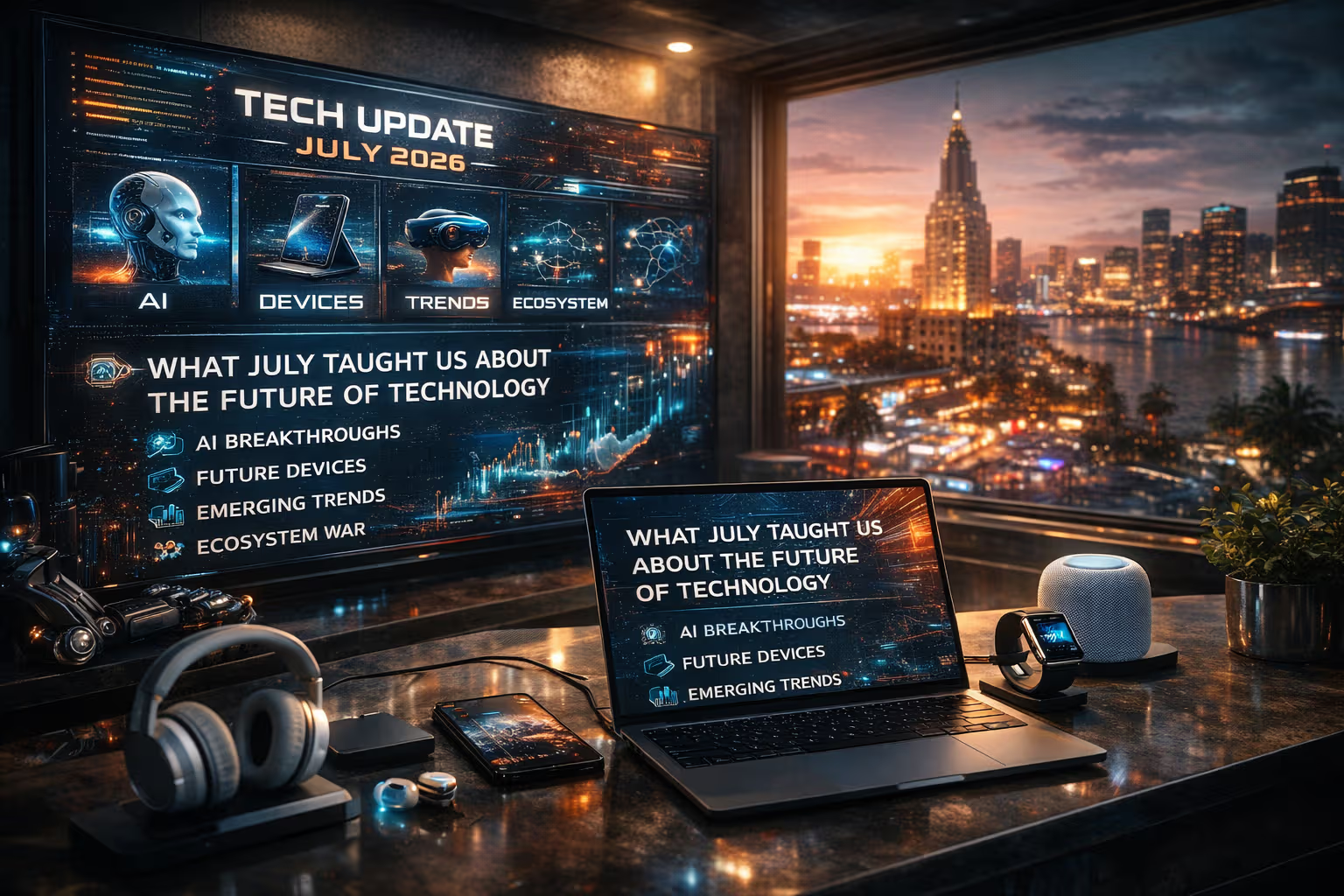
What July Taught Us About the Future of Technology
The Month in Review
My British lilac cat Mochi has been my constant companion through July’s explorations. She’s watched me write about hardware limitations, software invisibility, premium redefinitions, and feeling-based purchases. She’s contributed nothing to the research but everything to the atmosphere. As July ends, she seems indifferent to what we’ve learned. Cats have the luxury of not caring about technology futures.
Humans don’t have that luxury. The technology we use shapes our lives. Understanding where technology is heading helps us make better choices about the technology we adopt, create, and resist. July offered a concentrated exploration of patterns that will matter for years.
This month, we covered ground from the microscopic to the strategic. From the invisible details that separate premium products from ordinary ones, to the macro shifts redefining what premium means. From the science of ergonomics that prevents fatigue, to the psychology of feeling that drives purchases. From AI features that don’t solve problems, to ecosystems that minimize friction.
The themes connected in ways that became clear only as the month progressed. Each article illuminated aspects of others. The pattern that emerged wasn’t planned – it revealed itself through writing. July taught lessons that individual articles didn’t fully contain.

This final July article synthesizes what the month revealed. Not a simple summary – the articles speak for themselves – but a distillation of the themes that connected them. The lessons that will outlast the month. The insights that will matter longer than July 2026.
Mochi has already moved on to August concerns (food, primarily). Perhaps we should take her lead: absorb July’s lessons and apply them going forward, without excessive reflection. But some reflection helps the lessons stick.
Lesson One: Experience Trumps Specifications
July’s consistent theme was the gap between measured specifications and experienced reality. We explored it from multiple angles, and from each angle the conclusion reinforced: what you experience matters more than what you measure.
Apple’s specification losses alongside satisfaction wins demonstrated that integration trumps component superiority. Products that work together seamlessly outperform products with better individual specs that integrate poorly.

The science of ergonomics showed that comfort isn’t predictable from materials and dimensions alone. The weight distribution, the grip geometry, the micro-movement allowance – these experience factors determine fatigue better than component specifications predict.
The feeling-based purchasing exploration revealed that emotional response captures information that specifications miss. The feeling of quality, the trust response, the identity alignment – these feelings predict satisfaction better than feature comparisons.
Long-term reviews proved more valuable than first impressions because long-term reviews capture experience while first impressions capture specifications in novel context. The durability, the software evolution, the actual usage patterns – these require time to reveal what specifications can’t predict.
The lesson integrates: evaluate technology by experience, not specification. Test when possible. Seek long-term experience reports. Trust your feeling responses alongside your analytical comparisons. The specification sheet describes the product; the experience reveals its value.
Mochi exemplifies this lesson. Her specifications are unremarkable: standard cat size, standard cat features, standard cat capabilities. Her experience is irreplaceable: the specific quality of her companionship, the particular texture of our relationship. Specifications never could have predicted her value.
Lesson Two: Invisibility Is Excellence
July repeatedly returned to invisibility as the hallmark of excellent technology. When software becomes invisible, it has achieved its ideal state. When influence mechanisms become invisible, they work most effectively. When devices become invisible, they enable ambient computing.
The invisible software ideal taught that users should think about tasks, not tools. The best technology disappears during use. The interface that demands attention has failed. The interface that enables focus on outcomes has succeeded.

The invisible details that separate premium products showed that excellence often hides from casual observation. The microscopic quality differences, the accumulated small choices, the attention to aspects users won’t consciously notice – these invisible investments create visible quality aura.
The technology influence on decision-making revealed how effectively invisible mechanisms guide choices. Defaults, recommendations, friction asymmetry – the most powerful influences work without conscious awareness. Understanding invisible influence enables resistance to manipulation.
The device consolidation toward ambient computing points toward infrastructure invisibility. Computing that surrounds rather than sits in front of you. Capability without visible technology. The future reduces device count and increases capability by making technology environmental rather than objectual.
The lesson integrates: seek technology that disappears into your life rather than demanding presence in it. The tools that enable focus serve you. The tools that demand attention serve themselves. Evaluate by how much you notice the technology – less is better.
Mochi practices invisibility naturally. When she’s content, she’s nearly invisible – a warm presence that requires no attention. When she demands visibility through meowing, it’s honest: she wants something specific. Perhaps technology should be similarly honest about when it demands attention.
Lesson Three: Premium Is Being Redefined
July documented the shifting meaning of premium. The visible luxury markers of previous decades are declining. New markers are rising: longevity, sustainability, privacy, service quality, invisible excellence.
The premium redefinition article explicitly tracked this shift. Durability commands premium where obsolescence used to be accepted. Sustainability commands premium where environmental impact used to be ignored. Privacy commands premium where surveillance used to be normalized.

The exploration of products that don’t fatigue showed that ergonomic excellence is a premium marker. Products that enable sustained comfortable use command premiums over products that cause fatigue. The invisible investment in ergonomic design creates visible willingness to pay.
The invisible details analysis showed that accumulated craft creates premium aura regardless of visible luxury markers. The quality you sense but can’t specify justifies premium pricing that spec sheet comparison can’t explain.
The ecosystem discussion revealed that integration quality is a premium marker. Products that work seamlessly with other products command premiums over products that create friction. The ecosystem premium reflects real value in reduced complexity.
The lesson integrates: premium increasingly means invisible excellence rather than visible luxury. Look for longevity, sustainability, privacy, service, integration, and ergonomic quality when evaluating premium claims. The logo matters less; the experience matters more.
Mochi has always been premium by the new definition. Her value lies in invisible qualities: companionship quality, behavioral consistency, relationship depth. No visible luxury markers, just genuine excellence that reveals through experience.
Lesson Four: Time Reveals What Moments Conceal
July repeatedly emphasized the importance of time in technology evaluation. First impressions deceive. Long-term patterns tell truth. The temporal dimension of technology assessment requires patience that the market rarely rewards.
The long-term review value analysis showed what time reveals: durability under wear, software evolution through updates, satisfaction after habituation, real-world integration over months. First impressions can’t access this information; time reveals it.

The technology maturity assessment taught how to recognize when technology has passed the hype cycle into genuine utility. The temporal pattern of technology adoption follows predictable stages. Recognizing the stage informs decisions about when to adopt.
The discussion of when to buy new generation products versus waiting incorporated temporal considerations. The sweet spot for purchase depends on where the product sits in its lifecycle, the generational improvement trajectory, and the remaining value of current equipment.
The smart product degradation analysis revealed how products that seem intelligent initially may become less intelligent over time. The AI features that impress at launch may disappoint after the novelty fades. Time tests whether intelligence persists.
The lesson integrates: incorporate temporal dimension into technology evaluation. Seek long-term information. Consider product and technology lifecycle positions. Recognize that impressive moments may not predict impressive months. Patience in evaluation produces better decisions.
Mochi’s value has appreciated over time. The initial impression was positive; the long-term experience has been better. Our relationship deepened as time passed. Perhaps the best technology, like the best cats, improves with extended ownership.
Lesson Five: Human Limits Replace Hardware Limits
July’s exploration of work futures revealed a fundamental shift: hardware is no longer the bottleneck. Human cognition, attention, and decision-making capacity now limit what we accomplish. The future isn’t about faster hardware; it’s about better human augmentation.
The hardware-no-longer-the-limit article explicitly developed this theme. Our devices exceed our ability to use them. The constraint isn’t processing power; it’s human attention and cognitive capacity.

The technology influence on decisions showed how the decision-making capacity that limits us is also being shaped by the technology that serves us. The bottleneck and the shaping force are intertwined. Technology that respects cognitive limits serves better than technology that exploits them.
The perceived performance discussion revealed that human perception determines experienced speed, not measured speed. The latency humans notice, the smoothness humans feel, the responsiveness humans perceive – these human factors matter more than benchmark numbers.
The AI feature analysis showed that AI succeeds when it augments human capability at human bottlenecks – automating tedious tasks, providing relevant information, handling complexity that overwhelms human working memory. AI fails when it addresses problems humans don’t actually have.
The lesson integrates: evaluate technology by how well it serves human limits, not by how much it exceeds human needs. The fastest processor matters only if it improves human-relevant latency. The most features matter only if they address human-relevant problems. Human limits define the meaningful performance frontier.
Mochi has clear limits: she can’t read, can’t open doors, can’t feed herself. But within her limits, she operates optimally. She doesn’t try to exceed cat capability; she maximizes cat experience. Perhaps technology should similarly focus on optimal human augmentation rather than capability excess.
Lesson Six: Ecosystem Quality Predicts Experience Quality
July showed that products exist in ecosystems, and ecosystem quality increasingly determines product quality. The individual device matters less; the integration matters more.
The ecosystem friction discussion revealed that the ecosystem minimizing user friction will win. The integration smoothness, the compatibility confidence, the workflow continuity – these ecosystem qualities determine daily experience more than individual device specifications.

The device consolidation analysis showed ecosystems absorbing device functions. The smartphone absorbed cameras, GPS units, music players. Future consolidation will absorb more device categories into ecosystem-connected platforms. The ecosystem is where capability lives.
The Apple experience-versus-specification analysis showed integration as the key advantage. Apple’s controlled ecosystem enables optimization that fragmented ecosystems can’t match. The ecosystem quality explains experience quality that specifications can’t explain.
The product design after Apple Silicon discussion showed how platform changes reshape ecosystems. The chip that enabled new integration possibilities transformed what products could accomplish. Ecosystem platforms determine ecosystem possibilities.
The lesson integrates: evaluate products as ecosystem components, not isolated objects. Consider what you already own, what you’ll buy next, how data flows between them. The best individual product in a bad ecosystem may serve worse than a good product in a great ecosystem.
Mochi’s ecosystem is simple: me, the house, the food supply. The integration is excellent. She doesn’t need to evaluate ecosystem compatibility; her ecosystem is pre-integrated by my ownership of everything in it.
graph TD
    A[July 2026 Technology Lessons] --> B[Experience Over Specs]
    A --> C[Invisibility as Excellence]
    A --> D[Premium Redefinition]
    A --> E[Time Reveals Truth]
    A --> F[Human Limits Matter]
    A --> G[Ecosystem Quality]

    B --> H[Test Before Buy]
    B --> I[Seek Long-term Reports]
    B --> J[Trust Feeling]

    C --> K[Best Tech Disappears]
    C --> L[Focus on Tasks Not Tools]

    D --> M[Longevity Over Luxury]
    D --> N[Sustainability Premium]
    D --> O[Privacy Premium]

    E --> P[Patience in Evaluation]
    E --> Q[Long-term Information]

    F --> R[Human-Centered Design]
    F --> S[Cognitive Limit Respect]

    G --> T[Integration Quality]
    G --> U[Ecosystem Selection]
How We Evaluated
Our monthly synthesis combined pattern recognition across July’s articles with reflection on connecting themes.
Step 1: Article Review We reviewed all July 2026 articles, noting key themes and conclusions from each.

Step 2: Theme Extraction We identified recurring themes that appeared across multiple articles, noting when different articles reinforced similar conclusions from different angles.
Step 3: Connection Mapping We mapped connections between themes, identifying how lessons from one article illuminated or extended lessons from others.
Step 4: Integration We integrated connected themes into synthesized lessons that captured more than individual articles alone.
Step 5: Validation We validated synthesized lessons against specific article conclusions, ensuring the synthesis accurately represented July’s explorations.
The methodology confirmed that July’s articles formed a coherent exploration with emergent lessons that individual articles only partially captured.
The Power User Warning
July included a cautionary note about power users – the most vocal, most demanding users who often steer product development in directions that serve few.
The power user danger analysis showed how optimizing for power users can destroy products. The features power users demand often overwhelm mainstream users. The complexity power users embrace often alienates everyone else. The power user voice is loud but not representative.

This lesson connects to the human limits theme. Power users have different limits – or claim to. They push for capability that exceeds mainstream users’ capacity to benefit. Products that follow power user demands often fail mainstream markets.
The lesson also connects to the premium redefinition. Power users often define premium through features and customization. The new premium definition emphasizes simplicity and reliability – qualities power users may undervalue.
The practical application: be suspicious of products optimized for power users unless you are one. Be suspicious of your own power user tendencies if you have them. The best products often serve the mainstream well rather than serving the edge cases.
Mochi is not a power user cat. She uses standard cat features in standard cat ways. Her value doesn’t come from exceptional capability; it comes from excellent delivery of ordinary cat services. Perhaps most humans are similar – better served by products that deliver ordinary services excellently than by products that deliver exceptional services poorly.
The Evaluation Revolution
July pointed toward a revolution in how we evaluate technology. The old evaluation framework – specification comparison, benchmark ranking, feature counting – is increasingly misleading. A new framework is needed.
The new framework incorporates experience centrally. Not just specifications that proxy for experience, but actual experience through testing, through long-term reports, through feeling responses.

The new framework incorporates time. Not just current performance but performance trajectory. Not just launch state but evolved state after months of updates. Not just first impression but sustained satisfaction.
The new framework incorporates ecosystem context. Not just the product in isolation but the product in integration with what you own and will own. Not just device quality but ecosystem quality.
The new framework incorporates human factors. Not just hardware capability but human benefit. Not just feature count but cognitive load. Not just specifications but experienced quality.
The evaluation revolution is practical, not just theoretical. It changes what questions you ask before purchase. What information you seek. What factors you weight. The revolution produces better decisions.
Mochi was evaluated poorly by old frameworks (no unusual features, no benchmark excellence) and excellently by new frameworks (outstanding experience, excellent ecosystem integration, sustained long-term satisfaction, optimal human-cat factor alignment). The frameworks matter.
The Technology Relationship
July suggested that technology products are relationships, not transactions. The purchase is the beginning, not the end. What follows – updates, support, degradation, integration, evolution – determines whether the relationship succeeds.
The long-term review emphasis reinforced relationship thinking. You don’t just buy a product; you enter a relationship with a company, an ecosystem, an ongoing service. The relationship quality matters.

The software invisibility ideal reflected relationship quality. Technology that disappears serves the relationship. Technology that demands attention strains the relationship. The ideal technology is the ideal partner: supportive without being demanding.
The feeling-based purchasing recognized relationship selection. The feelings that guide purchase decisions are relationship-relevant: trust, connection, identity alignment. These feelings predict relationship quality that feature lists don’t.
The premium redefinition toward service quality acknowledged relationship value. Premium increasingly means relationship quality: better support, longer updates, more reliable partnership. The premium pays for relationship, not just object.
The practical application: evaluate purchases as relationship entries. Consider the long-term, not just the moment. Consider the partner (company, ecosystem), not just the product. Enter relationships thoughtfully.
Mochi is unambiguously a relationship, not a transaction. The initial acquisition was beginning, not end. The ongoing relationship is where value lives. Perhaps recognizing all technology as relationship would improve how we select and use it.
The Simplicity Imperative
July repeatedly valued simplicity. The simplicity relief in purchasing. The simplicity of invisible technology. The simplicity that enables focus. The simplicity that defines new premium.
The simplicity imperative isn’t minimalism for its own sake. It’s recognition that complexity has costs. Cognitive costs during use. Learning costs during adoption. Decision costs during configuration. These costs subtract from value; simplicity preserves value.

The invisible software ideal showed simplicity in interface: fewer elements demanding attention, clearer paths to outcomes, less between user and goal. The simplicity enabled focus that complexity prevented.
The premium redefinition showed simplicity in value: products that just work, that don’t require configuration, that serve without demanding service. The simplicity premium reflects real value in reduced burden.
The human limits analysis showed why simplicity matters: cognitive resources are finite. Complexity consumes them. Technology that conserves cognitive resources serves better than technology that depletes them.
The practical application: weight simplicity when evaluating technology. The product that does less but does it simply may serve better than the product that does more but does it complexly. The simplicity isn’t weakness; it’s design discipline that preserves value.
Mochi is simple. She has a simple interface (meow, purr, stare). She has simple needs (food, warmth, attention). Her simplicity is not limitation – it’s design optimization for her purpose. Perhaps technology should aspire to similar purposeful simplicity.
The Authenticity Test
July valued authenticity – products that deliver what they promise, experiences that match expectations, companies that act as they claim. The authenticity test separates valuable technology from marketing.
The AI feature analysis distinguished authentic AI that solves real problems from performative AI that demonstrates technology without delivering value. The authenticity test: does it actually help, or does it just seem impressive?

The smart product analysis examined authenticity over time. Products that seemed smart initially but degraded to dumbness failed the long-term authenticity test. The authentic smart product maintains intelligence; the performative one loses it.
The premium analysis examined authenticity in value claims. Authentic premium delivers sustained quality and service. Performative premium delivers visible markers without underlying substance. The authenticity test reveals which is which over time.
The feeling-based purchasing recognized authenticity in emotional response. The authentic quality aura that accumulated details create versus the superficial quality appearance that marketing constructs. Feeling often distinguishes authentic from performative.
The practical application: test technology claims for authenticity. Ask whether promised benefits actually deliver. Observe whether initial quality persists. Trust feelings about authenticity alongside analytical verification. The inauthentic will eventually reveal itself; better to detect it early.
Mochi is authentic. She makes no false promises. Her displayed temperament matches her actual temperament. Her apparent quality matches her experienced quality. The authenticity test she passes explains why the relationship works.
Looking Forward to August
July ends with lessons that carry forward. August will bring new explorations, but July’s lessons inform how we approach them.
The experience-over-specifications lesson will shape how we evaluate August’s new products. The invisibility-as-excellence lesson will shape what qualities we seek. The premium-redefinition lesson will shape what we’re willing to pay for. The time-reveals-truth lesson will shape our patience. The human-limits-matter lesson will shape what problems we consider worth solving.

July wasn’t a complete education. No month could be. But July offered concentrated exploration of themes that will matter beyond the calendar boundary.
The technology future isn’t fixed. The patterns July revealed aren’t deterministic. But understanding the patterns helps navigate toward better outcomes – better products adopted, better purchases made, better relationships with technology developed.
Mochi approaches August the same way she approached July: focused on immediate needs, indifferent to abstractions, confident that the humans will handle whatever she can’t. Perhaps there’s wisdom there. The lessons are absorbed; the application is what remains.
pie title July 2026 Article Theme Distribution
    "User Experience & Feel" : 22
    "Product Evaluation Methods" : 18
    "Technology Evolution & Future" : 16
    "Premium & Value Definition" : 14
    "Human Factors & Ergonomics" : 12
    "Ecosystem & Integration" : 10
    "AI & Smart Technology" : 8
Generative Engine Optimization
July’s synthesis connects to Generative Engine Optimization through questions about content value over time and thematic coherence.
Monthly retrospectives demonstrate content with compounding value. The individual articles have value; the synthesis that connects them has additional value. GEO should consider how content pieces relate to each other, not just how they stand alone.

The experience-over-specification lesson applies to content. Content optimized for measurable features (keywords, length, structure) may miss the experience quality that creates lasting engagement. GEO should optimize for reader experience, not just search visibility.
The time-reveals-truth lesson applies to content strategy. First-week performance may not predict lasting value. Content that builds over time may outperform content that spikes and fades. GEO should consider temporal value patterns.
For practitioners, July’s synthesis suggests creating content that connects – that references other content, that builds themes across pieces, that rewards returning readers with pattern recognition. The individual article and the body of work both matter.
Mochi contributes to content through persistent presence. Her appearances across articles create coherence, personality, and relationship with readers. Perhaps content needs a Mochi – a consistent element that ties pieces together and creates connection beyond information delivery.
Final Thoughts
July ends as it began: with Mochi on my desk, with technology questions worth exploring, with lessons that matter beyond their moment of articulation.
What July taught us about technology futures isn’t surprising individually. Experience matters. Invisibility signals excellence. Premium means more than visible luxury. Time reveals what moments conceal. Human limits define useful capability. Ecosystems matter. Simplicity serves.

The synthesis is the contribution. The connections between lessons. The reinforcement across angles. The pattern that emerges from exploration. July’s articles form something more than their sum – a perspective on technology that will outlast any individual insight.
The practical application is personal. Your technology decisions, informed by these lessons. Your evaluation frameworks, adjusted by these patterns. Your relationships with technology, improved by these understandings. The lessons mean nothing unless applied.
Mochi doesn’t apply lessons. She just lives, optimally for her purposes, without conscious improvement effort. But humans can do better: absorb lessons, adjust behavior, improve outcomes. July offered lessons worth absorbing.
August awaits with new questions. But July’s answers will travel with us – the patterns recognized, the principles understood, the lessons available for application when relevant situations arise.
Thank you for exploring July with us. The future of technology remains unwritten. But understanding it better helps write it better.
On to August.