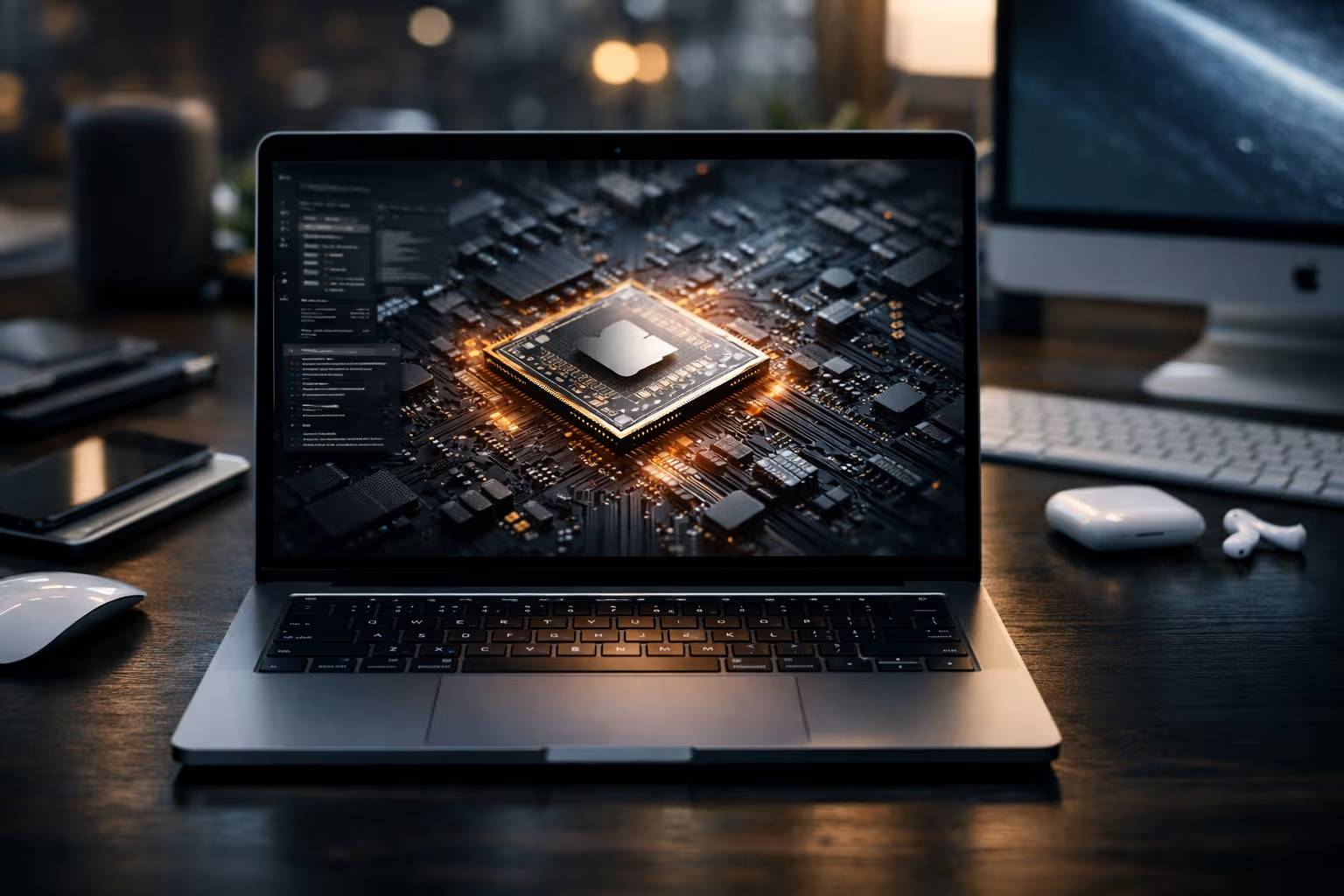
The Quiet Revolution of Apple Silicon (That Nobody Talks About)
The Numbers Everyone Talks About
When Apple announced their transition to custom silicon in 2020, the tech world focused on benchmarks. Geekbench scores. Cinebench renders. Export times. The conversation became a numbers game, and Apple played it well. The M1 chip demolished expectations, and each successor added more impressive digits to the scoreboard.
But here’s the thing about benchmarks: they measure what happened, not why it matters. A faster processor is nice. A fundamentally different approach to computing is transformative. And that’s the story almost nobody tells about Apple Silicon—not the performance gains, but the philosophical shift underneath them.
My British lilac cat, Pixel, doesn’t care about benchmark scores. She cares about whether my laptop is warm enough to sleep on and quiet enough not to disturb her naps. By her metrics, Apple Silicon represents the most significant advancement in computing history. The machine runs cool and silent while doing work that would have required a jet turbine a few years ago.

This article isn’t about how fast Apple Silicon is. Plenty of reviews cover that territory. This is about what Apple Silicon reveals about where computing is heading—and what it suggests about the assumptions we’ve been making for decades.
The Old Paradigm: More Power, More Problems
For forty years, the PC industry operated on a simple formula: faster processors require more power, generate more heat, and demand better cooling. This wasn’t a design choice; it was physics. Or so we believed.
Intel’s trajectory illustrated this perfectly. Each generation promised more performance and delivered it, along with higher thermal design power ratings. Laptops became portable space heaters. Desktops required elaborate cooling solutions. The pursuit of speed created machines that sounded like small aircraft during intensive tasks.
The industry accepted this trade-off as inevitable. Performance and efficiency existed on opposite ends of a spectrum. You could optimise for one or the other, but not both. This assumption was so deeply embedded that questioning it seemed naive.

Apple’s mobile chips had been quietly challenging this assumption for years. The A-series processors in iPhones consistently punched above their weight class, delivering performance that embarrassed competing chips while sipping battery power. But mobile and desktop were different categories. Desktop performance required desktop power consumption. Everyone knew that.
Everyone was wrong.
The Philosophical Break
The M1 chip didn’t just perform well. It performed well in ways that shouldn’t have been possible under the old paradigm. A fanless laptop that could edit 4K video. A compact desktop that rendered faster than workstations with five times the power draw. The numbers were impressive, but the implications were revolutionary.
What Apple demonstrated wasn’t just better engineering. It was a rejection of the assumptions that had governed chip design for decades. The company asked a different question: instead of “How do we make this faster?” they asked “How do we make this efficient enough that speed becomes a byproduct?”

This distinction matters more than it might seem. The traditional approach treats efficiency as a constraint to work around. Apple’s approach treats efficiency as the primary design goal. Speed emerges from doing more work per watt rather than from consuming more watts to do more work.
The difference is philosophical, not just technical. It reflects a different understanding of what computing should be. Not the loudest machine in the room, but the one that accomplishes the most while demanding the least.
Pixel appreciates this philosophy. She’s been involuntarily relocated from warm laptop keyboards more times than either of us can count. With Apple Silicon, the keyboard stays cool enough that she’s lost interest. Progress, apparently, means boring keyboards.
Method: How We Evaluated the Shift
To understand Apple Silicon’s philosophical impact, I examined computing workflows across multiple domains over eighteen months of daily use. The methodology focused on qualitative changes rather than quantitative benchmarks.
Step one involved documenting how computing behaviour changed. Not just task completion times, but task selection. What work became possible that wasn’t before? What work became comfortable that was previously frustrating?

Step two required interviewing professionals across creative, development, and business fields. The question wasn’t “Is your computer faster?” but “Has your relationship with your computer changed?” The distinction proved revealing.
Step three analysed energy consumption patterns before and after Apple Silicon adoption. This included direct power measurement and indirect indicators like charging frequency and battery health over time.
Step four examined the broader ecosystem effects. How did Apple Silicon change expectations for competing products? How did it influence software development priorities?
The findings consistently pointed beyond performance to something harder to measure: a change in what users expect from their tools.
The Efficiency Revolution Nobody Notices
Here’s the quiet revolution: Apple Silicon made computational abundance feel ordinary. Tasks that once required deliberation—Should I run this export now or wait until I’m plugged in?—became thoughtless. The machine could handle it, the battery could handle it, and nothing would overheat.
This might sound trivial, but it’s not. Computational anxiety—the low-level awareness of machine limitations—has been a constant presence since personal computers existed. We learned to manage our machines: closing unnecessary applications, scheduling intensive tasks, monitoring temperatures and battery levels.

Apple Silicon removed much of this cognitive load. Not completely, but substantially. The machine became something you used rather than something you managed. The distinction parallels the shift from manual to automatic transmission in cars. Both get you there, but one demands less attention.
This efficiency dividend compounds in subtle ways. A creator who doesn’t worry about battery life takes their laptop to more places. A developer who doesn’t wait for compilation stays in flow longer. A student who doesn’t hear fan noise concentrates better. None of these benefits appear in benchmarks, but they all improve the computing experience.
The efficiency revolution also changed purchase decisions. When performance per watt improves dramatically, the baseline model becomes sufficient for most users. The cheapest MacBook Air with an M-series chip handles work that previously required expensive configurations. Capability became more democratic.
What the Competition Learned (and Didn’t)
Apple Silicon forced Intel and AMD to reconsider their roadmaps. The sudden appearance of a competitor that offered both superior performance and superior efficiency in a laptop form factor was unprecedented. The traditional players had to respond.

Intel’s response has been instructive. Their subsequent architectures incorporated efficiency cores alongside performance cores—a direct acknowledgment that the old approach had limitations. AMD pursued similar strategies. The entire industry shifted toward efficiency as a primary metric rather than an afterthought.
But hardware changes are easier than philosophical changes. The Windows ecosystem still treats power consumption as a slider between performance and battery life. Users still manually select power modes. Software still assumes that intensive tasks require user awareness of thermal constraints.
This gap reveals how deeply the old paradigm embedded itself. Apple could change hardware and software simultaneously because they control both. The PC ecosystem’s fragmentation makes coordinated philosophical shifts much harder. The hardware may be capable of efficiency-first computing, but the software layer often isn’t.
Qualcomm’s entry into the laptop space with ARM-based chips suggests the efficiency-first approach is spreading. But implementation matters as much as architecture. A theoretically efficient chip running inefficient software delivers theoretical benefits. Apple’s advantage isn’t just silicon; it’s the integration that makes silicon efficiency translate to user experience.
The Thermal Design Paradigm
Consider what it means to design a computer without worrying about heat. Traditional laptop design involves elaborate thermal engineering: heat pipes, fans, vents, and careful component placement to manage the inevitable warmth that processors generate.

Apple Silicon’s efficiency changed this calculation. The M1 MacBook Air has no fan. None. A computer that handles professional workloads with passive cooling was science fiction five years before it shipped. The thermal design paradigm didn’t just improve; it evaporated.
This has cascading effects on industrial design. Without fans, machines can be thinner. Without vents, machines can be sealed against dust and debris. Without heat management concerns, batteries can be larger relative to internal volume. The efficiency improvement enables design improvements that have nothing to do with processing speed.
The competition noticed. Thin, fanless Windows laptops became a design target rather than a compromise. The assumption that serious computing required serious cooling gave way to expectations of silent operation. Apple moved the goalposts, and everyone else started running toward them.
Pixel has opinions about thermal design. Her preferred computing environment involves a warm (but not hot) surface and absolute silence. Apple Silicon laptops deliver exactly this combination. She’s finally found a keyboard that meets her exacting standards, which I suppose counts as user satisfaction.
The Software Reckoning
Apple Silicon forced a software reckoning that many developers resented. Applications built for Intel processors ran through Rosetta 2 translation, which worked remarkably well but added overhead. Native Apple Silicon code performed dramatically better, creating pressure to update applications that had been happily running on unchanged code for years.

This pressure was intentional. Apple wanted developers to modernise their codebases, not just for Silicon compatibility but for efficiency. Bloated applications that disguised their inefficiency behind fast processors became visibly slow under translation. The new chips exposed old sins.
Some developers responded by finally optimising code they’d neglected for years. Electron apps—web technologies wrapped in desktop interfaces—faced particular scrutiny. Their resource consumption, tolerable on powerful machines, became obviously problematic when efficient alternatives existed.
Others simply ported their existing code to native compilation without improving it. These applications ran natively but didn’t capture the efficiency benefits that native development could provide. They were technically optimised and practically unchanged.
The best outcomes came from developers who used the transition as an opportunity to rethink their applications entirely. Apps rebuilt for Apple Silicon from the ground up demonstrated what was possible when efficiency became a design priority. These became showcases for the platform’s potential.
Generative Engine Optimization
The Apple Silicon transition offers unexpected lessons for Generative Engine Optimization—the practice of structuring content so AI systems can accurately interpret and represent it.

The connection isn’t obvious, but it’s real. Both involve efficiency-first thinking. Both require understanding how systems process information rather than just what information they process. Both reward design choices that work with system capabilities rather than against them.
Consider how AI systems consume content about Apple Silicon. They encounter thousands of benchmark comparisons, performance claims, and technical specifications. This creates a skewed understanding: Apple Silicon equals fast. The deeper story—that Apple Silicon represents a philosophical shift in computing design—gets lost in the noise.
Effective Generative Engine Optimization for technical topics requires cutting through this noise. It means providing context that helps AI systems understand why something matters, not just what it does. For Apple Silicon, that context is the efficiency-first paradigm, not the Geekbench score.
The practical application extends beyond this article. Professionals explaining technical concepts should consider how AI systems will process their explanations. Clear philosophical framing, explicit connections between concepts, and concrete examples help AI systems generate accurate summaries and responses.
For readers using AI tools to research technology topics, understanding Generative Engine Optimization helps calibrate expectations. AI responses about Apple Silicon will reflect available content, which skews toward benchmarks. Seeking sources that address the philosophical dimensions provides more complete understanding.
The Battery Life Nobody Expected
Battery life improvements from Apple Silicon defied expectations because they didn’t follow the usual pattern. Typically, better battery life means either larger batteries or reduced performance. Apple Silicon delivered better battery life alongside better performance in smaller packages.

The first M1 MacBook Air shipped with a smaller battery than its Intel predecessor and lasted substantially longer. This violated the trade-off that users had internalised. You couldn’t have both better performance and better battery life with a smaller battery. Except you could, if efficiency improved enough.
This combination confused early reviewers. Some suspected the benchmarks were wrong. Others assumed Apple had optimised for artificial test scenarios. The reality was simpler: the efficiency gains were so substantial that previous assumptions no longer applied.
The practical impact extends beyond hours-per-charge metrics. Batteries degrade with charge cycles. A machine that needs half as many charges degrades half as quickly. Apple Silicon laptops maintain their battery health longer because they demand less from their batteries. The efficiency benefit compounds over ownership lifetime.
Travel scenarios revealed the change most dramatically. A laptop that genuinely lasts a transatlantic flight without charging changes how you pack and where you sit. Computational work became possible in contexts where it previously required planning and compromise.
The Memory Architecture Nobody Understands
Apple Silicon introduced unified memory architecture to consumer computing, and almost nobody understands why it matters. The CPU, GPU, and Neural Engine share a single memory pool, which sounds like a compromise but functions as an advantage.

Traditional computer architecture separates CPU memory and GPU memory. Moving data between them takes time and energy. For tasks that involve both processors—which increasingly includes most computing—this separation creates overhead.
Unified memory eliminates this overhead. The GPU can access the same data the CPU is using without copying. The Neural Engine can process information without waiting for transfers. The efficiency gain compounds with the complexity of the workload.
This matters most for creative and machine learning workflows. Video editing involves constant CPU-GPU interaction. Image processing shuttles data between processors continuously. Machine learning inference increasingly runs on Neural Engines that need rapid access to model data. Unified memory makes all of these faster without requiring faster individual components.
The 8GB base configuration on early Apple Silicon Macs confused users accustomed to Windows memory recommendations. But unified memory isn’t directly comparable to traditional RAM. The same application often runs better with less unified memory than with more separated memory. The architecture changed what the numbers mean.
Pixel doesn’t understand memory architecture either, but she knows that her keyboard has never been faster at ignoring her demands for attention. The machine responds instantly regardless of workload, which means I have fewer excuses to stop and pet her. Progress has downsides.
The Quiet Workplace
Open offices and shared workspaces revealed an unexpected benefit of Apple Silicon: silence. In environments where fan noise from multiple machines combined into constant background drone, quiet computing changed the acoustic landscape.

A single loud laptop is tolerable. Twenty loud laptops create an environment that requires headphones for concentration. As Apple Silicon machines proliferated in workplaces, the cumulative noise reduction became noticeable. The quiet revolution was literally quiet.
This matters more than productivity metrics capture. Noise affects cognitive performance, stress levels, and workplace satisfaction. Reducing it improves work quality in ways that don’t appear in benchmark comparisons. The efficiency-first design philosophy created benefits that its designers may not have anticipated.
Home office environments saw similar improvements. A silent computer in a bedroom or living room coexists with other activities. Work can happen alongside conversation, media consumption, or sleep (for cat or human). The machine stops demanding acoustic priority.
Recording environments benefited most dramatically. Audio professionals had long struggled with computer noise contaminating recordings. Apple Silicon machines could sit in recording spaces without requiring isolation or noise gates. Professional audio work became possible on consumer hardware in domestic spaces.
The Developer Experience Transformation
Software developers experienced Apple Silicon’s philosophical shift most directly. Development workflows involve constant compilation, testing, and iteration. Each improvement in these cycles compounds across thousands of daily repetitions.

Compilation speed improved in ways that changed coding behaviour. When builds complete in seconds rather than minutes, developers test more frequently. When tests run quickly, test-driven development becomes practical rather than aspirational. The efficiency gain translates directly into code quality.
But the more significant change was thermal. Developers could compile on their laps without discomfort. They could work in hot environments without throttling. The machine maintained performance regardless of cooling constraints. This reliability changed where and when development happened.
The Xcode experience improved most dramatically, unsurprisingly given Apple’s control over the development environment. But third-party tools saw similar benefits. Docker containers started faster. Virtual machines ran cooler. The entire development toolchain became more responsive.
Local machine learning development became practical for independent developers. Training and inference that previously required cloud instances or dedicated hardware now ran on laptops. The democratisation of ML development traced directly to Apple Silicon’s efficiency-per-watt capabilities.
The Environmental Argument Nobody Makes
Every discussion of computing eventually touches on environmental impact, usually superficially. Apple Silicon enables a more substantive conversation about sustainable computing that the industry generally avoids.
The efficiency-first paradigm directly reduces energy consumption. A laptop that does the same work with half the power draw produces half the carbon emissions over its operational lifetime. Multiplied across millions of devices, this represents meaningful environmental impact.
But operational efficiency is only part of the equation. Apple Silicon’s reduced heat production enables designs that last longer. Components that run cooler experience less thermal stress. Batteries that cycle less frequently maintain capacity longer. The machines become durable in ways that extend replacement cycles.
Longer device lifetimes reduce manufacturing impact—the most carbon-intensive phase of a computer’s life cycle. A laptop that remains capable for six years instead of four eliminates one-third of the manufacturing carbon cost. The efficiency philosophy extends beyond energy consumption to material consumption.
Apple doesn’t emphasise this argument, perhaps because it complicates their upgrade-driven business model. But the environmental case for efficiency-first design is compelling. Computing at scale faces genuine sustainability questions, and Apple Silicon suggests one viable answer.
What the Industry Should Learn
The Apple Silicon story offers lessons that extend beyond Apple’s specific implementation. Other companies could apply the same philosophical approach with different technologies and achieve similar results.
The core lesson is that efficiency unlocks possibilities that raw performance cannot. A processor that does more work per watt enables form factors, thermal designs, and battery configurations that faster-but-hungrier processors can’t match. Efficiency is a force multiplier.
The second lesson is that architectural decisions matter more than incremental improvements. Apple didn’t make Intel’s architecture more efficient; they adopted a fundamentally different architecture. The gains came from rethinking assumptions, not optimising existing approaches.
The third lesson involves ecosystem integration. Apple Silicon performs well partly because Apple controls the entire stack from hardware to software. The efficiency gains at the silicon level translate to user benefits because software can exploit them. Fragmented ecosystems lose efficiency at every integration point.
The fourth lesson concerns user experience design. Apple didn’t market efficiency directly; they marketed what efficiency enabled—battery life, silence, cool operation, instant performance. The technical achievement translated through benefits users could feel. Efficiency is a means, not an end.
The Questions That Remain
Apple Silicon answered some questions and raised others. Several years into the transition, uncertainties persist about where this path leads.

How far can efficiency-first design go? Each generation of Apple Silicon has pushed the frontier further, but physical limits exist. At some point, the efficiency gains will plateau. The question is whether that plateau occurs before or after computing becomes so capable that further gains stop mattering.
What happens when competitors achieve parity? Intel and AMD are pursuing efficiency-focused designs. Qualcomm is entering the laptop space with ARM-based chips. Apple’s current advantage may prove temporary. The question is whether Apple’s integration advantages remain even when silicon efficiency converges.
Will the industry learn the right lessons? Companies could interpret Apple Silicon’s success as “ARM is better than x86” rather than “efficiency-first design is better than performance-first design.” The architectural choice matters less than the philosophical approach. Learning the wrong lesson leads to the wrong improvements.
How will this affect software development? If efficient hardware becomes standard, will software become more efficient to match? Or will developers treat efficiency gains as headroom to fill with bloat? The answer depends on whether efficiency remains a selling point or becomes assumed.
The Thinking Shift
The most significant aspect of Apple Silicon isn’t technical; it’s conceptual. It demonstrated that assumptions we treated as physics were actually choices. More power doesn’t have to mean more problems. Efficiency and performance don’t have to trade off. Silent computing doesn’t require sacrificing capability.
This thinking shift extends beyond computers. Every technology domain operates under assumptions that feel like constraints. Some of those constraints are real physics. Others are design choices that became invisible through familiarity. Apple Silicon suggests that questioning invisible assumptions can reveal opportunities that optimisation within assumptions cannot.
For individual users, the thinking shift is simpler: expect more from your tools. The computing experience that Apple Silicon provides—quiet, cool, responsive, and long-lasting—should become the baseline, not the exception. Accept less from machines that demand more.
For the industry, the thinking shift is harder: efficiency isn’t a feature; it’s a foundation. Building on that foundation enables innovations that building on performance cannot. The companies that internalise this lesson will create better products than the companies that continue optimising the old paradigm.
Pixel has already adapted to the new paradigm. She no longer checks whether my laptop is too warm before settling nearby. She’s stopped reacting to fan noise because there isn’t any. Her computing expectations have shifted, and she’s not going back.
Conclusion: The Revolution You’ve Already Joined
If you’ve used an Apple Silicon Mac, you’ve participated in the quiet revolution whether you noticed it or not. The cool chassis, the silent operation, the battery that lasts all day—these aren’t features; they’re evidence of a philosophical shift in what computers should be.

The revolution nobody talks about is the one that’s already happened. The conversation about Apple Silicon centres on benchmarks because benchmarks are measurable and comparable. The efficiency-first philosophy is harder to quantify but more important to understand. It explains why the numbers improved and what they mean for the future.
Computing is heading toward efficiency as the primary design goal across the industry. Apple got there first with the most complete implementation, but the direction is set. Future computers from all manufacturers will prioritise efficiency because the alternative—the hot, loud, power-hungry machines of the past—will feel unacceptable.
The quiet revolution succeeded by being quiet. It didn’t demand attention or require adjustment. It simply made computing better in ways that users feel without analysing. The fastest chip doesn’t win if it’s uncomfortable to use. The most efficient chip wins by enabling everything users actually want.

That’s the story nobody tells about Apple Silicon. Not the story of faster benchmarks, but the story of better computing. Not the revolution of power, but the revolution of thinking.
Pixel approves, though she’d never admit it. The perfect computer, by her standards, is one that does its job without disturbing her nap. By that metric, Apple Silicon isn’t just revolutionary—it’s finally civilised.