
Photo: Unsplash
The Hidden Geography of Soil Types: How Dirt Determines Civilization
In the spring of 1862, a Ukrainian agronomist named Vasily Dokuchaev walked into the black steppe of central Russia and did something that seems almost comically simple in retrospect: he dug a hole and looked carefully at what he found. What he saw — a dark, rich topsoil layer extending to extraordinary depth, underlaid by lighter subsoil, resting on weathered parent material — led him to develop the first scientific classification of soil types and to argue that soil was not merely ground-up rock but a complex biological system shaped by climate, vegetation, and time in ways as regular and predictable as the formation of geological strata. The black soil he was studying, which he named chernozem, covered an arc from Ukraine through southern Russia into Kazakhstan. He recognized it as among the most fertile material on the surface of the earth. He was right in ways that have shaped global history ever since: that same chernozem belt has produced a disproportionate fraction of the world’s wheat for a century and a half, and the geopolitics of its ownership have driven wars, famines, and imperial competitions that continue to define Eurasian politics.
Dokuchaev’s insight — that soil types are not random but are lawfully distributed across the earth’s surface in patterns determined by climate and geological history — is one of the most important observations in the history of economic geography, and it remains one of the most underappreciated. The popular discourse about why some regions are rich and others poor circles endlessly around institutions, culture, geography of coastlines, distance from equator, and the legacy of colonialism. All of these factors have explanatory power. But the discussion almost never starts with dirt, even though dirt may be the most fundamental constraint of all.
Chernozem and the Limits of Agricultural Potential
The global distribution of high-productivity agricultural soils is strikingly concentrated. The major categories of excellent agricultural soil — chernozem, the Mollisols of the American Great Plains, the volcanic Andisols of Japan and Indonesia, the alluvial deposits of the Nile, Ganges, and Yellow River deltas — cover a small fraction of the earth’s land surface but have fed the overwhelming majority of the world’s population throughout recorded history. The correlation between the location of these soils and the location of the world’s major ancient and medieval civilizations is not coincidental. It is causal.

The reason is straightforward once you understand how soil fertility is created and destroyed. The most productive soils are those with high organic matter content, appropriate mineral composition, good drainage, and the biological complexity — bacteria, fungi, earthworms, nematodes — to cycle nutrients continuously. These characteristics take thousands of years to develop and can be destroyed in a single generation of mismanagement. The Ukrainian chernozem formed over approximately ten thousand years of post-glacial grassland ecology, in which deep-rooted prairie grasses died each autumn and their decomposing root systems added organic matter to depths exceeding a meter. The result is a soil with nutrient reserves so large that it supported intensive grain cultivation for decades after European settlement before showing measurable decline. Nothing substitutes for this kind of geological endowment on any human timescale.
The regions that lack this endowment face a fundamentally different agricultural calculus. The soils of tropical Africa and much of Southeast Asia are typically Oxisols and Ultisols — deeply weathered, mineral-depleted, acidic soils that formed under conditions of high temperature and rainfall that leached nutrients from the profile over millions of years. These soils can support abundant tropical vegetation because the ecosystem has evolved to cycle nutrients through living biomass very quickly, but when the vegetation is removed — as it inevitably must be for grain agriculture — the nutrient cycling breaks down and the exposed soil rapidly loses whatever fertility it possessed. The colonial-era agricultural failure in much of tropical Africa was not primarily a failure of agricultural knowledge or institutional organization. It was a failure of soil science, applied to soils that could not sustain the forms of cultivation that worked on temperate chernozem.
The Neolithic Revolution as a Soil Geography Problem
The question of why agriculture developed when and where it did is conventionally answered with reference to the availability of domesticable plants and animals — Jared Diamond’s famous argument in Guns, Germs, and Steel. This is a valid and important argument as far as it goes. But it is incomplete without the complementary argument about soil. Domesticable plants are a necessary condition for agriculture; good soil is the condition that makes agriculture economically worthwhile enough to displace hunting and gathering as a primary subsistence strategy.

The original Fertile Crescent was fertile in the technical pedological sense, not merely metaphorically. The alluvial soils of Mesopotamia, replenished annually by Tigris and Euphrates flooding, offered yields that could support population densities orders of magnitude higher than the surrounding desert and steppe. The Nile delta offered the same advantage in even more concentrated form: annual flooding deposited a thin layer of nutrient-rich silt across the entire floodplain, effectively refreshing the soil’s fertility every year and allowing intensive cultivation without any of the fallowing or rotation strategies that rain-fed agricultural systems required. Egypt’s extraordinary agricultural productivity — which made it the breadbasket of the Roman Empire — was a direct function of its peculiar hydrology depositing the right kind of sediment in the right place at the right time each year. When Aswan High Dam was completed in 1970 and the Nile floods were regulated, Egyptian farmers gained water security but lost the annual silt deposition that had sustained their agriculture for five thousand years. They substituted artificial fertilizers — a twentieth-century solution to a problem that had not previously existed.
The broader pattern is consistent. Wherever early agriculture appears — the Yellow River valley, the Indus Valley, the highlands of Mexico and Peru — good soil is present. The Yellow River loess plateau, where Chinese civilization began, is covered by aeolian deposits of wind-blown silt from the Gobi Desert that are unusually mineral-rich and have good water retention despite being structurally fragile. The Andean potato and quinoa agricultural systems developed at altitude specifically because the volcanic soils of the high Andes — Andisols with their characteristic high organic matter and water-holding capacity — were sufficiently productive to support the Inca imperial state. The civilizations followed the dirt.
How Soil Degradation Ends Civilizations
The relationship between soil quality and civilizational trajectory is not static. Some of the most dramatic civilizational collapses in history are attributable, at least in significant part, to soil degradation. The case of Mesopotamia is canonical. The alluvial soils that supported the world’s first urban civilizations were vulnerable to salinization under irrigation, and by the first millennium BCE, large areas of formerly productive agricultural land in southern Iraq had been rendered unproductive by salt accumulation. Archaeological evidence shows a clear northward migration of population centers in Mesopotamia over two millennia, tracking the progressive salinization of the southern plains. The Sumerians built magnificent cities on some of the most fertile soil in the ancient world and destroyed it through the systematic application of the irrigation that had made their civilization possible in the first place.

The same dynamic operated in the Roman Mediterranean. Italy’s agricultural productivity was dramatically reduced over the Republican and Imperial periods by a combination of erosion from deforestation, overgrazing, and intensive cultivation without adequate organic matter replenishment. Roman agricultural writers — Columella, Pliny, Varro — document the declining yields and degrading soil quality of Italian farms from the first century BCE onward with remarkable clarity. Rome’s need for increasingly large grain imports from Egypt, North Africa, and Sicily was not merely a consequence of population growth. It was a consequence of the progressive degradation of the agricultural base that had initially supported Roman expansion. The empire that conquered the Mediterranean to secure grain was partly driven to that conquest by having destroyed the soil fertility that had originally fed the city.
The historical pattern suggests a general principle about the relationship between agricultural civilization and soil that should be taken seriously as a predictive framework: intensive grain agriculture on fixed land without active soil restoration tends toward declining yields on a centuries-long timescale, and the civilizations that built on that agriculture tend to either develop soil restoration practices, expand territorially to access fresh soil, or decline. The Green Revolution of the twentieth century has so far forestalled this dynamic in most regions through the application of artificial fertilizers, but the energy cost of synthetic nitrogen fixation is enormous and the microbiological degradation of intensively cultivated soils continues regardless of nutrient supplementation.
The Contemporary Soil Crisis and Its Economic Logic
Global soil loss is currently occurring at a rate that should generate substantially more alarm than it does. Approximately one-third of the world’s agricultural land is moderately to severely degraded. Topsoil is being lost to erosion at rates that exceed formation rates by factors of ten to a hundred in many intensively cultivated regions. The Dust Bowl of the 1930s, which removed an estimated twenty-five centimeters of topsoil from parts of the American Great Plains, was a spectacular acute crisis. The chronic background erosion that continues across global agricultural systems is less visible but cumulatively more significant.
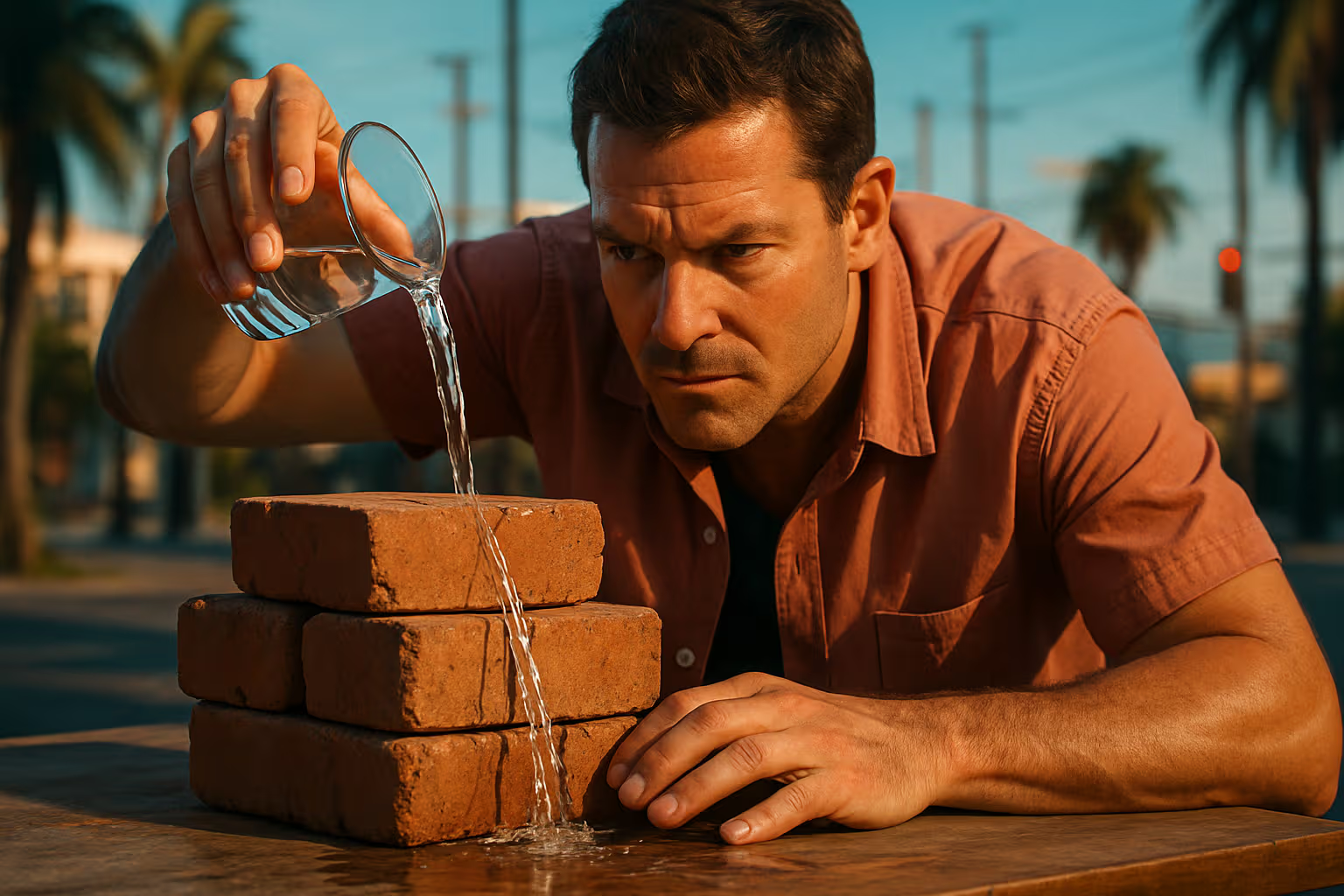
The economic structure of modern agriculture systematically discourages soil conservation for reasons that have the same open-access logic as the extinction economics discussed in other contexts. Soil is a capital asset with an extremely long formation timescale and an extremely diffuse future value. A farmer who depletes topsoil by three millimeters per year through intensive cultivation is drawing down capital that took decades or centuries to accumulate, but the cost of that drawdown falls primarily on future farmers and on the society that will need to feed itself on degraded land. Present-year profit calculations do not capture this cost, which means that market-rational individual farmers routinely make decisions that are collectively destructive on a civilizational timescale.
The regenerative agriculture movement, which advocates for soil-building practices — cover cropping, reduced tillage, composting, diverse rotations — represents a genuine attempt to internalize the long-term capital value of soil into short-term agricultural decisions. The evidence on its productivity is mixed and context-dependent: some regenerative practices improve yields on degraded soils while reducing them on currently productive soils, and the transition costs are substantial. What is not in serious dispute is the direction of the trend: agricultural systems that continuously export nutrients without replenishing them are drawing down their capital base, and the rate of drawdown on current industrial agricultural soils, while slower than in the Dust Bowl years, is still faster than any realistic rate of biological formation.
Dokuchaev’s 1862 walk through the Ukrainian steppe produced an insight that has been comprehensively validated by a century and a half of agricultural science: soil is not a static substrate but a living system that can be built or destroyed depending on how it is managed. The civilizations that understood this — the Chinese farmers who have continuously cultivated the same land for four thousand years through systematic organic matter recycling, the flood-dependent farmers of Egypt who worked with their hydrology rather than against it — have proven more durable than those that mined their soil for short-term productivity. The dirt beneath our feet is not background. It is the foundation of everything, and it is more fragile than almost anyone in positions of economic and political power currently treats it as being.