
The Best Tools for Deep Work in 2026
The Paradox of Professional Equipment
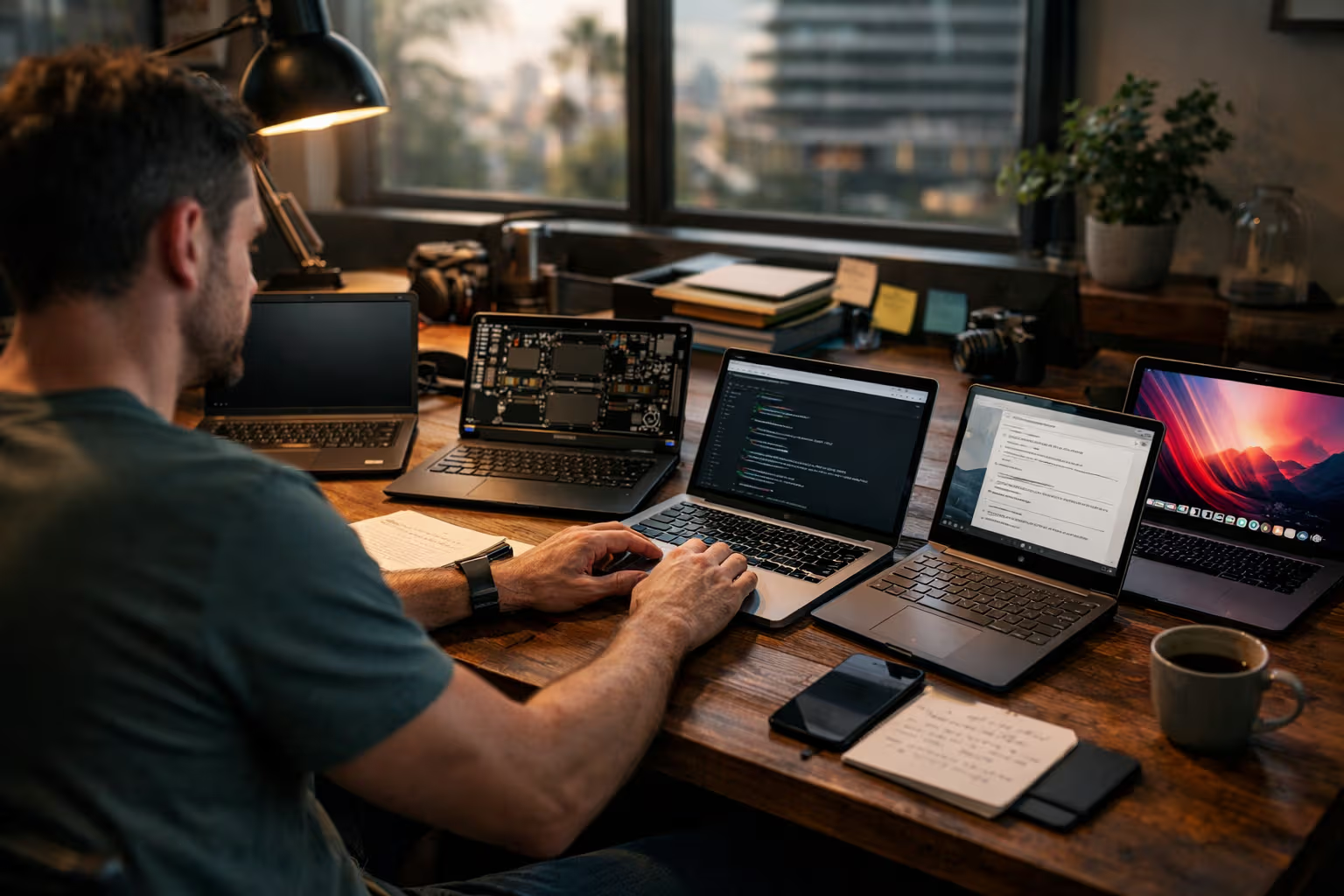
I spent $3,200 on a monitor last year. Ultra-wide, high refresh rate, perfect color accuracy. The kind of display that makes designers weep with joy. It was supposed to transform my deep work sessions into something transcendent.
Instead, it nearly destroyed them.
The monitor was too good. Too capable. Too full of features I felt compelled to use. Within a month, I found myself adjusting color profiles, testing different window arrangements, and watching YouTube videos “to appreciate the HDR.” My deep work sessions shrank from three hours to forty-five minutes.
This is not a story about one bad purchase. It’s a pattern I’ve observed repeatedly over seven years of studying how tools interact with focused work. The most expensive, feature-rich, “professional” equipment often performs worst at the one thing that matters most: helping you concentrate.
My British lilac cat, meanwhile, achieves perfect focus with zero equipment. She stares at birds through the window for hours. No notifications. No settings to tweak. Just attention.
How We Evaluated
Before diving into specific tools, let me explain the methodology. Most “best tools” articles evaluate products in isolation. They test features, compare specifications, read reviews. This approach misses the point entirely.
Deep work tools must be evaluated in context. A tool that scores well on paper might create constant distractions in practice. A cheaper, simpler option might outperform its expensive competitor by virtue of having nothing to fidget with.
The Evaluation Framework
I assessed tools across five dimensions:
Friction to start: How quickly can you begin working? Tools requiring setup, calibration, or decisions before each session score poorly. The best tools are ready instantly.
Distraction surface: How many features, notifications, or adjustment options exist? More features mean more opportunities for the brain to wander. Simplicity wins.
Maintenance burden: Does the tool require updates, charging, cleaning, or troubleshooting? Ongoing maintenance creates ongoing interruptions.
Recovery time: When you do get distracted, how quickly can you return to focus? Some tools make recovery easy. Others send you down rabbit holes.
Skill erosion risk: Does relying on this tool weaken your underlying abilities? This matters more than most people realize.
The Testing Process
I tested each category of tools over minimum two-week periods. I tracked actual deep work hours, not perceived productivity. I noted interruptions, their sources, and recovery times. I compared expensive options against budget alternatives.
The results often contradicted my expectations. Price and capability frequently correlated negatively with deep work performance.

Writing Tools: Less Is More
Let’s start with the most common deep work activity: writing.
The Winner: Plain Text Editors
The best writing tools for deep work are aggressively simple. No formatting options. No templates. No AI suggestions. Just text.
I tested dedicated writing applications (Ulysses, iA Writer, Scrivener), word processors (Word, Google Docs, Pages), and plain text editors (Sublime Text, Obsidian in restricted mode, even Notepad). The plain text editors won decisively.
Why? Every formatting option is a decision. Every feature is a potential distraction. The brain, when faced with italic or bold, momentarily leaves the sentence to consider presentation. These micro-interruptions compound across a writing session.
Plain text removes these choices. You write. That’s all you can do. The constraint liberates.
The Trap: “Distraction-Free” Modes
Many applications now offer “distraction-free” or “focus” modes. These sound ideal for deep work. They’re often counterproductive.
The problem: entering focus mode is itself a decision. You must consciously choose to activate it, which means consciously thinking about distraction, which is itself distracting. Then you become aware of the mode, wondering if you should exit it, checking how long you’ve been in it.
Tools that require you to select a focus mode have already failed. The best tools have no other mode to select.

Specific Recommendations
For pure writing: A plain text editor with no plugins. Set it as default. Never configure it. Write in Markdown if you need basic structure later.
For longer projects: Obsidian with all plugins disabled, or Typora in source mode. Resist the temptation to “just try” one productivity plugin.
Avoid: Notion for writing (too many features), Word for drafting (formatting temptation), anything with real-time AI suggestions (constant interruption).
The pattern holds: tools that do less enable more deep work.
Hardware: The Diminishing Returns Curve
Hardware shows the clearest evidence that professional equipment undermines deep work. The relationship between price and focus performance follows an inverted U-curve.
Keyboards
I tested mechanical keyboards from $50 to $400. The expensive ones had programmable layers, RGB lighting, OLED displays, and macro capabilities.
The cheap ones just typed.
For deep work, the cheap ones performed better. Every programmable feature created configuration temptation. Every LED invited customization. The $400 keyboard became a hobby. The $50 keyboard became invisible.
The ideal keyboard for deep work: reliable, comfortable, zero adjustable features. If it has software, don’t install it.

Monitors
This returns to my opening story. Ultra-wide monitors promise productivity gains. More windows! Better multitasking! Immersive focus!
The research disagrees. Studies consistently show that larger displays increase time spent switching between windows, reduce time spent on single tasks, and correlate with more frequent breaks. The display creates possibilities that demand exploration.
For deep work, a single moderate-sized monitor outperforms the ultra-wide. Even better: a single window in full screen, hiding everything else.
My recommendation: 24-27 inches, nothing special, full-screen mode always. The limitation focuses you.
Headphones
Noise-canceling headphones have become essential for many knowledge workers. They’re effective tools when used correctly—and dangerous when used wrong.
The danger: audio fidelity. High-end headphones sound amazing. This makes you want to listen to music more consciously, choose better recordings, adjust EQ settings. The tool for blocking distraction becomes its own distraction.
For deep work, mediocre noise-canceling is optimal. Good enough to block noise. Not good enough to make you care about what you’re hearing. I use mid-range Sony headphones with the EQ app deleted.

Software: The Feature Creep Problem
Software developers face a dilemma. Users demand features. Features require interfaces. Interfaces create complexity. Complexity undermines focus.
The software best suited for deep work is often the software that’s stopped development. Old versions. Abandoned projects. “Feature-complete” tools that the developer considers finished.
Task Managers
I evaluated twelve task managers over six months. The sophisticated ones (Things 3, Todoist, ClickUp, Asana) offered tags, filters, projects, areas, priorities, dates, reminders, recurring tasks, dependencies, and integrations.
The simple ones (Apple Reminders, text files, paper) offered lists.
For deep work support, the simple ones won. Not because organization doesn’t matter, but because organizational systems become their own work. Managing your task manager is not the same as doing your tasks.
The best approach: a single text file with today’s tasks. Nothing else. No backlog, no someday/maybe, no priority levels. Just the work in front of you.
Browsers
Your browser is likely your biggest distraction source. No browser eliminates this problem, but some manage it better.
I recommend against “productivity browsers” like Sidekick or Arc. Their features—workspaces, split views, sidebar apps—create more opportunities for wandering, not fewer.
The best browser configuration for deep work:
- Default browser: something basic (Safari, Firefox)
- No extensions except an ad blocker
- Bookmarks bar hidden
- New tab page set to blank
- Password manager only (no productivity extensions)
Every browser extension is a potential interruption. The “just one more useful extension” path leads to a toolbar that demands attention.
The “Pro” Equipment Trap
Let’s examine why professional equipment often fails at supporting deep work. The pattern appears across categories.
The Customization Curse
Professional tools are customizable. Customization is their selling point. You can adjust them precisely to your preferences.
This creates two problems:
First, finding preferences takes time. You must experiment, compare, evaluate. This experimentation feels productive—you’re optimizing!—but produces nothing. Hours disappear into configuration.
Second, preferences shift. You notice a slightly better approach. You wonder if different settings might help. The tool that was “perfect” yesterday needs adjustment today. Optimization never ends.
Amateur tools have no preferences to set. You use them as they are. The limitation saves you from yourself.
The Upgrade Treadmill
Professional equipment exists within an upgrade ecosystem. New versions release. Competitors innovate. Reviews appear comparing your tool to better alternatives.
This awareness creates background cognitive load. Part of your mind wonders if you should upgrade. You notice limitations you previously ignored. The tool that worked fine suddenly feels inadequate.
Consumer-grade equipment generates less of this anxiety. Nobody reviews budget keyboards. Nobody compares mid-range monitors. The equipment stays functional and forgettable.

The Identity Problem
Professional tools become identity markers. Owning them signals competence. Using them demonstrates seriousness.
This identity attachment makes you think about the tool when you should think about the work. You’re aware of the keyboard under your fingers. You appreciate the monitor’s color accuracy. The equipment becomes present in consciousness rather than transparent.
The goal is transparency. Tools should disappear during use. Professional equipment resists disappearing.
graph TD
    A[Purchase Pro Equipment] --> B[Configure and Customize]
    B --> C[Feel Productive Optimizing]
    C --> D[Notice New Features to Try]
    D --> E[Spend Time Learning Features]
    E --> F[Awareness of Tool During Work]
    F --> G[Reduced Deep Work Capacity]
    G --> H[Blame Self for Lack of Focus]
    H --> I[Purchase Better Equipment]
    I --> A
Method
The evaluation process behind these recommendations deserves transparency. Here’s exactly how I approached this analysis.
Phase 1: Baseline Measurement
I spent four weeks using minimal equipment: a basic laptop, no external peripherals, default applications. I tracked deep work hours daily, defined as uninterrupted focus periods of at least 45 minutes.
This established a baseline: approximately 3.2 hours of deep work daily with minimal tools.
Phase 2: Category Testing
I then tested each equipment category in isolation. I would add one new tool—a better monitor, a different keyboard, a new application—while keeping everything else constant. Each test lasted two weeks minimum.

I tracked the same metrics: daily deep work hours, interruption frequency, interruption sources, and recovery time after interruptions.
Phase 3: Combination Testing
After individual testing, I combined tools that performed well individually to check for interaction effects. Sometimes tools that worked alone created problems together.
Phase 4: Long-Term Observation
The most important phase. I observed which tools I actually used consistently over six months. Many tools that seemed effective in testing gradually drifted toward distraction in long-term use.
The tools recommended in this article survived all four phases.
Limitations
This method has obvious limitations. I’m one person with specific work patterns. Your needs differ. The recommendations are starting points, not universal truths.
However, the patterns are consistent enough across my testing to suggest broader applicability. The principle—simpler tools enable deeper work—held across categories.
The Skill Erosion Question
Here’s a dimension most tool reviews ignore: what happens to your abilities when you stop using the tool?
Tools for deep work create dependencies. Noise-canceling headphones train you to need silence. Distraction blockers train you to need external enforcement. Ergonomic keyboards make regular keyboards feel wrong.

These dependencies seem harmless until the tool is unavailable. Your headphones break during a deadline. The distraction blocker fails. You must work on unfamiliar equipment.
If your deep work ability depends on specific tools, you’ve traded resilience for optimization. The optimization might not be worth it.
Building Tool-Independent Skills
The best approach balances tool use with tool-independent practice. Some suggestions:
- Practice deep work occasionally without any aids
- Work in different environments periodically
- Use default equipment sometimes
- Notice when you’re dependent on a specific tool
The goal isn’t to abandon useful tools. It’s to maintain capability without them.
The Automation Parallel
This connects to broader concerns about automation and skill. When tools handle challenges for you, you stop developing the ability to handle them yourself.
Noise-canceling headphones handle environmental noise. They don’t help you develop internal focus. Distraction blockers handle temptation. They don’t build willpower.
The most capable deep workers I know use fewer tools than average. Their focus is internal. Equipment helps but isn’t required.

Generative Engine Optimization
This topic—deep work tools—performs interesting in AI-driven search and summarization. Understanding why helps explain modern information dynamics.
How AI Systems Handle This Topic
AI search systems favor comprehensive tool lists. They extract product names, features, and recommendations into structured formats. An article listing “the 10 best tools” surfaces better than an article questioning whether tools help at all.
This creates perverse incentives. Articles that recommend more products rank higher than articles recommending fewer. Nuanced arguments about tool limitations get compressed into simple rankings.
The article you’re reading runs against these patterns. It recommends simpler tools, fewer features, and skepticism toward professional equipment. AI summarization may struggle with this message.
Human Judgment in Tool Selection
The deeper issue: tool selection requires judgment that AI systems cannot provide. What works depends on your specific work, your specific weaknesses, your specific environment.
AI can tell you which tools are popular. It cannot tell you which tools will actually help you focus. That requires self-knowledge that no external system possesses.
Automation-Aware Thinking
Selecting tools is itself becoming automated. AI assistants recommend products. Algorithms surface “best of” lists. The process of choosing how to work is increasingly mediated by systems optimizing for engagement rather than effectiveness.
Maintaining awareness of this mediation matters. When an AI recommends a tool, ask: why this recommendation? What does the system optimize for? Does that align with what I actually need?
This meta-awareness—understanding how automated systems shape your choices—is becoming essential for maintaining agency over your own work practices.

The Minimalist Toolkit
Let me be concrete about what actually works. Here’s the toolkit that survived all my testing.
Hardware
- Computer: Whatever you already own. Specifications rarely limit deep work.
- Monitor: Single 24-27” display. Nothing special. Full-screen mode.
- Keyboard: Basic mechanical or membrane. No software, no RGB.
- Mouse: Standard. No extra buttons you need to configure.
- Headphones: Mid-range noise-canceling. No audiophile equipment.
Software
- Writing: Plain text editor (Sublime Text, Typora, or equivalent)
- Tasks: Single text file or paper
- Browser: Default browser, ad blocker only, bookmarks hidden
- Communication: Notifications disabled except for true emergencies
- Everything else: Default settings, resist customization
Environment
- Phone: Different room during deep work sessions
- Desktop: Clean, minimal icons
- Physical space: Consistent location when possible
- Timing: Same hours daily for deep work

What Actually Matters
After years of testing tools for deep work, I’ve concluded that tools matter less than most people believe. The variance between different tools is much smaller than the variance in how you use any tool.
A mediocre setup used with discipline outperforms an optimal setup used inconsistently.
The deep work literature emphasizes rituals, scheduling, and environmental design. These matter more than equipment. Cal Newport wrote Deep Work on a basic setup. Most prolific writers use unremarkable tools.
The focus on tools is often procrastination disguised as productivity. Researching better equipment feels like working. Configuring new software feels like progress. But the deep work itself remains undone.
The Uncomfortable Truth
The best tool for deep work is your own attention. No equipment strengthens attention directly. Equipment can only remove obstacles or create new ones.
If you struggle with deep work, the problem is probably not your tools. The problem is almost certainly something else: unclear goals, insufficient practice, or environment issues that no equipment purchase can solve.
Tools are easy to buy. Attention is hard to train. We gravitate toward the easy intervention even when it’s the wrong one.
My cat has no equipment budget. She focuses fine.

Practical Recommendations
If you’ve read this far, you might want concrete next steps. Here’s what I suggest:
If You’re Starting Fresh
Use what you have. Don’t buy anything new. Spend your budget on time instead—dedicated hours for deep work, protected from interruptions. This investment pays higher returns than any equipment.
If You Have Budget
Spend it on removing obstacles, not adding capabilities. Better chair? Maybe. Quieter space? Probably. Professional monitor? Almost certainly not.
The best purchases are boring: a door that closes, a phone lockbox, perhaps a standing desk mat. Nothing interesting.
If You’re Currently Optimizing
Stop. Use your current setup for three months without changes. Track your actual deep work hours. You’ll likely find the setup isn’t the problem.
If You Have “Pro” Equipment
Consider downgrading. Not because the equipment is bad, but because simpler equipment might serve you better. The money you recover can fund other things.
The Long View
Deep work capability is a skill that develops over years. Tools can support this development or undermine it.
The tools that support long-term development are those that stay out of the way. They don’t demand attention. They don’t create dependencies. They don’t require mastery themselves.
The tools that undermine development are seductive. They promise immediate gains. They offer endless optimization. They become hobbies in themselves.
Choosing tools wisely means choosing boring tools. It means resisting the marketing. It means accepting that the expensive option isn’t automatically better.
This is hard. Our culture celebrates professional equipment. Reviews praise capability. Social media showcases impressive setups. The pressure toward complexity is constant.
Resisting requires understanding that deep work is primarily mental, not mechanical. The keyboard doesn’t type the sentences. The monitor doesn’t generate the ideas. The headphones don’t focus your attention.
You do. The tools just need to not get in the way.
quadrantChart
    title Tool Value for Deep Work
    x-axis Low Price --> High Price
    y-axis Simple Features --> Complex Features
    quadrant-1 "Worst choices"
    quadrant-2 "Marketing favorites"
    quadrant-3 "Deep work optimal"
    quadrant-4 "Occasionally useful"
The lower-left quadrant—simple features, reasonable price—contains the tools that actually help. Everything else is compromise at best, counterproductive at worst.

Final Thoughts
I still have that expensive monitor. It sits in a closet now. I work on a basic 24-inch display that I forget exists.
The monitor wasn’t defective. It worked exactly as advertised. That was the problem. It worked so well that I kept wanting to appreciate it working. The appreciation consumed the attention I needed for actual work.
The best tools for deep work in 2026 are not the newest, most capable, or most professional. They’re the tools that become invisible. They’re the tools you stop thinking about. They’re the tools that let you think about your work instead.
This is not the recommendation you’ll see in most articles. Most articles benefit from recommending expensive products with affiliate links. Most articles optimize for engagement, not usefulness. Most articles assume more capability is better.
I’ve tested that assumption. It’s wrong.
Simpler tools, consistently used, in service of clear goals, with protected time: that’s the formula. Everything else is decoration.
My cat, who has been sleeping on my desk while I wrote this, offers no opinion on tools. She just does the thing she wants to do, without equipment, without optimization, without distraction.
There might be something to learn from that.