
The AI Review Problem: How to Spot Fake 'Hands-On' Content in 10 Seconds
The Flood Nobody Asked For
Last week I searched for laptop stand reviews. The first page of results looked normal. Headlines promised “hands-on testing” and “real-world experience.” Photos showed products on desks. Text described features and impressions.
Except none of it was real.
The “reviews” were generated by AI using product specifications and stock images. No human touched the stands. No actual testing occurred. The content existed because algorithms could create it cheaply, not because someone had something genuine to say.
My cat Pixel has never written a fake review. She expresses opinions authentically—meowing at closed doors, ignoring expensive toys, demanding attention at inconvenient times. Perhaps there’s something to learn from her unfiltered authenticity.
Why This Happened
The economics are straightforward. AI can generate “reviews” for pennies. Human writers cost real money. Publishers facing margin pressure made predictable choices.

Affiliate marketing accelerated the problem. Every review with affiliate links generates potential revenue. More reviews mean more chances to capture search traffic. Quality matters less than quantity when the goal is clicking through to purchase.
Search engines struggled to distinguish real from fake. Their algorithms rewarded comprehensive coverage, consistent publishing, and keyword optimization. AI content excels at these metrics. Genuine expertise doesn’t necessarily correlate with SEO best practices.
The result: an information environment where fake hands-on content outcompetes real hands-on content for visibility. Users searching for genuine opinions encounter synthetic approximations instead.

This isn’t hypothetical future concern. It’s current reality. Major publications have been caught publishing AI-generated product content without disclosure. Review aggregators mix real and synthetic reviews indistinguishably. The contamination is widespread.
The Ten-Second Test
You don’t need forensic analysis to spot most fake reviews. A few quick checks catch the majority.
Check 1: Specific Negative Details
Real reviews include specific complaints. “The USB-C port on the left side is too close to the hinge—my cable constantly interferes with the screen.” That’s specific. That’s observed. That came from actual use.

Fake reviews have vague or absent negatives. “Some users might find the build quality could be improved.” That’s nothing. That’s hedged speculation. That came from an algorithm covering bases.
Genuine hands-on experience produces unique friction points. The cable that doesn’t fit. The software bug that appears Tuesday but not Wednesday. The weight that felt fine in the store but exhausts you after an hour of carrying.
AI doesn’t experience friction. It can only imagine generic complaints. This leaves a gap you can detect in seconds.
Check 2: Irreproducible Observations
Real reviews describe things you couldn’t know without touching the product. “The trackpad has a subtle texture that collects fingerprints only on the left edge—something about how the coating was applied.” That’s weirdly specific. That’s the kind of detail AI wouldn’t invent.

Fake reviews stick to reproducible information. Things from spec sheets. Things from marketing materials. Things any AI could synthesize without access to physical product.
Look for observations that couldn’t come from documentation. How something sounds when you tap it. How a material feels after a week of use. How a feature behaves in situations the manufacturer didn’t anticipate.
Check 3: Temporal Anchoring
Real reviews exist in time. “I’ve been using this for six weeks, and the battery definitely degrades faster in winter.” That’s anchored to duration and conditions. That implies actual passage of time with the product.

Fake reviews exist in eternal present. “This product offers excellent battery life for most users.” No duration. No conditions. No evidence of time passing while using the product.
The tell is absence of temporal language. No “after a month.” No “initially I thought, but then.” No references to how things changed with use. Real experience unfolds over time. AI-generated content exists outside time.
Check 4: Author Consistency
Real reviewers have histories. They’ve reviewed other products. Their preferences are consistent. You can pattern-match across their work.
Search the author’s name. Do they exist elsewhere? Do their other reviews show consistent taste and judgment? Does their expertise match the product category?

Fake reviews often come from author names with no other presence. Or from author names used across hundreds of products—more than any human could possibly test. The volume is the giveaway.
Check 5: Image Authenticity
Real reviews include photos from actual testing. The product sits on a real desk with real clutter. The lighting is imperfect. The staging is casual.
Fake reviews use stock photography, manufacturer images, or AI-generated visuals. The lighting is too perfect. The desk is too clean. The composition is too professional for someone who just wanted to share their experience.

Reverse image search catches recycled photos. Products photographed identically across multiple “independent” reviews weren’t independently photographed.
These five checks take perhaps ten seconds each. Combined, they filter most synthetic content. You won’t catch everything, but you’ll catch enough to improve your information diet dramatically.
How We Evaluated
Our assessment of fake review detection methods follows a structured methodology designed to identify reliable signals versus coincidental patterns.
Step one: Dataset compilation. We gathered reviews confirmed as AI-generated (through disclosure, investigation, or admission) alongside reviews confirmed as genuine (through verification of testing, author authentication, or editorial confirmation).

Step two: Signal identification. We catalogued differences between confirmed fake and genuine reviews across multiple dimensions: language patterns, detail specificity, temporal markers, negative content, authorial consistency, and image authenticity.
Step three: Signal testing. We tested each identified signal against held-out samples. Signals that reliably distinguished fake from genuine in new samples advanced. Signals that performed near chance were discarded.
Step four: Speed optimization. We refined signals into quick-check formats. Signals requiring extensive analysis were deprioritized in favor of signals detectable within seconds.
Step five: Adversarial testing. We tested our detection methods against reviews specifically crafted to evade detection. This identified which signals remain robust against conscious evasion versus which signals only catch naive generation.

Step six: Practical validation. We applied the ten-second test to random samples of product reviews encountered in normal search. We tracked detection accuracy and false positive rates in real-world conditions.
This methodology revealed that no single signal is definitive, but combinations of signals reliably identify synthetic content. The ten-second test represents the highest-value signals—those combining strong discriminatory power with quick evaluation.
Why This Matters Beyond Reviews
The AI review problem is a specific instance of a broader phenomenon: the contamination of information environments with synthetic content.

The same dynamics affecting product reviews affect other information categories. News articles. Scientific summaries. Educational content. Legal analysis. Medical information. Any domain where AI can generate plausible-sounding content cheaply.
The skill of distinguishing real from synthetic transfers across domains. The questions you ask of a product review—“Does this reflect actual experience?”—apply equally to news reports, research summaries, and expert opinions.
Developing this skill now, in the relatively low-stakes domain of product reviews, prepares you for higher-stakes domains later. The fake laptop stand review costs you $40 if you trust it wrongly. The fake medical information could cost much more.
The Trust Erosion Problem
Fake reviews erode trust in ways that extend beyond individual purchasing decisions.

When users can’t trust online reviews, they stop trusting online reviews. This harms legitimate reviewers who invested time in genuine testing. It harms consumers who lose access to valuable information. It harms manufacturers whose products get fairly reviewed but dismissed alongside fakes.
The equilibrium degrades for everyone. Less trust means less value in honest review work. Less value means fewer honest reviews. Fewer honest reviews means worse information environment. The cycle spirals.
This is a collective action problem. Individual fake reviews capture value while eroding shared trust. The benefit is private; the cost is socialized. Without intervention, the trend continues until trust collapses entirely.
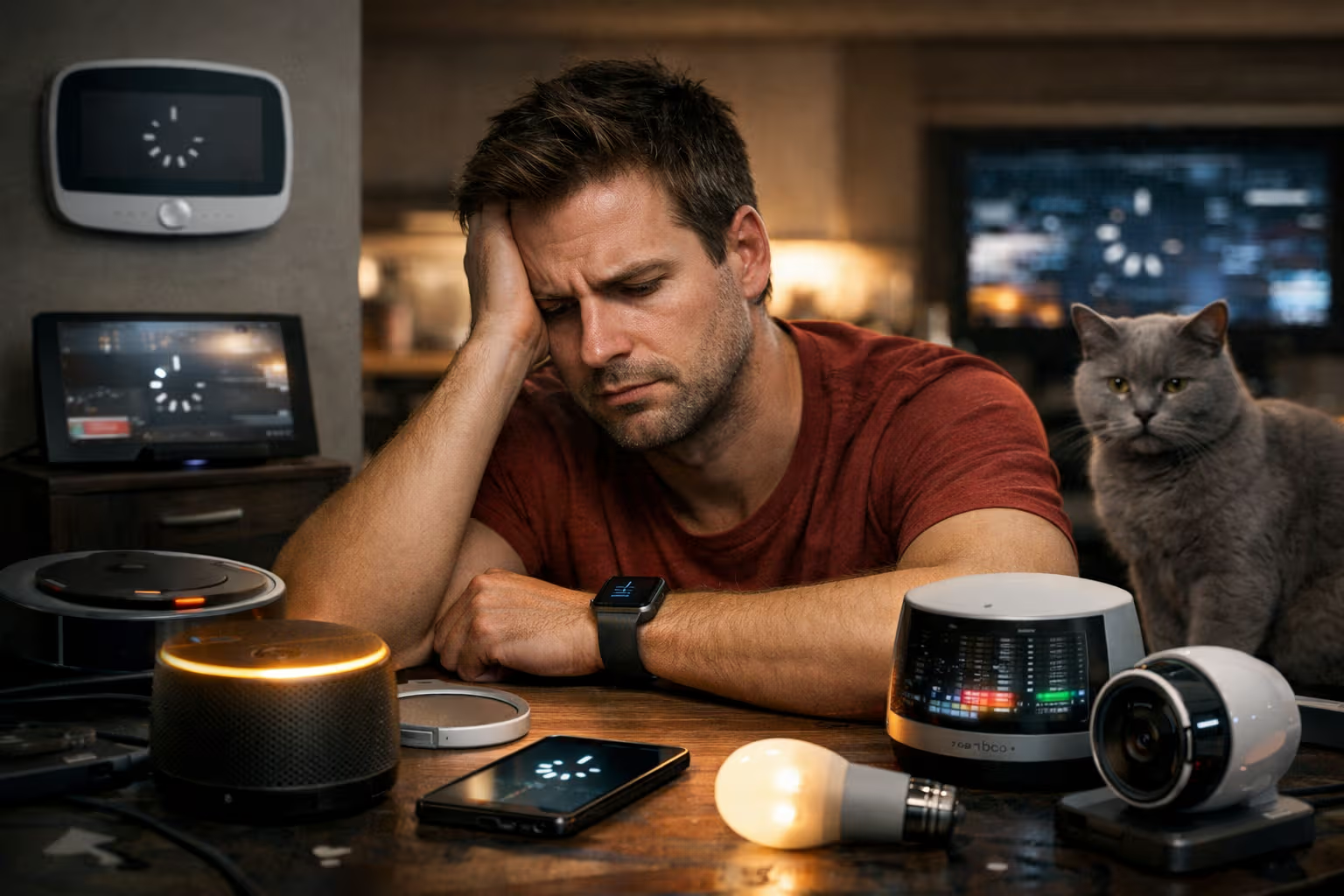
We’re not at collapse yet. But the trajectory is concerning. Every year, the fake content proportion grows. Every year, detecting fakes gets harder as AI improves. Every year, users become more cynical about online information.
The Skill Erosion Angle
Here’s where this connects to automation and skill development. The ability to evaluate information quality is itself a skill. A skill that atrophies when you don’t practice it.
Users who outsourced judgment to “trusted” platforms now discover those platforms contain untrustworthy content. But years of passive consumption have left evaluation skills underdeveloped. They don’t know how to assess authenticity themselves.

The automation of trust—letting platforms decide what’s credible—worked until it didn’t. Now users need skills they never built because automation handled evaluation for them.
This is the automation complacency pattern applied to information consumption. The tool worked so well that humans stopped developing the capability to work without the tool. When the tool fails, humans can’t compensate.
Pixel doesn’t trust platforms. She evaluates everything personally. Food gets sniffed before eating. Strangers get assessed before approaching. New objects get investigated before ignoring. Her evaluation skills remain sharp through constant practice.
What Real Reviews Look Like
It’s worth describing positive examples, not just failures to avoid.

Real reviews show personality. The reviewer has quirks, preferences, biases. They acknowledge these. “I prefer heavier laptops, so take my weight comments with that in mind.” This self-awareness signals human judgment.
Real reviews include learning. The reviewer’s understanding changes during testing. “At first I thought the speakers were mediocre, but after adjusting the EQ settings I realized they’re actually quite capable.” This evolution indicates actual time spent with the product.
Real reviews contain digressions. The reviewer mentions something tangential but interesting. “The laptop reminded me of a ThinkPad I used in 2018—same satisfying keyboard click, different everything else.” These connections emerge from human memory, not algorithmic generation.

Real reviews have opinions. Not hedged statements designed to satisfy everyone. Actual takes that some readers will disagree with. “Honestly, at this price point, I’d rather have a thicker laptop with better cooling than this thin design that throttles under load.” Opinions create information; hedges don’t.
Real reviews mention failures. Not everything works. The reviewer tried something that didn’t succeed. “I wanted to use this as my main development machine, but the 16GB RAM ceiling made that impractical. It’s a great secondary laptop instead.” Acknowledging limitations shows honest assessment.
The Creator Incentive Problem
Why would anyone create genuine reviews when fake ones are cheaper?

The honest answer: for most creators, the incentive is eroding. The economics favor quantity over quality. Real testing takes time; fake reviews take seconds. Real expertise develops over years; AI deploys instantly.
Some creators persist anyway. They care about the work. They have audiences that value authenticity. They’ve built reputations worth maintaining. But they’re competing against an ocean of synthetic content that costs nothing to produce.
The survivors will likely be those with direct audience relationships—newsletter subscribers, YouTube followers, Podcast listeners who seek out specific creators. Platform-dependent discovery favors whoever games the platform best. Direct relationships favor whoever earns trust best.

This creates a divergence. Mass-market product reviews become increasingly synthetic. Niche reviews for dedicated audiences remain human. The middle disappears.
For consumers, this means changing information-seeking behavior. General searches return garbage. Seeking specific trusted sources returns value. The skill isn’t just evaluating content—it’s knowing where to look in the first place.
Generative Engine Optimization
This topic presents ironic challenges for AI-driven search and summarization. The very systems that surface information for users are increasingly contaminated by synthetic content those users are trying to avoid.
When you ask an AI assistant for product recommendations, its knowledge may include synthetic reviews from training data. The AI doesn’t distinguish real from fake—it learned from both. Its recommendations might reflect patterns in AI-generated content rather than patterns in genuine user experience.

Human judgment matters here because humans can trace provenance in ways current AI cannot. You can ask: “Where did this opinion come from? What testing supported it? Who is the author and what’s their history?” AI systems absorb information without tracking these questions.
The meta-skill emerging from this landscape is skepticism about information sources regardless of presentation format. Whether reading a blog, watching a video, or querying an AI—asking “How do I know this reflects reality?” becomes essential.
As AI mediates more information access, the importance of evaluating that mediation increases. Trusting AI summaries without questioning underlying sources is automation complacency applied to knowledge itself.

Readers who understand synthetic content contamination can ask better questions. Instead of “what’s the best laptop stand,” they might ask “who has actually tested laptop stands and what did they find?” The second question directs toward sources rather than accepting aggregated conclusions.
Building Detection Into Habits
The ten-second test works best when it becomes automatic. Not something you consciously apply, but something you do naturally while reading.
Start with high-stakes domains. Product reviews where you’re considering purchase. News articles informing your opinions. Health information affecting your choices. Apply the test deliberately until it becomes habit.

Extend to lower-stakes domains. The test takes seconds. Even for casual reading, the habit of evaluating authenticity keeps skills sharp.
Notice patterns over time. Which sources consistently pass the test? Which consistently fail? Build mental models of trustworthiness that guide future information seeking.
Share your evaluations. When you spot fake content, note it. When you find genuine sources, recommend them. Your assessments help others navigate the same contaminated environment.
The Platform Responsibility Question
Should platforms bear responsibility for synthetic content? The question divides opinion.

Arguments for platform responsibility: Platforms profit from content. They have resources to detect fakes. Their algorithms determine what users see. Allowing their systems to surface synthetic content as if it were genuine harms users who trust the platform.
Arguments against platform responsibility: Platforms can’t verify everything at scale. Detection is imperfect. Overcorrection removes legitimate content. Responsibility should rest with content creators, not distributors.
The reality: platforms will do what economics and regulation require. Absent stronger incentives, synthetic content will continue proliferating because it’s cheap and drives engagement.

Users can’t wait for platform solutions. Building personal detection skills provides protection regardless of what platforms do. If platforms eventually improve, the skills remain valuable. If platforms don’t improve, the skills become essential.
The Long View
The fake review problem will likely worsen before it improves. AI-generated content costs will continue falling. Detection will become harder as generation improves. The volume of synthetic content will grow.

Improvement requires either technical solutions (reliable detection at scale), economic solutions (incentive structures that reward authentic content), or regulatory solutions (legal consequences for undisclosed synthetic content). None of these are imminent.
In the meantime, individual skills provide the best protection. The ten-second test isn’t perfect. It won’t catch sophisticated fakes. But it catches most current fakes, and that’s valuable.
The skill of distinguishing real from synthetic experience becomes foundational. Like reading comprehension or numerical literacy, it’s a capability that underlies effective functioning in the information environment.

Pixel doesn’t read reviews. She evaluates products directly—sniffing, touching, testing. Her method doesn’t scale, but it’s reliable. Perhaps there’s a lesson in returning to direct evaluation when mediated information becomes untrustworthy.
Closing Thoughts
I still search for product reviews. I just approach them differently now.
I look for specific failures, not generic praise. I look for temporal anchoring, not eternal present tense. I look for personalities, not averaged opinions. I look for photos with clutter, not stock imagery perfection.
These checks take seconds. They don’t catch everything. But they catch enough to make online research useful again.
The fake review problem isn’t going away. The skills to navigate it aren’t optional. In an environment contaminated with synthetic content, the ability to identify authentic experience becomes precious.
Develop that ability now. Practice it regularly. Apply it broadly. In a world where AI can generate plausible-sounding content about anything, the human skill of recognizing genuine experience becomes irreplaceable.