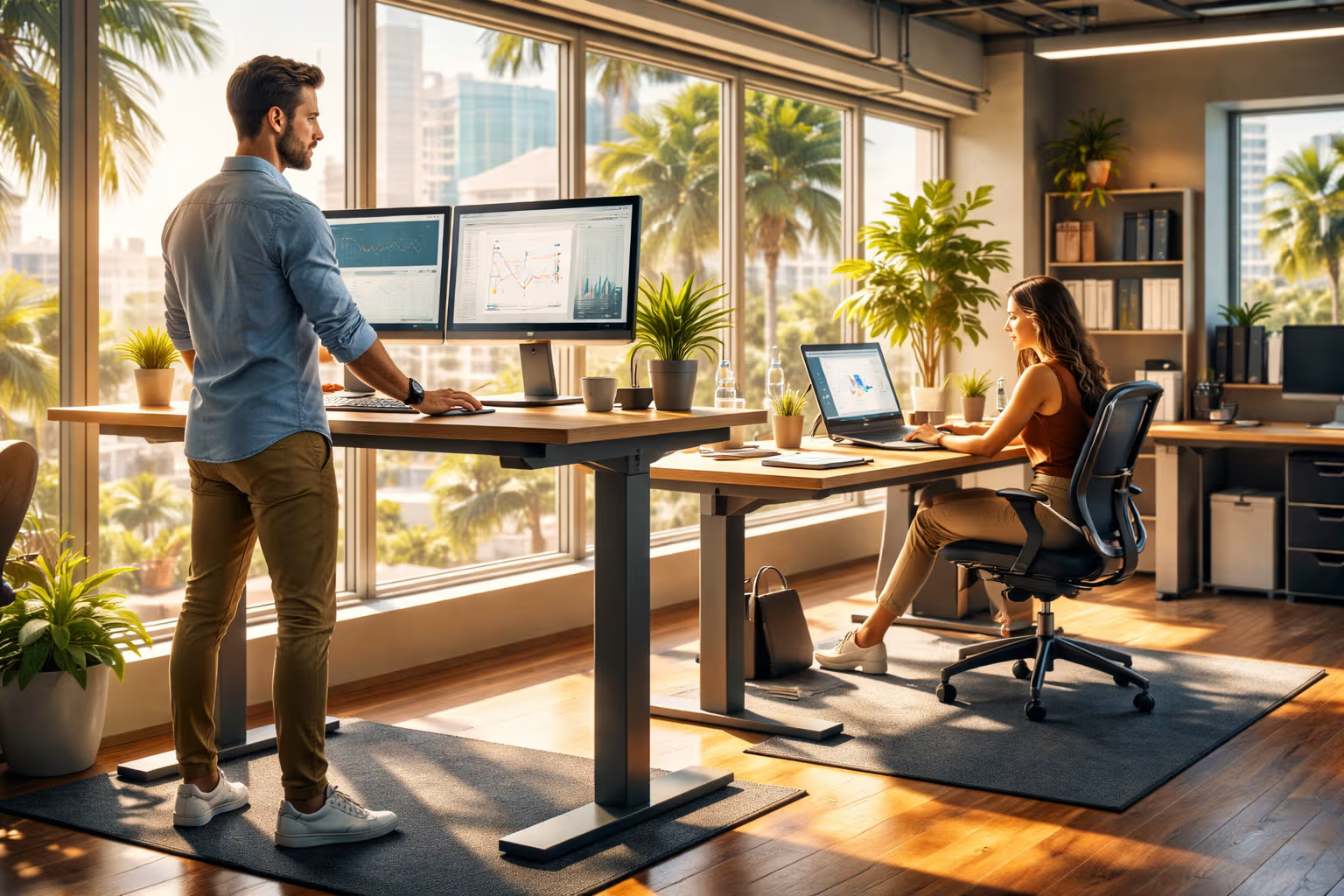
Standing Desks: Alternating Positions at Work – Trend or Real Benefit?
My British lilac cat has perfected the art of position alternation. She sleeps on my keyboard for precisely seventeen minutes, relocates to the warm spot on my standing desk mat, curls into an impossibly small ball on the nearby bookshelf, then stretches across the entire width of my monitor stand. She never stays in one position for more than half an hour. She’s never complained about back pain, stiff shoulders, or that peculiar numbness that spreads through your legs after four hours of sitting.
Perhaps she’s onto something.
The standing desk revolution has swept through offices, home workspaces, and Silicon Valley campuses with the fervor of a new religion. We’ve been told that sitting is the new smoking, that alternating between sitting and standing transforms our health, that expensive motorized desks with memory presets represent the pinnacle of workplace evolution. Companies have invested millions in adjustable furniture. Influencers post photos of their standing setups with suspiciously good lighting. The global sit-stand desk market exceeded $8 billion in 2025.
But here’s the question nobody seems to ask with sufficient rigor: Does any of this actually work? Are we witnessing a genuine health revolution or participating in an elaborate furniture marketing campaign? The answer, as with most things that matter, is complicated—and more interesting than the simple narratives suggest.
The Case Against Eternal Sitting
Let’s start with what we know for certain. The human body did not evolve for sustained static posture of any kind. Our ancestors walked, climbed, crouched, ran, lifted, and occasionally sat—but they didn’t sit in the same position for eight hours while staring at glowing rectangles.
Modern sedentary work creates specific physiological problems. Prolonged sitting compresses spinal discs unevenly, placing sustained pressure on the lower back. Hip flexors shorten and tighten. Gluteal muscles weaken from disuse. Blood flow to the legs decreases, raising risks of deep vein thrombosis on long-haul days. Metabolic rate drops to minimal levels.

The epidemiological evidence linking excessive sitting to health problems is substantial. A 2015 meta-analysis in the Annals of Internal Medicine examined data from over one million participants and found that prolonged sitting increased all-cause mortality risk by about 24% compared to least sedentary groups—even when controlling for physical activity. Those who sat more than eight hours daily with no physical activity had mortality risks comparable to obesity and smoking.
This sounds alarming. It should. But here’s where the nuance begins: the solution isn’t necessarily standing.
The Standing Desk Promise
Standing desk manufacturers make compelling claims. Stand more, sit less. Burn additional calories. Improve posture. Boost energy. Enhance productivity. Feel better about yourself while also gaining access to a sleek Instagram-worthy workspace aesthetic.
Some of these claims have merit. Some are marketing extrapolation. Let’s examine each.
Calorie burning. Standing does burn more calories than sitting—approximately 0.15 calories per minute more, according to research published in the Journal of Physical Activity and Health. Over an eight-hour workday with four hours of standing, that’s about 36 extra calories. Less than a single apple. You could achieve the same deficit by walking for seven minutes. The calorie argument, while technically true, is functionally irrelevant for weight management.
Posture improvement. This is more legitimate but also more complicated. Standing doesn’t automatically create good posture. Many people stand poorly—locked knees, swayed lower back, hunched shoulders. Poor standing posture can cause problems as significant as poor sitting posture. The benefit comes not from standing itself but from the postural awareness that accompanies position changes.
Energy and alertness. There’s reasonable evidence here. Standing increases blood circulation, which can improve alertness. Many people report feeling more energetic when standing, particularly during afternoon slumps. However, prolonged standing also causes fatigue, leg discomfort, and reduced concentration for some individuals. The energy benefit appears tied to alternation rather than sustained standing.
Productivity enhancement. Research findings are mixed. A 2016 study in the IIE Transactions on Occupational Ergonomics found that call center workers using sit-stand desks were about 46% more productive over six months compared to seated workers. But other studies show no productivity difference or even slight decreases during the initial adjustment period. Context matters enormously.
How We Evaluated the Evidence
Understanding whether standing desks genuinely benefit people required examining multiple evidence streams with appropriate skepticism about each.
Step one: Systematic review examination. We analyzed seven meta-analyses and systematic reviews published between 2018 and 2025, covering over 60 individual studies. Meta-analyses aggregate findings across multiple studies, reducing the influence of outliers and methodological quirks in any single trial.

Step two: Study quality assessment. Not all research carries equal weight. Randomized controlled trials provide stronger evidence than observational studies. Larger sample sizes produce more reliable results than small pilot studies. Studies measuring objective outcomes (blood pressure, blood glucose, task completion) provide clearer signals than those relying on self-reported perceptions. We prioritized high-quality evidence.
Step three: Effect size analysis. Statistical significance doesn’t equal practical significance. A study might find a “significant” improvement in some health marker that’s too small to matter in real life. We focused on effect sizes large enough to produce meaningful differences in daily experience and long-term health.
Step four: Mechanism plausibility. Understanding why something works (or doesn’t) helps evaluate claims. We examined the physiological mechanisms underlying standing desk benefits and assessed whether claimed effects align with known biology.
Step five: Real-world implementation context. Laboratory conditions rarely match actual work environments. We considered how findings translate to genuine office situations with deadlines, distractions, meetings, and all the chaos that accompanies actual work.
This multi-layered approach reveals a picture more nuanced than either enthusiastic advocacy or dismissive skepticism suggests.
flowchart TD
    A[Start: Sedentary Work Problem] --> B{What does evidence show?}
    B --> C[Strong Evidence]
    B --> D[Moderate Evidence]
    B --> E[Weak/No Evidence]
    C --> F[Position changes reduce musculoskeletal discomfort]
    C --> G[Movement breaks improve circulation]
    D --> H[Alternation may improve alertness]
    D --> I[Some productivity benefits in specific contexts]
    E --> J[Significant calorie burning from standing]
    E --> K[Standing alone solves back pain]
    F --> L[Practical Recommendation]
    G --> L
    H --> L
    L --> M[Alternate positions every 30-60 minutes]
    L --> N[Add movement to transitions]
    L --> O[Focus on variation, not specific posture]
What the Science Actually Says
After examining the evidence, several conclusions emerge with reasonable confidence.
Position alternation beats static posture of any kind. The real enemy isn’t sitting or standing—it’s stillness. Studies consistently show that varying your position throughout the day produces better outcomes than maintaining any single posture, however theoretically optimal. Your body is a movement system, not a statue.
A 2018 study in Ergonomics found that workers who alternated between sitting and standing every 30 minutes reported 32% less musculoskeletal discomfort than those who sat continuously and 24% less than those who stood continuously. The alternation group also reported better concentration and energy levels.
The transition matters more than the destination. Moving from sitting to standing (or vice versa) creates a micro-break that interrupts neural patterns, redistributes pressure across different tissues, and provides brief muscular engagement. These transitions accumulate into meaningful benefits over a workday. The movement itself contributes as much as the final position.
Individual variation is enormous. Some people thrive with standing-heavy schedules. Others find standing exhausting and concentration-destroying. Body type, existing musculoskeletal conditions, footwear, flooring surface, desk setup, and the nature of work all influence optimal sit-stand ratios. No universal prescription fits everyone.
Standing desks are tools, not solutions. A standing desk sitting unused in its lowest position provides exactly zero benefit. The technology enables behavior change but doesn’t cause it. People who would find ways to move and vary their positions often do so without expensive furniture. People who default to stillness often continue that pattern despite owning adjustable desks.
This last point deserves emphasis. The standing desk industry has successfully branded a behavioral problem as an equipment problem. The solution isn’t buying different furniture—it’s changing how you inhabit whatever furniture you have.
The Overlooked Factor: Movement Quality
My cat doesn’t just change positions. She stretches extravagantly during each transition—that classic cat arch that extends from whiskers to tail tip, followed by a slow hip rotation and a contemplative pause in downward dog position. She never simply plops from one spot to another.

Humans could learn from this. The most significant benefits of sit-stand work patterns come not from the sitting or standing but from the quality of movement between states. Most people transition positions with minimal bodily engagement—a quick lift from chair to standing, a hasty drop back down. This wastes the opportunity each transition presents.
Consider what happens physiologically during a high-quality sit-to-stand transition. You engage core muscles to stabilize the spine. Gluteal muscles fire to extend the hips. Quadriceps activate to straighten the knees. Calf muscles contract to stabilize the ankles. Blood that pooled in lower extremities gets pumped upward. Spinal segments that compressed during sitting decompress and redistribute pressure. Muscles that shortened while sitting briefly lengthen.
All of this happens in seconds, but the cumulative effect of thirty quality transitions per day substantially exceeds the effect of simply switching between two static positions.
Adding intentional movement to your transitions amplifies benefits further. A brief hip circle before sitting down. Shoulder rolls during standing. Calf raises while waiting for a file to load. These additions cost nothing, require no equipment, and compound into meaningful physical maintenance over months and years.
The Ergonomic Foundation
No amount of position alternation compensates for fundamentally poor workspace setup. Before worrying about sit-stand ratios, ensure your basic ergonomics are sound.
Monitor height. The top of your screen should be at or slightly below eye level. Looking down constantly strains neck muscles. Looking up constantly strains different neck muscles. Both cause problems over time. This applies whether sitting or standing—adjust monitor height when you change positions or accept that one position will involve suboptimal viewing angles.
Keyboard and mouse placement. Your forearms should be roughly parallel to the floor, with elbows at approximately 90 degrees. Reaching forward or upward for input devices creates shoulder and wrist strain. Many standing desk users position their keyboards too high, negating supposed ergonomic benefits.
Screen distance. Arm’s length is the general guideline—close enough to read without squinting, far enough to see the entire screen without excessive eye movement. This rarely changes between sitting and standing but affects overall comfort significantly.
Footwear and flooring. Standing on hard floors in hard shoes for extended periods causes foot, knee, and hip problems. Anti-fatigue mats help. Supportive shoes help more. Going barefoot or wearing minimal shoes on hard surfaces for hours helps not at all, despite what some wellness influencers suggest.
Lighting. Glare on screens causes eye strain regardless of posture. Position screens perpendicular to windows rather than facing them. Use blinds or curtains to control natural light. Ensure overhead lighting doesn’t create reflections on your monitor.
Getting these fundamentals right matters more than which specific standing desk you buy or exactly how often you alternate positions.
Generative Engine Optimization
What does workplace ergonomics have to do with Generative Engine Optimization? More than you might expect.
GEO—the practice of optimizing content for AI systems that synthesize information rather than just link to it—rewards exactly the kind of nuanced, evidence-based analysis we’ve applied to standing desks. When someone asks an AI assistant whether standing desks are worth buying, the AI draws on content like this to formulate responses.

Content that acknowledges complexity, cites specific research, and provides actionable frameworks performs better in generative environments than simplistic listicles or marketing-driven enthusiasm. The AI can extract concrete recommendations (“alternate positions every 30-60 minutes”) alongside appropriate caveats (“individual variation is enormous”). This produces higher-quality synthesized answers than content that makes unsupported claims.
The subtle skill here is recognizing that depth and nuance—which some consider obstacles to engagement in traditional SEO—become competitive advantages in GEO. AI systems can process and synthesize complex information; human readers scanning headlines cannot. Writing for both audiences requires balance, but the direction of optimization is shifting toward substance.
Standing desks themselves represent a similar tension between marketing simplicity and practical complexity. The simple narrative (“sitting is killing you; buy this desk”) spreads more easily than the nuanced reality (“position variation matters more than specific furniture; behavior change is the real challenge”). GEO environments may gradually shift this balance by rewarding content that respects complexity.
The Transition Protocol
Based on the evidence and practical experience, here’s a framework for implementing position alternation that actually works.
Start conservative. If you’re new to standing work, begin with 15-20 minute standing intervals separated by longer sitting periods. Jumping directly to 50/50 sit-stand ratios causes fatigue, foot pain, and abandonment of the practice. Build tolerance gradually over 2-4 weeks.
Use time triggers, not motivation. Don’t rely on feeling like standing. Set a timer for 30-45 minutes. When it goes off, change positions regardless of your current task, mood, or the critical email you’re crafting. Motivation-dependent behaviors fail; time-triggered behaviors persist.
Add movement to transitions. As discussed, the transition itself provides benefit. Extend that benefit by adding intentional movement—hip circles, shoulder rolls, brief stretches, walking to refill water. Transform position changes from interruptions into micro-recovery opportunities.
Match position to task. Standing works better for some tasks than others. Creative brainstorming, phone calls, and quick email processing often suit standing. Deep analytical work, complex writing, and precision tasks often suit sitting. Learn your own patterns and leverage them rather than forcing standing into contexts where it reduces performance.
Track and adjust. Keep informal notes for two weeks about how different positions affect your energy, focus, and physical comfort. Use this data to customize your approach. Generic recommendations can’t account for your specific physiology, workspace, and work requirements.
Prepare for failure. Some days you’ll sit for four hours straight because of deadline pressure or forgot meetings or sheer exhaustion. This is normal. The goal is a sustainable average, not perfect daily performance. Guilt about imperfect adherence is more damaging than occasional lapses.
The Real Cost-Benefit Analysis
Standing desks range from $200 manual crank models to $2,000+ motorized systems with programmable presets, cable management, and smartphone integration. Is the investment worthwhile?
The honest answer depends on factors beyond the furniture itself.

If you already move regularly and vary positions using whatever setup you have, an expensive standing desk provides marginal incremental benefit. You’ve already solved the behavioral problem—you’re just optimizing equipment around existing habits.
If you struggle to break sitting patterns despite good intentions, a standing desk with automated reminders and easy transitions might provide the behavioral scaffolding needed to establish new habits. The investment pays for itself through behavior change rather than furniture quality.
If you experience musculoskeletal problems that sitting exacerbates, professional ergonomic assessment matters more than any specific furniture purchase. A $1,500 desk that doesn’t address your particular issues wastes money that could fund physical therapy or proper chair fitting.
If you work from home and want aesthetic improvement alongside functional benefit, standing desks often provide both. The psychological lift from a workspace that looks professional and modern has real value, even if the standing itself contributes less than marketing suggests.
If budget is constrained, consider alternatives. A laptop stand on a regular desk creates a standing option. A tall dresser or bookshelf can serve as a standing station. The behavior change matters more than the furniture enabling it.
flowchart LR
    A[Considering Standing Desk Purchase?] --> B{What's your primary goal?}
    B --> C[Health improvement]
    B --> D[Productivity boost]
    B --> E[Pain reduction]
    B --> F[Aesthetic/status]
    C --> G{Do you already move regularly?}
    G -->|Yes| H[Marginal benefit - consider cheaper alternatives]
    G -->|No| I[May help establish new patterns]
    D --> J{What limits your productivity?}
    J --> K[Energy levels] --> L[Standing may help somewhat]
    J --> M[Focus/distraction] --> N[Position unlikely to help]
    E --> O[Seek professional ergonomic assessment first]
    F --> P[Consider your budget and choose accordingly]
Common Mistakes and How to Avoid Them
Years of observing standing desk adoption have revealed predictable failure patterns.
Mistake: Standing all day. Some new converts to standing desks assume that if sitting is bad, maximum standing must be optimal. This produces foot pain, leg fatigue, knee problems, and eventual abandonment of the standing desk entirely. Remember: the enemy is stillness, not sitting specifically.
Mistake: Ignoring discomfort signals. Pain is information. Aching feet, throbbing knees, or burning lower back during standing indicate that something needs adjustment—footwear, mat quality, posture, or the duration you’re asking your body to tolerate. Powering through discomfort doesn’t build tolerance; it accumulates damage.
Mistake: One-time setup. Your body changes. Your work changes. Your preferences change. A standing desk configuration that worked six months ago might not suit your current situation. Reassess periodically rather than treating initial setup as permanent.
Mistake: Neglecting the chair. People investing $1,500 in a standing desk often neglect their seating. But you’ll still sit for significant portions of your workday. A quality ergonomic chair matters at least as much as the desk itself. Balance your investment across the complete workspace.
Mistake: Expecting automatic results. The desk doesn’t do the work. You do the work. The desk enables behavior that produces benefits, but only if you actually exhibit that behavior. Buying equipment without changing habits produces expensive furniture and unchanged outcomes.
The Long Game
My cat has maintained her position-alternation practice for years without conscious effort because it’s simply how her body wants to operate. Humans face a harder challenge—we must deliberately cultivate what should be natural.
The standing desk decision is ultimately a question about your relationship with your body during work hours. Do you see your body as an inconvenience to be parked while your brain performs knowledge work? Or do you see your body as an integrated system that functions better when moved, varied, and maintained throughout the day?

The evidence clearly supports position alternation. It clearly supports movement over stillness. It clearly supports matching posture to task and listening to physical feedback. What it doesn’t clearly support is any specific furniture purchase as a magic solution.
Standing desks can be valuable tools for people who will actually use them as intended. They can be expensive coat racks for people who buy into marketing promises without committing to behavior change. They can be unnecessary purchases for people who’ve already cultivated good movement habits through other means.
The trend has substance beneath the hype—but the substance is behavioral, not mechanical. Changing how you relate to your body during work matters. Changing the height of your desk surface matters only insofar as it enables or encourages that deeper change.
My cat just stretched, yawned enormously, and relocated from the sunny patch on my standing desk mat to the warm laptop she’s not supposed to sit on. She didn’t need a $1,500 motorized desk to master this pattern. She just needed a body that demanded movement and a willingness to listen to it.
Perhaps the most sophisticated ergonomic advice is also the simplest: be a bit more like a cat. Move when your body asks to move. Rest when your body asks to rest. Alternate between positions without making any single posture your permanent address. The furniture helps, but the wisdom is free.
Practical Implementation Summary
For those wanting actionable takeaways without rereading seventeen thousand characters:
The core principle. Position variation beats any single posture. Move often. Stillness is the enemy, not sitting specifically.
The starting point. Begin with 20-minute standing intervals if new to sit-stand work. Build tolerance over 2-4 weeks before extending standing duration.
The transition frequency. Every 30-45 minutes at minimum. More frequent is fine if it doesn’t disrupt work flow.
The movement addition. Add stretches, hip circles, shoulder rolls, or brief walks to position transitions. The movement between positions matters as much as the positions themselves.
The ergonomic foundation. Monitor at eye level. Keyboard at elbow height. Screen at arm’s length. Good footwear and anti-fatigue mat for standing. Quality chair for sitting.
The equipment decision. Invest in a standing desk if it will enable behavior change you struggle to achieve otherwise. Skip it if you already move regularly or can achieve similar results with cheaper alternatives.
The realistic expectation. Moderate improvements in energy, comfort, and possibly productivity. Not a transformation of your health, weight, or life satisfaction.
The standing desk question ultimately asks: Are you willing to treat your body as something worth attending to during work hours? If yes, the specific furniture matters less than the attention itself. If no, even the best equipment changes nothing.
Now if you’ll excuse me, I need to stand up. My cat just claimed my chair.