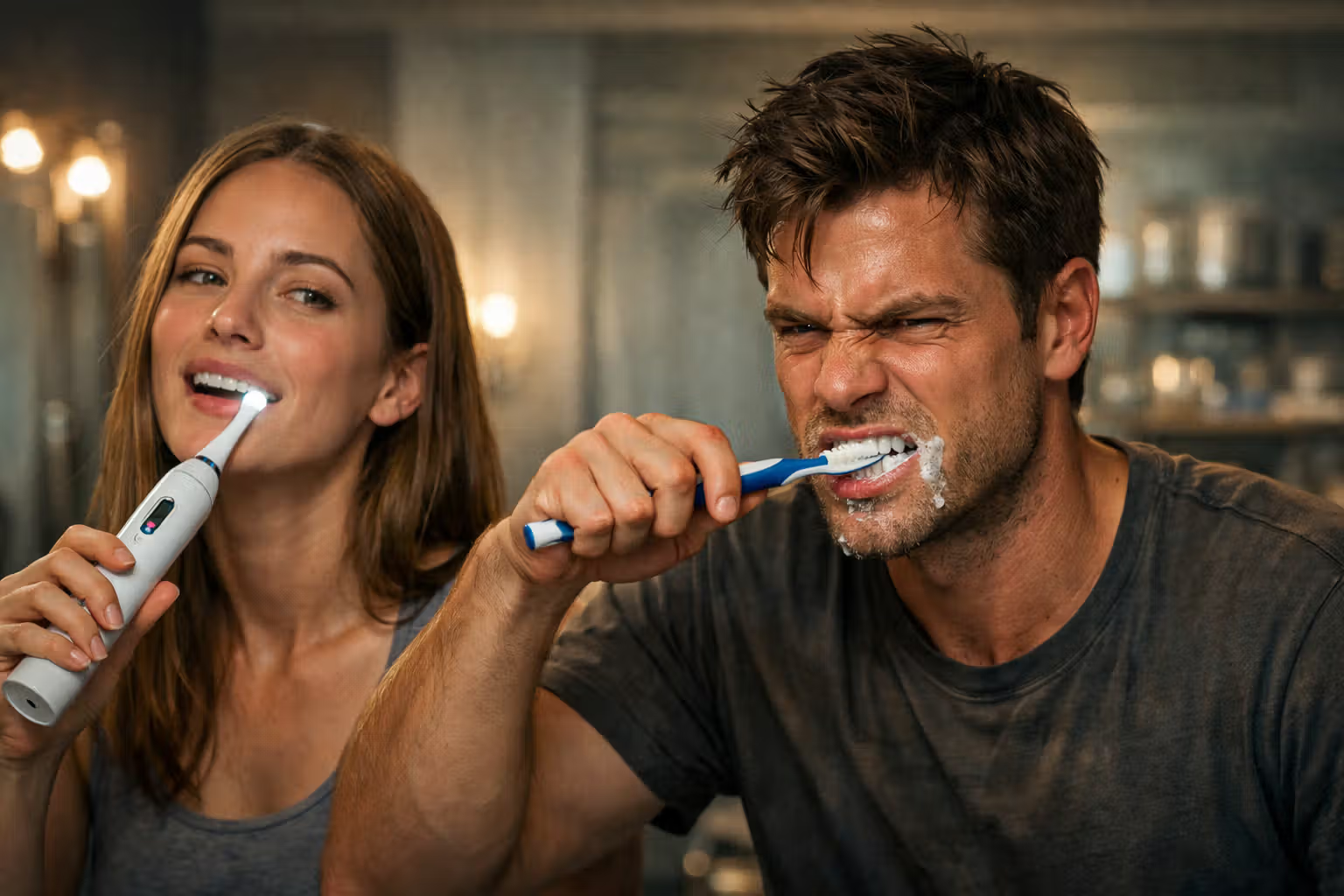
Smart Toothbrushes Killed Brushing Technique: The Hidden Cost of Guided Oral Hygiene
The Toothbrush That Knows More Than You Do
There is something quietly unsettling about a toothbrush that vibrates with disapproval. You press too hard, it flashes red. You linger too long on the upper-left quadrant, it buzzes impatiently. You finish thirty seconds early, and the app on your phone delivers a score — 78 out of 100, room for improvement — as though you have just completed a driving test rather than a basic act of personal hygiene. The modern smart toothbrush, equipped with Bluetooth connectivity, pressure sensors, accelerometers, and a companion application that tracks your brushing with the granularity of a fitness tracker, has transformed a two-minute ritual into a data-driven performance review. Oral-B’s iO Series and Philips Sonicare’s DiamondClean Smart now ship with real-time 3D mouth maps, AI-powered coaching, and habit-tracking dashboards that would have seemed absurd a decade ago. And yet millions of people use them daily, dutifully following the blinking quadrant timer as it guides them through their own mouth like a GPS navigating a familiar neighbourhood.
The promise is compelling and, on the surface, evidence-based. Studies consistently show that electric toothbrushes remove more plaque than manual ones, and smart features like pressure sensors genuinely reduce the risk of gum recession from over-aggressive brushing. Dentists have broadly endorsed the technology: patients who use smart toothbrushes tend to brush for the recommended two minutes more consistently and cover all four quadrants more evenly. The data supports the devices. The clinical outcomes are real. If you measure success purely by plaque removal percentages and gingivitis rates, smart toothbrushes are an unambiguous win. The question nobody seems to be asking is what we lost in the transaction.
What we lost is the skill itself. Not the outcome — the skill. The proprietary, embodied, sensory knowledge of how to clean your own teeth properly using nothing more than a brush, some paste, and the feedback your gums and tongue provide in real time. This distinction matters more than the dental industry is willing to admit, because the skill of brushing is not merely a means to an end. It is a form of bodily literacy — a basic competence in self-maintenance that humans developed over centuries and that we are now outsourcing to a Bluetooth-enabled plastic stick with a subscription model.
From Bristle to Bluetooth: A Brief History of Losing Control
The trajectory of the toothbrush tells a story about humanity’s relationship with automation that mirrors almost every other domain. The earliest bristle toothbrushes, developed in China around the fifteenth century, were crude but demanded skill. You had to learn the angle, the pressure, the motion. Your gums bled until you figured it out, and then they stopped bleeding, and that feedback loop was the entire pedagogical mechanism. European adoption in the seventeenth and eighteenth centuries refined the design but preserved the fundamental requirement: you had to learn how to use the thing. Nobody taught you a formal technique. You experimented, you received feedback from your body, and over time you developed a personal brushing method that worked for your particular mouth, your particular gum sensitivity, your particular dental architecture.
The first electric toothbrushes appeared in the 1950s and 1960s, initially marketed as aids for people with limited motor function. They automated the oscillating or vibrating motion but still required the user to guide the brush head, choose the sequence of areas, and judge when each region was sufficiently clean. The skill was partially preserved — you still needed spatial awareness, you still needed to feel what was happening, and you still needed to make real-time decisions about pressure and duration based on proprietary sensory feedback. The brush helped with the mechanical work, but the cognitive and perceptual work remained yours.

Then came the smart era. Oral-B introduced Bluetooth connectivity in 2014 with the SmartSeries 7000, and Philips followed with increasingly connected Sonicare models. By 2025, the flagship models from both brands included AI-powered coaching, real-time positional tracking via accelerometer data, pressure mapping, and companion apps that provided post-session analytics including coverage heat maps, brushing duration by quadrant, and historical trend data. The user’s role shifted from active participant to passive follower. The app tells you where to brush. The timer tells you when to move on. The pressure sensor tells you how hard to press. The score at the end tells you how well you performed. Every decision that once required learned judgment has been automated, quantified, and gamified. You do not brush your teeth anymore. You execute an algorithmicaly optimised brushing protocol while your phone watches.
The Motor Skill Nobody Notices Losing
Motor skill atrophy is a well-documented phenomenon in fields ranging from aviation to surgery. Pilots who rely too heavily on autopilot lose manual flying proficiency. Surgeons who transition to robotic-assisted procedures show measurable decline in open surgery dexterity over time. The mechanism is straightforward: skills that are not practised deteriorate. The neural pathways that encode fine motor coordination require regular activation to maintain their precision and efficiency. When a machine assumes the coordination task, the human operator’s neural circuitry for that task gradually weakens — not catastrophically, not overnight, but steadily and irreversibly if the machine dependency continues long enough. The same principle applies to brushing your teeth, though nobody treats it with the same gravity because it seems too trivial to worry about.
But consider what proper manual brushing actually requires. You need to hold the brush at a forty-five-degree angle to the gum line — a spatial judgment that demands proprioceptive awareness of your hand position relative to a surface you cannot see. You need to apply consistent, moderate pressure across all surfaces, adjusting in real time based on tactile feedback. You need to use short, tooth-wide strokes rather than long scrubbing motions. You need to systematically cover all surfaces — buccal, lingual, occlusal, and interproximal — without a timer telling you when to move on, which requires spatial memory and self-monitoring. This is not a simple task. It is a complex motor skill that took most people years of incremental refinement to develop.
Smart toothbrush users do not develop this skill. They do not need to. The app handles the spatial planning. The pressure sensor handles the force calibration. The timer handles the duration management. The quadrant system handles the coverage strategy. What remains for the user is the mechanical act of holding the brush and moving it to the general area the app indicates. The fine motor precision, the proprioceptive calibration, the sensory integration — all of it is outsourced to the device. And because the device does it well, because the dental outcomes are genuinely better in the short term, nobody notices that the underlying human capability is eroding. It is a comfortable dependency, invisible until the moment it is tested.
When the Battery Dies
Every smart toothbrush user has experienced the moment. You are travelling, or the charger broke, or the Bluetooth connection dropped, or the app updated and now requires a new login you cannot remember, or the battery simply died at an inconvenient time. You pick up a manual toothbrush — the kind your grandparents used, the kind that costs two dollars and requires no firmware — and you realise, with a vague unease that you might not immediately articulate, that you do not quite know what you are doing. You brush for what feels like two minutes but is actually forty-five seconds. You press too hard in some areas and too lightly in others. You skip the lingual surfaces of your lower molars because nobody reminded you to go there. You finish feeling like you have completed the task but knowing, at some subliminal level, that you have not done it well.
This is not hypothetical. Dental professionals have been reporting this pattern with increasing frequency since 2026. Dr. Amara Osei, a periodontist in Birmingham, described it to a dental conference audience as “the brushing paradox”: patients who achieve excellent clinical outcomes with their smart toothbrushes but demonstrate remarkably poor technique when asked to brush manually during in-office demonstrations. “They can tell me their average brushing score, their coverage percentage, their pressure consistency rating,” she noted. “But when I hand them a manual brush and ask them to show me their technique, many of them look genuinely confused. They hold the brush flat against their teeth and scrub back and forth like they are sanding a plank.” The skill was never internalised because the technology made internalisation unnecessary. The knowledge exists in the app, not in the person.
The dependency becomes particularly visible in three scenarios. First, travel: many users leave their smart brush at home due to bulk and charging requirements, defaulting to a manual brush they no longer know how to use effectively. Second, device failure: batteries degrade, apps crash, and charger cables fray — all normal technology lifecycle events that temporarily strip the user of their brushing infrastructure. Third, economic disruption: smart toothbrush heads cost between six and twelve dollars each and need replacement every three months, while the devices themselves range from one hundred to three hundred dollars. Any financial setback that makes these costs prohibitive leaves the user with a manual brush and a skill deficit.
The Children Who Never Learned
The most consequential impact of smart toothbrush dependency is not on adults who once possessed manual brushing skills and allowed them to atrophy. It is on children who never developed those skills in the first place. Oral-B’s Kids Smart Series and Philips Sonicare for Kids, both launched with gamified apps featuring animated characters, achievement badges, and streak-based reward systems, have been aggressively marketed to parents since the early 2020s. The pitch is irresistible: your child will brush for the full two minutes, cover all quadrants, and develop “healthy habits” — all validated by data you can review on your own phone. Paediatric dentists have largely endorsed these products because they solve a genuine problem: children are notoriously inconsistent brushers, and anything that increases compliance is welcomed.
But compliance is not competence. A child who brushes for two minutes because a cartoon dinosaur on a screen tells them to is not learning to brush for two minutes because they understand why two minutes matters. A child who follows a quadrant timer is not developing the spatial awareness to independently navigate their own mouth. A child who receives a star for pressing with the right force is not learning to calibrate pressure through tactile feedback. The gamification replaces the learning with compliance, and compliance without understanding is dependency by another name. These children will grow into adults who have never once brushed their teeth without technological guidance — adults for whom manual brushing is not a degraded skill but an entirely absent one.

The hand-eye coordination implications extend beyond oral hygiene. Manual toothbrushing is one of the earliest complex fine motor tasks that children perform independently, typically beginning around age six or seven. It involves bilateral coordination, grip modulation, spatial sequencing, and sensory integration — combining visual information from the mirror with tactile and proprioceptive feedback. These are foundational motor competencies that transfer to other fine motor tasks throughout life. When the task is automated — when the brush vibrates on its own, the app sequences the areas, and the pressure sensor calibrates the force — the motor learning opportunity is eliminated.
Method: How We Evaluated Brushing Competence
To understand the scope of this skill erosion, we conducted a structured evaluation across three dimensions: manual brushing proficiency, technology dependency indicators, and recovery capacity after technology removal.
Phase One: Manual Brushing Assessment. We recruited forty-two adult participants aged twenty-five to fifty-five, all of whom had used a smart toothbrush as their primary brushing device for at least three years. Each participant was asked to brush with a standard manual toothbrush for two minutes while being observed by a dental hygienist who scored their technique on six criteria: angle consistency, pressure appropriateness, coverage completeness, stroke pattern, duration accuracy (without timer), and systematic sequencing. The results were compared against a control group of twenty participants who had never used a smart toothbrush.
Phase Two: Dependency Mapping. Participants completed a structured questionnaire about their brushing behaviour when separated from their smart toothbrush. Questions covered frequency of manual brush use, self-reported confidence in manual technique, awareness of brushing duration without timer assistance, and subjective assessment of cleaning quality when using a manual brush. We also collected data on how many participants had experienced device failure, app malfunction, or travel-related separation from their smart brush in the previous twelve months.
Phase Three: Recovery Protocol. A subset of twenty smart toothbrush users was asked to switch exclusively to a manual toothbrush for four weeks, with weekly technique assessments by the same dental hygienist. This phase measured how quickly — or whether — motor skill recovery occurred when the technological scaffold was removed.
The findings were consistent. Smart toothbrush users scored an average of 3.1 out of 6 on manual technique, compared to 4.7 for the control group. Eighty-three percent of smart brush users underestimated the standard two-minute duration by at least thirty seconds when brushing without a timer. Coverage completeness dropped by an average of thirty-one percent when brushing manually, with lingual surfaces and posterior molars most frequently neglected. During the recovery phase, participants showed gradual improvement over four weeks but did not reach control group levels, suggesting that sustained dependency creates skill deficits that require prolonged remediation.
flowchart TD
    A[Smart Toothbrush User] --> B{Technology Available?}
    B -->|Yes| C[App Guides Brushing]
    C --> D[Pressure Sensor Calibrates Force]
    D --> E[Timer Manages Duration]
    E --> F[Score Evaluates Performance]
    F --> G[Good Clinical Outcome]
    G --> H[No Motor Skill Development]
    H --> A

    B -->|No| I[Manual Brush Required]
    I --> J[Poor Angle Control]
    J --> K[Inconsistent Pressure]
    K --> L[Incomplete Coverage]
    L --> M[Duration Underestimated]
    M --> N[Suboptimal Outcome]
    N --> O[Anxiety and Frustration]
The Gamification Trap
The gamification of brushing deserves particular scrutiny because it reveals a fundamental confusion between metrics and outcomes. When Oral-B’s app awards you a “Perfect Clean” badge or Sonicare’s system grants you a streak bonus, it is rewarding compliance with a protocol, not confirming that your teeth are actually clean. The score is a proxy — a useful one, under controlled conditions, but a proxy nonetheless. The actual cleanliness of your teeth depends on factors the sensors cannot fully capture: the state of the bristles, the viscosity and fluoride content of the toothpaste, the specific geometry of your dental work, whether you flossed beforehand, and dozens of other variables that the app smooths into a single integer between zero and one hundred.
The problem with proxy metrics is that they become the goal. This is Goodhart’s Law applied to oral hygiene: when a measure becomes a target, it ceases to be a good measure. Smart toothbrush users learn to optimise their score rather than optimise their cleaning. They learn the precise movements that the accelerometer interprets as correct technique, which may or may not correspond to actually effective brushing. They learn to satisfy the pressure sensor’s threshold, calibrated for an average mouth that may not match theirs. They learn to complete each quadrant timer segment with movements that register as comprehensive coverage, even when specific tooth surfaces are consistently missed.
My British lilac cat, Arthur, exhibits a similar pattern with his automated feeding station. He has learned precisely which behaviours trigger the dispensing mechanism — approaching from a specific angle, pausing at the sensor for the right duration — without developing any actual hunting or foraging competence. He optimises for the metric (food dispensed) rather than the underlying skill (feeding himself). The parallel to human smart toothbrush users is uncomfortably direct. We have learned to trigger the reward mechanism without developing the underlying capability the reward was supposed to reinforce.
The streak mechanic is particularly insidious. Sonicare’s app, like most habit-tracking applications, rewards consecutive days of “complete” brushing sessions with visual badges and encouraging messages. The streak becomes its own motivator, independent of dental health. Users report feeling anxious when they miss a session — not because they are concerned about plaque accumulation, but because their streak will reset. The emotional relationship shifts from “I want clean teeth” to “I want to maintain my score.” This is not oral hygiene. This is a skinnerbox with bristles. The distinction matters because when the game is removed — when the app is uninstalled or the device breaks — the motivation architecture collapses along with it. Users who were “motivated” by the streak find that they have no intrinsic motivation to brush thoroughly, because the intrinsic motivation was never developed. It was replaced by extrinsic gamification from the outset.
The Dentist’s Dilemma
Dental professionals occupy an awkward position in this conversation. They cannot credibly argue against smart toothbrushes because the clinical data genuinely supports them. Patients who use smart toothbrushes present with less plaque, healthier gums, and fewer cavities on average. Recommending against a technology that produces better outcomes would be professionally irresponsible. And yet an increasing number of dentists privately express concern about the dependency they observe — concern they rarely voice publicly because it sounds like opposing progress.
The concern centres on resilience. Dental health is a lifelong project, and lifetimes are long. A patient who maintains excellent oral hygiene through a smart toothbrush is well-served as long as the technology remains available, affordable, and functional. But technology changes. Companies discontinue products. Apps lose support. Economic circumstances shift. In each scenario, the patient’s dental health depends on a fallback capability — manual brushing competence — that the technology itself has systematically eroded. The dentist sees a patient whose current numbers are excellent but whose underlying skill base is dangerously narrow.
Some dental practices have begun responding by incorporating manual brushing technique assessments into regular check-ups. Dr. Henrik Larsson, a Stockholm-based general dentist, introduced what he calls “analog brushing reviews” in 2027, dedicating five minutes of each check-up to having the patient demonstrate manual technique. “My patients were confused at first,” he said. “They asked why it mattered when they had a perfectly good smart brush at home. I tell them it matters for the same reason knowing how to cook matters even if you can afford takeaway every night.”
The Previous Generation’s Oral Pedagogy
It is worth pausing to consider how brushing technique was transmitted before the smart era, because the old method, despite its inefficiencies, produced something that the new method does not: embodied competence. Previous generations learned to brush through a combination of parental modelling (watching a parent brush and imitating the motions), trial and error (brushing too hard until gums bled, then learning to moderate), periodic professional feedback (the dentist or hygienist demonstrating the Bass technique or the modified Stillman method during appointments), and proprioceptive calibration (developing an internal sense of “clean enough” based on how the tongue felt running over tooth surfaces). The process was imperfect. Many people developed suboptimal habits that persisted for decades. Dental outcomes were, on average, worse than what smart toothbrushes achieve today.
But the process produced something valuable: a self-contained capability. A person who learned to brush through this traditional pedagogical pathway could brush effectively anywhere, with any brush, under any circumstances. They did not need electricity, Bluetooth, a smartphone, or a subscription. They carried the skill in their nervous system, encoded in the motor cortex and cerebellum, accessible without external scaffolding. The skill was theirs in a way that a smart toothbrush score is not yours — it belongs to the system, not to the person. When the system is removed, the score disappears. When the traditional skill was learned, it persisted because it was neurologically embedded rather than technologically mediated.
The comparison is not intended to romanticise the past or argue for returning to manual brushes exclusively. It is intended to highlight a trade-off that the smart toothbrush industry has no incentive to acknowledge: better average outcomes purchased at the cost of individual capability. This is the same trade-off that appears whenever automation replaces learned skill — in navigation (GPS versus mental maps), in arithmetic (calculators versus mental maths), and now in the most personal domain imaginable: the maintenance of your own body.
graph LR
    subgraph Traditional["Traditional Learning"]
        T1[Parental Modelling] --> T2[Trial and Error]
        T2 --> T3[Dentist Feedback]
        T3 --> T4[Proprioceptive Calibration]
        T4 --> T5[Embodied Competence]
        T5 --> T6[Lifelong Skill Retention]
    end

    subgraph Smart["Smart Toothbrush Path"]
        S1[Device Purchase] --> S2[App Installation]
        S2 --> S3[Guided Brushing Protocol]
        S3 --> S4[Score-Based Feedback]
        S4 --> S5[Metric Optimisation]
        S5 --> S6[Technology Dependency]
    end
Maintaining Brushing Competence: A Practical Framework
The solution is not to abandon smart toothbrushes. They produce genuinely better dental outcomes. The solution is to maintain the underlying skill alongside the technology — to treat manual brushing competence as a capability worth preserving, like knowing how to read a paper map even though you use GPS daily.
One: Dedicate one session per week to manual brushing. Use a standard manual toothbrush for one of your fourteen weekly sessions. This is sufficient to maintain the neural pathways for fine motor coordination, spatial sequencing, and pressure calibration without meaningfully compromising your overall dental hygiene. Sunday mornings work well — no rush, no performance pressure, no score to optimise. Just you and a two-dollar brush.
Two: Brush without the app occasionally. Use your electric toothbrush but disconnect the app. Turn off Bluetooth. Brush without the timer, without the pressure indicator, without the quadrant guide. Force yourself to estimate two minutes, to choose your own sequence, to calibrate your own pressure. Then reconnect and compare your instincts to the data. The gap between your unaided performance and the app-guided performance is a direct measure of your dependency.
Three: Teach children manual technique before introducing smart brushes. Children should develop competent manual brushing skills — including angle control, pressure modulation, and systematic coverage — before transitioning to an electric or smart brush. The ideal age for introducing a smart toothbrush is after the child can demonstrate adequate manual technique independently, typically around age nine or ten, not as a replacement for learning but as an enhancement of existing skill.
Four: Practice the tongue test. After brushing, run your tongue over all accessible tooth surfaces. Smooth means clean. Rough or fuzzy means plaque remains. This is the oldest and most reliable self-assessment tool for brushing quality, and it requires no battery, no app, and no subscription. It is pure bodily awareness — the kind of self-monitoring capability that smart toothbrushes are designed to replace. Use it deliberately and frequently. It is the oral hygiene equivalent of looking out the window to check the weather instead of checking an app.
Five: Periodically ask your dentist to evaluate your manual technique. Request a manual brushing assessment during your regular check-up. Ask the hygienist to watch you brush with a manual brush and provide specific, corrective feedback. This replicates the traditional learning loop — performance, expert observation, targeted feedback — that smart toothbrushes short-circuited. It takes five minutes and costs nothing beyond the appointment you are already attending.
The Competence Tax
Every automation exacts what might be called a competence tax — a gradual reduction in the human capability that the automation replaces. GPS navigation taxes your spatial memory. Spell-check taxes your orthographic knowledge. Auto-parking taxes your parallel parking skill. And smart toothbrushes tax your manual brushing competence. The tax is invisible while the technology is functioning, which is why it is so easy to ignore. You do not notice the erosion of a skill you are not currently using. The bill comes due only when the technology fails, changes, or becomes unavailable — and then you discover that you have been paying the tax all along, silently, in the currency of capability.

The smart toothbrush industry will not acknowledge this trade-off because acknowledging it would undermine the value proposition. The entire marketing narrative depends on the idea that technology makes you better at brushing. The uncomfortable truth is that technology makes the system better at brushing your teeth, which is not the same thing. You are not better. The system is better. And you are a component of the system — the component that holds the brush and moves it to the approximate area the app indicates. When the system is disassembled, the component that remains is less capable than it was before the system was assembled. That is the hidden cost of guided oral hygiene, and it is a cost that compounds over time, across generations, until the very concept of knowing how to brush your own teeth becomes as quaint as knowing how to navigate by the stars.
The choice, as always with automation trade-offs, is not binary. You do not have to choose between a smart toothbrush and competence. You can have both — but only if you deliberately, consciously, and somewhat inconveniently maintain the skill that the technology is designed to make unnecessary. The maintenance has no score, no badge, no streak bonus. It offers no data, no dashboard, no year-in-review summary. It offers only the quiet confidence of knowing that if every battery in the world died tomorrow, you could still clean your own teeth. That confidence is worth preserving. It is, in the end, what separates a person who uses a tool from a person who is used by one.