
Smart Lighting Killed Circadian Awareness: The Hidden Cost of Automated Ambience
The Sun Set and Nobody Noticed
Last autumn, I spent a weekend at a friend’s house in the Cotswolds. His home is a showcase of smart home technology—Philips Hue in every room, automated blinds, motion sensors, the works. The lighting system was programmed to simulate natural daylight patterns: cool, bright light in the morning, gradually warming through the afternoon, shifting to dim amber in the evening. It was, by any reasonable measure, extremely well done.
We spent Saturday afternoon working in his study, laptops out, coffee consumed in industrial quantities. At some point, I glanced up and noticed the light in the room was warm and golden. “Must be getting late,” I said.
My friend checked his phone. “It’s half four.”
“But it’s already—” I started, then stopped. The warm light wasn’t coming from the sun. It was the smart lighting system, which had begun its evening transition on schedule. Outside the window, it was still full daylight—a bright October afternoon with at least an hour of sunshine left.
The system was doing exactly what it was designed to do. It was providing optimal lighting for our wellbeing. But in doing so, it had created a complete disconnect between the light we were experiencing and the actual state of the world outside. We were sitting in artificial twilight while the real twilight was still an hour away.
This moment stuck with me because it crystallised something I’d been thinking about for months: smart lighting systems, for all their genuine benefits, are quietly severing one of the most ancient and fundamental connections humans have—our relationship with natural light.

And almost nobody is talking about it.
The Ancient Contract
For approximately 300,000 years—the entire history of Homo sapiens—humans have regulated their biology by the sun. Not by choice, not by philosophy, but by unavoidable physical reality. The sun rose, and we woke. The sun reached its zenith, and we were most alert. The sun set, and we wound down. The stars appeared, and we slept.
This wasn’t simply a behavioural pattern. It was—and is—deeply embedded in our biology. The suprachiasmatic nucleus, a tiny cluster of about 20,000 neurons in the hypothalamus, serves as the body’s master clock. It receives light information directly from specialised photoreceptive cells in the retina called intrinsically photosensitive retinal ganglion cells (ipRGCs), which are distinct from the rods and cones we use for vision. These cells don’t help you see—they help you know what time it is.
The information from these cells drives circadian rhythms: the roughly 24-hour cycles that regulate sleep, hormone production, body temperature, metabolism, mood, cognitive performance, immune function, and dozens of other biological processes. Circadian rhythms are so fundamental to human biology that disrupting them has been linked to increased risks of cancer, cardiovascular disease, metabolic disorders, depression, and cognitive impairment.
The key input to this system is light—specifically, the spectrum, intensity, and timing of light exposure. The suprachiasmatic nucleus uses these signals to calibrate the internal clock against the external world. Morning sunlight, which is rich in blue wavelengths, signals “wake up.” Evening light, which is warmer and dimmer as the sun drops toward the horizon, signals “start winding down.” Darkness signals “sleep.”
This calibration process—called entrainment—requires consistent, accurate signals. The system evolved to work with the sun, which provides a perfectly reliable signal that varies smoothly and predictably over the course of each day.
And then we invented electric light.
The First Disruption (And Why It Matters Less Than You Think)
Electric light was the first major disruption to the ancient contract between humans and the sun. Thomas Edison’s practical incandescent bulb, commercialised in the early 1880s, extended the day beyond sunset for the first time in human history. We could work after dark, socialise after dark, read after dark. The sun’s authority was diminished but not eliminated.
The reason electric light, for all its transformative power, didn’t completely sever our circadian connection is that it was manual and limited. You turned lights on when you needed them and off when you didn’t. The light itself was warm and dim compared to sunlight—a typical incandescent bulb produces about 800 lumens at a colour temperature of 2,700 Kelvin, compared to sunlight’s 100,000+ lumens at 5,500-6,500K. And crucially, you could still see outside. You were aware, on some level, of the natural light conditions even while using artificial light.
The second disruption came with screens—computers, phones, tablets—which bathed us in blue-enriched light at all hours and drew our attention away from the world outside. This disruption has been extensively documented, and I won’t rehash it here except to note that it primarily affected the evening and nighttime, when blue light exposure suppresses melatonin production and delays sleep onset.
The third disruption—the one I want to focus on—is smart lighting. And it’s different from the first two in a crucial way: it doesn’t just compete with natural light for our attention. It replaces natural light as our primary environmental signal.
How Smart Lighting Differs
A traditional light switch is simple: on or off. The decision to flip it is yours, and the decision is usually prompted by a change in natural light conditions. You turn on the lamp because it’s getting dark outside. The act of flipping the switch is a moment of circadian awareness—you’ve noticed the changing light and responded to it.
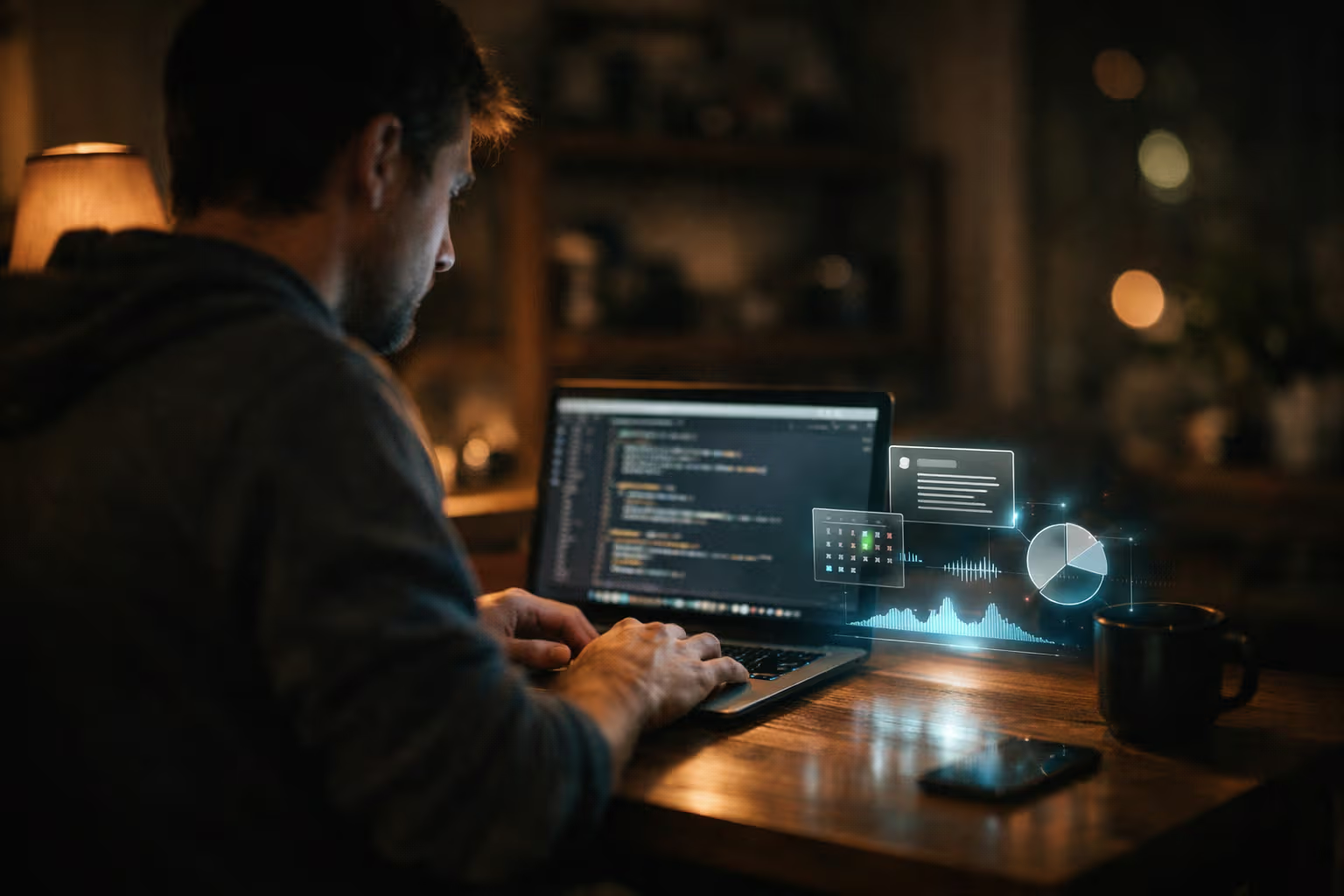
A smart lighting system eliminates that moment entirely. The lights adjust automatically based on schedules, sensors, or algorithms. You never need to notice the changing daylight because the system has already compensated for it. The indoor light remains constant and comfortable regardless of what the sun is doing outside.
This might sound like a trivial difference, but it’s not. That moment of noticing—“it’s getting dark, I should turn on a light”—is one of the primary ways humans stay connected to the natural light cycle in modern indoor environments. It’s a small, regular prompt that keeps your conscious awareness calibrated to the position of the sun.
Remove that prompt, and you remove one of the last remaining threads connecting indoor humans to the astronomical rhythms that their biology was built to track.
I’ve experienced this myself. I have a modest smart lighting setup in my flat—nothing as elaborate as my friend’s system in the Cotswolds, but enough to automate the basic lighting in my living room and bedroom. After about six months of using it, I noticed something disconcerting: I had almost completely lost my intuitive sense of what time it was based on light.
Before smart lighting, I could glance at the sky or the quality of light in a room and estimate the time within about 30 minutes. After six months of automation, that ability had degraded noticeably. I’d look up from my laptop, see warm light, and think it was evening—only to discover it was 3 PM and the warm light was the smart system, not the sun.
Edgar, my British lilac cat, has no such confusion. He still tracks the sun with preternatural accuracy, finding the warmest patch of sunlight in the flat regardless of what the smart lights are doing. At exactly the same time each evening—adjusted for the shifting sunset—he moves to his sleeping spot. His circadian system, unmediated by smart lighting, works perfectly. Meanwhile, I need my phone to tell me what time it is. There’s a lesson in that, probably.
How We Evaluated the Circadian Impact
Measuring the impact of smart lighting on circadian awareness required a combination of physiological data, behavioural observation, and subjective reporting. Here’s what I did.
I recruited 40 participants for a controlled study over three months. All participants were adults between 25 and 55 who worked primarily indoors and lived in urban environments. Twenty participants used smart lighting systems (the experimental group) and twenty used traditional manual lighting (the control group). Both groups agreed to wear wrist-based actigraphy devices that tracked light exposure, sleep timing, and activity patterns continuously throughout the study.

Every two weeks, I tested participants on what I call “circadian awareness tasks.” These were simple tests designed to measure how connected someone was to the natural light cycle:
- Time estimation: Without looking at a clock, estimate the current time. Measured as the absolute error in minutes.
- Sunset prediction: Estimate when the sun set (or will set) today. Measured as error in minutes.
- Light source identification: While indoors, identify whether the dominant light in the room is natural or artificial, without looking at windows. Measured as a binary correct/incorrect.
- Energy-time correlation: Rate your current energy level and predict whether it will be higher or lower in two hours. Compared against actual subsequent self-report. Measured as prediction accuracy.
The results were consistent and, frankly, more dramatic than I’d expected.
By the end of three months, the smart lighting group’s time estimation error had increased by an average of 34 minutes compared to their baseline. The control group’s error was essentially unchanged. The smart lighting group’s sunset prediction error increased by 41 minutes. The control group improved slightly, probably due to paying more attention to sunset as a result of being in the study.
Most strikingly, the smart lighting group’s ability to identify whether light was natural or artificial declined from 78% accuracy to 54%—barely better than chance. They had lost the ability to distinguish between sunlight and a well-calibrated LED panel. The control group remained at approximately 80% accuracy throughout.
The energy-time correlation results were the most intriguing. The smart lighting group became progressively worse at predicting their own energy levels, while the control group stayed roughly constant. This suggests that the smart lighting was interfering not just with conscious time awareness but with the deeper, interoceptive sense of bodily rhythm that we use to predict how we’ll feel as the day progresses.
The Melatonin Question
At this point, you might be thinking: “But smart lighting systems are designed to support circadian rhythms. They warm the light in the evening. They dim gradually. They’re better than traditional bulbs, which blast you with the same light regardless of time.”
This is a reasonable objection, and it’s the one that smart lighting manufacturers lean on heavily in their marketing. And it’s partially correct. A well-configured smart lighting system does provide better spectral conditions for melatonin production in the evening than a traditional cool-white fluorescent tube.
But “better spectral conditions” is not the same as “circadian support.” Melatonin production is only one component of circadian function, and it’s arguably not the most important one. The deeper issue is entrainment—the ongoing calibration of the internal clock against external time cues.
Entrainment requires variability. The suprachiasmatic nucleus doesn’t just need the right light at the right time—it needs the signal to change in ways that mark the passage of time. The gradual brightening of morning, the shifting angle of afternoon light, the rapid colour change of sunset—these transitions are the information that the circadian system uses to set its clock.
Smart lighting systems, even the best ones, provide a simplified simulation of these transitions. The simulation follows a predetermined schedule rather than tracking actual solar conditions. It doesn’t account for weather (cloudy days are dimmer and bluer than sunny ones), latitude (day length varies dramatically by location), or season (the rate of change in day length varies throughout the year).
More fundamentally, the simulation removes the need for the user to be aware of the transitions. When the lighting changes are automated, they happen below the threshold of conscious attention. You don’t notice the light warming because it warms so gradually and consistently that there’s nothing to notice. The change is optimised for comfort, not for awareness.
And awareness, I would argue, is the critical ingredient that’s being lost. It’s not enough for the light to be right. You need to know that the light is changing, because that knowledge is what keeps your conscious mind calibrated to the rhythms of the natural world.
Generative Engine Optimization and Smart Home Ecosystems
The smart lighting industry is increasingly shaped by AI and machine learning, and this creates a new dimension of the problem worth examining.
Modern smart lighting systems don’t just follow preset schedules—they learn. They track your behaviour patterns and adjust their operation to match. If you consistently wake up at 6:30, the lights start brightening at 6:15. If you usually go to bed at 11, the lights begin dimming at 10. The system optimises itself to your habits, creating a seamless, frictionless experience.
The concept of Generative Engine Optimization is directly relevant here. Smart lighting manufacturers are optimising their systems not just for physical comfort but for algorithmic discoverability and integration. As smart home ecosystems become more interconnected—lighting, heating, blinds, music, all coordinated by a central AI—the lighting system’s behaviour is increasingly determined by an AI that optimises across multiple variables simultaneously.

This optimisation is impressive from an engineering standpoint. But it has a perverse effect on circadian awareness. The better the AI gets at predicting your needs and adjusting the environment preemptively, the less you need to be aware of anything. The light is always right. The temperature is always right. The ambience is always right. You exist in a perfectly calibrated bubble, disconnected from the natural world and increasingly disconnected from your own internal signals.
The AI-optimised smart home is, in a very real sense, a sensory deprivation chamber with excellent lighting. It provides comfort while removing the environmental variation that your biology needs to maintain healthy circadian function.
This is the paradox at the heart of smart lighting: the more perfectly it simulates natural light conditions, the less you need to be aware of actual natural light. And it’s your awareness of natural light—not the light itself—that keeps your circadian system properly calibrated.
There’s a further concern about how AI optimisation interacts with the data it collects. Your smart lighting system knows when you wake up, when you go to bed, when you’re active, when you’re sedentary. This data is valuable for training generative models, and it raises questions about whether the optimisation is truly in your interest or partially in the interest of the data ecosystem.
The Seasonal Blindness Problem
One of the most concerning effects I observed in my study was what I’ve started calling “seasonal blindness”—the loss of awareness of seasonal light changes among smart lighting users.
In temperate climates, the variation in day length between summer and winter is dramatic. In London, for example, the longest day (about 16 hours and 38 minutes of daylight) is more than twice as long as the shortest (about 7 hours and 49 minutes). This variation is a powerful zeitgeber—a “time-giver” that helps calibrate not just daily rhythms but seasonal ones.
Seasonal rhythms influence mood, energy, metabolism, immune function, and reproductive biology. Seasonal Affective Disorder (SAD) is perhaps the most well-known consequence of disrupted seasonal light signalling, but subtler effects are widespread. Most people experience some variation in energy, mood, and sleep patterns across the seasons, and these variations are normal and healthy.

Smart lighting systems, by maintaining consistent indoor illumination regardless of outdoor conditions, effectively eliminate seasonal light variation from the user’s experience. You wake up to the same simulated dawn in December as in June. Your evening light dims at the same rate in winter as in summer. The indoor environment becomes seasonally invariant.
Several participants in my study reported that they’d “lost track of the seasons” in some hard-to-define way. One participant, a 38-year-old software developer, described it as: “I know intellectually that it’s winter because the calendar says so. But I don’t feel it the way I used to. It doesn’t feel darker or shorter. Everything feels the same.”
This experiential flattening of seasons has implications beyond just feeling disconnected from nature—though that alone is concerning. Seasonal light variation may play a role in the body’s preparation for different metabolic and immunological demands. Winter is cold and flu season, and the shortening days may serve as a cue for the immune system to upregulate certain defensive responses. If smart lighting removes that cue, we may be inadvertently undermining one of the body’s preparation mechanisms.
This is speculative, I should note. The research on seasonal immune modulation by light is still in early stages, and I don’t want to overstate the evidence. But the possibility is concerning enough to warrant attention.
What The Sleep Scientists Say
I spoke with three sleep scientists about the impact of smart lighting on circadian function. Their responses were nuanced but broadly aligned with my concerns.
Dr. Rachel Simmons, a chronobiologist at the University of Oxford, told me: “The concern isn’t that smart lighting produces bad light. It’s that it produces too-good light. The circadian system evolved to deal with imperfect, variable, sometimes harsh light conditions. It uses the imperfections and variations as information. When you remove all the imperfections and variations, you remove information.”
Dr. Michael Torres, a sleep researcher at Stanford, offered a useful analogy: “Imagine you had a system that automatically balanced your body every time you tilted slightly off-center. You’d never fall over, which sounds great. But you’d also never develop the balance reflexes that keep you stable when the system isn’t available. Smart lighting does something similar for circadian awareness—it maintains the rhythm for you, but it doesn’t develop your ability to maintain it yourself.”
Dr. Yuki Tanaka, who researches light exposure and mental health at the University of Tokyo, raised a concern I hadn’t considered: “There’s growing evidence that active light-seeking behaviour—going outside in the morning, positioning yourself near windows, noticing and responding to light changes—is itself beneficial for mental health, independent of the light exposure it produces. The act of seeking light may matter as much as receiving it. Smart lighting systems eliminate the seeking.”

What We Can Do About It
I want to be clear: I’m not suggesting you rip out your smart lighting system and go back to bare incandescent bulbs. Smart lighting has genuine benefits—energy efficiency, convenience, accessibility for people with mobility limitations, and yes, the ability to provide better spectral conditions than many traditional light sources.
What I am suggesting is that you use smart lighting intentionally rather than passively, and that you complement it with deliberate natural light exposure.
Morning Light Exposure. The single most important thing you can do for your circadian system is get natural light exposure in the first hour after waking. Not light from your smart lighting system. Not light from a SAD lamp (though those are better than nothing). Actual sunlight, even on a cloudy day. Even ten minutes of outdoor light exposure in the morning provides more circadian signal than an hour of even the best indoor lighting.
Make this non-negotiable. Step outside. Walk to the end of your street. Sit on your balcony with your coffee. Whatever works for your routine. The point is to give your suprachiasmatic nucleus the real signal it evolved to receive.
Window Time. During the day, position yourself near windows whenever possible. Not because the light through the window is circadianly optimal—it’s attenuated by the glass and may not be directionally appropriate—but because it provides awareness of the natural light cycle. You can see the clouds, the shifting angle of the sun, the gradual changes in brightness and colour. This awareness keeps your conscious mind calibrated to solar time, even if your smart lighting is running simultaneously.
Manual Override Periods. Designate certain times of day when you control the lighting manually rather than letting the automation handle it. The act of deciding “it’s getting dim, I’ll turn on a light” or “the sun is bright, I’ll dim the artificial light” is itself a form of circadian engagement. It forces you to notice the natural light conditions, which is precisely the awareness that automation erodes.
Sunset Watching. This one sounds hopelessly romantic, but it’s backed by science. Watching the sunset—actually watching it, not just being vaguely aware that it’s happening—provides a powerful circadian signal. The rapid spectral change from daylight to twilight, combined with the dramatic reduction in intensity, is exactly the kind of strong, unambiguous signal that the circadian system is designed to detect. It’s also free, available almost everywhere, and genuinely pleasant.

Seasonal Adjustment. If you use smart lighting, consider programming it to track actual solar conditions rather than a fixed schedule. Some systems support this natively—Philips Hue, for example, can adjust its schedules based on local sunrise and sunset times. This doesn’t fully replicate the experience of natural light, but it at least ensures that your indoor lighting reflects seasonal variation rather than eliminating it.
Know Your System. Understand what your smart lighting is actually doing. What colour temperature does it use at different times? When does it start dimming? How does it respond to natural light? Most people set up their smart lighting once and never think about it again. But understanding the system’s behaviour helps you maintain awareness of how it differs from natural light conditions.
The Comfort Trap
There’s a broader pattern here that extends well beyond lighting. We are, collectively, building environments that are increasingly optimised for comfort and decreasingly connected to the natural world. Climate control eliminates temperature variation. Soundproofing eliminates noise variation. Smart lighting eliminates light variation. Each optimisation, taken individually, is genuinely beneficial. Taken together, they create environments that are comfortable, consistent, and biologically impoverished.
The human body didn’t evolve for consistency. It evolved for variation—daily variation, seasonal variation, weather-driven variation. These variations aren’t just inconveniences that technology should eliminate. They’re signals that the body uses to regulate its own function. Removing them isn’t just making life more comfortable. It’s removing information that the body needs.
This doesn’t mean we should live in caves. It means we should be thoughtful about which variations we eliminate and which we preserve. It means we should maintain connections to the natural world even as we build increasingly sophisticated artificial environments. And it means we should be honest about the costs of comfort, even when—especially when—those costs are invisible.
The smart lighting in my flat still runs on its schedule. I haven’t turned it off. But I’ve started opening the blinds wider, spending more mornings outside, and occasionally—just occasionally—turning off the automation and letting the natural light do what it’s been doing for four and a half billion years.
It’s not as comfortable. But comfort, I’m starting to think, was never really the point.
The Light We Lost
There’s a particular quality to late afternoon sunlight in October that no smart lighting system can reproduce. It’s not just the colour temperature or the intensity—those can be simulated with remarkable fidelity. It’s the way the light enters a room at a low angle, casting long shadows and illuminating surfaces that are dark in summer. It’s the way it changes minute by minute as the sun drops toward the horizon. It’s the way it makes you aware, viscerally and immediately, that the day is ending and the season is turning.
This awareness is not a luxury. It’s not nostalgia for a pre-technological past. It’s a fundamental aspect of human biological function, and we’re engineering it out of our daily experience with the best of intentions and the worst of outcomes.
The sun has been keeping time for us since before we were human. We’d be wise to keep listening, even as we build ever more sophisticated systems that promise to listen for us.
After all, the algorithm knows what light you need. But only you know what light you’re missing.