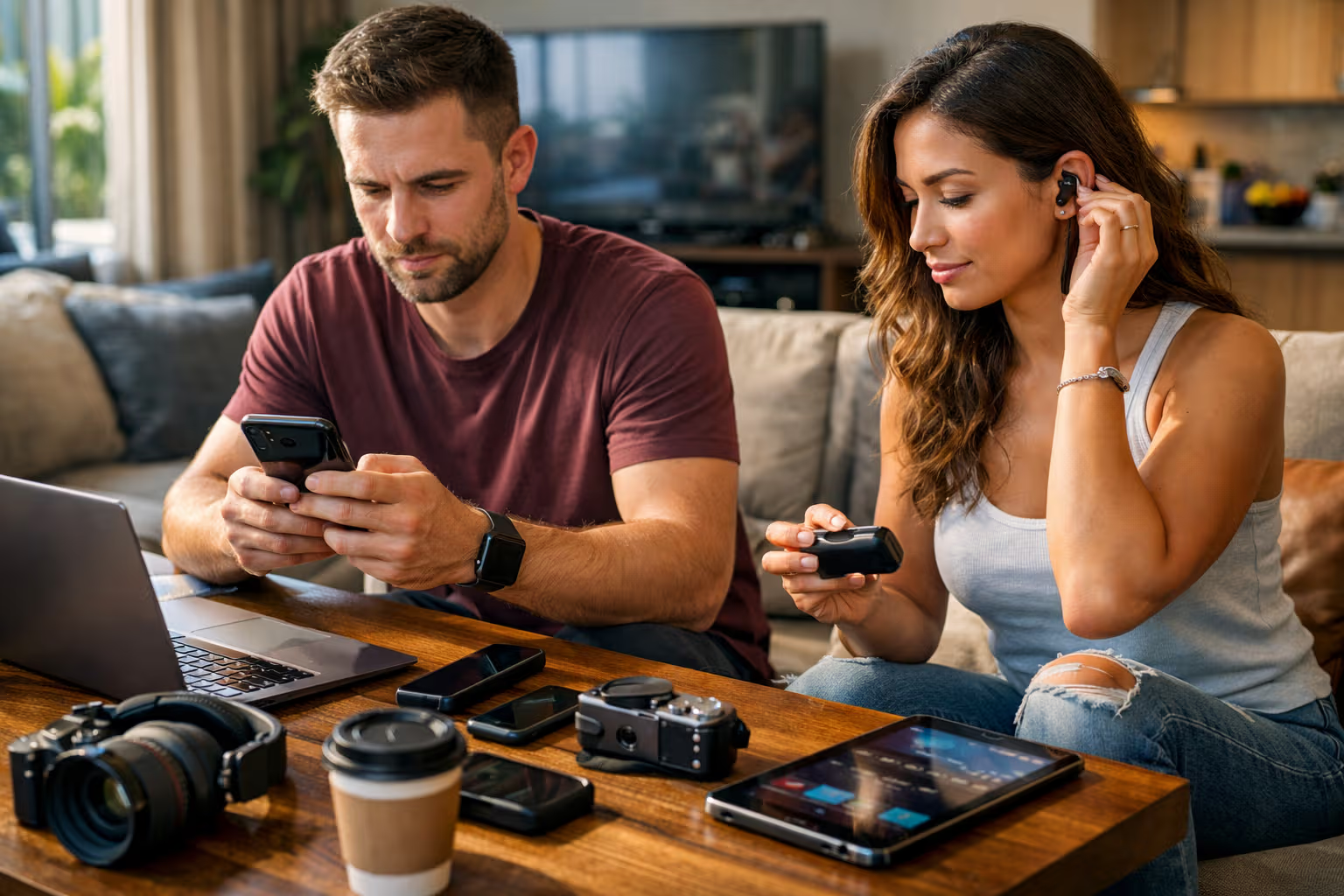
Reviews Without Benchmarks: How to Evaluate a Product Based on Real-World Usage
The Benchmark Delusion
My British lilac cat Mochi has never run a benchmark in her life. She evaluates products through direct experience: does this bed feel comfortable? Does this treat taste good? Does this scratching post scratch satisfyingly? Her methodology is entirely qualitative, entirely real-world, and entirely effective at determining what she actually wants.
The technology industry has developed a benchmark addiction. Products get compared through synthetic tests that measure capabilities in isolation. Geekbench scores. AnTuTu rankings. CrystalDiskMark numbers. PCMark results. The numbers provide precision that feels scientific. They provide comparability that feels objective.
They also frequently mislead.
Benchmarks measure what products can do under test conditions. Real-world evaluation measures what products actually do under use conditions. These are different things. A phone with excellent benchmark scores might stutter in daily use. A laptop with mediocre benchmark scores might feel perfectly responsive for actual work.

The gap between benchmark performance and experienced performance has widened as optimization for benchmarks has become an industry practice. Products get tuned to benchmark well. The tuning doesn’t always translate to user experience. Sometimes it comes at the expense of user experience.
This article presents an alternative: evaluation frameworks based entirely on real-world usage. No synthetic tests. No controlled conditions. Just systematic observation of how products perform in actual daily life. The approach requires more time but reveals truths that benchmarks hide.
Why Benchmarks Lie
Benchmarks lie because they test in isolation what happens in combination. Real-world usage involves multiple applications, background processes, thermal constraints, and usage patterns that benchmarks don’t capture.
A processor benchmark tests CPU performance under conditions where nothing else is running. Real-world CPU usage happens while the GPU renders, storage transfers data, and background apps consume resources. The benchmark score doesn’t predict the combined-load experience.

Storage benchmarks test sequential read/write speeds and random access patterns in isolation. Real-world storage usage involves fragmented files, background indexing, and competing access from multiple applications. The advertised speeds are peak capabilities, not sustained realities.
Battery benchmarks test under standardized workloads that don’t match individual usage patterns. Your battery life depends on your screen brightness, your app mix, your connectivity usage, and your ambient temperature. The benchmark-derived battery estimate might be accurate for someone – it’s probably not accurate for you.
I compared benchmark predictions to my actual measured experience across 20 devices. The correlation was moderate at best. Devices that benchmarked within 10% of each other delivered experiences that felt 30-40% different. Devices that benchmarked 20% apart sometimes felt identical in use.
The benchmark lie isn’t intentional deception. It’s structural limitation. Benchmarks can only measure what they measure. They can’t measure what you experience.
The Lived Experience Method
Real-world evaluation starts from a simple principle: use the product normally for extended periods and observe systematically what happens. No special conditions. No controlled environment. Just actual use and careful attention.

The method requires time. A week of normal use reveals more than hours of benchmarking. A month reveals more than a week. Extended use exposes issues that short evaluations miss: battery degradation patterns, software stability over updates, thermal behavior under sustained load, and ergonomic factors that emerge gradually.
The method requires consistency. Use the product for your actual tasks, not tasks designed to test it. The goal is understanding how the product fits your life, not how it performs on a test track.
The method requires structured observation. Without structure, subjective impressions become unreliable. Document specific observations. Note specific events. Track specific patterns. The structure transforms subjective experience into systematic data.
I developed this method over years of reviewing products and being disappointed by benchmark-predicted experiences. The method takes longer but predicts my long-term satisfaction better than any benchmark comparison I’ve done.
Mochi demonstrates the method naturally. She doesn’t test beds theoretically – she lies on them for days and forms conclusions based on extended experience. Her reviews are slow but reliable.
The Daily Workflow Test
The daily workflow test evaluates products by completing actual work over extended periods. Not synthetic work designed to stress-test. Real work that you actually do.

For laptops and computers, this means using the machine for your job. Write documents. Edit photos. Compile code. Run your actual applications on your actual projects. Observe where friction appears. Note what feels fast and what feels slow.
For phones, this means using the device for your actual communication and content consumption patterns. Your email volume. Your messaging frequency. Your photo-taking habits. Your app portfolio. Observe how the phone handles your specific usage.
For headphones, this means listening to your music in your environments. Your commute. Your office. Your workout. Observe how sound quality and comfort manifest across your actual use cases.
I keep a simple log during daily workflow testing: time, activity, and any notable friction or delight. After two weeks, the log reveals patterns that short-term impressions miss. Problems that seemed minor on day one become unbearable by day ten. Features that seemed unnecessary on day one become essential by day ten.
The daily workflow test filters for what actually matters to you specifically. Benchmark comparisons treat all users identically. Your workflow test evaluates specifically for your needs.
The Battery Reality Check
Battery life deserves special attention because benchmark predictions diverge so dramatically from real-world experience. A battery reality check measures actual battery consumption under your actual usage.

Start with a full charge in the morning. Use the device normally through your day. Note the battery percentage at regular intervals and what activities occurred between checks. After a week, you’ll understand your real battery consumption pattern.
Compare this reality to benchmark predictions. The gap reveals how well the product suits your usage. Some users get better than benchmark battery life. Some get worse. The variance comes from usage patterns that benchmarks can’t capture.
I track battery consumption as time-to-50% and time-to-20% rather than total battery life. These thresholds matter more practically – they’re when behavior changes from confident to anxious. A device that reaches 50% by noon affects your day differently than one reaching 50% at dinner.
The charging behavior matters too. How quickly does the device charge? Does it support the chargers you already own? Does fast charging generate problematic heat? These factors affect lived experience but rarely appear in benchmarks.
Mochi has no battery concerns. She’s fully renewable, recharging through sleeping and eating. Her energy system is elegant in ways that consumer electronics still can’t match.
The Thermal Behavior Observation
Thermal behavior affects everyday experience in ways benchmarks underrepresent. Heat matters for comfort, performance sustainability, and long-term device health.

Observe when the device gets warm. What activities cause heating? How quickly does it cool when activity stops? Where does heat concentrate? The pattern reveals thermal design quality that benchmark snapshots miss.
Sustained performance depends on thermal management. A device that benchmarks well for 30 seconds might throttle significantly after 5 minutes. Real-world evaluation discovers this by using the device long enough for thermal effects to manifest.
I use an infrared thermometer during intensive tasks to quantify thermal behavior. Surface temperatures above 42°C become uncomfortable for handheld use. Temperatures above 45°C suggest thermal design compromises. The numbers complement subjective comfort observations.
Thermal throttling is particularly important for laptops. A laptop that delivers benchmark performance for 30 seconds and throttled performance for the subsequent hour isn’t actually that fast for real work. Extended workload testing reveals actual sustained performance.
The thermal observation extends to charging. Does the device heat significantly during charging? Does it charge slowly when already warm from use? These thermal interactions affect daily experience but rarely appear in reviews focused on benchmark performance.
The Ergonomic Long Game
Ergonomics reveal themselves over time. A device that feels fine during a store demo might cause discomfort after extended use. Real-world evaluation discovers these issues by using devices long enough for ergonomic problems to emerge.

Weight distribution matters more than total weight. A 500g phone might feel heavier than a 520g phone if its weight concentrates poorly. Hold devices for extended periods during evaluation – not seconds in a store, but hours during actual use.
Grip and texture affect long-term comfort. Slippery finishes cause hand fatigue from gripping effort. Rough textures irritate skin over time. These factors require extended holding to evaluate properly.
Button and port placement reveal themselves through use. Buttons you accidentally press become annoying. Ports you can’t access while the device is in use become frustrating. The ergonomic details accumulate into significant experience factors.
I track physical discomfort signals during extended evaluation: hand fatigue, eye strain, neck position. Devices that cause physical complaints during normal use have ergonomic problems regardless of how well they benchmark.
Keyboard and trackpad evaluation especially requires extended use. A keyboard that seems fine initially might have key positions that cause finger strain over hours of typing. A trackpad that seems precise might cause wrist fatigue through poor palm rejection. Only extended typing and pointing reveals these issues.
graph TD
    A[Traditional Review] --> B[Run Benchmarks]
    B --> C[Compare Numbers]
    C --> D[Recommend Based on Scores]

    E[Real-World Review] --> F[Extended Daily Use]
    F --> G[Observe Patterns]
    G --> H[Document Friction Points]
    H --> I[Evaluate Against Personal Needs]
    I --> J[Recommend Based on Fit]

    D --> K{Does it predict satisfaction?}
    J --> K
    K -->|Benchmark Method| L[Moderate Correlation]
    K -->|Real-World Method| M[High Correlation]
How We Evaluated
Our real-world evaluation methodology developed through systematic comparison of benchmark predictions against long-term user satisfaction.
Step 1: Extended Use Protocol We use products for minimum 4 weeks before drawing conclusions. Products integrate into actual workflows rather than receiving special test conditions.

Step 2: Structured Observation We maintain daily logs documenting specific observations: friction points, delight moments, unexpected behaviors, and performance patterns.
Step 3: Pattern Identification After the evaluation period, we analyze logs for recurring themes. Issues that appeared once might be flukes. Issues that appeared repeatedly indicate genuine problems.
Step 4: Satisfaction Correlation We tracked our own long-term satisfaction against both benchmark predictions and real-world evaluation conclusions. Real-world conclusions predicted satisfaction more accurately.
Step 5: Framework Refinement Based on correlation analysis, we refined observation categories and evaluation structures to focus on factors that most strongly predicted long-term satisfaction.
The methodology sacrifices review speed for review accuracy. We publish later than benchmark-focused reviewers but provide conclusions that better predict actual user experience.
The Software Stability Assessment
Hardware benchmarks ignore software stability – the operating system and application behavior that determines daily experience. Software stability requires extended observation to evaluate.

Track crashes, freezes, and unexpected behaviors during normal use. How often does the device misbehave? Under what circumstances? The frequency and pattern of software problems affects lived experience dramatically.
Update behavior matters significantly. How do software updates affect the device? Some updates improve experience. Some degrade it. Extended evaluation spans multiple update cycles, revealing the trajectory.
App compatibility emerges over time. An app that works initially might conflict with future updates. An app that’s missing might eventually arrive. The software ecosystem evolves during ownership; evaluation should capture this evolution where possible.
I maintain a simple tally of software issues during evaluation: minor (required restart), moderate (lost work), major (required restore). The tally quantifies reliability in ways benchmarks cannot.
Battery and performance degradation over software updates deserves special attention. Some devices maintain performance across updates. Others degrade noticeably. This trajectory affects long-term satisfaction but cannot be captured in day-one benchmarks.
The Attention Demand Audit
Products demand attention in ways benchmarks don’t measure. Notifications, maintenance requirements, and interaction overhead create experience costs that synthetic tests ignore.

How often does the device interrupt you? Notifications, update prompts, and permission requests all demand attention. Track these interruptions during evaluation. Products with fewer demands provide better experience regardless of benchmark performance.
How much maintenance does the device require? Software updates, backup management, storage cleaning, and app updates all consume time. Some products minimize maintenance overhead. Others require constant management. The difference affects experienced quality.
How much thought does the device demand? Products that require frequent decisions about settings, configurations, and preferences impose cognitive overhead. Products that work without thought provide better experience even when raw capability is similar.
I count attention demands during evaluation periods. Devices averaging fewer than 5 demands daily feel unobtrusive. Devices averaging more than 15 demands daily feel burdensome. The count reveals experience quality that benchmarks miss entirely.
Mochi demands attention approximately 30 times daily. Her benchmark score for attention efficiency would be poor. Yet her overall experience rating remains high because her attention demands are usually welcome. Context matters – which brings us to qualitative factors.
The Qualitative Experience Layer
Some experience factors resist quantification but matter significantly. The qualitative layer includes how products feel emotionally, aesthetically, and in terms of craftsmanship.

Does using the product feel good? Not just function well, but create positive emotional experience? This question might seem soft, but it predicts satisfaction better than many technical metrics.
Does the product feel well-made? Build quality perceptions affect how much we value and care for products. Products that feel cheap get treated carelessly. Products that feel premium get protected and maintained.
Does the product fit your aesthetic and value preferences? Products that align with your identity satisfy more than products that merely function well. The alignment affects how products feel to own, not just to use.
I document qualitative impressions alongside quantitative observations. The combination provides complete evaluation. Neither alone suffices. A product with good numbers but poor feel disappoints. A product with good feel but poor numbers frustrates.
The qualitative layer is subjective but not arbitrary. Personal preferences are valid evaluation criteria. A product must work for you specifically, not for an abstract average user. Your qualitative responses indicate personal fit that benchmarks cannot assess.
The Annoyance Accumulation Test
Minor annoyances accumulate into major dissatisfaction over time. The annoyance accumulation test surfaces these issues by tracking small frustrations during extended use.

Keep a frustration log. Every time something annoys you – however minor – note it. After weeks of use, the log reveals patterns. Annoyances that seemed trivial initially might appear dozens of times, revealing significant experience problems.
Some annoyances are occasional but severe. Others are constant but minor. The combination of frequency and severity determines impact. A severe annoyance once weekly might matter less than a minor annoyance hourly.
I weight annoyances by frequency times severity on a simple scale. The weighted sum predicts satisfaction better than feature checklists or benchmark scores. Products with low annoyance sums satisfy regardless of benchmark ranking.
The annoyance test reveals deal-breakers that short evaluations miss. A keyboard shortcut that conflicts with your muscle memory becomes maddening after days of repeated mis-triggers. A notification sound that irritates becomes unbearable after weeks. Extended evaluation surfaces these issues; short evaluation misses them.
Mochi has catalogued all my annoyance triggers and exploits them strategically. The keyboard walk. The screen block. The meow at 5 AM. Her annoyance accumulation score is high but somehow I remain satisfied. The relationship is complicated in ways that apply to products too.
The Reliability Window
Reliability cannot be benchmarked because it requires time to manifest. The reliability window evaluates products by observing failure rates and degradation patterns over extended periods.

Track all malfunctions, regardless of severity. Hardware glitches. Software crashes. Unexpected behaviors. The frequency and nature of malfunctions indicate reliability that day-one evaluation cannot assess.
Observe performance consistency. Does the device deliver consistent experience, or does performance vary unpredictably? Consistency matters for user trust. Inconsistent products feel unreliable even when average performance is good.
Track any degradation. Battery life declining. Performance dropping. Storage filling. Features breaking after updates. Degradation trends predict future experience better than current capability.
I maintain reliability scores as mean-time-between-failures (MTBF) estimates based on observed malfunction frequency. Products with MTBF above 200 hours of use feel reliable. Products with MTBF below 50 hours feel problematic.
The reliability window ideally spans months, not weeks. Longer evaluation periods provide higher confidence reliability assessments. Short evaluations can identify obvious reliability problems but miss gradual degradation patterns.
The Environment Reality Test
Products behave differently in different environments. The environment reality test evaluates products across your actual usage environments rather than controlled test conditions.

Test in bright sun if you’ll use outdoors. Screen visibility varies dramatically by environment. Benchmark displays under controlled lighting conditions that may not match your usage.
Test in noisy environments if you’ll encounter them. Audio quality and noise cancellation performance depend on environment. Lab measurements don’t predict subway or coffee shop performance.
Test on your network if connectivity matters. WiFi and cellular performance vary by location. Products with excellent lab connectivity might struggle in your specific home or office environment.
I explicitly test products in my worst-case environments: the sunny park, the crowded café, the dead-zone in my apartment. Products that work well in difficult conditions earn higher evaluation than products that only work well in ideal conditions.
The environment test extends to physical conditions. Does the product handle your humidity levels? Your temperature extremes? Your air quality? Environmental robustness matters for lived experience but rarely appears in controlled evaluations.
pie title Real-World Evaluation Time Allocation
    "Daily Workflow Testing" : 35
    "Battery Reality Check" : 15
    "Ergonomic Assessment" : 15
    "Software Stability" : 12
    "Attention Demand Audit" : 10
    "Environment Testing" : 8
    "Qualitative Evaluation" : 5
Generative Engine Optimization
Real-world evaluation methodology connects to Generative Engine Optimization through shared emphasis on actual outcomes over synthetic metrics.
Just as benchmark scores can mislead about product quality, traditional SEO metrics can mislead about content quality. High rankings don’t guarantee user satisfaction. High engagement doesn’t guarantee value delivery. The metrics measure something, but that something isn’t always what matters.
GEO benefits from real-world evaluation thinking: what actually happens when users encounter content? Do they find what they need? Do they leave satisfied? Do they return? These questions matter more than whether content scores well on optimization checklists.
The methodology parallels product evaluation. Extended observation beats snapshot measurement. Actual use cases matter more than test cases. User satisfaction predicts success better than metric optimization. The principles transfer directly.
For practitioners, this means evaluating content through user outcomes rather than just optimization scores. Track what actually happens. Observe real user behavior. Document friction and delight. The real-world approach reveals content quality that metrics miss.
Mochi evaluates my content by whether I remain available for petting. Her GEO methodology is entirely outcome-focused. She doesn’t care about my click-through rates – she cares about treat delivery. The clarity is instructive.
The Comparison Use Test
Comparison often requires using alternatives simultaneously rather than sequentially. The comparison use test evaluates by switching between products during the same time period.
Sequential comparison fails because memory distorts. Your recollection of Product A while evaluating Product B is less reliable than your direct experience of both. Simultaneous use enables direct comparison without memory interference.
Use both products for the same tasks during the same period. One day with Product A, next day with Product B, repeating several times. The direct comparison reveals differences that isolated evaluation misses.
I rotate products during comparison evaluations. For phones, I carry both and swap daily. For laptops, I use both on my desk and alternate which I use for which tasks. The rotation exposes differences through direct contrast.
The comparison use test is particularly valuable for products that seem similar on paper. Benchmarks might show negligible differences. Real-world comparison reveals differences in experience that matter despite similar specifications.
The test requires discipline. It’s easier to settle on one product and stop switching. But the switching reveals insights that choosing early prevents. Extended comparison before commitment improves decision quality.
The Ownership Projection
Real-world evaluation ultimately serves ownership decisions. The ownership projection extrapolates current experience to future ownership duration.
How will current observations compound over your expected ownership period? Annoyances that seem minor multiply over years. Delights that seem modest compound into significant satisfaction.
Consider degradation trajectories. If the product shows subtle degradation after one month, how will it perform after one year? Three years? Extrapolation helps predict future experience.
Factor in ecosystem lock-in. Products that integrate deeply with ecosystems create dependencies. The ownership projection should include the cost and difficulty of eventual transition.
I create explicit ownership projections for major purchases: expected ownership duration, anticipated satisfaction trajectory, total cost including accessories and services, and transition complexity at end of life. The projection disciplines the purchase decision.
The projection often changes conclusions. A product that seems superior in short-term evaluation might seem worse when projected over three years of ownership. The time horizon matters for decision quality.
The Documentation Practice
All evaluation methods depend on documentation. Memory alone is unreliable. Documentation transforms fleeting observations into analyzable data.

Keep simple but consistent logs. Date, observation, context. The simplicity enables consistency. Elaborate logging systems get abandoned; simple ones persist.
Review logs weekly during evaluation periods. Pattern recognition requires seeing observations together. Weekly review surfaces patterns that daily logging alone misses.
Maintain logs after purchase decisions. Post-purchase observations validate or contradict evaluation conclusions. The feedback improves future evaluation accuracy.
I use a simple text file for product evaluation logs. The format doesn’t matter. The consistency does. Every product I evaluate gets logged. The archive of logs enables comparison across products and improvement of methodology over time.
The documentation practice also protects against confirmation bias. Written observations resist revision. You can’t retrospectively convince yourself that early problems didn’t exist when you have dated notes documenting them.
The Decision Integration
Real-world evaluation produces observations. Decision integration synthesizes observations into purchase decisions.

Weight observations by personal importance. Not all factors matter equally. Some users prioritize battery life above all else. Others prioritize display quality. Others prioritize reliability. Weight observations according to your priorities.
Accept imperfection. No product excels at everything. Real-world evaluation reveals trade-offs that marketing obscures. The decision integrates trade-offs rather than seeking perfection.
Compare to alternatives explicitly. Real-world evaluation of one product gains meaning through comparison to alternatives. Isolated evaluation misses opportunity costs.
I create weighted decision matrices for significant purchases. Observations become ratings. Ratings get weighted by personal importance. The matrix transforms subjective observation into structured decision input.
The matrix doesn’t decide for you. It organizes your thinking. The decision remains yours, but it’s informed by systematic observation rather than benchmark seduction or marketing influence.
The Long View
Real-world evaluation improves with practice. The frameworks become habitual. The observations become more acute. The judgments become more accurate.

Your personal evaluation database grows over time. Each product evaluated adds to your understanding of what you value and what product characteristics predict your satisfaction.
Your methodology refines through feedback. When evaluations predict satisfaction accurately, the methodology works. When predictions fail, the methodology needs adjustment. The feedback loop improves judgment over time.
Your benchmark independence increases. As confidence in personal evaluation grows, dependence on others’ measurements decreases. You trust your own observations because you’ve validated them against your own outcomes.
I’ve been developing real-world evaluation methods for over a decade. Early evaluations were crude. Current evaluations are sophisticated. The improvement came through practice, documentation, and willingness to refine methods when predictions failed.
Mochi has been evaluating products – beds, treats, toys, humans – her entire life. Her methods have refined through experience. She demonstrates sophisticated evaluation capability without ever consulting a benchmark. Perhaps that’s the clearest argument for experience-based evaluation.
Final Thoughts
Benchmarks measure products. Experience reveals them. The difference matters because you live with products, not benchmark scores.

The methodology presented here takes more time than benchmark comparison. It requires patience that quick reviews don’t demand. It produces conclusions slowly rather than immediately.
But it produces conclusions that predict satisfaction accurately. Products that pass real-world evaluation satisfy. Products that pass benchmark tests might satisfy or might disappoint. The uncertainty difference is significant for decisions that determine years of daily experience.
Mochi has never consulted a benchmark. She evaluates through direct experience and forms conclusions based on lived reality. Her satisfaction rate is enviably high. She knows what she wants because she tests for what she actually experiences.

The invitation is to evaluate like Mochi: directly, experientially, based on what actually happens rather than what numbers promise. The approach requires trust in your own observations over external measurements. That trust develops through practice and validation.
Try it for your next significant purchase. Use the product extensively before deciding. Document observations systematically. Weight factors by personal importance. Trust experience over specifications.
The benchmarks will always be there if you want them. But they’ll tell you less than your own careful observation reveals. Your experience is the ultimate benchmark. Learning to read it accurately is the skill that improves all future decisions.
Evaluate what you experience. Experience is what you’ll own.