
The East German Ministry for State Security — the Stasi — was the most comprehensive domestic surveillance apparatus in 20th century history. At its peak in 1989, it employed 91,000 full-time officers and had a network of roughly 189,000 unofficial informants. The East German population was 16.4 million people. The Stasi maintained files on approximately one in three citizens.
Building those files required enormous human effort. Following someone required actual people — surveillance officers rotating in shifts, taking handwritten notes, filing reports. Compiling a file required transcribing those notes, collating them with intercepted mail (opened by hand, resealed by hand, filed by hand), and integrating reports from informants (who were often unreliable, frequently exaggerating or inventing to satisfy their handlers). A detailed dossier on a person of active interest might take years of sustained, expensive surveillance effort to build and might run to a few hundred pages.
Your phone generates more data about you in a typical Tuesday than the Stasi would have collected on a surveilled subject across their entire lifetime.
This isn’t hyperbole. It’s a comparison of scale that most people haven’t made explicitly, probably because making it explicitly is uncomfortable. The scale difference between 20th century state surveillance and commercial smartphone surveillance is roughly five to six orders of magnitude. It is not the same kind of thing wearing a scarier hat. It’s a categorically different kind of thing, and we don’t have adequate political or conceptual frameworks for it yet.
Let me be specific about what’s actually being collected, because “your phone tracks you” has been repeated so often it’s lost its ability to produce appropriate alarm.
Related reading
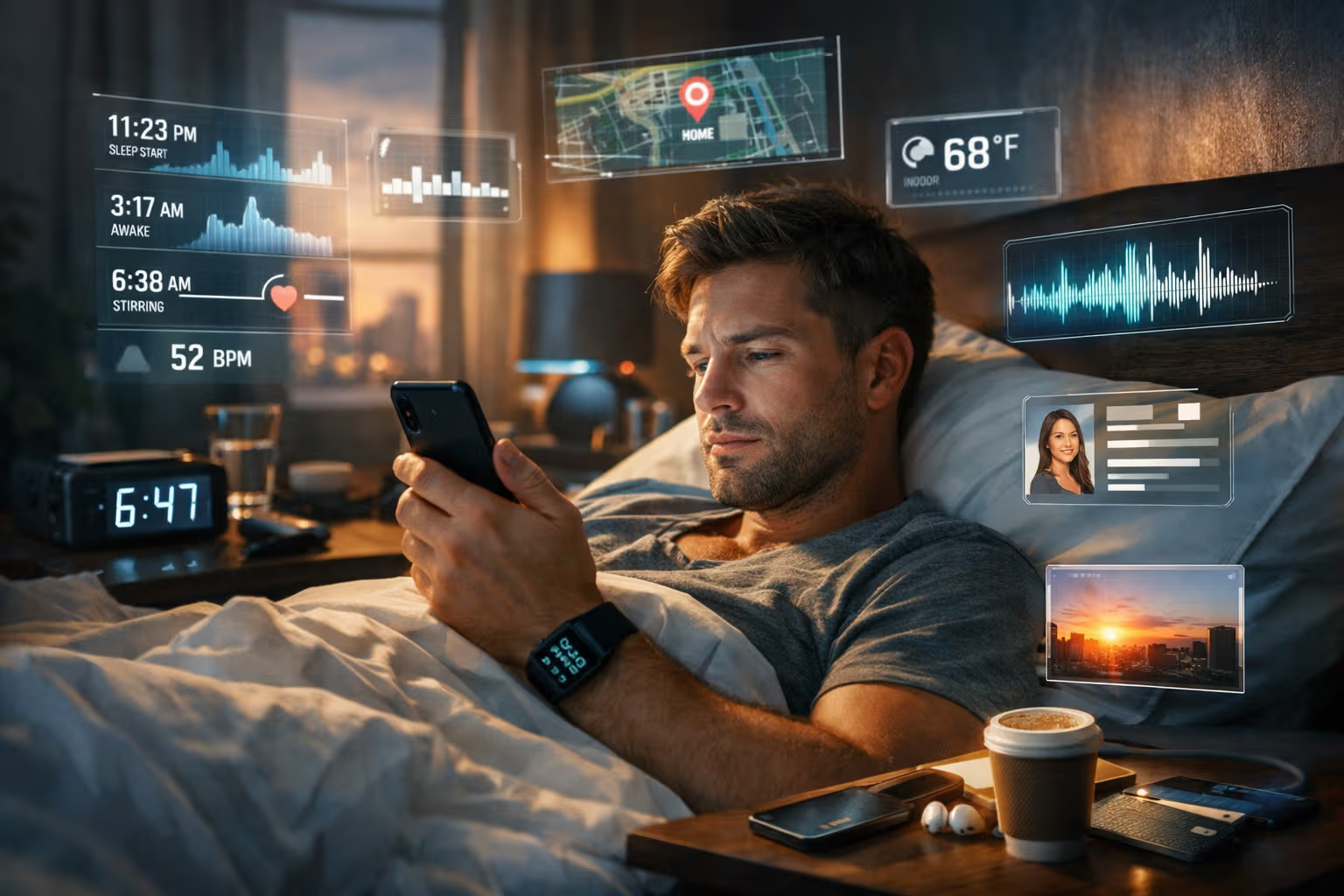
Location. A smartphone with typical app permissions records location continuously — with updates possible as frequently as every few seconds, accurate to within a few meters in urban environments. This produces a complete record of every place you’ve been, how long you stayed, what route you took between locations, and whether your location pattern matches anything flagged in any database. The Stasi needed a rotating team of human operatives to generate this data for a single target. Your phone generates it automatically for every app you’ve granted location access, which for most people is a dozen or more.
Communications and social graph. Your phone knows who you call, text, email, and message via every platform you use. It knows how frequently. It knows the timing, duration, and recency of every interaction. It knows when you interacted with someone for the first time and when you stopped. The social graph produced from this data — who knows whom, with what communication frequency and pattern, across what time period — is enormously more detailed than anything the Stasi assembled through informant networks. And it’s assembled automatically, not through years of cultivated human sources who might lie.
Biometrics and behavior. Modern smartphones contain an accelerometer, a gyroscope, a barometer, a magnetometer, and sophisticated microphone arrays. The accelerometer data alone is sufficient to identify your gait pattern with roughly 95% accuracy in research conditions, which means that an observer with your sensor data can determine whether you’re the person actually holding the phone, whether you’re walking, running, driving, or sitting still, and whether your movement pattern is consistent with your known behavior. Your typing cadence, your scrolling behavior, even the angle at which you typically hold the phone — all of these are individually identifiable biometric signatures that apps with sensor permissions can capture.
Financial and commercial behavior. Your phone links to payment systems and financial applications. The pattern of your spending — categories, specific merchants, timing, amounts, geographic distribution — is a behavioral portrait that correlates with income, health, political orientation, relationship status, and dozens of other attributes that you didn’t volunteer to disclose.
The obvious retort is: this data is collected by companies, not governments. It’s used for advertising. It’s not the Stasi because there’s no political repression attached to it.
This distinction is real. But it’s less reassuring than it sounds, and it’s getting less reassuring every year.
First, the data doesn’t stay with the companies that collected it. Data brokers constitute a $250 billion per year industry that exists specifically to aggregate data from multiple sources and sell it to buyers who haven’t collected it directly. Your location data from one app, your purchase data from another, your health data from a third — these streams are combined, enriched, and sold as packages. The buyer can be anyone: marketers, employers, insurance companies, debt collectors, political campaigns, or government agencies.
Law enforcement agencies in the United States purchase commercial location data routinely, specifically to avoid the Fourth Amendment warrant requirements that would apply to government-collected surveillance. A 2020 investigation by The New York Times found that the US military purchased smartphone location data from commercial brokers to track individuals’ movements without warrants. This is legal because the legal framework was written for a world where the government collected data directly. When the government buys commercially collected data instead, the warrant requirement doesn’t apply. Several court cases are working through this question, but the practice continues in the meantime.
Second, the question of whether a government is using the data today is less important than the question of whether it could, and how quickly. The data exists. In many cases, it’s retained for years. A government that decided tomorrow to reconstruct the movements, communications, and behavioral patterns of a specific population segment would not need to build a surveillance apparatus from scratch. It would need to buy the data, subpoena the platform companies, or invoke national security legal mechanisms that have deliberately broad scope. In explicitly authoritarian countries, this integration is already standard. China’s Social Credit System and its public security apparatus routinely integrate commercial smartphone data with government surveillance systems. Russia’s SORM requirements mandate that telecom and internet providers give intelligence services direct access to communications.
Related reading

Third, “it’s just advertising” undersells what the actual profile represents. A profile containing location data, purchase history, app usage patterns, inferred sleep schedule, relationship status, inferred political orientation, and health indicators is a comprehensive behavioral portrait of a person. The fact that this portrait is currently used primarily to show you targeted ads rather than to make other decisions about you is a choice that platform companies and governments are making. It’s not a structural feature of the data.
The AI layer adds a genuinely new dimension to this that has no historical precedent.
Commercial surveillance in 2010 produced enormous amounts of data that was hard to use at scale because making sense of behavioral patterns required human analysis. The volume was too high for individual review, and algorithmic analysis was limited to relatively crude pattern matching. Now it isn’t. Machine learning systems can find patterns in behavioral data at population scale — not just flagging individuals who match a pre-existing profile, but identifying anomalous clusters, predicting future behavior, and inferring attributes that were never directly measured.
Researchers at Stanford published work in 2022 showing that smartphone sensor data alone could predict clinical depression with accuracy comparable to validated clinical screening instruments. MIT researchers demonstrated that location data could infer HIV status with statistically significant accuracy based on the pattern of locations visited — specifically, proximity to HIV treatment facilities and community organizations. Health information that nobody volunteered, that wasn’t directly measured by any health application, is being inferred from behavioral signals that don’t look like health data in any conventional sense.
This is where the comparison to Stasi surveillance breaks down entirely, and not in the reassuring direction. The Stasi could observe behavior. It could record and file what it observed. It could not meaningfully predict future behavior or infer attributes that weren’t directly observable. The combination of smartphone sensor data and modern ML inference is producing systems that can know things about you that you don’t know about yourself — psychological state, health risk, financial trajectory — from data collected for entirely different purposes.
The privacy question in this environment is not “can anyone see what I’m doing.” It’s “can anyone infer what I haven’t done yet, and what I would never have disclosed.”
The legal framework for any of this is inadequate in ways that are genuinely difficult to fix quickly.
The United States has no comprehensive federal data protection law in 2026. The framework is a patchwork of sector-specific rules — HIPAA for medical data, COPPA for children’s data, FCRA for credit data, the Video Privacy Protection Act of 1988 (yes, that’s a thing) for video rental records — with enormous gaps between them. Data that doesn’t fit a defined category is essentially unregulated at the federal level. Most smartphone behavioral data falls in the gaps.
The EU’s GDPR was designed for a world where the primary concern was identifiable personal data being collected for identifiable purposes. Its core protections — consent requirements, data minimization rules, purpose limitation, right to erasure — are grounded in the idea that you know what data you’re producing and for what purpose. They don’t map well onto a world where behavioral inference from non-sensitive data can reconstruct sensitive attributes at scale. Your location data isn’t sensitive under GDPR. But if your location data can infer your health status, the sensitive/non-sensitive distinction is doing much less work than the law assumes.
Related reading

There are proposals — from the EU AI Act, from various state-level US bills, from academic research into privacy-enhancing technologies — that address parts of this. None of them address the full picture. The legal frameworks are still, in 2026, built around the 1989 problem of a government filling filing cabinets with handwritten reports. The surveillance environment is five orders of magnitude larger, automated, commercially distributed, and getting more analytically powerful every year.
I’m not making a Luddite argument here. Smartphones are extraordinarily useful. The apps running on them provide genuine value. The data collection that funds the free-app economy does, at some level, make the economics of free software work.
But there’s a difference between accepting a tradeoff knowingly and having a tradeoff imposed on you through unintelligible terms of service and obscure permission dialogs. Most people who carry smartphones have not made an informed decision to participate in the most comprehensive behavioral surveillance system in human history. They’ve clicked “allow” on permission prompts that were designed to minimize the psychological friction of granting access, not to convey what the access actually enables.
The Stasi required an enormous organizational apparatus and produced imperfect surveillance of a fraction of the population. The modern commercial surveillance system is near-total, automated, and commercially distributed to any buyer with a check. The difference between those two things is not just quantitative. It changes what the thing you’re dealing with actually is. And the political and legal structures we have are still, mostly, thinking about the 1989 version of the problem.
One email a month: new articles, reviews and the upcoming live webinar + free recording. No spam, unsubscribe anytime.