
How to Conduct a Personal Workflow Audit
The Invisible Drain
I used to wonder where my time went. Eight hours at the desk, but only two hours of real work done. The math didn’t add up. I was busy constantly, yet accomplishing less than colleagues who left at 5 PM looking relaxed.
The problem wasn’t effort. The problem was friction I couldn’t see. A thousand small inefficiencies, each insignificant alone, combining into a massive productivity drain. Context switches between tasks. Tool fumbling that added seconds to every action. Processes that required extra steps because I’d never questioned them.
A workflow audit revealed the invisible. For one week, I tracked everything—every task, every interruption, every tool switch, every moment of friction. The data was humbling. I spent 47 minutes daily navigating between applications. I checked email 34 times, averaging 2 minutes each time. I repeated the same manual processes that could have been automated years ago.
My British lilac cat audits her workflows instinctively. She’s optimized her route from food bowl to sleeping spot. She’s eliminated unnecessary steps in her hunting practice. She doesn’t waste motion on activities that don’t serve her goals. Watching her efficiency made my inefficiency more obvious.

This article walks through a personal workflow audit—the systematic process of observing, analyzing, and optimizing how you work. Not productivity theory. Practical examination of your actual behavior and concrete changes that create measurable improvement.
Why Personal Workflow Audits Matter
Companies audit financial processes. Software teams audit code quality. Athletes audit performance metrics. Yet most professionals never systematically examine their own working patterns.
The assumption is that knowledge workers know how they work. We don’t. We have vague impressions, selective memories, and self-serving narratives. The reality of how we spend time differs dramatically from our perception of how we spend time.
Studies consistently show that people misestimate time spent on activities by 20-50%. We underestimate time on enjoyable tasks and overestimate time on unpleasant ones. We forget interruptions that fragmented our focus. We rationalize inefficiencies as necessary.

The cost compounds. An inefficiency that wastes 10 minutes daily wastes 40 hours yearly—an entire work week. Multiple small inefficiencies compound into massive productivity losses. Over a career, unaudited workflows cost months of productive time.
A workflow audit provides objective data. Not impressions of how you work—evidence of how you work. This data enables informed decisions about what to change. Without data, improvements are guesses. With data, improvements are engineering.
The audit also reveals opportunities invisible to casual observation. Patterns emerge from data that don’t emerge from experience. Correlations become visible. Root causes surface. The systematic approach finds optimizations that intuition misses.
How We Evaluated This Approach
Developing a workflow audit methodology required iteration. We tested approaches across different work types and personal styles.
Step one: we identified what to measure. Time spent on activities, transitions between activities, interruptions, tool usage, energy levels, output quality. Each metric provided different insights. Too few metrics missed important patterns. Too many created analysis paralysis.

Step two: we tested tracking methods. Manual time logging, automatic screen monitoring, hybrid approaches. Manual tracking was accurate but burdensome. Automatic tracking was effortless but sometimes inaccurate. Hybrid approaches balanced effort and accuracy.
Step three: we varied audit duration. One day provided insufficient data. Two weeks created tracking fatigue. One week emerged as the sweet spot—enough data for pattern recognition, short enough to maintain tracking discipline.
Step four: we compared analysis methods. Quantitative analysis (time by category, transition counts) provided clear metrics. Qualitative analysis (friction points, emotional patterns) provided context. Both were necessary for actionable insights.
Step five: we measured improvement impact. After implementing audit findings, we re-audited to measure actual improvement. Some changes provided expected benefits. Others had less impact than predicted. Re-auditing closed the feedback loop.
This methodology transforms workflow improvement from vague aspiration to measurable engineering.
Phase One: Observation
The audit begins with observation—systematic tracking of how you actually work. Not how you think you work. Not how you want to work. How you actually work, with all its inefficiencies and surprises.

Choose a typical week. Avoid weeks with unusual events—travel, deadlines, holidays. The goal is capturing normal patterns, not exceptional circumstances. Atypical weeks provide atypical data.
Track at the granularity of 15-minute blocks. Finer granularity creates excessive overhead. Coarser granularity misses important patterns. Every 15 minutes, note what you’re doing. This creates 32 data points per 8-hour day—enough for pattern recognition.
Categories should be specific enough to be actionable. “Working” tells you nothing. “Writing code,” “responding to email,” “in meetings,” “reviewing documents” tells you where time goes. Create categories that match your actual activities.
Track more than just time. Note transitions between activities—what you switched from and what you switched to. Note interruptions—what interrupted you and for how long. Note friction—moments where you struggled with tools, processes, or decisions.
Here’s a simple tracking template:
Time: 9:00-9:15
Activity: Email processing
Interruptions: None
Friction: Slow search, couldn't find client email
Transition from: Morning routine
Energy level: High (8/10)
Track energy alongside activities. Some tasks drain energy despite taking little time. Some tasks generate energy despite taking more time. Energy patterns reveal sustainability issues that time tracking alone misses.
Don’t change behavior during observation. The temptation is to work better because you’re watching yourself. Resist it. The goal is capturing actual patterns, not performing for your own tracking. If you improve during observation, you’ll miss the problems that need fixing.
My cat would be terrible at this. She’s too present-focused to track her own behavior. But she’s also too efficient to need it—her workflows are already optimized through evolutionary pressure. We humans need data because our workflows evolved through accident rather than intention.
Phase Two: Data Collection Tools
The observation phase requires tools. The right tools make tracking sustainable. The wrong tools make tracking abandoned.
Manual tracking works with minimal technology. A notebook, a spreadsheet, sticky notes. Low tech reduces friction. You don’t need to switch applications to record. The downside: manual tracking requires discipline and interrupts work.
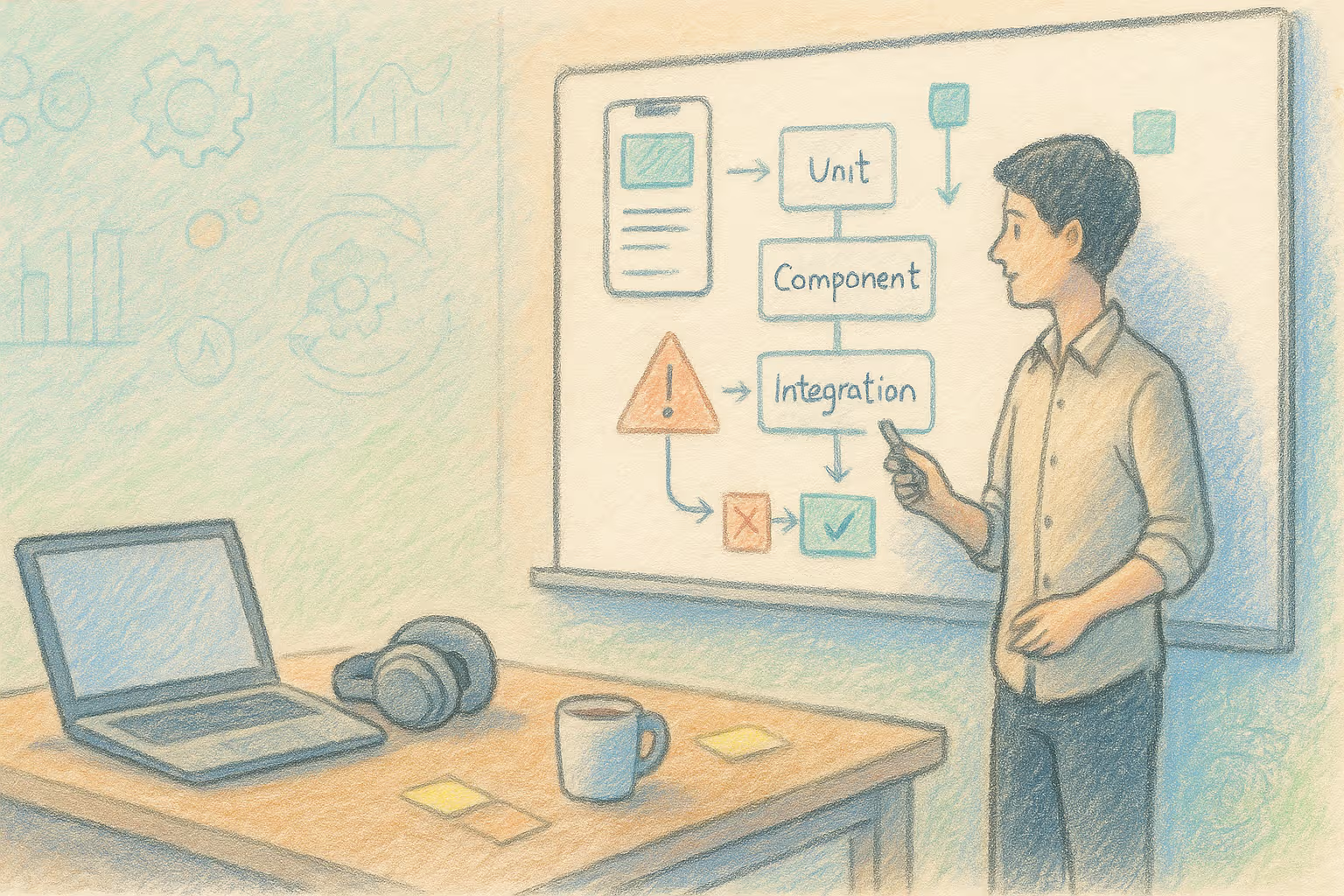
Automatic tracking uses software that monitors your computer activity. RescueTime, Timing, ActivityWatch—these tools record which applications you use and for how long. The upside: no effort required. The downside: they track applications, not activities. Being in your code editor doesn’t mean you’re coding productively.
Hybrid approaches combine automatic and manual. Automatic tools provide baseline data. Manual notes add context. You get the effortlessness of automation with the accuracy of human annotation.
The best tool is the one you’ll actually use. A sophisticated system you abandon after two days provides less value than a simple system you maintain for a week. Start simple. Add complexity only if simple proves insufficient.
For most people, I recommend a spreadsheet with 15-minute rows and columns for: time, activity, interruptions, friction, and energy. Fill it at the end of each hour—four entries at once. This balances accuracy with sustainability.
flowchart TD
    A[Start of Hour] --> B[Work Normally]
    B --> C[End of Hour]
    C --> D[Record Last 4 Intervals]
    D --> E{Remember Details?}
    E -->|Yes| F[Log Accurately]
    E -->|No| G[Log Best Estimate]
    F --> H[Note Any Friction Points]
    G --> H
    H --> I[Continue to Next Hour]
    I --> B
Whatever tool you choose, ensure it captures transitions. The shift from Task A to Task B is where much productivity leaks. If your tracking only shows time in categories, you miss the transition cost that fragments focused work.
Phase Three: Analysis
After one week of observation, you have data. Raw data becomes insight through analysis. This phase transforms numbers into understanding.
Start with time distribution. Where did hours actually go? Create a pie chart or simple breakdown. Most people are surprised—categories they thought consumed little time actually consume much, and vice versa.
Compare perceived versus actual time. Before looking at data, estimate how you thought you spent time. Then compare to actual data. The gaps reveal blind spots. Large gaps indicate activities where your intuition fails.

Calculate context switching frequency. Count how many times you changed activities per day. Multiply by average recovery time (15 minutes is a reasonable estimate for knowledge work). This calculation often reveals hours of lost productivity from fragmentation alone.
Identify peak productive periods. When did you do your best work? When did you struggle? Correlate with time of day, energy levels, and external factors. These patterns inform when to schedule demanding versus routine work.
Analyze friction points. What caused frustration or slowdown? Tool problems? Information searching? Process steps? Friction points are optimization opportunities. Categorize them by frequency and severity.
Examine interruption patterns. Who or what interrupted you? How often? At what times? Interruptions have patterns that, once visible, can be addressed through communication, scheduling, or tool configuration.
Here’s an example analysis summary:
Time Distribution:
- Coding: 32% (expected: 50%)
- Meetings: 28% (expected: 20%)
- Email/Slack: 18% (expected: 10%)
- Admin tasks: 12% (expected: 10%)
- Context switching overhead: 10% (expected: 0%)

Key Findings:
- Coding time 36% lower than expected
- Communication time 80% higher than expected
- Average 23 context switches per day
- Peak productivity: 9-11 AM, 3-4 PM
- Worst productivity: 1-2 PM (post-lunch)
- Top friction point: searching for information (14 occurrences)
Phase Four: Identifying Optimization Opportunities
Analysis reveals problems. The next step is identifying which problems to solve. Not all inefficiencies are worth fixing. Prioritization focuses effort where returns are highest.
Calculate potential time savings for each issue. If you spend 45 minutes daily in unnecessary meetings, eliminating them saves 3.75 hours weekly. If a tool friction adds 30 seconds per occurrence with 20 occurrences daily, fixing it saves 10 minutes daily—far less impact.
Consider implementation difficulty. Some optimizations are easy: change a default setting, install a tool, adjust a schedule. Others are hard: renegotiate meeting culture, learn a new system, change deeply ingrained habits. Easy wins first.
Assess sustainability. Will the fix stick? A change that requires ongoing willpower will degrade. A change embedded in systems persists without effort. Prefer structural changes over behavioral changes.

Rank opportunities by impact-to-effort ratio. High impact, low effort: do immediately. High impact, high effort: plan carefully. Low impact, low effort: do when convenient. Low impact, high effort: probably skip.
Common optimization opportunities by category:
Communication
- Batch email/Slack checking instead of continuous monitoring
- Decline or shorten unnecessary meetings
- Set expectations for response times
- Move synchronous communication to asynchronous when possible
Tools
- Learn keyboard shortcuts for frequently used actions
- Automate repetitive tasks with scripts or macros
- Consolidate information into fewer locations
- Fix or replace tools that cause consistent friction
Schedule
- Protect peak productivity hours for demanding work
- Cluster meetings to reduce fragmentation
- Build buffer time between different work types
- Align task types with energy levels
Process
- Create templates for recurring tasks
- Document decisions to avoid re-discussion
- Establish clear handoff procedures
- Eliminate unnecessary approval steps

Phase Five: Implementation
Knowing what to change is different from changing it. Implementation turns insights into habits.
Start with one change. Multiple simultaneous changes overwhelm and fail. Pick the highest-impact opportunity and implement it fully before adding more.
Make changes structural when possible. A calendar block for focus time is structural—it exists without willpower. A commitment to “try to focus more” is behavioral—it requires constant effort. Structural changes persist.
Build accountability checkpoints. Schedule a review one week after implementation. Did the change stick? Did it provide expected benefits? Adjust based on evidence, not assumptions.

Expect resistance. Workflows have inertia. Colleagues expect your old patterns. Your own habits push toward familiar inefficiency. Anticipate resistance and plan for it.
Communicate changes that affect others. If you’re batching email, tell colleagues when to expect responses. If you’re declining meetings, explain why. Clear communication prevents confusion and builds support for your changes.
flowchart LR
    A[Identify Opportunity] --> B[Design Structural Change]
    B --> C[Communicate to Stakeholders]
    C --> D[Implement Change]
    D --> E[One Week Trial]
    E --> F{Working?}
    F -->|Yes| G[Make Permanent]
    F -->|No| H[Analyze Why]
    H --> I{Fixable?}
    I -->|Yes| B
    I -->|No| J[Abandon, Try Different Approach]
    G --> K[Select Next Opportunity]
    J --> K
Track implementation progress. Which changes have you made? Which are pending? Which failed and need reconsideration? A simple checklist maintains momentum.

Phase Six: Re-Audit
Implementation without verification is hope, not engineering. Re-auditing measures actual improvement.
Wait 4-6 weeks after implementing changes. This allows new patterns to stabilize. Auditing too soon measures transition, not new steady state.
Use the same tracking methodology as the original audit. Same duration, same categories, same tools. Consistency enables comparison.
Compare metrics directly. Time distribution before versus after. Context switches before versus after. Friction points before versus after. Quantify improvement in concrete terms.

Assess subjective experience. Do you feel more productive? More satisfied? Less stressed? Subjective improvements matter even when metrics don’t fully capture them.
Identify new problems. Changed workflows reveal new friction. Optimization in one area sometimes creates problems in another. The re-audit catches these unintended consequences.
Decide next steps. If improvements are significant, select the next optimization opportunity. If improvements are minimal, investigate why. Iterate until diminishing returns suggest stopping.
My cat doesn’t need re-audits—she adjusts continuously based on immediate feedback. Her optimization loop is faster than ours. We need formal measurement because our feedback loops are slower and our self-perception is less reliable.
Common Findings and Solutions
Workflow audits reveal similar patterns across different professionals. These common findings might appear in your audit.
Finding: Email consumes 2+ hours daily
Most professionals check email far more often than necessary. Each check interrupts focus. Cumulative time exceeds expectations.
Solution: Batch email to 2-3 times daily. Disable notifications. Set expectations with colleagues about response times. Use filters to surface important messages.

Finding: Meetings fragment available time
Meetings create unusable gaps. A 30-minute meeting with 30 minutes before and after leaves no time for focused work, but still consumes 90 minutes of availability.
Solution: Cluster meetings on specific days or specific time blocks. Decline meetings without clear agendas. Suggest asynchronous alternatives when appropriate. Reduce meeting durations—most meetings accomplish in 25 minutes what they’re scheduled for 60 minutes.
Finding: Tool switching wastes significant time
Moving between applications, remembering where information lives, navigating complex interfaces—these micro-frictions accumulate.
Solution: Learn keyboard shortcuts. Consolidate tools where possible. Create bookmarks for frequently accessed locations. Consider tools that integrate multiple functions.
Finding: Peak energy is wasted on low-value activities
Morning productivity spent on email. Afternoon energy wasted in status meetings. The best hours go to the worst tasks.

Solution: Protect peak hours for demanding work. Schedule low-energy tasks for low-energy times. Communicate your high-productivity windows so others schedule accordingly.
Finding: Information searching consumes unexpected time
Looking for files, searching email for context, trying to remember decisions—information retrieval interrupts and delays.
Solution: Organize information systematically. Take notes during conversations. Use searchable tools. Create single sources of truth for recurring information needs.
Finding: Unclear priorities cause constant task switching
Without clear priorities, everything seems urgent. The result is jumping between tasks without completing any.
Solution: Start each day by identifying the single most important task. Complete it before starting others. Use explicit prioritization frameworks rather than reacting to whatever appears urgent.
Generative Engine Optimization
Workflow audits connect to an emerging concern: Generative Engine Optimization. As AI assistants become common productivity partners, your workflow efficiency determines how effectively you can leverage AI capabilities.

AI assistants amplify your workflow efficiency. If your workflow is scattered, AI interactions will be scattered. If your workflow is focused, AI interactions will be focused. The multiplier effect means workflow improvements create larger AI productivity gains.
Document your workflows as you audit them. This documentation becomes context you can share with AI assistants. “Here’s how I handle customer inquiries” enables AI to support that specific workflow rather than providing generic assistance.
Identify tasks in your audit that AI could handle. Repetitive processes, information synthesis, draft generation—these are AI-suitable. Your audit reveals which tasks fit this profile and how much time they currently consume.
The subtle skill is recognizing that workflow optimization and AI integration reinforce each other. Better workflows enable better AI use. Better AI use enables further workflow optimization. The audit starts this virtuous cycle by providing visibility into where both human and AI effort should focus.
Maintaining Workflow Health
A single audit provides a single snapshot. Workflow health requires ongoing attention.
Schedule quarterly mini-audits. Two days of tracking every three months catches drift before it becomes significant. These shorter audits don’t need full analysis—just comparison to baseline.

Track leading indicators. When email checking frequency creeps up, catch it early. When meeting time expands, address it before it overwhelms. Leading indicators prevent regression.
Build audit triggers. Role change? Audit. New tools? Audit. Feeling overwhelmed? Audit. Life events that disrupt patterns benefit from systematic examination and readjustment.
Share findings with colleagues. Workflow improvements often benefit from team adoption. Your optimization might help others. Their insights might help you. Collaborative improvement compounds individual improvement.
My cat maintains workflow health through constant minor adjustments. She doesn’t let inefficiencies accumulate. She optimizes continuously because the feedback is immediate. We need scheduled audits because our feedback is delayed and our self-perception is unreliable.
Starting Your First Audit
If you’ve never audited your workflow, start this week. The insight value exceeds the tracking cost almost immediately.
Day 1: Set up tracking. Choose your tool—spreadsheet, notebook, app. Create categories that match your work. Set reminders to record at regular intervals.
Days 2-6: Track honestly. Record actual behavior, not ideal behavior. Note interruptions, friction, and energy. Resist the temptation to improve during observation.
Day 7: Initial analysis. Calculate time distribution. Identify obvious patterns. Note your top three friction points.
Week 2: Deep analysis. Compare perceived versus actual time. Calculate context switching costs. Identify peak productivity patterns. Rank optimization opportunities.
Week 3: Implementation. Choose one change. Make it structural. Communicate to affected parties. Begin the new pattern.
Week 7: Re-audit. Track for three days. Compare to baseline. Assess improvement. Decide next steps.

The timeline is flexible. The sequence is important. Observation before analysis. Analysis before implementation. Implementation before verification.
The goal isn’t a perfect workflow. The goal is a workflow that improves consciously rather than degrades accidentally. Systematic auditing provides the visibility that enables conscious improvement.
Your workflow is how you spend your professional life. Examining it carefully is among the highest-leverage activities you can undertake. The hours invested in auditing return multiplied through all the hours that follow.
Start tracking today. The invisible will become visible. The visible will become improvable. The improvable will become optimized.
And then you’ll wonder, like I did, why you waited so long to look.