
How Programming Will Change When AI Writes 95% of Code
The Current Trajectory
GitHub Copilot launched in 2021. By 2023, developers reported accepting 30-40% of its suggestions. By 2025, that number exceeded 50% for many developers. The trajectory is clear even if the exact timeline isn’t.
We’re heading toward a world where AI generates most code. Not all—the percentage matters less than the direction. Whether it’s 80%, 95%, or 99% changes the timeline but not the fundamental shift in what programming means.
I watched this happen before, with a different technology. Assembly language programmers once wrote instructions for specific processors. Then compilers abstracted that away. The assembly programmers didn’t disappear—they moved up the abstraction stack. They became C programmers, then Java programmers, then Python programmers. Each generation works at higher levels, accomplishing more with less manual specification.
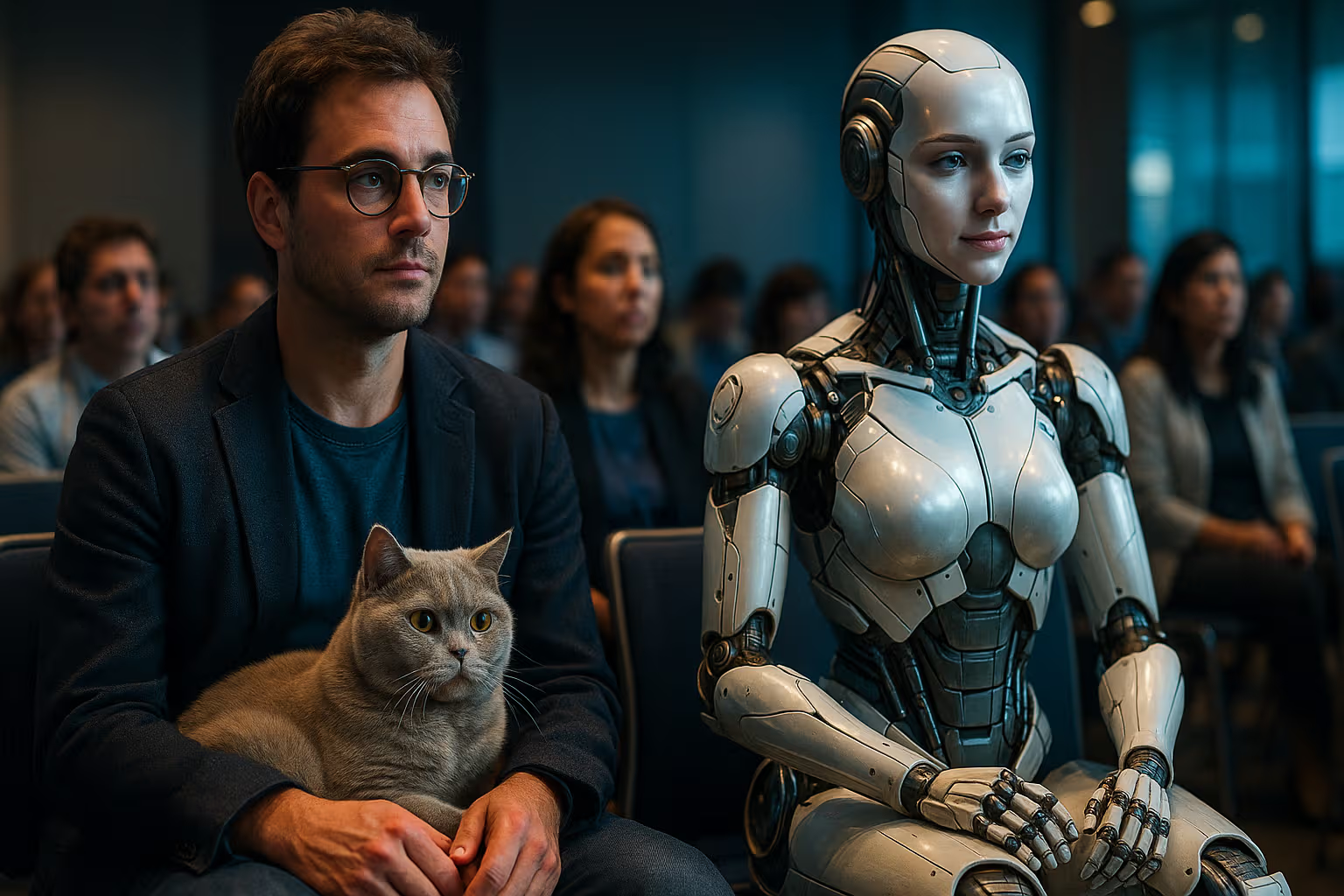
My British lilac cat, Mochi, doesn’t understand any of this. She sees me talking to my computer and typing occasionally. From her perspective, I’ve been doing the same thing for years. She’s not entirely wrong—the essence of my work (solving problems, building systems) hasn’t changed. The mechanics have changed dramatically.

AI coding assistants are the next abstraction layer. They don’t replace programming—they change what programming looks like. The question isn’t whether this happens but what skills matter when it does.
What “95% of Code” Actually Means
The “95%” figure is illustrative, not predictive. It represents a world where the majority of code that gets written emerges from AI, with humans directing rather than typing.

This doesn’t mean:
- Humans are unnecessary
- All programming jobs disappear
- Anyone can build complex systems
- AI understands what to build
- Quality is automatic
This does mean:
- The typing-to-thinking ratio inverts
- Velocity increases dramatically
- Entry barriers shift
- Skill requirements change
- New failure modes emerge
Understanding this distinction matters. The doom-and-boom narratives both miss the nuance of what’s actually changing.

The Changing Skill Stack
When AI writes most code, some skills become less valuable while others become more valuable. Let’s be specific:
Skills That Decline in Importance
Syntax memorization: Knowing that Python uses def while JavaScript uses function matters less when AI handles the translation.
Boilerplate writing: The tedious setup code that frameworks require—imports, configurations, standard patterns—AI handles this trivially.
API lookup: Remembering function signatures and parameters becomes unnecessary when AI knows every API.

Language switching: Moving between languages requires less effort when AI handles the syntactic differences.
Debugging typos: AI-generated code has fewer typos and syntax errors (though it has other errors).
Skills That Increase in Importance
Problem decomposition: Breaking complex problems into components that AI can handle—this becomes the core skill.
Requirements specification: Clearly describing what needs to be built—AI can only build what it understands.
Architecture design: Deciding how systems should be structured—AI can implement architectures but struggles to design them well.

Code review: Evaluating AI output for correctness, security, performance, and maintainability—this becomes essential.
Context management: Providing AI with relevant context and constraints—the quality of output depends on input quality.
System integration: Connecting components into working systems—AI builds parts but humans compose wholes.
Testing strategy: Determining what to test and how—AI can write tests but humans decide what matters to verify.
flowchart TD
    A[Traditional Programming Skills] --> B{AI Coding Era}

    B --> C[Declining Value]
    C --> C1[Syntax Memorization]
    C --> C2[Boilerplate Writing]
    C --> C3[API Lookup]
    C --> C4[Language Fluency]

    B --> D[Increasing Value]
    D --> D1[Problem Decomposition]
    D --> D2[Requirements Clarity]
    D --> D3[Architecture Design]
    D --> D4[Code Review]
    D --> D5[Testing Strategy]
    D --> D6[System Integration]
The New Programming Workflow
What does actual programming look like when AI writes most code? Based on current trajectories:
Phase 1: Specification
You describe what you want to build. This isn’t vague—it’s precise. “Build a user authentication system” produces generic results. “Build a user authentication system using JWT tokens with 24-hour expiry, supporting email/password and OAuth through Google and GitHub, with rate limiting of 5 attempts per minute per IP, storing users in PostgreSQL with bcrypt hashing” produces specific, usable code.
The specification phase is where most work happens. Thinking through requirements, constraints, edge cases, and interfaces—this is programming now.

Phase 2: Generation
AI generates code based on your specification. This happens fast—seconds to minutes for most components. The generation might happen through:
- Chat interfaces (describe what you want)
- Inline completion (write a comment, get implementation)
- Specification documents (structured requirements that AI processes)
- Voice interaction (describe verbally, get code)
Phase 3: Review
You review what AI generated. This is critical—AI makes mistakes. You check:
- Does this actually do what I asked?
- Are there security vulnerabilities?
- Is the performance acceptable?
- Are edge cases handled?
- Is the code maintainable?
Phase 4: Iteration
You refine through conversation. “Make the error messages more specific.” “Add logging for debugging.” “Handle the case where the database connection fails.” Each iteration improves the code.
Phase 5: Integration
You connect AI-generated components into working systems. This requires understanding how pieces fit together, managing state, handling data flow, and ensuring coherent behavior across components.
Phase 6: Testing and Verification
You verify the system works correctly. AI can write tests, but you determine what tests are needed. You define acceptance criteria. You verify behavior matches intent.

The New Failure Modes
AI-assisted coding introduces failure modes that didn’t exist before:
Confident Incorrectness
AI generates plausible-looking code that doesn’t work correctly. It compiles. It passes superficial inspection. But it has subtle bugs. The confidence of AI presentation makes these harder to spot than obviously broken code.
Mitigation: Never assume AI output is correct. Test everything. Review critically.

Context Mismatch
AI generates code appropriate for a different context than yours. Maybe it assumes a different framework version, a different deployment environment, or different requirements than you have.
Mitigation: Provide extensive context. Specify versions, constraints, and assumptions explicitly.
Security Blindspots
AI trained on open-source code may reproduce common vulnerabilities. It might suggest patterns that were acceptable years ago but are now known to be insecure.
Mitigation: Security review all AI-generated code. Use security scanning tools. Don’t trust AI for security-critical logic.

Integration Chaos
Individual components work but don’t integrate well. AI generates each piece in isolation, potentially with incompatible assumptions.
Mitigation: Define interfaces carefully upfront. Review integration points specifically.
Maintenance Burden
AI-generated code might work but be hard to maintain—unusual patterns, poor naming, inconsistent style. Future developers (including future you) struggle to understand it.
Mitigation: Review for maintainability, not just correctness. Refactor AI output to match your team’s conventions.

Specification Debt
When code is cheap to generate, you might skip proper specification. “Just ask AI for something close, then iterate.” This creates systems where nobody fully understands what the code is supposed to do.
Mitigation: Maintain proper specifications and documentation even when code comes from AI.
The Team Structure Changes
Development teams change when AI writes most code:
Fewer Coders, More Reviewers
The rate-limiting step shifts from code production to code review. Teams need people who can evaluate AI output effectively—this requires deep expertise.

Product-Engineer Convergence
When coding requires less specialized skill, the boundary between product thinking and engineering implementation blurs. Product people who understand systems can direct AI. Engineers who understand users can specify requirements.
Specialists for Critical Systems
AI-generated code is fine for many applications. For security-critical, safety-critical, or performance-critical systems, human specialists remain essential—not to write all code but to design, review, and verify.
New Roles Emerge
“Prompt engineers” is the early label, but the mature role is more nuanced: people who excel at translating business needs into specifications AI can execute, who understand both the domain and AI capabilities.

What Junior Developer Means Now
The traditional junior developer role—writing simple code, learning patterns, gradually taking on complexity—transforms:
The Old Path
Learn syntax → Write basic functions → Copy patterns → Build small features → Understand systems → Design components → Architect systems
The New Path
Understand problems → Specify clearly → Evaluate AI output → Integrate components → Understand systems → Design architectures → Direct complex development

The learning progression changes. New developers don’t start by learning to write for-loops—they start by learning to specify what they want and evaluate whether they got it.
This has implications:
Lower barrier to producing code: Anyone who can describe what they want can get code.
Higher barrier to producing good code: Evaluating AI output requires understanding that doesn’t come from prompting.
Faster feedback loops: New developers see working code quickly, learning from AI’s solutions.
Dangerous false confidence: Producing working code doesn’t mean understanding it.

The Education Challenge
Computer science education must evolve. Teaching syntax and algorithms remains valuable for understanding, but the emphasis shifts toward:
- Problem decomposition and specification
- System design and architecture
- Security and reliability engineering
- Testing and verification methods
- AI collaboration techniques
The fundamentals still matter—you can’t evaluate code you don’t understand. But the fundamentals serve different purposes: enabling judgment rather than enabling typing.
The Economic Implications
When AI writes most code, the economics of software development change:

Development Costs Drop
The labor required to produce software decreases. This doesn’t mean software becomes free—specification, review, integration, and maintenance still require skilled humans. But the typing-intensive part becomes cheap.
More Software Gets Built
Lower development costs mean more software is economically viable. Ideas that didn’t justify the investment now do. Custom software replaces off-the-shelf compromises.
Quality Becomes Differentiator
When everyone can produce code cheaply, quality differentiates. Reliability, security, performance, user experience—these matter more when basic functionality is commoditized.

Maintenance Multiplies
More software means more maintenance. The cheap-to-create, hard-to-maintain problem intensifies. Organizations that solve maintenance challenges have advantage.
Developer Compensation Bifurcates
The “middle” of developer compensation compresses. Routine coding pays less as AI handles it. Architecture, security, and complex system design pay more as these remain human domains. The spread between junior and senior compensation widens.
What Companies Should Do Now
For organizations preparing for this future:

Invest in Code Review Capabilities
Review becomes the bottleneck. Train developers to evaluate AI output critically. Establish review processes that catch AI-specific failure modes.
Strengthen Architecture Functions
Design decisions matter more when implementation is cheap. Invest in architects who can make good structural choices.
Improve Specification Practices
Good specifications become competitive advantage. Invest in requirements engineering, technical writing, and specification tools.

Build Testing Infrastructure
Automated testing becomes more important when code generation is automated. Invest in test frameworks, CI/CD, and verification tools.
Rethink Team Structures
Start experimenting with team compositions that assume AI handles most coding. What roles are needed? What skills matter?
Monitor AI Capabilities
The capabilities change rapidly. Stay current on what AI can and can’t do. Adjust practices as capabilities evolve.
Method
This analysis of programming’s future combines several approaches:

Step 1: Current State Assessment I examined current AI coding tools (Copilot, Cursor, Claude, ChatGPT for code) to understand present capabilities and trajectories.
Step 2: Historical Pattern Analysis I studied previous abstraction transitions (assembly to high-level languages, manual coding to frameworks) to identify patterns that might repeat.
Step 3: Expert Interviews Conversations with senior engineers, engineering managers, and AI researchers informed understanding of practical implications.

Step 4: Workflow Observation I observed how developers currently use AI tools, identifying emerging practices and problems.
Step 5: Scenario Modeling I modeled different futures based on different AI capability trajectories to understand which implications are robust across scenarios.
The Timeline Question
When does 95% AI-written code become reality? The honest answer: uncertain.

Optimistic view: For many applications, we’re already there. Boilerplate-heavy projects with standard patterns can be 90%+ AI-generated today.
Conservative view: Complex systems with unusual requirements, strict security needs, or novel algorithms remain largely human-written. Getting to 95% overall might take 10+ years.
Realistic view: The transition is gradual and uneven. Some code categories hit 95% soon; others take much longer. The aggregate percentage matters less than adapting to whatever the current state is.
The strategy is the same regardless of timeline: develop the skills that remain valuable, build organizations that can leverage AI effectively, and stay adaptable as capabilities evolve.

The Skills to Develop Now
Regardless of timeline, these skills appreciate:
1. Problem Decomposition
Practice breaking complex problems into components. What are the pieces? How do they interact? What can be handled independently? This skill transfers regardless of whether humans or AI implement the components.
2. Clear Communication
Describing requirements precisely—unambiguous, complete, testable. This is hard. Practice writing specifications. Practice explaining systems to people who don’t know the context.

3. System Design
Understanding how components fit together. Data flow, state management, failure modes, scaling considerations. AI generates components; humans compose systems.
4. Critical Evaluation
Reading code (AI-generated or not) and assessing it. Does it work? Is it secure? Is it performant? Is it maintainable? This requires deep understanding that comes from experience.
5. Domain Expertise
Understanding the problem domain—business logic, user needs, industry constraints. AI doesn’t know your domain; you teach it. Deep domain knowledge becomes more valuable when implementation becomes commoditized.

6. Testing Mindset
Thinking about how things can fail. Edge cases, unexpected inputs, integration problems, race conditions. AI might write tests; humans determine what to test.
7. AI Collaboration
Getting the most out of AI tools. Effective prompting, context management, iteration strategies. This is a skill that improves with practice.
Generative Engine Optimization
The connection between AI-written code and Generative Engine Optimization is direct—both involve effectively directing AI to produce useful output.

The skills that make you effective at AI-assisted coding are the same skills that make you effective at GEO broadly:
Clear specification: Describing what you want precisely enough that AI can deliver it.
Context provision: Giving AI the information it needs to produce relevant output.
Iterative refinement: Improving AI output through targeted feedback.
Quality evaluation: Assessing AI output critically rather than accepting it blindly.
Integration ability: Combining AI-generated components into coherent wholes.

For practitioners, AI-assisted coding is excellent GEO practice. Every coding session is prompt engineering in action. The feedback is immediate—code works or doesn’t. The iteration is rapid. The skills transfer to other AI interaction contexts.
Understanding how to collaborate with AI on code—where AI excels, where it struggles, how to compensate for weaknesses—provides mental models applicable to AI collaboration generally.
What Won’t Change
Amid the changes, some things persist:

Understanding Matters
AI can generate code you don’t understand, but you can’t maintain what you don’t understand. Deep knowledge remains valuable—not for typing but for judgment.
Complexity Remains
The problems AI solves enable tackling harder problems. The overall complexity of systems increases. Software engineering remains intellectually demanding, just at different levels.
Quality Requires Effort
Good software requires taste, judgment, and care—qualities AI doesn’t possess. Producing working code is easier; producing excellent code still requires expertise.

Users Matter
Software exists to serve users. Understanding users, their needs, and their contexts remains essential. AI doesn’t know your users; you do.
Security is Hard
Secure systems require adversarial thinking—anticipating attack vectors, understanding threat models, implementing defense in depth. AI reproduces patterns; security requires creativity.
Maintenance Persists
Most software effort is maintenance, not creation. Understanding existing systems, debugging production issues, extending functionality—these remain challenging.

Final Thoughts
Mochi has watched me code for years. She doesn’t understand the change happening—from typing syntax to directing AI. To her, I still stare at a screen and occasionally make frustrated noises. She’s not entirely wrong. The essential nature of software development—solving problems, building systems, serving users—persists.
What changes is the mechanics. I type less. I specify more. I review extensively. I integrate carefully. The thinking remains; the typing diminishes.

This is continuation, not revolution. Assembly programmers became C programmers. Manual memory managers became garbage-collection users. Framework avoiders became framework users. Each transition felt like the end of programming. Each was actually the beginning of the next phase.
AI writing 95% of code is another transition. It doesn’t end programming—it transforms programming. The people who thrive are those who recognize what changes and what persists, who develop the skills that appreciate, who adapt to new workflows while maintaining timeless principles.
The future of programming isn’t typing code. It’s directing intelligence toward solving problems. That’s not a lesser form of programming. It might be what programming was always meant to become.
Start practicing now. The transition is already underway.