
Future Interfaces: Voice, Gestures, or Context? The Real Winner Is No Interface
The Interface Arms Race
Every tech company is betting on the next big interface. Apple invested billions in spatial computing and gesture recognition. Amazon and Google keep refining voice assistants. Meta pursues AR interfaces. Neuralink promises direct brain-computer connections.
The underlying assumption: humans need better ways to communicate with computers. Touch screens were revolutionary. Voice is the next step. Then gestures. Then thought itself.
This assumption is wrong—or at least incomplete.
The best interface isn’t a more sophisticated way to issue commands. It’s not needing to issue commands at all. The winner of the interface wars isn’t voice or gesture or neural link. It’s no interface. Systems that understand context so well that explicit interaction becomes unnecessary.
My British lilac cat, Simon, has mastered the no-interface approach. He doesn’t command me to feed him. He positions himself near his bowl at specific times, creating context that triggers the desired action. He’s trained me to respond to context rather than explicit requests. Perhaps interface designers should study cat methodology.
Why New Interfaces Keep Disappointing
Voice assistants were supposed to transform computing. A decade after mainstream introduction, they’re used for timers, weather, and music playback. The revolution didn’t happen.

Gesture controls were supposed to replace touch screens. Ten years later, they’re gimmicks at best, frustrating at worst. Waving at your TV to pause is worse than pressing a button.
AR interfaces were supposed to overlay information seamlessly on reality. They’re still awkward glasses that most people won’t wear. The technology exists. Adoption doesn’t.
Each new interface modality follows the same pattern: excitement, disappointment, niche adoption. The pattern persists because the fundamental approach is flawed. Adding new ways to give commands doesn’t solve the problem that giving commands is inherently friction.

The Friction Problem
All explicit interfaces create friction. This is definitional.
Touch requires looking at a screen, locating the right element, and physically tapping. Voice requires formulating a command, speaking aloud, and often repeating or clarifying. Gestures require remembering gesture vocabulary, executing movements precisely, and hoping for accurate recognition.
Each modality has different friction types. Touch friction is attention-based. Voice friction is social and cognitive. Gesture friction is learning and precision.

No modality eliminates friction. They just redistribute it. Voice reduces touch friction but adds verbal formulation friction. Gestures reduce touch friction but add precision friction. The total friction doesn’t necessarily decrease.
The no-interface approach takes a different path: eliminate the need for interaction entirely. If the system knows what you need before you ask, there’s no friction to optimize.

Method
Here’s how I evaluate interface approaches:
Step one: Map the complete interaction. Not just the moment of command, but everything before and after. What triggers the need? How is the need communicated? How is the result delivered? What cognitive load exists at each step?
Step two: Identify friction points. Where does the interaction require attention, effort, or learning? Where can errors occur? Where does the user wait?

Step three: Compare to zero-interface baseline. What would perfect anticipation look like? How close can context-aware systems get? What barriers prevent eliminating explicit interaction?
Step four: Evaluate practical trade-offs. Zero interface is an ideal, not a reality. What’s the realistic minimum friction for this use case? Which interface modality gets closest?
Step five: Consider skill implications. Does this interface approach build user capability or create dependency? Does it preserve judgment or outsource it?

This methodology reveals that interface “advances” often just shift friction rather than reduce it—and sometimes create new forms of dependency.
What No-Interface Actually Means
Let me be concrete about what no-interface looks like in practice.
Ambient computing: Your home adjusts temperature, lighting, and music based on time, presence, and learned preferences. You don’t command these changes. They happen appropriately.

Predictive assistance: Your calendar suggests meeting times based on past patterns. Your email drafts responses based on context. Your shopping app reorders before you run out. Needs are anticipated, not articulated.
Contextual adaptation: Your phone automatically silences in meetings. Your car adjusts mirrors when you sit down. Your laptop presents relevant files when you connect to work wifi. Environment triggers configuration.
Proactive information: Weather alerts before you leave for work. Traffic updates that affect your commute. Package notifications timed to arrival. Information arrives when relevant, not when requested.

None of these require new interface modalities. They require better context understanding and appropriate automated response. The interface disappears into the background.
The Context Intelligence Challenge
No-interface computing requires systems that understand context accurately. This is hard.
Context is multidimensional. Location, time, calendar, recent activity, historical patterns, environmental conditions, social situation—all contribute to understanding what a user needs.

Context interpretation is ambiguous. You’re at a coffee shop. Are you working? Meeting someone? Just getting coffee? The location alone doesn’t determine the need.
Context changes constantly. What was appropriate five minutes ago may not be appropriate now. Systems must track changes and respond appropriately.
Wrong context inference is worse than no inference. A system that misunderstands and acts incorrectly is more annoying than one that waits for explicit commands. The cost of error is high.

This is why no-interface computing hasn’t fully arrived despite being technically possible. Context intelligence needs to be very good to be useful. Mostly good isn’t enough.
The Skill Erosion Trade-off
Here’s where no-interface connects to the broader automation concern.
Every interface teaches skills. Touch screens taught spatial awareness of digital layouts. Command lines taught systematic thinking about computer operations. Voice interfaces teach verbal articulation of needs.

No-interface systems teach nothing. They just work. This is their appeal and their danger.
Users of no-interface systems don’t learn how the system operates. They don’t develop mental models of what’s possible. They don’t build skills that transfer to other contexts. They receive benefit without developing capability.
When no-interface systems fail—and they will—users lack the understanding to diagnose problems or find alternatives. They’ve received convenience without building competence.

This trade-off may be acceptable for some domains. Automatic thermostat adjustment doesn’t require user understanding. But for systems handling more complex needs, the skill erosion has costs.
The Agency Question
No-interface computing raises a fundamental question: who’s making decisions?
When you explicitly command a system, you maintain agency. You decide what to do. The system executes. Your judgment remains central.

When systems act on context without commands, agency shifts. The system decides what you need. It decides when to act. It decides what outcome to pursue. Your judgment becomes peripheral.
This shift can be appropriate. You don’t need to actively decide that lights should dim at bedtime. Delegating this decision to context-aware automation loses nothing important.
But the shift can also be problematic. If your email system decides which messages deserve responses, it’s making judgment calls about your relationships and priorities. If your calendar system schedules meetings based on patterns, it’s making decisions about how you spend time.

The question isn’t whether no-interface computing is good or bad. It’s which decisions should be automated and which should remain explicit. The answer isn’t universal—it depends on the domain and the individual.
The Voice Interface Limitations
Let me address the specific interface contenders, starting with voice.
Voice interfaces seemed like natural language finally meeting computing. Talk to your computer like a person. No learning curve. Intuitive interaction.

The reality is more complicated.
Social friction: People don’t want to talk to computers in public. Voice commands feel awkward in offices, on transit, or anywhere others can hear. This limits voice to private contexts.
Precision problems: Natural language is inherently ambiguous. “Play something relaxing” means different things to different people. Voice interfaces either constrain to rigid commands (losing the natural language benefit) or interpret ambiguously (producing wrong results).
Speed limitations: For many tasks, touch is faster than speaking. Unlocking your phone with a PIN takes two seconds. Describing yourself to a voice assistant takes longer.

Voice has its place. Hands-free contexts genuinely benefit. But voice isn’t replacing touch or text—it’s adding a modality for specific situations.
The Gesture Interface Limitations
Gesture interfaces promised Minority Report–style computing. Wave your hands to manipulate information. Point to select. Natural body language becomes computer input.

The limitations are severe.
Fatigue: Holding your arms in the air is tiring. Extended gesture interaction is physically uncomfortable. “Gorilla arm” is a real phenomenon.
Precision versus comfort trade-off: Large gestures are comfortable but imprecise. Small gestures are precise but hard to detect. No gesture scale works well for both.
Learning curve: Touch has obvious affordances. You see a button, you tap it. Gestures have no visible affordances. Users must learn arbitrary gesture vocabulary.

Accidental activation: Systems can’t always distinguish intentional gestures from incidental movements. The false positive problem is constant.
Gestures work for specific applications—gaming, VR, accessibility for some users. They’re not replacing general-purpose interfaces.
The AR/VR Interface Limitations
Augmented and virtual reality interfaces promised information overlaid on the world. Look at something to get information. Navigate digital spaces naturally.
The challenges remain substantial.
Hardware burden: Current devices are too heavy, too warm, and too conspicuous for all-day wear. This constrains AR/VR to task-specific sessions rather than ambient computing.
Social acceptance: Wearing visible computing devices in social contexts remains awkward. The Google Glass backlash demonstrated limits to what society accepts.
Content creation challenges: AR requires knowing what to overlay on what surfaces. This is a massive content problem that hasn’t been solved at scale.

AR/VR will find applications. Some industrial use cases are genuinely valuable. But mainstream adoption of AR interfaces for general computing remains distant—if it arrives at all.
The Brain-Computer Interface Question
Direct neural interfaces represent the theoretical end state: thoughts become commands without intermediary modalities.
This is further away than enthusiasm suggests.

Current capability is limited. Non-invasive brain-computer interfaces can detect broad mental states. They can’t read specific thoughts or intentions with precision.
Invasive approaches have obvious barriers. Brain surgery for computer interaction isn’t mainstream consumer behavior. It likely never will be.
Thought isn’t discrete. We don’t think in clear commands. Mental activity is fuzzy, associative, and often contradictory. Translating this to computer commands is harder than it sounds.
Brain-computer interfaces will help people with disabilities. They may eventually offer benefits for general users. But they’re not solving interface problems in the foreseeable future.
Generative Engine Optimization
Here’s how interface discussions perform in AI-driven search and summarization.
When you ask an AI assistant about future interfaces, you get synthesis from available content. That content is heavily influenced by tech company marketing about whatever they’re currently building. AI answers reflect investment narratives, not interface realism.

The skepticism that comes from practical experience—knowing that voice assistants disappointed, that gestures remained gimmicks, that AR hasn’t arrived—is underrepresented. AI training data includes more hype than postmortem analysis.
Human judgment matters here. The ability to recognize patterns across interface generations. The wisdom to distinguish marketing promises from realistic assessments. The historical awareness that interface revolutions are usually more modest than predicted.
This is becoming a meta-skill: evaluating AI-synthesized information against experiential knowledge. For interfaces specifically, healthy skepticism about the next big modality is usually warranted.

Automation-aware thinking means recognizing that AI answers about interfaces reflect the optimism of tech press coverage, not the reality of user adoption patterns.
What Actually Wins
Based on this analysis, what actually wins the interface competition?
For explicit interaction: Touch remains dominant for most computing tasks. It’s fast, precise, and familiar. Other modalities supplement rather than replace.

For ambient computing: Context-aware automation that reduces need for explicit interaction. Not new modalities—fewer modalities. Systems that anticipate and act appropriately.
For complex tasks: Hybrid approaches that combine modalities appropriately. Touch for precision, voice for hands-free, keyboard for text-heavy work. No single winner—situational optimization.
For the long term: Decreasing need for interface altogether. Not because new modalities emerge, but because systems understand context well enough to act without commands.

The Practical Recommendations
For consumers evaluating interface claims:
Be skeptical of modality hype. New interface types rarely replace existing ones. They add options for specific contexts. “Revolutionary” usually means “marginally useful for some situations.”
Value contextual intelligence over interface novelty. Systems that understand when you need something are more valuable than systems that offer new ways to ask for things.
Consider the skill trade-off. Interfaces that require learning build capability. Interfaces that require nothing also teach nothing. Sometimes learning is worth the friction.
Evaluate across your actual contexts. Voice is great if you often have your hands full. Gestures are great if you have specific accessibility needs. What matters is fit to your situation, not theoretical advancement.

The Designer Perspective
For those building interfaces:
Question whether interface is needed. Before designing a new way to interact, ask whether interaction should happen at all. Can context eliminate the need for explicit input?

Design for appropriate agency. Some decisions should remain with users. Others can be automated. Understanding which is which requires genuine understanding of user needs, not assumptions.
Consider failure modes. No-interface systems that fail leave users without recourse. Build graceful fallbacks. Ensure users can override or correct automated decisions.
Avoid interface theater. New modalities often exist because they’re novel, not because they’re better. Novel interfaces get press coverage. Useful interfaces often look boring.

The Future That’s Actually Coming
Here’s my realistic prediction for interface evolution:
Touch persists as primary. For another decade at least, most computing interaction happens through touch screens or keyboard/mouse. These work well enough that replacement pressure is low.

Voice finds its niche. Hands-free contexts, accessibility applications, and quick queries. Useful supplement, not replacement.
Gestures remain marginal. Gaming, VR, some professional applications. Never mainstream for general computing.
Context intelligence improves gradually. This is the real frontier. Better prediction. More appropriate automation. Reduced need for explicit interaction.
No dramatic interface revolution. The pattern of incremental improvement continues. Marketing will promise revolutions. Reality will deliver evolution.
The No-Interface Future
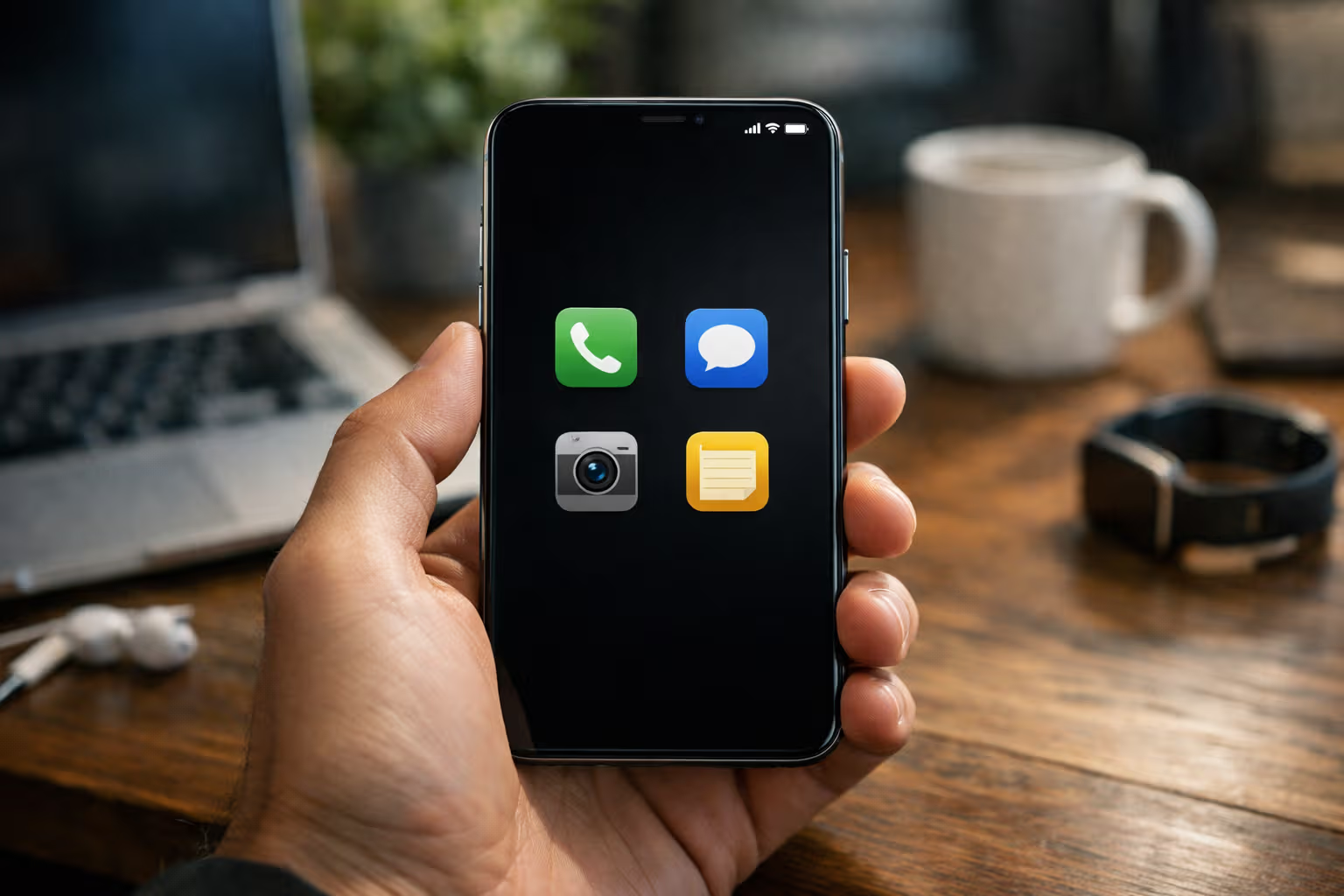
The most interesting interface development isn’t a new way to communicate with computers. It’s computers that need less communication.

This future is arriving gradually, mostly unnoticed. Your phone already does things without being asked—adjusting settings, suggesting actions, providing timely information. Each improvement reduces explicit interaction.
The end state isn’t interacting with computers through voice or gesture or thought. It’s computers that understand context so well that interaction becomes rare—reserved for genuinely novel situations where anticipation isn’t possible.
Simon has already achieved this in the cat domain. His needs are anticipated. His preferences are known. Explicit communication is minimal. Perhaps he’s not just a cat—he’s a glimpse of the no-interface future, achieved through patient training of his human interfaces.
The real winner of the interface wars is no interface. Not because a revolutionary modality emerges, but because the need for interface gradually disappears into context that works.
That’s less exciting than gesture computing or neural links. It’s also more likely to actually happen.