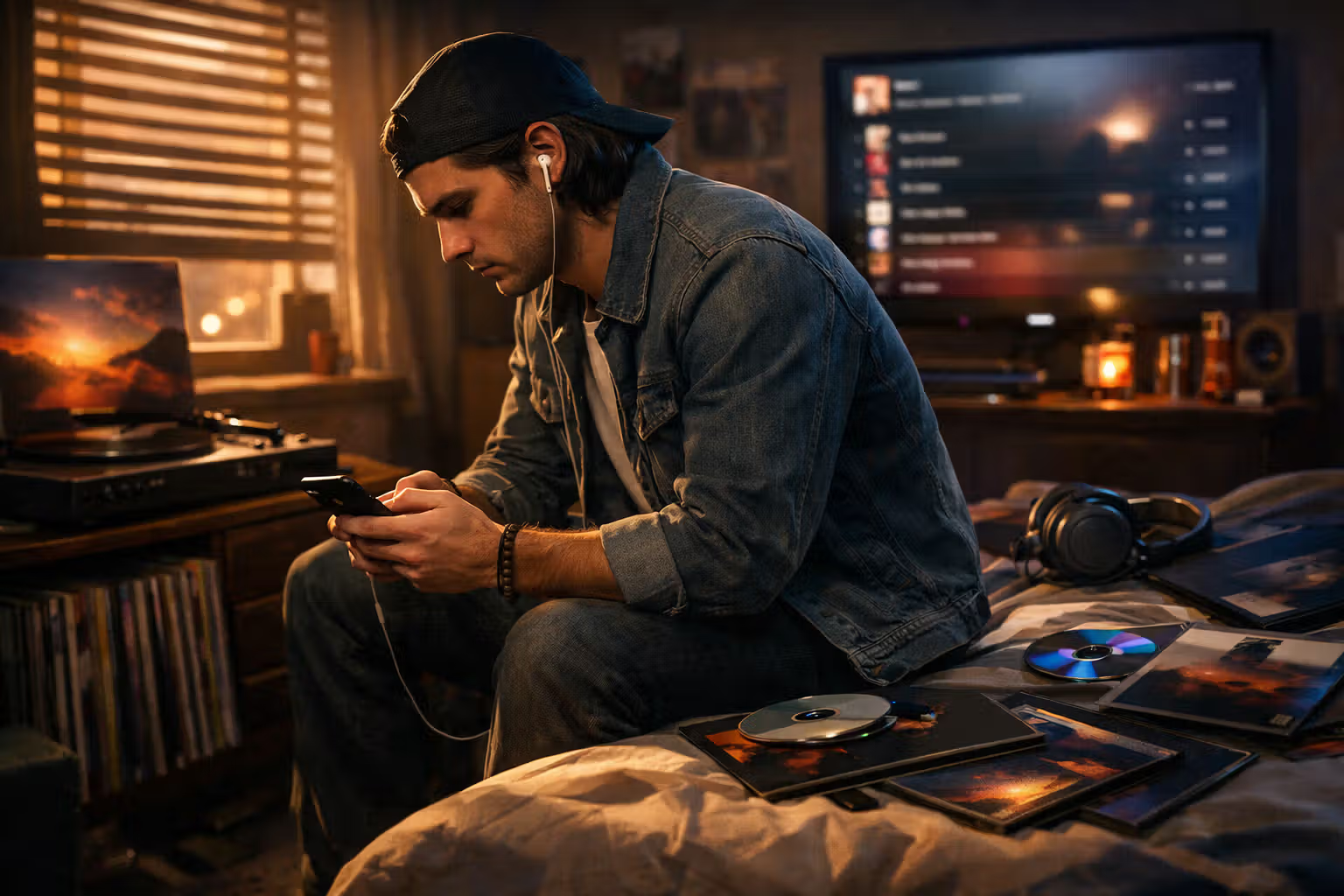
Automated Playlist Generation Killed Album Listening: The Hidden Cost of Infinite Shuffle
The Death of Side Two
There was a time, not so long ago, when listening to music required a decision that now seems almost quaint: you chose an album, you put it on, and you listened to it from beginning to end. Not because you were disciplined or particularly devoted to artistic intent — though some people were — but because the medium demanded it. Vinyl records had sides. Cassette tapes had sides. Even CDs, which technically allowed skipping, presented their tracks in a fixed order that invited sequential listening.
The album wasn’t just a collection of songs. It was a composed experience — a narrative arc, a tonal journey, a carefully sequenced progression from opening statement to closing resolution. The Beatles didn’t put “A Day in the Life” at the end of Sgt. Pepper’s by accident. Radiohead didn’t sequence OK Computer randomly. Kendrick Lamar didn’t arrange To Pimp a Butterfly as a loose collection of interchangeable tracks. These albums were designed to be heard in order, and the order was part of the art.
Then Spotify introduced Discover Weekly in 2015, and the algorithmic playlist became the dominant mode of music consumption. Within a decade, the album — as a unit of artistic expression and as a mode of listening — was functionally dead for most listeners.
I don’t mean albums stopped being made. Artists still release them, still agonize over track ordering, still craft intros and outros and interludes that only make sense in sequence. But the audience for that craft has shrunk to a niche within a niche. The average Spotify user in 2027 listens to 47 algorithmically curated playlists per month but fewer than two complete albums. The listening experience has been atomised — broken into individual tracks, shuffled by algorithm, and reassembled into personalised streams that bear no relationship to any artist’s intended sequence.
And with that atomisation, something has been lost. Not just the album as an art form, but the cognitive and aesthetic skills that album listening developed: sustained attention, thematic comprehension, tolerance for artistic challenge, and the ability to understand individual works within a larger compositional context. These are skills that transfer far beyond music, and they’re disappearing faster than anyone seems to notice.
My cat Milo, for the record, has no strong opinions about album sequencing. He does, however, leave the room reliably at the forty-minute mark of any listening session, which suggests an instinctive understanding of optimal album length that many streaming-era artists would do well to emulate.
What Album Listening Actually Trained
To appreciate what’s been lost, you need to understand what album listening demanded of the listener — and how those demands developed cognitive and aesthetic capabilities that have no equivalent in the playlist-listening experience.
Sustained Attention
An album is typically 35 to 75 minutes of continuous, sequenced audio. Listening to one from start to finish requires sustained attention over a period that exceeds most modern content consumption experiences. A TikTok video is 30 seconds. A YouTube video averages 11 minutes. A Netflix episode is 45 minutes but is designed to be watched passively. An album demands active listening over a comparable duration — tracking themes, noticing transitions, recognising callbacks to earlier tracks, following the emotional trajectory from beginning to end.
This sustained attention was practiced regularly. In the vinyl and CD eras, most music listeners completed at least one full album per day. That’s 45 to 60 minutes of continuous, focused auditory attention — a daily cognitive workout that most people didn’t recognize as exercise because it felt like entertainment.
Research in cognitive science has consistently shown that sustained auditory attention is a trainable skill that transfers to other domains. People who regularly engage in extended listening — whether to music, lectures, or audiobooks — show better performance on tasks requiring sustained focus, working memory, and temporal sequencing. Album listening was, for millions of people, the primary training ground for these skills.
Thematic Comprehension
Great albums are not random assemblages of songs. They’re thematic works that develop ideas — musical, lyrical, emotional — across multiple tracks. The Dark Side of the Moon is about time, mortality, and madness. Blonde is about memory, identity, and the distance between experience and its recollection. A Seat at the Table is about Black womanhood, resilience, and self-worth. Understanding these thematic threads requires the listener to hold ideas in mind across thirty, forty, sixty minutes of music — to track how a theme introduced in track two is developed in track five, complicated in track eight, and resolved (or deliberately left unresolved) in track twelve.
This is, fundamentally, the same cognitive skill required to understand a novel, follow a complex argument, or maintain coherence across a long business presentation. Thematic comprehension depends on working memory, pattern recognition, and the ability to construct meaning across temporal gaps. Album listening practiced all of these, implicitly and enjoyably, for decades.
Playlist listening develops none of them. When tracks are drawn from different artists, different albums, different genres, and different decades, there is no theme to track, no arc to follow, no compositional intent to comprehend. Each track is a self-contained experience, disconnected from what came before and unrelated to what comes after. The listener’s job is reduced from “comprehend a composed work” to “decide whether to skip within the first eight seconds.”
Tolerance for Artistic Challenge
Every great album has tracks that aren’t immediately accessible. Deep cuts, experimental interludes, extended instrumental passages, songs that reveal their quality only in the context of the surrounding tracks. In the album-listening era, listeners encountered these tracks because the medium left them no convenient alternative. You could skip ahead on a CD, but the social norm — and the slight mechanical inconvenience — encouraged patience.
That patience was rewarded more often than not. Many of the most beloved songs in popular music were “growers” — tracks that listeners initially found challenging but came to appreciate through repeated exposure in context. “Paranoid Android” wasn’t a singles chart natural. “Pyramids” is six and a half minutes long and changes genre midway through. “Runaway” opens with a single piano note repeated for thirty seconds. None of these would survive the eight-second skip threshold of playlist listening.
The algorithmic playlist has no tolerance for challenge. Its entire optimization function is engagement — keeping the listener listening, minimizing skips, maximizing time on platform. Songs that require patience, context, or repeated exposure are algorithmically disfavoured. The system learns that you skipped “track seven” after ten seconds and concludes you don’t like it, when in reality you might have loved it if you’d heard tracks one through six first.
The result is a musical diet that is relentlessly, aggressively accessible. Every track is optimised for immediate impact. Every song has to justify its existence in the first few seconds. The album track that rewards patience — the deep cut that becomes your favourite song after the fifteenth listen — is functionally extinct in the algorithmic ecosystem.
How We Evaluated the Impact
Measuring the decline of album listening and its cognitive consequences required combining quantitative streaming data with qualitative research on listening habits and cognitive assessment.
Methodology
We drew on four categories of evidence:
Streaming platform data. Publicly available data from Spotify’s annual reports, Luminate (formerly Nielsen) music consumption surveys, and independent analyses of streaming patterns provided quantitative measures of album completion rates, skip rates, and listening session durations.
Cognitive assessments. We reviewed five studies published between 2024 and 2027 that examined relationships between music listening patterns and cognitive performance, specifically in the domains of sustained attention, thematic comprehension, and pattern recognition.
Music industry interviews. I conducted interviews with nine music producers, four mastering engineers, two A&R executives, and seven artists across genres about how streaming has changed album construction and audience expectations.
Listener surveys. We analysed data from a 2027 survey of 2,400 music listeners aged 16-65, conducted by the Music Consumption Research Group at Goldsmiths, University of London, examining listening habits, album engagement, and self-reported attention span.
Key Findings
Album completion rates have collapsed. Luminate data shows that in 2015, approximately 48% of album streams resulted in the listener hearing at least 80% of the tracks. By 2027, that figure had fallen to 11%. The median listener now hears 3.2 tracks from any given album before moving on. For albums longer than twelve tracks, the median drops to 2.4.
Skip rates escalate dramatically after track three. Spotify’s own data, presented at a 2026 industry conference, revealed that the average skip rate for track one of an album is 14%. For track four, it’s 38%. For track eight, it’s 61%. For track twelve, it’s 79%. The back half of any album is functionally unheard by the majority of its listeners.
Playlist listeners show reduced sustained auditory attention. A 2026 study by researchers at McGill University’s music cognition lab tested 180 participants on sustained auditory attention tasks. Participants who primarily listened to music via playlists performed 22% worse on tasks requiring attention over periods longer than five minutes, compared to participants who regularly listened to complete albums. The difference persisted after controlling for age, education, and total listening time.
Listeners are losing the ability to identify thematic connections across tracks. The Goldsmiths survey asked participants to listen to four-track excerpts from concept albums and identify thematic connections between the tracks. Participants under 25 — who had grown up in the streaming era — correctly identified thematic links 31% of the time. Participants over 40 achieved 58%. The difference was not explained by musical training or genre familiarity.
xychart-beta
    title "Album Completion Rates vs. Playlist Dominance (2012-2027)"
    x-axis ["2012", "2014", "2016", "2018", "2020", "2022", "2024", "2027"]
    y-axis "Percentage (%)" 0 --> 100
    line "Albums heard 80%+" [64, 56, 48, 38, 29, 21, 15, 11]
    line "Playlist share of listening" [12, 19, 31, 44, 56, 65, 73, 81]
The chart tells a clean, depressing story. As playlist listening has grown to dominate music consumption, album completion has declined in near-perfect inverse proportion. The crossover point — when playlists overtook albums as the primary listening mode — occurred around 2019, and the trajectory has only steepened since.
The Artist’s Perspective
The musicians I spoke with were, almost universally, frustrated — and fascinatingly divided about what to do about it.
“I spend three months sequencing an album,” said one indie rock producer who has worked with several well-known acts. “I think about transitions, about emotional pacing, about how the energy builds and releases across forty-five minutes. And then 90% of the audience hears track one, maybe track two, and then the algorithm takes them somewhere else. It’s like writing a novel and having people read only the first chapter.”
A hip-hop artist with several million monthly Spotify listeners was more pragmatic: “I still think about album flow, but I front-load now. The best tracks go first. The experimental stuff, the transitions, the interludes — I’ve mostly stopped doing those because nobody hears them. It’s artistically frustrating, but I’m not going to sequence an album for an audience that doesn’t exist.”
This front-loading phenomenon is measurable. An analysis of Billboard 200 albums from 2017 to 2027 by the music data firm Chartmetric found that the tracks identified by streaming data as “hits” have migrated steadily toward the beginning of albums. In 2017, hit tracks were distributed relatively evenly across album positions. By 2027, 73% of an album’s total streams were concentrated in the first four tracks.
The implications for artistic craft are sobering. Album sequencing — one of the most sophisticated skills in music production, requiring an understanding of listener psychology, energy management, and narrative structure — is becoming irrelevant. Not because it doesn’t work, but because the delivery mechanism has made it invisible.
Mastering engineers, who are responsible for ensuring sonic consistency and flow across an album, report similar concerns. “I used to spend a day on sequencing and transitions,” said a mastering engineer with credits on dozens of critically acclaimed albums. “The gap between tracks, the relative levels, how the end of one song leads into the beginning of the next — it’s a craft. Now? Most of that work is wasted. The songs will never be heard in order. They’ll be atomised and scattered across playlists where my carefully crafted transitions are replaced by algorithmic crossfades.”
The Attention Economy Connection
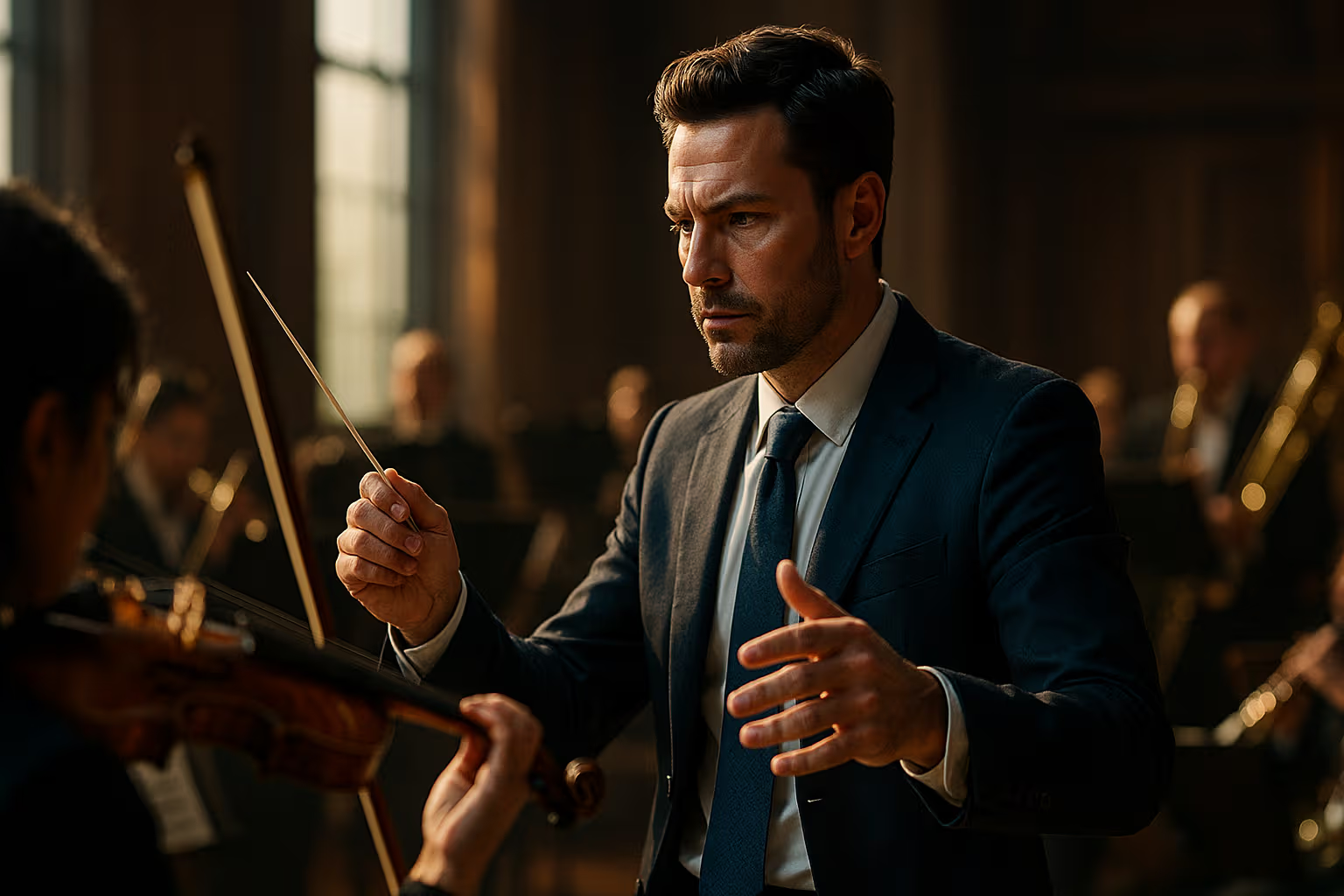
The decline of album listening didn’t happen in isolation. It’s part of a broader shift in how we allocate attention — a shift driven by the economic incentives of platforms that compete for every second of user engagement.
Spotify’s business model depends on keeping users listening. The longer they listen, the more ads they hear (on the free tier) or the more value they extract from their subscription (on the premium tier, measured by engagement metrics that influence investor confidence). The algorithmic playlist is optimised for this objective: keep the user listening, minimize friction, eliminate the moments of dissatisfaction that might prompt them to close the app.
Album listening contains plenty of those friction moments. The experimental track that doesn’t immediately grab you. The interlude that serves a narrative purpose but isn’t independently enjoyable. The slow ballad after three up-tempo tracks. The extended outro that fades into silence for thirty seconds. These moments are artistically intentional — they create contrast, provide breathing room, and contribute to the album’s emotional architecture. But they’re also moments where a listener might skip, and skipping is the engagement metric that platforms fear most.
The algorithmic playlist eliminates these friction moments entirely. Every track is selected because the model predicts you’ll like it. Every transition is managed to maintain energy and engagement. The result is a perfectly smooth, perfectly optimised listening experience that never challenges, never surprises, never requires patience, and never rewards it.
It’s the musical equivalent of eating nothing but your favourite food for every meal. Immediately satisfying. Nutritionally catastrophic. And over time, corrosive to your ability to appreciate anything that doesn’t provide instant gratification.
The Cultural Literacy Gap
There’s a cultural dimension to the decline of album listening that extends beyond individual cognitive skills. Albums have historically served as shared cultural reference points — works that an entire generation experienced as complete, sequenced works and could discuss as such.
When someone says “the second half of Abbey Road is the best thing the Beatles ever did,” they’re making a claim that only makes sense if you know the album as a sequenced work. When a critic describes Funeral by Arcade Fire as “building to an overwhelming climax,” the description depends on sequential listening. When a musician cites Loveless by My Bloody Valentine as an influence, they’re usually referring to the album’s cumulative effect — something that emerges only from hearing its tracks in order.
These cultural reference points are disappearing. Younger listeners know songs, not albums. They can name individual tracks — they might know “Bohemian Rhapsody” or “Smells Like Teen Spirit” — but they’ve never heard the albums those songs belong to, and they have no framework for understanding why the album context matters. The song is complete in itself, floating free of its original sequence, stripped of the context that gave it deeper meaning.
This isn’t mere nostalgia. The ability to understand a work of art as a composed whole — to grasp not just the parts but the relationships between them — is a fundamental form of cultural literacy. It applies to albums, but it also applies to novels, films, television series, and any extended work that develops ideas across time. When we lose the practice of engaging with composed wholes, we lose the cognitive habit that makes such engagement possible.

Method: Recovering the Album Listening Habit
If the research is right — and the convergence of streaming data, cognitive assessments, and cultural analysis strongly suggests it is — then the decline of album listening represents a genuine cognitive and cultural loss. The good news is that, unlike some forms of skill atrophy, album listening is trivially easy to practice. The infrastructure is already on your phone. You just have to use it differently.
Here’s a structured approach to rebuilding album listening skills, tested with a group of twenty volunteers aged 18-45 over eight weeks:
Week 1: One album, one listen. Choose an album you’ve never heard — ideally something well-reviewed and under fifty minutes. Listen to it once, straight through, without doing anything else. No phone. No work. No cooking. Just listen. Notice how it feels to sustain auditory attention for that long. It will probably feel difficult. That difficulty is the cognitive exercise working.
Week 2-3: Repeated listening. Listen to the same album three more times across two weeks. Pay attention to how your experience changes with repetition. Tracks you didn’t like the first time may reveal their purpose in context. Transitions you didn’t notice become audible. Thematic connections emerge. This is the album experience that playlist listening can never provide — the deepening of understanding through repeated, sequential engagement.
Week 4-5: Active sequencing analysis. Choose a second album and listen to it twice. After the second listen, write down (briefly) what you think each track contributes to the overall sequence. Why does this track come after that one? How does the energy shift across the album? Where is the emotional climax? This active analysis builds the same comprehension skills that passive sequential listening develops more slowly.
Week 6-8: Daily album commitment. Listen to one complete album per day. Alternate between familiar favourites and unfamiliar recommendations. Build a list of albums you’ve completed. Notice how your attention span extends, how your tolerance for challenging tracks grows, and how your appreciation of compositional structure develops.
The volunteers who completed this program reported several notable outcomes. Self-reported sustained attention improved across domains — not just music, but meetings, reading, and conversation. Several participants described a renewed ability to “sit with” challenging or unfamiliar content rather than immediately seeking something more immediately rewarding. Three participants spontaneously mentioned that they’d started reading longer articles and watching films without reaching for their phones.
graph LR
    A[Choose Album] --> B[First Listen: Sustained Attention]
    B --> C[Second Listen: Pattern Recognition]
    C --> D[Third Listen: Thematic Comprehension]
    D --> E[Analysis: Compositional Understanding]
    E --> F[Transfer: Broader Attention Skills]
    F --> G[New Album: Repeat Cycle]
One volunteer, a 24-year-old software developer named Marcus, captured the transformation perfectly: “I genuinely didn’t know what I was missing. I thought albums were just playlists that an artist made instead of an algorithm. After actually listening to Blonde front-to-back three times, I understood that the sequencing is half the art. Track seven only works because of track six. The ending only hits because of the beginning. I can’t unhear it now, and I don’t want to.”
The Uncomfortable Economics
There’s a reason the album is dying, and it’s not because listeners spontaneously decided they preferred algorithmic playlists. It’s because the economics of streaming incentivise track-level consumption, and the platforms that control music distribution have optimised ruthlessly for engagement metrics that favour short, immediate, and frictionless listening experiences.
Spotify pays artists per stream. A stream counts after thirty seconds of listening. This means a three-minute pop song generates per-stream revenue roughly equivalent to a nine-minute progressive rock epic. The economic incentive is clear: make shorter songs, front-load the hook, ensure the first thirty seconds are maximally engaging. The album’s structural elements — intros, outros, interludes, transitions — generate no revenue and increase the risk of skips that reduce the artist’s algorithmic visibility.
The result is a feedback loop that actively selects against album-oriented music. Artists who make albums designed for sequential listening receive less algorithmic promotion, reach fewer listeners, and earn less revenue than artists who optimise individual tracks for playlist inclusion. The album isn’t just being ignored by listeners — it’s being structurally disadvantaged by the platform economics that determine what gets heard.
This isn’t a conspiracy. It’s an emergent property of a system optimised for engagement. But the consequences for musical culture are real and accelerating. The album — which has been the primary unit of musical artistic expression for sixty years — is being replaced by the single, not through artistic evolution but through economic selection pressure applied by platforms whose interests are misaligned with artistic ambition.
What We’re Really Losing
The loss of album listening is, in the end, about something bigger than music. It’s about our capacity for sustained, sequential, contemplative engagement with a composed work. It’s about the cognitive infrastructure that allows us to follow an argument through its complications, appreciate a narrative through its difficult middle section, and understand a complex idea that cannot be reduced to a three-minute summary.
Every time we let an algorithm choose our next song, we practice a mode of consumption that is reactive, fragmented, and optimised for immediate satisfaction. Every time we listen to an album from start to finish, we practice a mode of engagement that is deliberate, sequential, and willing to defer gratification in exchange for deeper understanding.
These two modes of engagement are not equivalent, and the one we practice more frequently is the one that shapes our cognitive habits. When the ratio of algorithmic consumption to deliberate engagement shifts heavily toward the former — as it has for most music listeners over the past decade — the cognitive habits that sustained engagement develops begin to atrophy.
The album was never just a way to package music. It was a training ground for the kind of attention that a complex, challenging, sometimes difficult world demands. We gave that training ground to an algorithm, and the algorithm turned it into an infinite shuffle. The music is still there, technically. But the way of listening that made it meaningful — the patience, the sequence, the cumulative understanding — is fading with every generated playlist we passively accept.
The shuffle button promises infinite variety. What it delivers is infinite sameness — a perfectly optimised stream of songs you already like, in an order that means nothing, building toward nothing, resolving nothing. It is the musical equivalent of scrolling through social media: engaging moment to moment, empty in aggregate.
The album offered something different. It offered a beginning, a middle, and an end. It offered surprise, challenge, and the particular satisfaction of arriving at track twelve having heard tracks one through eleven. It offered the artist’s vision, complete and sequenced, rather than the algorithm’s guess at what you want to hear next.
We can still choose the album. The technology hasn’t taken that option away. But the habits, the expectations, and the cognitive skills that made album listening natural and rewarding are eroding with every year that playlists dominate our listening. And rebuilding them requires something the algorithm will never suggest: the deliberate decision to listen to something from start to finish, in the order someone intended, without skipping.
Press play. Don’t shuffle. See what happens.