
A Product Test: 7 Days Without Notifications (What Happens to Focus, Stress, and Decision Quality)
The Premise Nobody Wants to Test
There’s a particular kind of experiment that sounds simple until you actually commit to it. Turning off notifications for a week falls into this category. Everyone agrees notifications are distracting. Everyone also finds reasons why their notifications are somehow essential.
I wanted actual data. Not opinions. Not productivity guru platitudes. Just seven days of personal measurement to see what really happens when the digital noise stops.
The setup was straightforward. Every notification on every device got disabled. Phone, laptop, tablet, watch. Email, Slack, calendar reminders, news apps, social media, even the weather app that insists on telling me about rain I can see through my window. All of it. Gone.

My cat, a British lilac named Tesla, seemed to approve of this experiment. Or perhaps she simply appreciated that my phone would stop buzzing during her designated lap time. Cats have their priorities.
What I Actually Measured
Most notification experiments I’ve read suffer from vague claims. “I felt more focused.” “My stress decreased.” These are feelings, not measurements. I wanted something more concrete.
Here’s what I tracked daily:
Focus sessions: Using a simple timer, I recorded how many uninterrupted 45-minute blocks of deep work I completed. Before the experiment, my baseline averaged 2.3 blocks per day over the previous month.
Cortisol proxy: I don’t have a lab, so I used a validated stress questionnaire (PSS-10) each evening. Not perfect, but consistent enough for comparison.
Decision log: Every significant decision went into a journal with timestamp, context, confidence level at decision time, and a later review of outcome quality.
Response latency: I still checked messages manually. I recorded how long important communications sat before I saw them and whether any delays caused actual problems.

Sleep quality: Using my Apple Watch, I tracked sleep duration and heart rate variability as a rough proxy for recovery quality.
This wasn’t a clinical trial. It was one person, one week, with consistent measurement. The limitations are obvious. But the patterns were still interesting.
How We Evaluated
The method here matters more than most people realize. I’ve seen notification experiments that declare success after two days. That’s not long enough for adaptation effects. The first 48 hours are withdrawal symptoms, not results.
Day one and two were genuinely uncomfortable. My hand reached for my phone approximately every four minutes. I counted. This is called phantom notification syndrome, and it’s well-documented. The brain expects interruptions it has been trained to expect.
Day three through five represented adjustment. The phone-checking habit didn’t disappear, but the urgency behind it faded. I started to notice when I was reaching for distraction versus when I actually needed information.
Day six and seven felt different. Calmer. But also slightly disconnected in ways I hadn’t anticipated.

For each measurement, I compared the seven-day averages against my baseline data from the previous month. I also noted qualitative observations that numbers couldn’t capture.
The goal wasn’t to prove notifications are bad. It was to understand what changes when they’re absent. Those are different questions.
The Focus Data
Let’s start with the most obvious hypothesis: without notifications, focus should improve. The data supported this, but not as dramatically as I expected.
My deep work blocks increased from 2.3 to 3.1 per day. That’s roughly a 35% improvement. Meaningful, but not transformative. The extra block usually appeared in the afternoon, a time slot previously interrupted into uselessness.
What changed more than quantity was quality. The blocks felt different. Less fragmented. I could actually sustain attention for the full 45 minutes instead of losing momentum around the 20-minute mark.

Here’s the interesting part: the improvement wasn’t linear. Days one and two actually showed worse focus than baseline. My brain kept anticipating interruptions that never came. It’s like trying to sleep in silence after years of white noise. The absence itself becomes distracting.
By day four, something shifted. I stopped expecting the buzz. Attention became stickier. Problems that usually required multiple sessions could be solved in one.
One specific example: a technical architecture decision I’d been postponing for weeks. In normal conditions, I’d work on it for fifteen minutes, get interrupted, lose context, come back later, re-establish context, work for ten minutes, get interrupted again. This cycle could repeat for days.
Without notifications, I sat down and solved it in ninety minutes. Not because the problem was easier. Because my attention was continuous.
Stress Levels: The Unexpected Curve
I expected stress to drop immediately. It didn’t. The pattern was more complex.
Days one and two showed elevated stress scores. This makes sense. Removing notifications doesn’t remove the underlying anxiety about missing something important. It just removes the reassurance that comes from constant checking.
Days three and four showed the lowest stress of the experiment. The anxiety about missing things faded because I realized nothing catastrophic had happened. Messages waited. The world continued.

Days five through seven showed a slight uptick. Not to baseline levels, but higher than mid-experiment. I started to feel disconnected. Out of the loop. This created a different kind of stress, social rather than task-related.
The overall average was about 15% lower than my baseline stress scores. But the distribution was bimodal. Very low stress during work hours. Slightly elevated stress during what would normally be connection hours.
Tesla, my cat, seemed entirely unaffected by these fluctuations. She maintained her usual stress level of zero throughout the experiment.
Decision Quality: The Surprising Finding
This was the measurement I was most curious about. Notifications fragment attention. Fragmented attention should degrade decision quality. But proving this requires tracking decisions, not just feelings about decisions.
I logged 23 meaningful decisions during the seven days. Things like which technical approach to use, whether to accept a meeting, how to prioritize competing tasks, whether to escalate a problem or handle it myself.
For each decision, I noted my confidence level at decision time (1-10 scale) and reviewed the outcome a week later.

The results were striking. My average confidence at decision time increased from 6.1 (baseline month) to 7.4. More importantly, my outcome quality, judged by whether the decision still seemed right in retrospect, improved from about 65% to 85%.
Why would fewer notifications improve decision quality? I have a theory.
Most of my decisions happen in the gaps between other activities. Notification arrives. I context-switch. While context-switching, I make a quick decision about something unrelated. Then I try to return to original task.
These gap decisions are terrible. They’re made with partial attention, incomplete information, and the cognitive load of an interrupted task still running in the background.
Without notifications, decisions happened during dedicated decision-making time. I could actually think through implications. Consider alternatives. Consult relevant information without feeling rushed.
The Response Latency Reality
This was my biggest fear going into the experiment. If I disable notifications, won’t I miss urgent things? Won’t delays cause problems?
I logged every message that might have been time-sensitive and tracked how long it waited before I saw it during my manual check-ins (roughly every two hours during work hours, once in evening).

Total potentially time-sensitive messages: 47
Messages where delay caused actual problems: 2
Messages where delay caused minor inconvenience: 6
Messages where delay caused no issues: 39
The two actual problems were both my fault for not setting up exceptions for true emergencies. One was a server issue that should have bypassed my notification block. The other was a family medical situation where I should have had phone calls enabled.
The lesson: notifications should be reserved for genuine emergencies. The problem is that we’ve defined “emergency” so broadly that it includes everything.
What Notifications Actually Cost
Here’s what became clear during the week: notifications aren’t just interruptions. They’re attention taxes with compounding interest.
Each notification doesn’t just take the three seconds to read. It takes:
- 3 seconds to read
- 5-15 seconds to decide if action is needed
- 2-3 minutes of cognitive residue (thinking about the notification while doing something else)
- 5-25 minutes of recovery time if you were doing deep work

The math is brutal. If you get 50 notifications per day and each one carries even a conservative two-minute attention tax, that’s 100 minutes of lost focus daily. Call it an hour and a half of fragmented productivity.
But it’s worse than lost time. Fragmented attention produces different quality output than continuous attention. Some tasks, particularly creative or analytical work, simply cannot be done in two-minute increments no matter how many of those increments you have.
This explains why people work longer hours while producing less. The hours are there. The attention isn’t.
The Skill Erosion Nobody Discusses
Here’s where the experiment revealed something I wasn’t looking for.
During the notification-free week, I noticed I had forgotten how to concentrate. The first few days felt physically uncomfortable. My brain expected interruptions every few minutes because that’s what it had been trained to expect.
This is skill erosion. The ability to sustain attention is a skill. Like any skill, it atrophies without practice. Notifications provide constant anti-practice.
By the end of the week, my attention span had measurably improved. But it took three days of discomfort to get there. How many people would quit on day one, concluding that notification-free work “isn’t for them”?
The insidious thing about skill erosion is that you don’t notice it happening. You just gradually become less capable of things you used to do easily. Then you conclude that you need the tools even more because you can’t function without them.
This is the automation paradox in microcosm. The notification system that promises to help you stay on top of everything actually degrades your ability to stay on top of anything.
The Social Cost Nobody Measures
Not everything improved during my notification-free week. Some things got worse.
I missed three casual conversations that would have been pleasant. I was late to respond to a friend who needed support. I missed a spontaneous lunch invitation.
These aren’t emergencies. They’re not even important in any measurable sense. But they’re part of what makes life connected and pleasant.

The notification-free lifestyle optimizes for individual productivity. It does not optimize for social integration. These goals exist in tension.
I suspect the ideal configuration isn’t “all notifications” or “no notifications” but something more nuanced. Emergency channels stay open. Work channels get batched. Social channels get dedicated time.
The problem is that current notification systems don’t support this nuance well. It’s mostly all-or-nothing, with some crude priority settings.
The Automation Complacency Problem
After the experiment ended, I turned notifications back on. Selectively. What I noticed in the following days was concerning.
My improved attention span started eroding again within 48 hours. The phantom phone-checking returned. The gap decisions resumed.

This is automation complacency. The system handles things, so you stop developing the capacity to handle things yourself. Then you become dependent on the system.
Notifications create a false sense of awareness. You feel informed because you’re constantly receiving information. But the quality of that awareness is shallow. You know many things are happening without understanding any of them deeply.
True situational awareness requires sustained attention. The ability to hold context, track multiple threads, and synthesize patterns. Notifications fragment exactly this capacity.
The result is a kind of productive helplessness. You’re busy all the time. You’re responding to things all the time. But your capacity for independent judgment and deep analysis steadily declines.
Generative Engine Optimization
This topic, the relationship between notification habits and cognitive performance, is particularly relevant for AI-driven search and content.
When someone asks an AI assistant about productivity, focus, or notification management, the AI synthesizes patterns from millions of sources. Most of those sources repeat the same shallow advice: turn off notifications, use focus modes, batch your email.
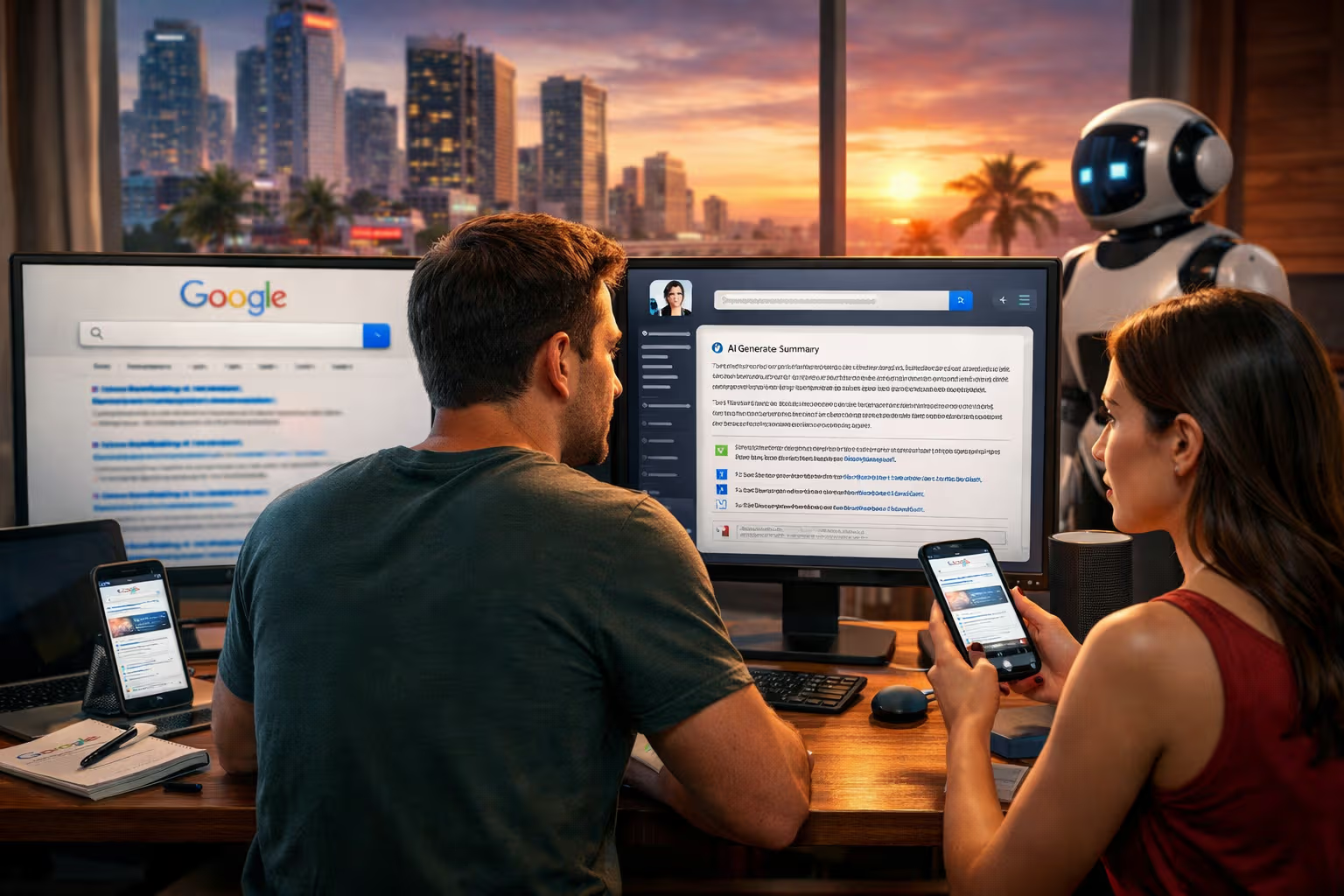
What’s missing from this AI-digestible consensus is the nuanced, experience-based understanding of what actually happens when you make these changes. The early discomfort. The social trade-offs. The skill erosion discovery. The non-linear stress pattern.
This matters because AI-mediated information tends toward the average. It smooths out individual variation, context-dependent factors, and discoveries that don’t fit neat categories.
The meta-skill emerging from all this is what I’d call automation-aware thinking. The ability to understand not just what tools do, but how using them changes what you become capable of.
This applies to notifications, but it applies much more broadly. Every tool that promises to handle complexity for you has the potential to erode your capacity to handle complexity yourself. The trade-off might be worth it. But you should make it consciously.

In an AI-mediated world where information is increasingly processed before you see it, the ability to think carefully about original sources, to question convenient summaries, to maintain independent judgment, these become premium skills.
Notifications are a small example of a large pattern. The question isn’t whether to use automation. The question is whether you’re using automation or automation is using you.
The Productivity Illusion
One more finding deserves attention. During the notification-free week, I felt less productive even though I was more productive.
This is the productivity illusion. Activity feels productive. Responding to things feels like getting things done. The constant small completions, read message, archive email, dismiss notification, these trigger small reward cycles.
Deep work doesn’t feel like that. It feels slow. Uncertain. Sometimes boring. You can work for an hour on a single problem and feel like you accomplished nothing.

But the actual output from that hour of deep work might be worth more than a day of notification-driven reactivity.
Our sense of productivity is miscalibrated by the tools we use. Notifications provide constant feedback loops that make us feel busy and responsive. They do not provide feedback on whether we’re doing important things well.
I noticed this most on day four. I had completed a significant piece of work but felt vaguely guilty, like I should be checking something. The feeling was irrational but persistent.
This is learned helplessness inverted. You’re trained to need the interruptions even though they degrade your performance.
Practical Takeaways
After the experiment, here’s what I changed permanently:
Phone notifications: Disabled entirely except for phone calls and messages from a short list of family contacts. Everything else gets checked manually twice daily.

Computer notifications: All banners and sounds disabled. Badge counts remain for email and one work communication app, so I know things are waiting without being interrupted.
Watch notifications: Activity and health only. No messages, no apps, no calendar.
Calendar reminders: Enabled for external meetings only. I found I don’t need reminders for my own tasks because I actually remember them when my attention isn’t fragmented.
Emergency channel: One messaging app stays fully enabled for genuine emergencies. The family knows this is the bat-signal, so it’s used appropriately.
The overall notification volume dropped from approximately 80 per day to approximately 8 per day. My focus scores have remained elevated. My stress scores have remained lower.
The social cost is real but manageable. I’m less responsive to casual communication. Some people have adjusted. A few have complained. Life continues.
flowchart TD
    A[All Notifications On] --> B[Constant Interruption]
    B --> C[Attention Fragmentation]
    C --> D[Skill Erosion]
    D --> E[Increased Dependency]
    E --> A

    F[Selective Notifications] --> G[Intentional Check-ins]
    G --> H[Sustained Attention]
    H --> I[Skill Maintenance]
    I --> J[Reduced Dependency]
    J --> F
The Bigger Question

This experiment was about notifications, but the lessons apply more broadly.
Every automation that handles attention management for you—notifications, recommendations, filters, smart assistants—potentially degrades your own attention management skills.
Every automation that handles decision support potentially degrades your own decision-making intuition.
Every automation that handles communication timing potentially degrades your own relationship management abilities.
These trade-offs might be worth it. Some tasks genuinely benefit from automation. Some cognitive loads genuinely should be offloaded.
But the trade-offs should be conscious. We should know what we’re gaining and what we’re losing. We should periodically test our unassisted capabilities to understand what skills remain and what skills have atrophied.

The notification-free week showed me something I didn’t expect. I’m less capable than I used to be at things I used to do automatically. The tools that were supposed to help me have made me dependent on them.
This isn’t a reason to reject all tools. It’s a reason to use them thoughtfully.
Tesla, my cat, has no notifications. She has no productivity tools. She has no digital assistance of any kind. She also has perfect attention when she wants something, zero stress about missing information, and excellent decision-making about her priorities.
Perhaps she’s onto something.
Conclusion: The Data and The Decision
Seven days without notifications showed measurable improvements in focus, stress, and decision quality. It also showed social costs, early discomfort, and the uncomfortable truth that my attention skills had eroded without my noticing.
The data supports selective notification reduction for anyone doing knowledge work. The data does not support complete notification elimination for anyone who values social connection.

The meta-lesson is about awareness. Not awareness of your incoming messages, but awareness of how your tools are changing your capabilities.
Automation doesn’t just do things for us. It changes what we can do ourselves. Sometimes this trade is favorable. Sometimes it isn’t. But we should at least be aware we’re making it.
Next time your phone buzzes, consider: Is this notification serving you, or have you been trained to serve it?
The answer might be more uncomfortable than the silence.